Author: Lucas Planeta Exo

  • How many days should you spend in Lençóis Maranhenses?

    How many days should you spend in Lençóis Maranhenses?

    Planning your trip depends on several factors, such as logistics, weather, and travel style

    The Lençóis Maranhenses National Park covers a massive area of 155,000 ha, which means you need at least 3 full days to truly experience the paradisiac atmosphere—though there are options for quick 2-day treks in selected areas across the sand dunes.

    Logistics also plays a huge part when it comes to travel planning, as this is a remote location that requires long journeys to reach the base cities (Barreirinhas, Atins, and Santo Amaro). Seasons, weather, and each traveler’s pace should also be considered when deciding how many days you should stay in Lençóis Maranhenses.
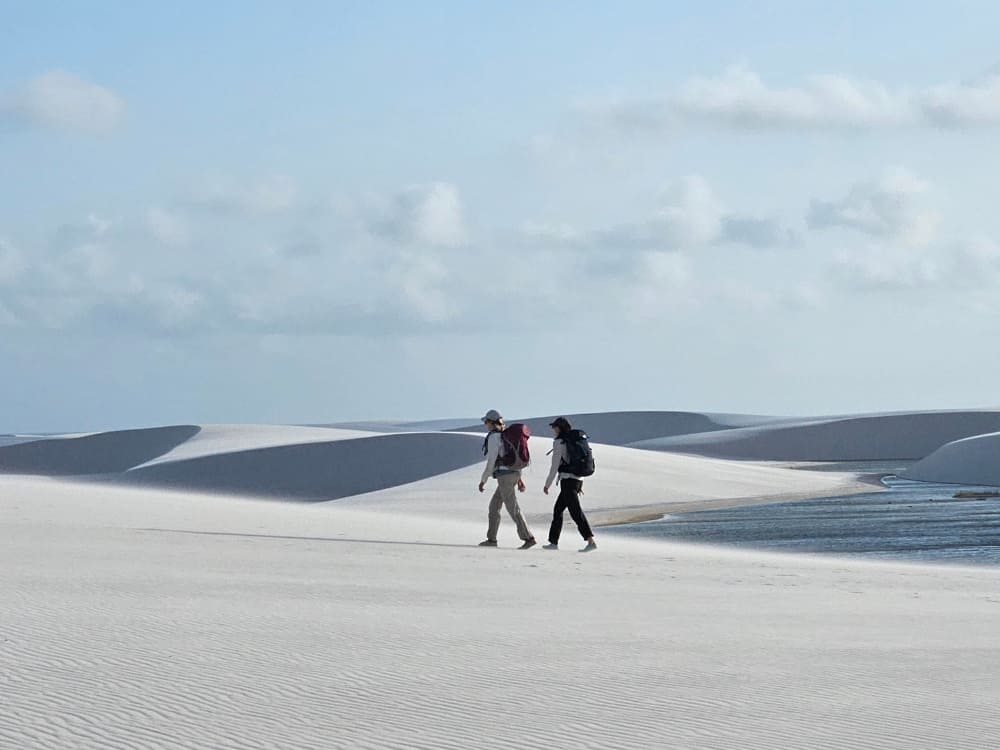
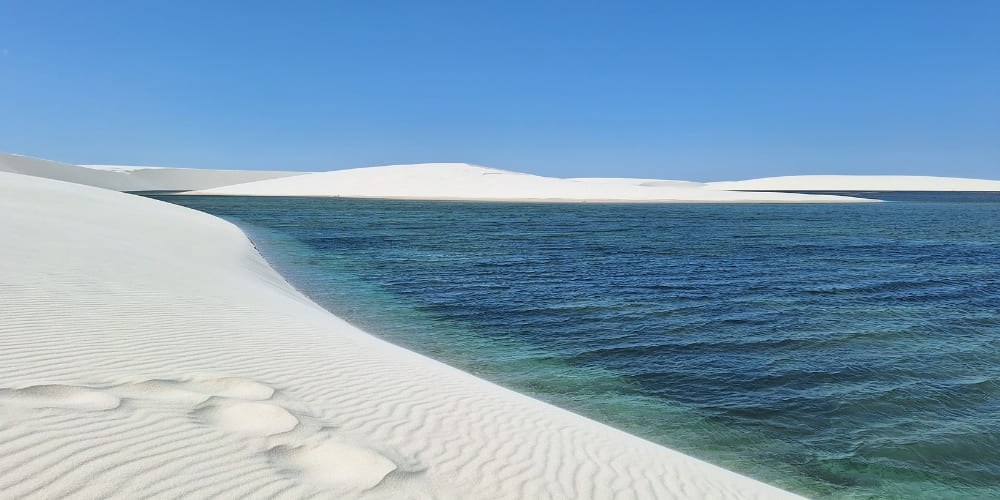
    Two backpackers hike across the vast white sand dunes next to a freshwater lagoon in Lençóis Maranhenses National Park.
    .

    Need a hand with your trip? PlanetaEXO is an ecotourism platform specializing in Lençóis Maranhenses tours that knows everything about trips to Brazil’s wet desert. Check it out below!

    What determines how many days you should stay in Lençóis Maranhenses?

    Logistics 

    In northeastern Maranhão, Lençóis Maranhenses is located in a remote area. After arriving in the capital São Luís, it takes 4-5 hours by road to reach one of the base towns: Barreirinhas, Atins, and Santo Amaro.

    The main transportation options are buses, private cars, or shared vans, but it’s also possible to reach Barreirinhas by chartered plane or by boat to Atins (departing from Barreirinhas).

    The transfer to your destination must be considered in your planning, as a significant part of the trip is spent on the Lençóis-São Luís route.
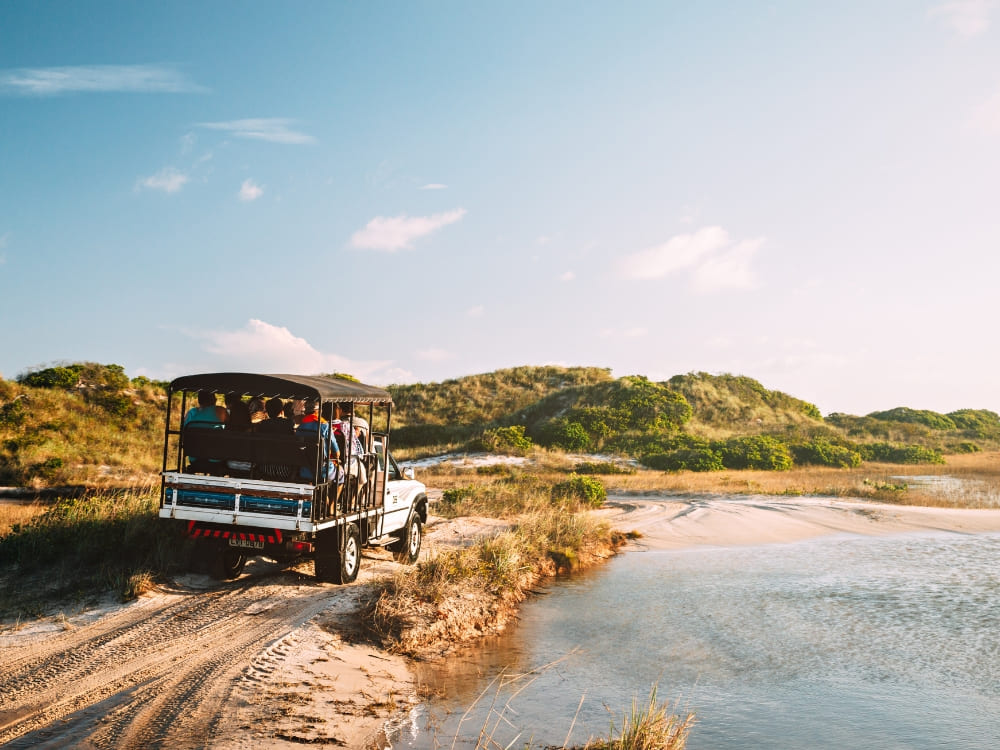
    Tourists in an adapted 4x4 vehicle drive along a sandy water trail, illustrating the transport options for exploring the Lençóis Maranhenses lagoons.

    👉 Read more: How to get to Lençóis Maranhenses?

    Season and weather

    The weather in Lençóis Maranhenses dictates the experiences—some seasons may be better enjoyed than others, depending on what you are looking for.

    The rainy season begins in February and extends until April, causing downpours that form new lagoons and fill up existing ones. The rain doesn’t stop tourists from visiting, but it can make walks through the dunes a bit more complicated.

    The rain stops when the dry season (May to September) begins, presenting conditions most people prefer: full lagoons scattered across the sand dunes, warm weather, and a refreshing breeze. This is the period when the park is busiest, marking the high season.

    From October onwards, the lagoons begin to dry up. Until January, the national park has more sand than water, but it’s still possible to venture out with trekking, boat trips on the Preguiças River, and kitesurfing on Atins Beach.

    Don’t forget: before deciding how many days you should spend in Lençóis Maranhenses, check the weather forecast for the desired period.

    👉 Read more: When is the best time to visit Lençóis Maranhenses?

    Travel style and pace

    The vastness of the white dunes, the calmness of the crystal-clear lagoons, and the endless blue of the sky contribute to the peaceful atmosphere of the national park, perfect for those seeking rest and disconnection from the tensions of day-to-day life.

    However, there are also opportunities for adventure, such as 4×4 rides, trekking across the park—and spending the night in locals’ houses—boiacross, and kitesurfing.

    The extent of the trip depends on the availability and style of each traveler, but Lençóis Maranhenses is versatile enough for all scenarios and paces, from quick 2-day experiences walking through the main points of the park to multi-day trips that even cover other states.
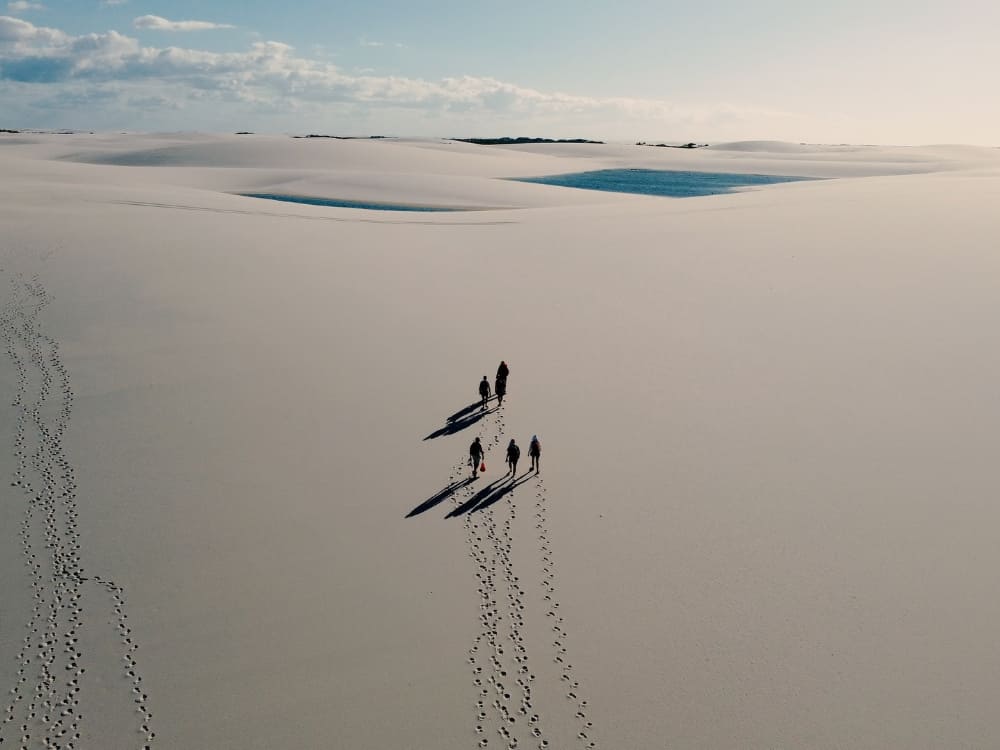
    Aerial view of a group trekking across the immense white sand dunes of Lençóis Maranhenses, with small blue lagoons in the background.
    .

    2 to 3-day trip: the essential

    Even on a tighter schedule, it’s perfectly possible to experience the magic of Lençóis Maranhenses simply by choosing the pace of your adventure.

    If you’re looking for something more relaxed, the 2-day trek from Atins (easy level) is perfect: a lighter hike through the stunning dunes and lagoons, starting and ending in the charming village. Are you an adventurous spirit and physically fit? Then you should check the 2-day desert trek (difficult level), which requires more effort but rewards you with a deep immersion and an unforgettable overnight stay in the Baixa Grande oasis.

    With 3 days available, the range of experiences opens up even more. You can opt for the 3-day trek (moderate level), walking among dunes and visiting two different oases, with an overnight stay in the homes of local families. If you prefer comfort, the 3-day tour from Santo Amaro (easy level) allows you to explore the most pristine lagoons in 4×4 vehicles, based in a very peaceful village.

    And for a truly unique experience, you can cross the white sand desert on our 3-day horseback riding expedition, an easy-level adventure that will create memories to last a lifetime!

    Silhouettes of five people horseback riding across the sand dunes of Lençóis Maranhenses under the bright late afternoon sun.
    .

    4 to 5-day trip: digging deeper

    For those with a little more time, investing 4 to 5 days is the best way to disconnect and get into the rhythm of nature.

    The 4-day tour from Atins is ideal for those who want to enjoy the rainwater lagoons during the day and enjoy the rustic and welcoming atmosphere of the village at night without much physical effort.

    If hiking is your thing, the 4 and 5-day treks (moderate level) are the classic crossings. On these itineraries, you experience the ultimate immersion: entire days hiking through surreal landscapes, swimming in exclusive lagoons, and having rich contact with the culture of the local communities that live in the oases within the park.
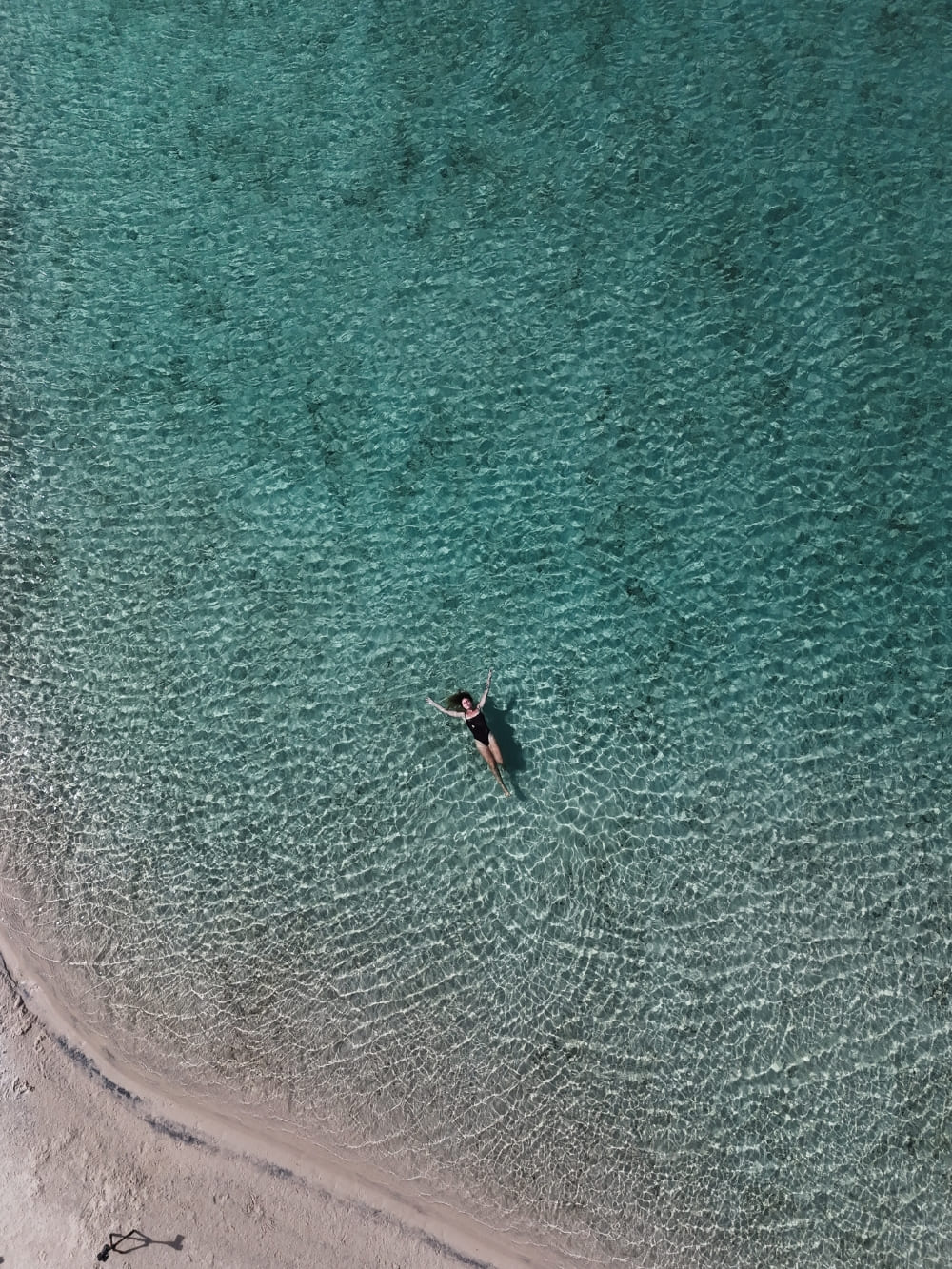
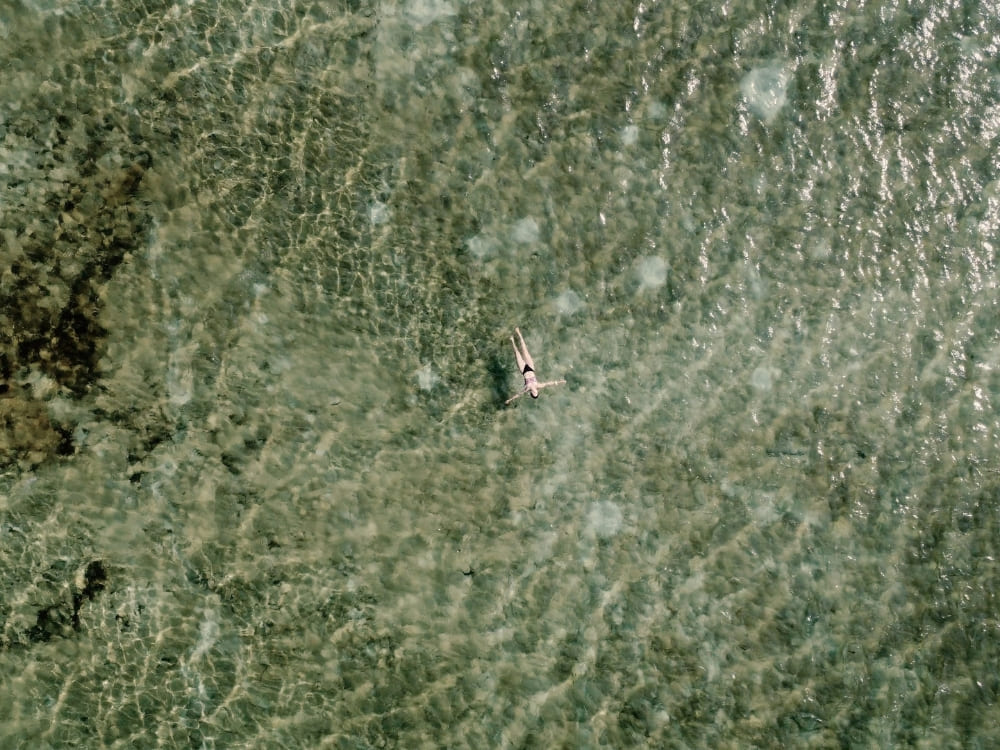
    Top view of a woman floating in the calm, greenish waters of an exclusive lagoon during a trip to Lençóis Maranhenses.
    Photo: Marcelo Bonifacio

    6-day trip: the full experience

    Six days open doors to the most complete and spectacular trips in the Brazilian Northeast, both easy-level and focused on comfort and contemplation.

    The Lençóis Maranhenses Full Itinerary takes you to explore the three main bases of the region: Barreirinhas, Santo Amaro, and Atins. You will take boat trips, visit the most famous dunes, and have a 360º view of the park without having to do long walks.

    The famous Route of Emotions is an epic interstate trip. It allows you to start your journey exploring Lençóis Maranhenses, pass through the incredible beauties of the Parnaíba Delta in Piauí and end the trip relaxing on the paradisiacal beaches of Jericoacoara, in Ceará.

    Woman sitting on a beach sarong on the white sand, admiring the golden sunset reflecting on the waters of the Lençóis Maranhenses lagoons.
    .

    Your vacation in Lençóis Maranhenses with PlanetaEXO

    If you’re still not sure of how many days you should spend in Lençóis Maranhenses, we are here to help!

    PlanetaEXO is an ecotourism platform specializing in Lençóis Maranhenses tours, from tailor-made itineraries to bookings and transfer options. Our team works with the best local operators to make sure you’ll experience a vacation you’ll never forget. Contact us now!
  • 10 Travel Tips for Lençóis Maranhenses to Make the Most of Your Trip

    10 Travel Tips for Lençóis Maranhenses to Make the Most of Your Trip

    Seasons, locations, safety tips, and health precautions. See our recommendations for an unforgettable travel experience in Brazil’s Lençóis Maranhenses National Park!

    Located in northeast Brazil, Lençóis Maranhenses National Park is a destination sought after by adventurers from all over the planet. Recognized as a UNESCO World Heritage Site, this natural wonder is famous for its vast, giant white sand dunes and crystal-clear freshwater lagoons. 

    But don’t let its otherworldly beauty fool you—exploring this fantastic place requires thoughtful planning to make the most of your time, energy, and budget. Considering elements like location, weather, and activities, following some Lençóis Maranhenses travel tips can help to make your vacation even more memorable.

    That’s why PlanetaEXO, an ecotourism platform specialized in Lençóis Maranhenses tours, has put together 10 essential recommendations for a wonderful experience in one of the most beautiful places in Brazil. Check them out below!

    1. Pick your base city: Barreirinhas, Atins, or Santo Amaro

    The choice of base cities can shape your entire experience, so analyzing the options and choosing the one that makes the most sense for your travel style is the first tip to thoroughly enjoy Lençóis Maranhenses.

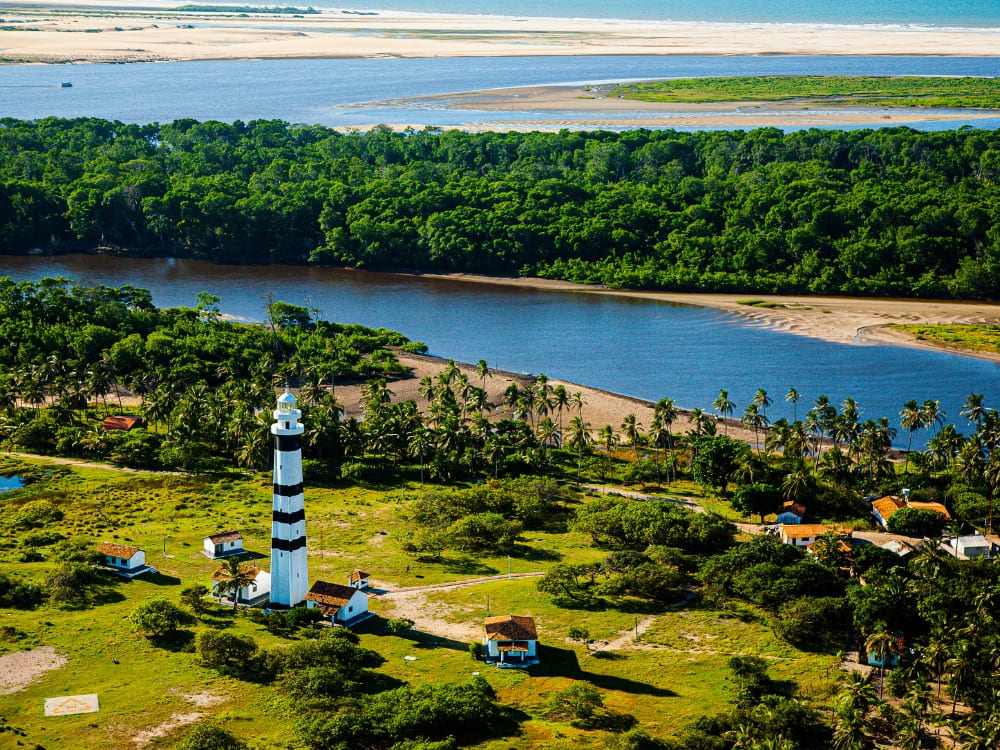
    Aerial view of a tall black and white striped lighthouse and lush green vegetation near the base cities for Lençóis Maranhenses tours.
    Photo: Gabriel Boieras

    Barreirinhas is the most popular hub, with solid infrastructure and easy access. Atins is a peaceful fishing village, harder to reach, but offering rustic charm and great conditions for kitesurfers. Meanwhile, Santo Amaro has the closest access to the national park and beautiful lagoons, but restaurants, bars, and other services are rather scarce.

    Besides considering the different atmospheres and logistics of each base, it’s also possible to combine more than one city throughout a single trip. This way, you can experience each side of Lençóis!

    👉 Read more: How to get to Lençóis Maranhenses?

    2. Time it right: when the lagoons are at their best

    The weather is ideal for those looking to explore ecotourism in Brazil. The best time to visit Lençóis Maranhenses is between May and September, when the lagoons are full from seasonal rains and the sky is usually clear with no rain. This window offers the most spectacular views and the best overall conditions for hiking and swimming.

    A traveler walking along the edge of a pristine blue lagoon surrounded by sand dunes during the best time to visit Lençóis Maranhenses
    .

    From February to April, the heavy rainfall might disrupt travel plans, while the period between November and January causes the lagoons to shrink or disappear completely.

    Lençóis offers great experiences all year round, but the itineraries vary according to the seasons. Make sure to check the weather forecast and plan your trip according to your preferences!

    3. Health tips: vaccination and fighting the heat

    Foreign tourists are not required to get vaccinated, but Brazil’s Ministry of Health recommends that visitors from other countries be protected against diphtheria, tetanus, polio, and measles

    A smiling woman enjoying a refreshing swim in a crystal-clear freshwater lagoon on a sunny day in Lençóis Maranhenses.
    .

    Additionally, as a precaution, it is advisable to get vaccinated against yellow fever and hepatitis A and B—even though there is no imminent risk of these diseases within national territory.

    The heat is also something to consider, as Lençóis Maranhenses is located in one of the hottest regions in the entire country. To protect yourself against the intense sun and high temperatures, always apply sunscreen, wear a cap/hat when exploring the sand dunes, and stay well-hydrated at all times.

    👉 See more information: CDC Travelers’ Health (USA) / Vaccine for Travelers (Brazil)

    4. Trust the locals

    One of the best Lençóis Maranhenses travel tips is to trust the locals for a truly immersive, fulfilling experience.

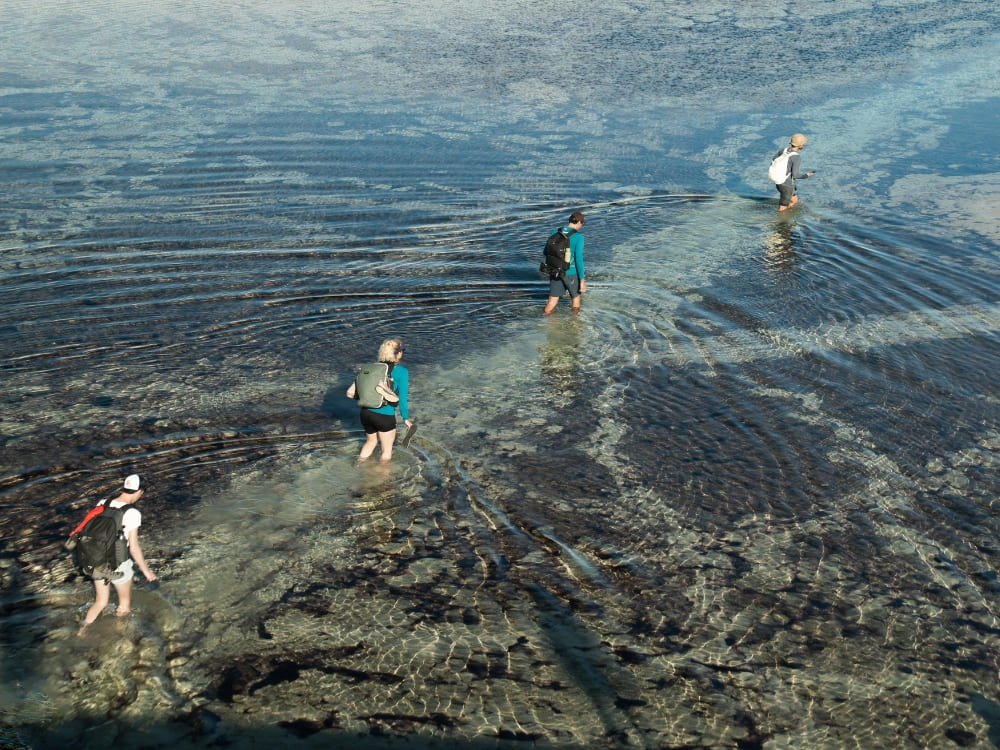
    Lençóis is a protected area with no marked trails. As the dunes stretch endlessly, it’s easy to lose your sense of direction. Tour guides know the safest and most scenic routes, how to avoid getting lost, and can tailor your experience to your interests. Remember: never venture into the national park without a qualified professional.

    A guided group of travelers hiking through shallow water in the endless sand dunes on a Lençóis Maranhenses tour.
    Photo: Marcelo Bonifacio

    Local residents also play an important role in the stay experience, as many travelers making the dune crossing, which can last several days, spend the night in the homes of locals within the park.

    The accommodations are simple, yet clean and comfortable—ideal for resting a weary body after a long day of trekking. This is also a wonderful way to meet new people and connect with Brazilian and Maranhense culture.

    👉 Read more: Where to stay in Lençóis Maranhenses?

    5. Lençóis Maranhenses treks are demanding (be prepared!)

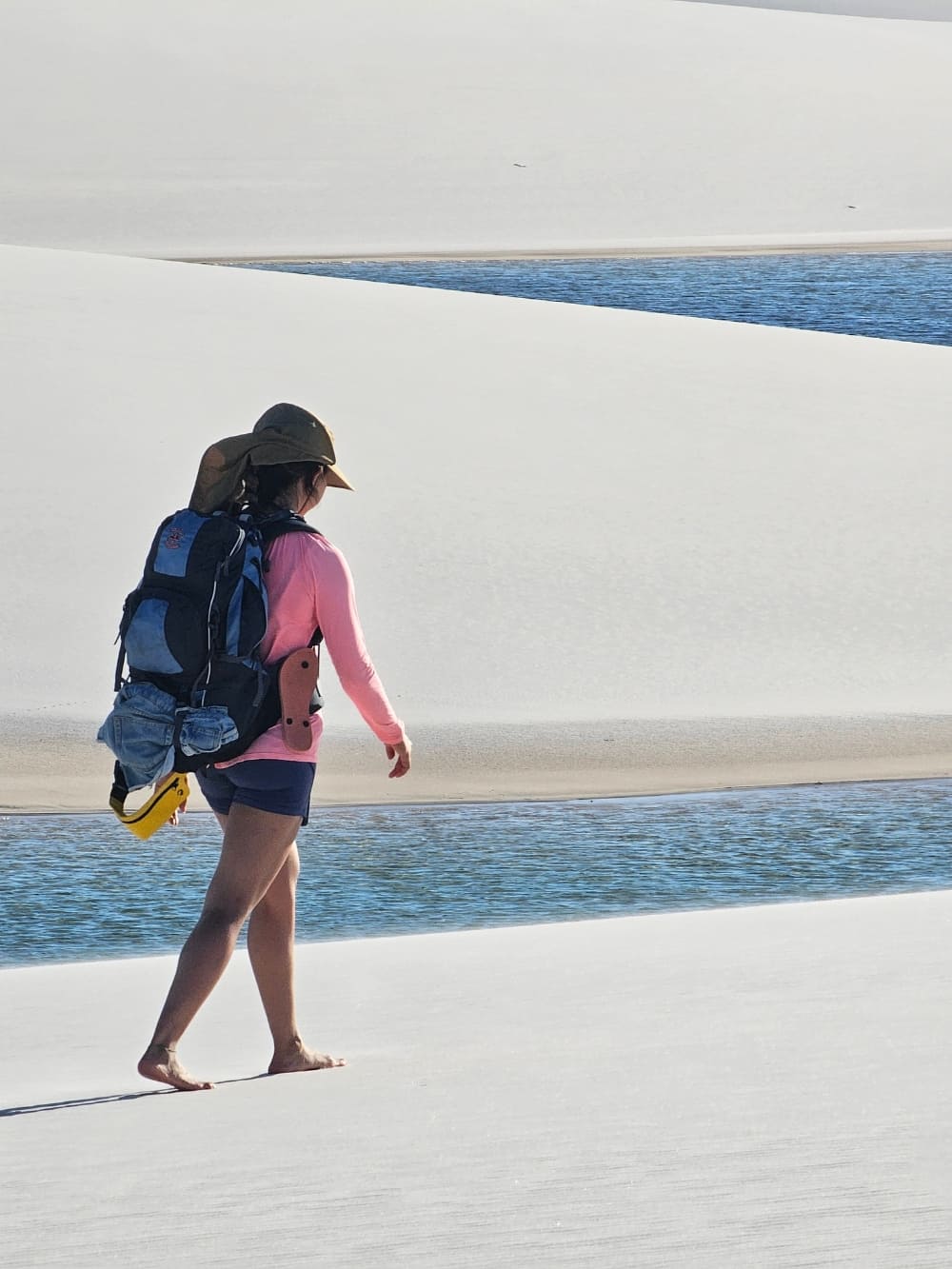
    Expect a workout. The sand is uneven and the dunes are tall, so the ground slips out from under your feet as you walk. 

    A backpacker walking barefoot across the white sand dunes near a bright blue lagoon during a physically demanding Lençóis Maranhenses trek.
    .

    Under the hot sun, physical exertion becomes even greater. To avoid stressful situations, exhaustion, and other health issues, dress in light, airy clothes, drink plenty of water, and don’t rush. And while most people enjoy walking barefoot, hiking sandals work just fine!

    All this effort and dedication are worth it: you will be rewarded with landscapes that seem out of this world and indescribable experiences to carry with you for the rest of your life!

    6. Pack smart

    Pack smart, light, and functional. Comfortable, appropriate items for physical activities and warm weather are indispensable:

    • Swimwear
    • UV-resistant clothing
    • T-shirts
    • Shorts
    • Flip-flops
    • Sandals or light hiking shoes
    • Socks
    • Hats or caps
    • Towels
    • Sunglasses
    • Reusable water bottle (at least 1.5L)
    • Eco-friendly sunscreen (non-toxic to aquatic life; SPF 30 or higher)

    And, as with any other trip, don’t forget the essentials: documents, insect repellent, medication, a power bank, and chargers (phones, cameras, laptops, and tablets). 

    Bring your own cash (Brazilian real), as ATMs are scarce (especially in Atins and Santo Amaro), and connectivity for debit/credit cards is limited.

    7. Don’t underestimate transfer times

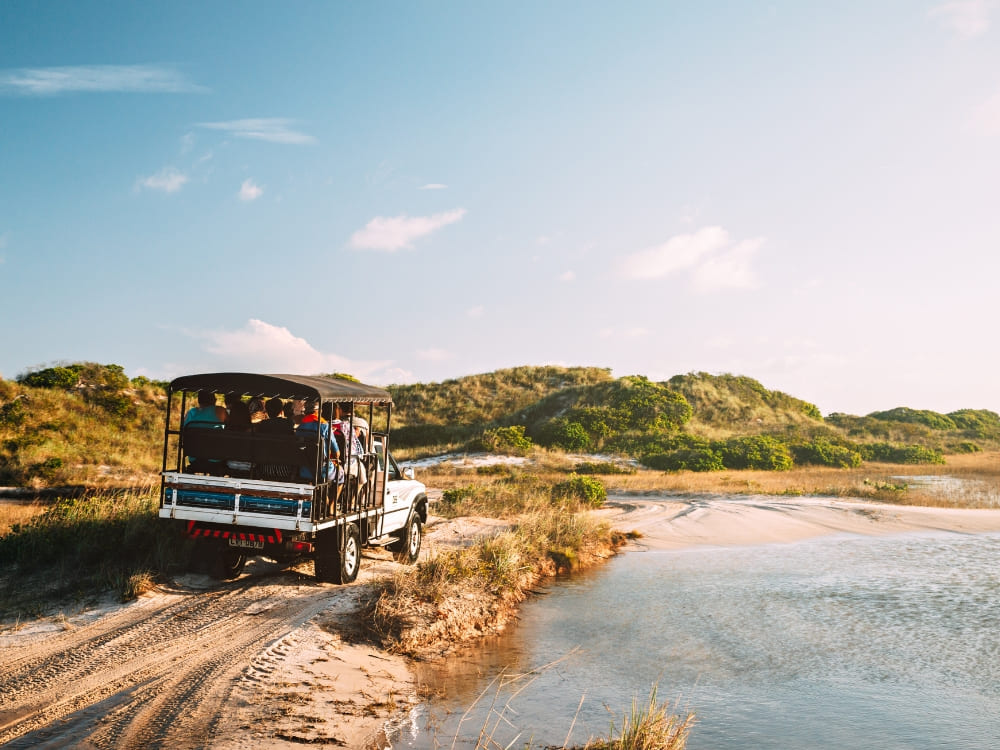
    Lençóis Maranhenses National Park is located in a remote area. From the capital of Maranhão, São Luís, to the base cities, the drive takes between 4 and 5 hours.

    A 4x4 safari vehicle transporting tourists through a sandy and flooded trail to visit Lençóis Maranhenses National Park.
    .

    When planning your vacation, map out the round-trip transfer to ensure you enjoy every single second and to avoid any problems with your schedules—like missing a flight, for example.

    Your trip should last at least 3 days, but it obviously depends on your availability and the type of experiences you’re looking for.

    8. Go for multi-day treks

    Speaking of how many days should you spend in Lençóis Maranhenses, if you’re up for a real adventure, consider trekking across the dunes from one village to another.

    This is a more intense experience than the day tours, but far more rewarding. You’ll hike through remote parts of Lençóis Maranhenses that most visitors never see, sleep in locals’ homes or campsites, and enjoy simple, home-cooked meals.

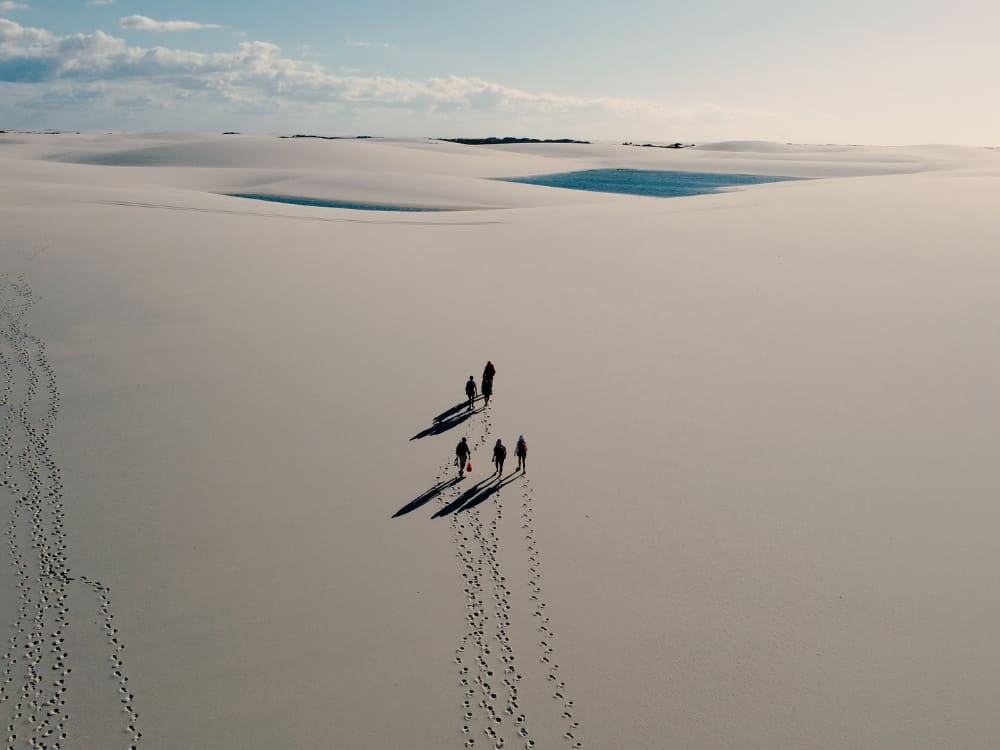
    A small group of hikers casting long shadows while walking across a vast expanse of white sand dunes on a multi-day Lençóis Maranhenses trek.
    .

    In the afternoons, after the hikes, you’ll have a few quiet hours to relax and recharge. It’s the perfect moment to disconnect, take a nap, or simply admire the breathtaking beauty that surrounds you.

    9. Bring your own snacks and drinks on the tours

    Lençóis tours typically only stop during lunchtime, and there are no restaurants or diners inside the national park. If you plan to spend several hours (or even days) in Lençóis Maranhenses, it’s important to bring your own food and water.

    Opt for light, non-perishable snacks such as crackers, nuts, protein/fruit bars, etc. Use reusable containers and keep the packaging in your backpack to dispose of it once you return to the city. Never litter in the dunes or lagoons.

    10. Download Google Translate for offline use

    Don’t expect English everywhere; most locals only speak Portuguese.

    Downloading Google Translate (or other translation apps) before arriving and setting up the Portuguese language pack for offline use is highly recommended. This will help with everything you might need, from ordering food to asking for directions.

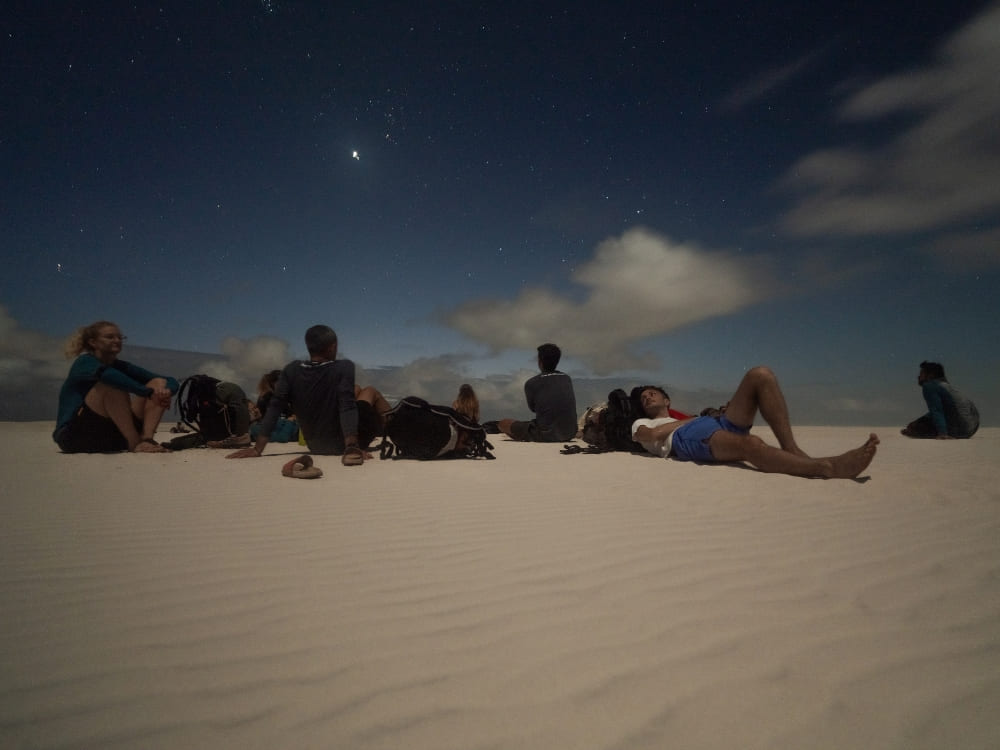
    A group of travelers resting on the sand dunes under a starry night sky after a full day exploring Lençóis Maranhenses.
    .

    Take the opportunity to learn a few basic words in Portuguese, like “bom dia” (good morning) and “obrigado” (thank you). Small gestures like these show kindness, openness, and appreciation for the people and the place you’re visiting!

    Visit Lençóis Maranhenses with PlanetaEXO

    Now that you know 10 essential travel tips for Lençóis Maranhenses visitors should follow, it’s time to start planning your trip!

    PlanetaEXO, an ecotourism platform specializing in Lençóis Maranhenses tours, works with the best local partners to turn your dream vacation into reality. Our team is ready to help you with bookings, transfer options, and tailor-made itineraries for a fantastic experience. Contact us now! 
  • World Environment Day: 10 Ways to Reduce Plastic on Nature Trips

    World Environment Day: 10 Ways to Reduce Plastic on Nature Trips

    While the world discusses solutions to the plastic crisis, conscious tourism and sustainable travel experiences are gaining ground in environmental conservation.

    On June 5, World Environment Day draws attention to one of the greatest contemporary challenges: plastic pollution. Created by the United Nations, the date is dedicated to reflecting on the urgency of environmental preservation. In 2025, the chosen theme is “Ending global plastic pollution,” reinforcing the warning about the impacts of excessive plastic consumption, which already extends beyond the oceans and reaches human bodies, the food chain, and entire ecosystems.

    According to Oceana, an international organization that advocates for the preservation of the seas, Brazil is among the largest plastic polluters on the planet. The country dumps 1.3 million tons of plastic every year. As a result, there is growing pressure for structural changes and more conscious habits. In the tourism sector, ecotourism has been consolidating itself as a viable and educational alternative for those who want to explore the world with less environmental impact.

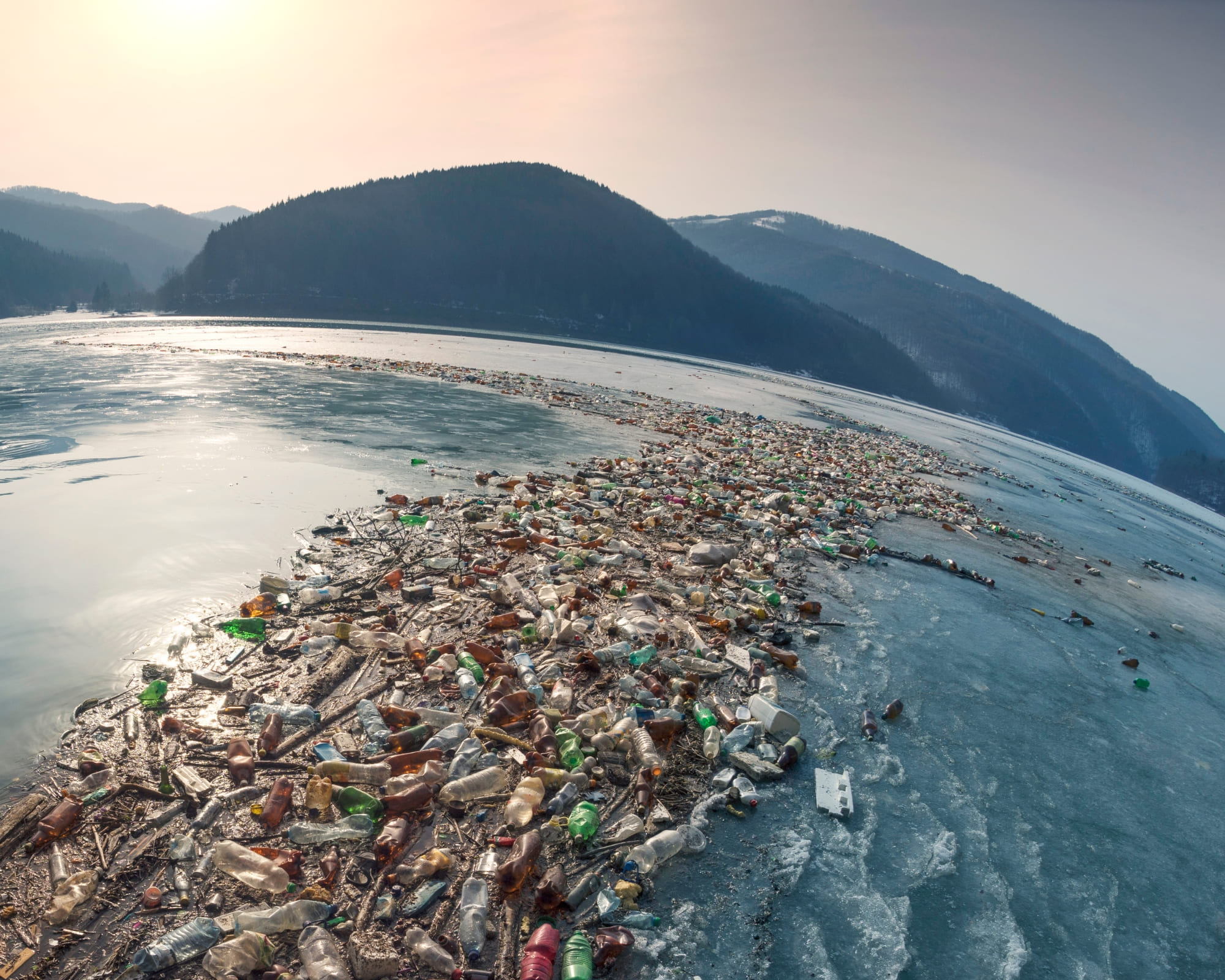
    How to reduce plastic in nature
    Photo: Yuliya Taba

    Drawing on PlanetaEXO’s experience with nature-based and low-impact tourism, we’ve put together simple and effective tips to help reduce plastic use while traveling. In line with the message of World Environment Day, these practices highlight how ecotourism can raise awareness through direct experience.

    “By offering journeys to remote and often fragile areas, ecotourism makes people witness the damage caused by plastic pollution. They return changed. That personal shift is the first step toward collective impact,” says Lucas Ribeiro, founder of the platform. Check out the tips below:

    1. Bring your own reusable bottle

    It seems obvious, but it’s still one of the most neglected habits among travelers. Plastic bottles are still among the main types of waste found on trails, rivers, and beaches. To avoid disposing of this material, always bring a reusable bottle. Models with thermal insulation or filters are ideal for keeping water cool and safe during long expeditions, without relying on disposable packaging.

    2. Say no to plastic packaging on trails

    Avoid consuming processed snacks, such as cereal bars or chips, which generate waste that is difficult to manage in natural areas. Choose fresh or dry foods carried in reusable containers, waxed cloths, or fabric bags. In addition to reducing waste, you encourage more conscious consumption.

    3. Be part of the cleanup

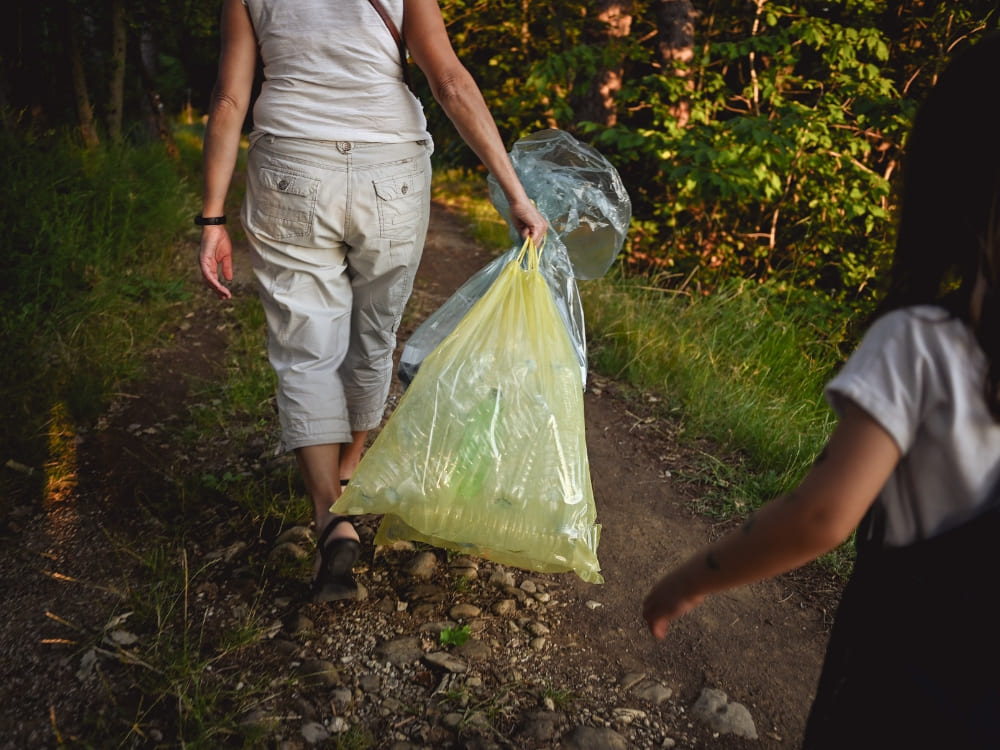
    Even when it’s not yours, picking up trash you find along the way is a gesture of collective responsibility. Plastic bags, bottle caps, and packaging are common on trails and in wooded areas. By removing them, you directly contribute to the preservation of the ecosystem and inspire other travelers to do the same.

    World Environment Day 2025
    Photo: Neustock Images

    4. Get informed and share

    Before traveling, learn about the impacts of plastic pollution in the region and the best practices adopted locally. During your trip, share this knowledge with others, whether in conversation or on social media. Individual examples help to form a collective culture of respect for the environment.

    5. Choose sunscreens without plastic and microplastics

    Many sunscreens come in plastic packaging and also contain microplastics in their composition, which end up in rivers and seas, directly affecting aquatic life. Choose biodegradable, plastic-free options with solid or refillable packaging. It’s a simple choice that reduces your environmental impact without compromising skin protection.

    👉 Do you also want to learn more about the positive impacts of ecotourism? Click here to read

    6. Encourage and support local communities that recycle

    In many natural destinations, waste management is carried out by cooperatives or small local groups. Supporting these initiatives, whether by hiring their services or buying recycled products, strengthens the region’s economy and directly contributes to reducing irregularly discarded plastics.

     Waste pickers in Brazil
    Photo: People Images

    7. Store your trash until you find the right place to dispose of it

    On trails or in remote areas, it can be difficult to find trash cans or collection points. Therefore, bring a sturdy bag to store your trash until you can dispose of it properly. It’s a basic but essential step to prevent the accumulation of waste in protected areas.

    8. Avoid industrially packaged snacks on trails

    In addition to generating more waste, these products are generally not reusable or recyclable in the field. Prepare your own snacks in advance or buy in bulk. This avoids the use of disposable plastics and also allows for healthier and more economical food choices.

    Ways to reduce plastic
    Photo: Panaramka

    9. Use reusable containers to store food and personal items

    They are practical for carrying snacks, leftovers, or hygiene products while traveling. And although it may seem ironic to use plastic containers to combat excessive plastic use, reuse is precisely what makes the difference. A lightweight, durable container used over a long period of time prevents dozens of disposable packages from being used during a trip.

    10. Make it clear that you don’t want plastic when buying something

    When shopping at fairs, markets, or stalls, kindly let the seller know that you do not need a plastic bag, straw, or cutlery. Many establishments provide these items automatically. When consumers express a preference, they help break patterns and encourage change.

    👉 Why not take a look at the top 7 ecotourism destinations to visit in Brazil? Read here

    Ecotourism Travel consciously
    Photo: Ticiana Giehl

    Travel consciously

    Reducing plastic use when traveling does not require great sacrifices, just awareness. Every choice made during the planning and execution of a trip can have a direct impact on the environment visited. Ecotourism alone will not solve the plastic crisis, but it is part of the answer: it promotes knowledge, encourages sustainable behavior, and strengthens communities that depend on preservation.

    On this World Environment Day, the invitation is clear: travel more consciously, with less plastic, and more purpose.

    Discover how your next trip can make a difference. Explore PlanetaEXO’s nature-based tours and be part of a more sustainable way to travel.

  • Mount Roraima Travel Guide

    Mount Roraima Travel Guide

    Learn valuable details to set off on the adventure of a lifetime and uncover the secrets of this ancient, breathtaking mountain.

    Ready to get lost in the heights? This Mount Roraima Travel Guide highlights a setting where the grandeur of nature unfolds, with peaks that touch the sky and an atmosphere of mystery that surrounds every step.

    Mount Roraima is an invitation to intrepid adventurers, providing a unique journey through the fascinating landscapes of the region. Be prepared to marvel at impressive rock formations, crystal-clear streams, and vegetation that defies gravity.

    In this guide, we have compiled essential information to guide your adventure, from the best time for climbing to the trails that will lead you to the heart of this natural monument.

    Let’s Go!

    1. Where is Mount Roraima?
    2. How to get to Mount Roraima?
    3. When is the best time to visit Mount Roraima?
    4. How many days to spend in Mount Roraima
    5. How hard is it to trek Mount Roraima?
    6. Is it safe to visit Mount Roraima?
    7. What’s on top of Mount Roraima?
    8. Is Mount Roraima the oldest place on Earth?
    9. What to bring to Mount Roraima?

    About Mount Roraima

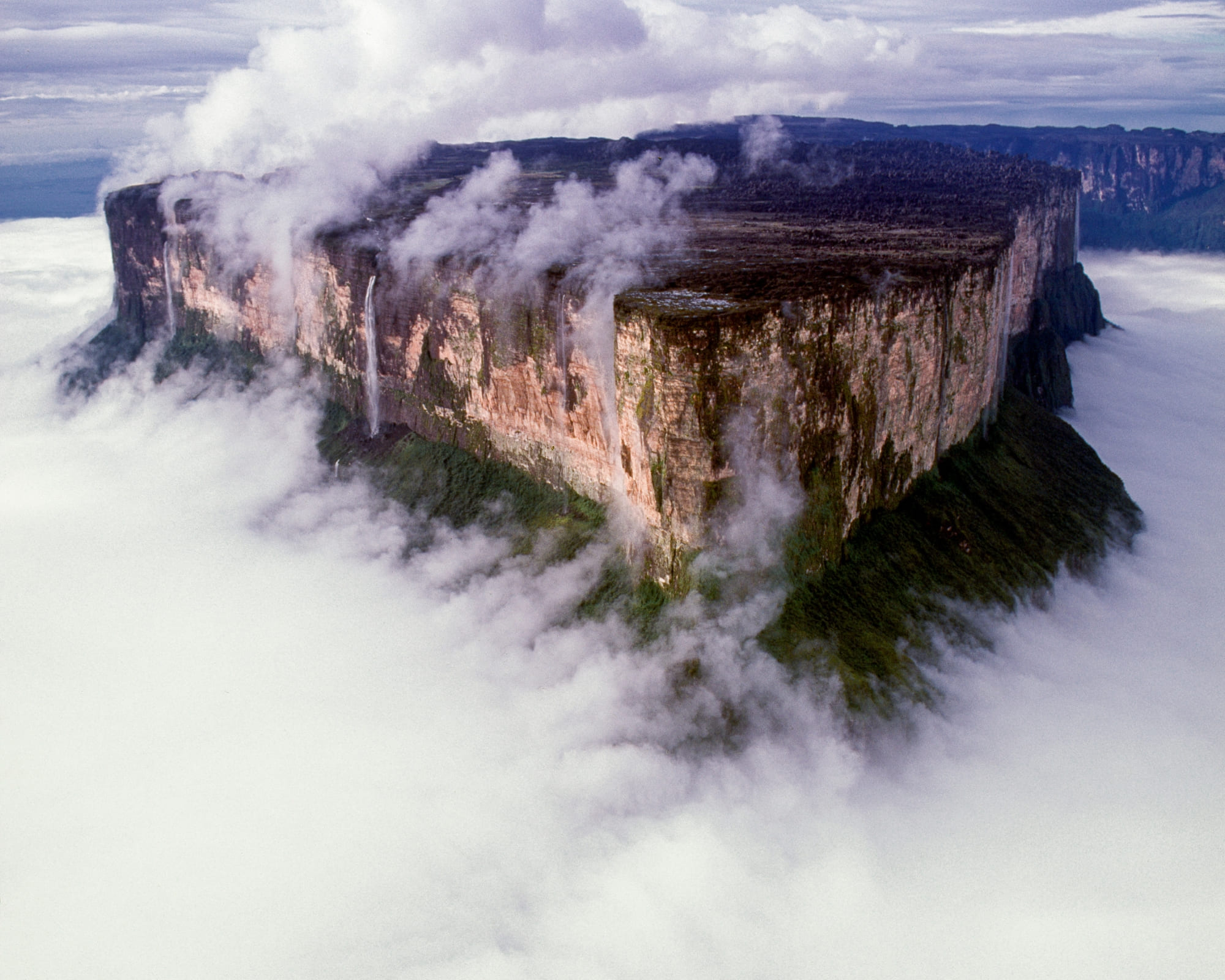
    Mount Roraima, standing tall at an impressive altitude of 2,810 meters (9,219 feet), is an ancient geological marvel that offers breathtaking views of plateaus, cliffs, and a unique natural landscape. It is renowned as one of the oldest formations on Earth. Based on historical records, the mount was first climbed in 1884 by Sir Everard Thurn, marking a significant moment in its story. Mount Roraima invites adventurers to explore its untouched beauty and timeless allure.

    Its most distinctive feature is the flat top, covering approximately 31 square kilometers (12 square miles), surrounded by cliffs that plunge almost vertically for hundreds of meters. The geological formation of Mount Roraima is believed to be the result of millions of years of erosion, giving it an impressive and truly unique appearance.

    Mount Roraima Travel Guide

    Where is Mount Roraima?

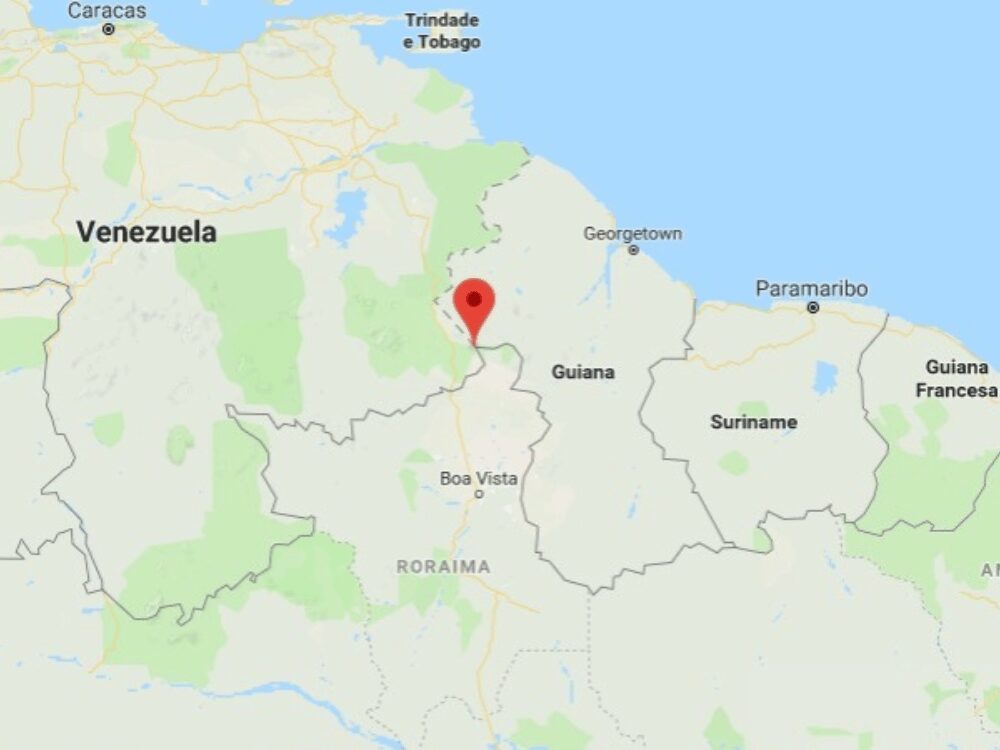
    Curious about where Mount Roraima is located? This stunning natural wonder sits at the intersection of three countries: Guyana, Venezuela, and Brazil. A significant portion of its territory is divided among these nations, with 5% in Brazil, 10% in Guyana, and the largest share, 85%, in Venezuela.

    The management of this area is overseen by the state of Roraima, more specifically, in the city of Uiramutã. Its unique position near the triple border offers an extraordinary opportunity to explore a remarkable corner of the world. For a clearer understanding of its exact location and how to navigate your way there, check out the Mount Roraima map.

    Where is Mount Roraima Travel Guide

    How to get to Mount Roraima?

    Mount Roraima, located at the crossroads of Brazil, Venezuela, and Guyana, can be reached from different entry points, with Boa Vista in Brazil being the most popular. The airport of Boa Vista is categorized as international, but in practice, it receives almost exclusively domestic flights from cities such as Brasília, Manaus, and São Paulo.

    From there, travelers head north on the BR-174 highway, crossing into Venezuela and arriving in Santa Elena de Uairén, the main hub for expeditions. This town provides accommodations and a pause before the trek begins.

    While Santa Elena has a small airport, flights are rare and less reliable, making the road journey from Boa Vista the preferred option. From Santa Elena, the route continues toward the Community of Paraitepuy, the official gateway to the trails. The drive across the Gran Sabana reveals breathtaking landscapes, where travelers often catch their first glimpse of the tepui.

    👉 Want the full guide with all routes, logistics, and tips? Read our complete article on how to get to Mount Roraima.

    How to get to Mount Roraima?

    When is the best time to visit Mount Roraima?

    The weather on Mount Roraima is highly unpredictable and follows the tropical climate of Venezuela. Rain, fog, and sudden temperature changes can happen at any time, so being prepared for all conditions is essential throughout the year.

    From October to March (dry season), the trek is generally easier, with less rain and clearer trails. Views from the top of Mount Roraima are more frequent, and temperatures range from 20–25°C (68–77°F) at the base to 10–15°C (50–59°F) at the summit during the day, dropping to 5°C (41°F) or even 0°C (32°F) at night.

    From April to September (rainy season), the trails become muddier and more challenging, but waterfalls are fuller and some appear only during this period. 

    Year-round, trekkers should expect cold nights, frequent winds, afternoon showers, and mist at the summit: elements that make every expedition unique.

    When is the best time to go to Mount Roraima?

    How many days to spend at Mount Roraima?

    The trek to Mount Roraima lasts at least 6 days. The first thing to bear in mind is that the climb to the summit involves 3 days of trekking through dense jungle and challenging trails, followed by 2 days of descending. At an altitude of 2,875 metres, Mount Roraima is the eighth highest point in Brazil, being a challenging and rewarding hike for the adventurer to this magical place.

    PlanetaEXO offers an 8-day package that includes 3 nights at the summit, while the 10-day option allows for an extended 5-night stay at the top of the plateau, whilst the 6-day trips are available for private groups. Our expeditions include transportation, guides, camping gear, and meals. This is a perfect adventure for those with good physical fitness and a deep desire for a more connection with nature.

    How long to spend in Mount Roraima?

    How hard is it to trek up Mount Roraima? 

    Trekking Mount Roraima is a challenging hike that demands endurance and preparation. Some sections, like steep ascents and slippery rocky passages, require extra caution and physical strength. The trek covers up to 100 km in 8 to 10 days, with long walks, river crossings, and rugged trails. Nights at high altitude bring cold temperatures and less-than-ideal camping conditions.

    Still, with good fitness, proper gear, and the support of experienced local guides, the adventure is absolutely achievable and deeply rewarding.

    👉 Discover all the details in How hard it is to trek up Mount Roraima

    How hard is it to trek up Mount Roraima
    Photo: Lucas Gobatti

    Is it safe to visit Mount Roraima? 

    Yes, visiting Mount Roraima is considered safe, especially when starting the journey through Brazil. Boa Vista is a reliable gateway with daily flights from major cities, and the crossing into Venezuela via Santa Elena de Uairén is a well-established route frequently used by tourists. 

    With organized tours, border procedures are straightforward, and the town itself has adapted to receive trekkers, offering accommodations, restaurants, and support for expeditions. Traveling with local operators ensures logistics run smoothly and gives you peace of mind from the moment you land in Brazil.

    The trek itself is also safe when done with experienced local guides who know the terrain and conditions. Hiking to the top of Mount Roraima requires physical preparation, but the paths are well-marked, and campsites are organized. With proper guidance and realistic expectations, visitors can enjoy this adventure securely and focus on the incredible landscapes along the way.

    👉 Before planning your trek, remember to check the visa requirements

    Top of Mount Roraima
    @overlandtheamericas

    What’s on top of Mount Roraima?

    On the top of Mount Roraima, adventurers find a collection of remarkable features including the Triple Border Point where Venezuela, Brazil, and Guyana converge, and the Valley of Crystals, known for its quartz crystals glittering in the sunlight. Notable points that you will have the opportunity to visit also include El Foso, a natural depression, and La Ventana lookout which offers expansive views of the savannah below. The summit is home to “Jacuzzis,” natural pools formed by rainwater, and the Maverick Rock, the mountain’s highest point.

    Reaching the summit of Mount Roraima isn’t just about the stunning vistas; it’s an expedition into a living museum of Earth’s ancient past. Contrary to expectations, the plateau isn’t flat but a rugged landscape that soars over 300 meters, adorned with rock formations, waterfalls, and crystal-clear pools. However, it’s the unique ecosystem that truly sets Roraima apart.

    The mountain hosts a remarkable variety of plant life, including diverse orchids, bromeliads, and carnivorous plants, many of which are exclusive to this location. But the vibrant tapestry of flora is matched by its fauna. at last, the plateau is also a sanctuary for a fascinating array of animals, including insects, birds, toads, small reptiles, and mammals like mice, each species playing a role in this biodiverse haven.

    What is on top of the mountain?
    .

    👉 Want to learn more? Read the full article: What’s on top of Mount Roraima?

    Is Mount Roraima the oldest place on Earth?

    Mount Roraima, discovered by Europeans in 1595 during the Spanish and British colonization of South America, is a true geological and historical treasure. It was only in 1884 that the adventurer Everard Ferdinand Im Thurm conquered the challenge of climbing this impressive “Crystal Mountain.” Its fame extends beyond climbing feats; Mount Roraima is known as the “Lost World,” a title that reflects its age.

    Its geological composition, predominantly formed by Precambrian rocks dating back approximately two billion years, provides a unique window into the planet’s distant past. Over millions of years, the mountain has resisted relentless erosion, shaping its unique landscape and revealing its flat plateau that extends for about 31 square kilometers.

    In addition to the ancient rocks, the tectonic activity that sculpted Mount Roraima. This is a crucial factor for its title as the oldest place on Earth. As part of the ancient Pakaraima mountain range, formed over billions of years by the movement of tectonic plates. The mountain bears witness to the geological forces that shaped the planet. This connection to geological processes from the distant past reinforces the antiquity of Mount Roraima.

    Is it the oldest place on Earth?

    What to bring to Mount Roraima?

    Packing smart is key to a successful Mount Roraima expedition. Equip yourself with durable hiking boots, breathable yet protective clothing, and weather-resistant gear to tackle the mountain’s diverse climates.

    Essential include a robust backpack, a comfortable sleeping bag rated for 0°C (32°F), reliable trekking poles, and an efficient headlamp. Prioritize hydration with eco-friendly water bottles, and ensure safety with a portable water purifier. Round off your gear with energy-boosting snacks, protective sunscreen, sunglasses, and a hat to shield you from the elements.

    What to bring?

    As we reach the end of this guide, remember that each step on Mount Roraima is a story waiting to be captured. Don’t leave behind anything but footprints and take everything but memories, captured on your camera or phone. Essential items like cash (Brazilian real BRL), passport, international certificate of vaccination with proof of yellow fever vaccination administered at least 10 days prior and important documents should not be forgotten.

    Eager for an adventure like no other at Mount Roraima? Check out our travel deals, designed for memorable trips. Click to see what’s waiting for you.

    At PlanetaEXO, we believe every journey can make tourism kinder to our planet, keeping its beauty intact. Book now for a tour experience beyond limits.

    Read more!

  • Where does my waste go? Practical tips for separating waste and supporting recycling

    Where does my waste go? Practical tips for separating waste and supporting recycling

    Learn how to separate waste correctly and support recycling

    Trash is serious business. PlanetaEXO, a company based in São Paulo that works with nature tourism and positive impact, wants to broaden the debate about the destination of this waste and encourage more conscious habits. In the capital of São Paulo, for example, more than 12 million inhabitants generate a huge amount of waste every day. This is how the Café com Propósito was born, an event created in partnership with Spaces Vila Madalena, to promote reflection and local solutions.

    São Paulo produces around 12,000 tons of waste a day, according to Recicla Sampa. Each person generates an average of 1.5 kg of waste every day. Yet most people don’t see themselves as part of the problem or the solution. There is an entire system behind waste collection, with cooperatives, sorting and collectors, which depends on our cooperation.

    Understanding what happens to waste after it leaves our homes is the first step. Separating waste correctly prevents damage to the environment and helps those working in the recycling chain. Getting informed is the start of change. So here are some practical ways to separate waste correctly:

    1 – Wet and dry waste should be separated

    Avoid mixing wet waste (food waste, leaves and dirty paper) with recyclables. Wash and dry packaging before disposing of it (that’s right!). If possible, create a compost bin to turn organic waste into natural fertilizer (humus).

    For example, here at Spaces Vila Madalena the separation is done by named garbage cans, into organic and recyclable waste. Employees who use the space are encouraged to dispose of it correctly, and thus collaborate in the process.

    2 – Not all waste goes in the same bag

    Syringes, razors and broken glass should not be put out with the regular garbage. To avoid accidents with collectors, put them in separate bins or bags marked “contains sharp object”. If you also want to avoid incidents with animals, the use of bins is even more recommended.

    3 – Pay attention to special waste

    These are materials that can’t go either in the regular garbage or in the separate collection: cells, batteries, light bulbs, cooking oil, tires, medicines, electronics, etc. This waste contains toxic substances and can cause serious damage to the environment if disposed of incorrectly. The Recicla Sampa platform indicates  collection points in São Paulo for each type of material.

    4 – Avoid using black bags

    It sounds like a detail, but it makes a difference: white or blue bags make it easier for collectors to identify the contents, speeding up separation and sorting for recycling.

    5 – Get to know and support local initiatives

    In Brazil, there are more than 800,000 waste pickers, according to data from EBC. They are responsible for 58% of the country’s plastic collection. Many work in cooperatives, which play a fundamental role in the recycling chain and in generating income. Supporting these movements, whether with donations or these simple actions of separating waste for recycling, is part of the incentive.

    Waste pickers in Brazil
    Photo: People Images

    6 – Understand the types of plastic

    Not all plastic is the same. There are two main ones: those with a long life (such as those found in electronics) and those with a short life (such as disposable packaging). The latter accounts for more than 30% of the world’s plastic production and is often used only once.

    Plastic can take up to 400 years to decompose, so it is essential to reduce its use and prefer recyclable or biodegradable packaging.

    7 – … And speaking of plastic

    In Brazil, less than 2% of plastic is recycled. This shows that we still have a long way to go. Look for the recycling symbol on packaging. When it is there, it is a sign that the material can be recycled. Even if there is no symbol, dispose of it in dry bags so that the sorting work can be done by cooperatives or recycling centers.

    Recycling symbol on packaging
    Photo : Plastico.com

    Don’t just throw it away?

    There is no such thing as “away”. When we throw something “away”, we usually think that the problem disappears. But everything we produce continues on the planet. Soil, rivers, oceans and even the air we breathe can be impacted by what we dispose of incorrectly.

    That’s why it’s essential to rethink our habits and adopt a more responsible attitude. Simple everyday attitudes are part of a collective effort that transforms the fate of waste and the future of the planet.

    The role of PlanetaEXO

    At PlanetaEXO, we believe that every adventure can have a positive impact. That’s why, in addition to promoting sustainable travel in nature, we are always updating our environmental practices and strengthening partnerships with local communities. We understand that change starts with us, and we want to walk side by side with those who believe the same.

    If you’ve read this far, don’t stop at the content: put it into practice. And share it. The world needs more people committed to this cause.

    Read more:

  • The Abrolhos Archipelago in Brazil – Travel Guide

    The Abrolhos Archipelago in Brazil – Travel Guide

    Experience one of South America’s most diverse marine habitats in this archipelago in Bahia.

    Deep in South America, far from the packed beaches and already beaten tourist tracks, lies a secret underwater realm: The Abrolhos Archipelago in Brazil, a protected spot on the southern coast of Bahia. Known for its rare coral formations and historic shipwrecks, it offers an intimate and authentic encounter with nature. 

    top diving spot in Brazil
    Photo: @cicero.bezerra

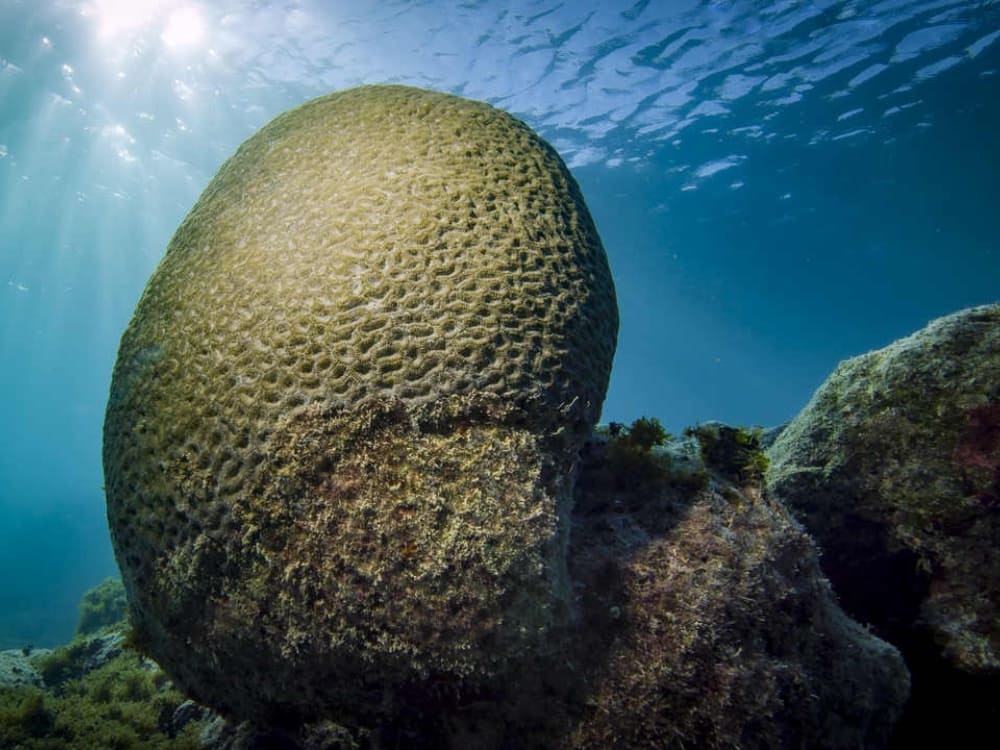
    This is one of the remotest and best-preserved destinations in the second half of the north-east, home to the greatest coral reefs in the South Atlantic. That’s why it’s the unassailable diving destination of the country, and for the best coral island experience, where you can observe an active marine life among the great chapeirões, individual mushroom-shaped coral formations. 

    Abrolhos Archipelago in Brazil
    Photo: ICMbio

    Abrolhos is a place to meditate silently on life and to hold nature in deep and holy regard. If you’re in search of peace, untamed beauty, and pure adventure, this could very well be your next memorable trip

    Are you ready to dive into this underwater paradise? 

    Table of contents:

    1. About Abrolhos 
    2. What to do in Abrolhos
    3. When is the best time to visit Abrolhos?
    4. How to get to Abrolhos
    5. Marine life in Abrolhos
    6. How Many Days to Spend in Abrolhos?
    7. Taxes and fees in Abrolhos
    8. Where to stay in Abrolhos?

    About Abrolhos 

    Consisting of five volcanic islands (Santa Bárbara, Redonda, Guarita, Sueste, and Siriba) and a large coral reef, the area has a total area of 87,943 hectares and is part of the Abrolhos National Marine Park, the country’s first marine national park, established in 1983. 

    The Abrolhos Archipelago Coral
    Photo: ICMbio

    The name Abrolhos is derived from a Portuguese term, “Abre Olhos,” which translates to “Open eyes.” As history has it, it was a caution call for 16th-century sailors and the dangerous region of reefs through which they traversed. 

    Today, it is also a call to notice the incredible beauty and biodiversity hidden under the surface. The archipelago, which contains the largest coral complex in the South Atlantic, is home to hundreds of species of animals that dwell in and outside of the sea. It’s also a humpback whale nursery (they come to this area to breed). 

    The reality is that despite its enormous ecological significance, Abrolhos is still predominantly off the traveller’s trail. There are no hotels on the islands, and tourism here is tightly restricted to help preserve its sensitive ecosystems. What you won’t find are beach bars or any resorts, but authentic wildlife experiences, world-class diving, or a quiet escape to maximum nature If that’s what you’re after, Abrolhos is worth the journey. 

    Of the five islands, the only one currently inhabited is Santa Bárbara Island, populated by military personnel and their families, as well as researchers and employees of the Chico Mendes Conservation Institute (ICMBio), responsible for managing and preserving the park. Siriba Island is the only one open to visitors.

    👉 Read our 10 Facts About Abrolhos and discover more about this marine paradise

    What to do in Abrolhos 

    Even though the archipelago may appear remote, there’s plenty of adventure to discover, with nature lovers, divers, and anyone interested in low-impact travel in mind. Here are some ideas for what to see and do in the region: 

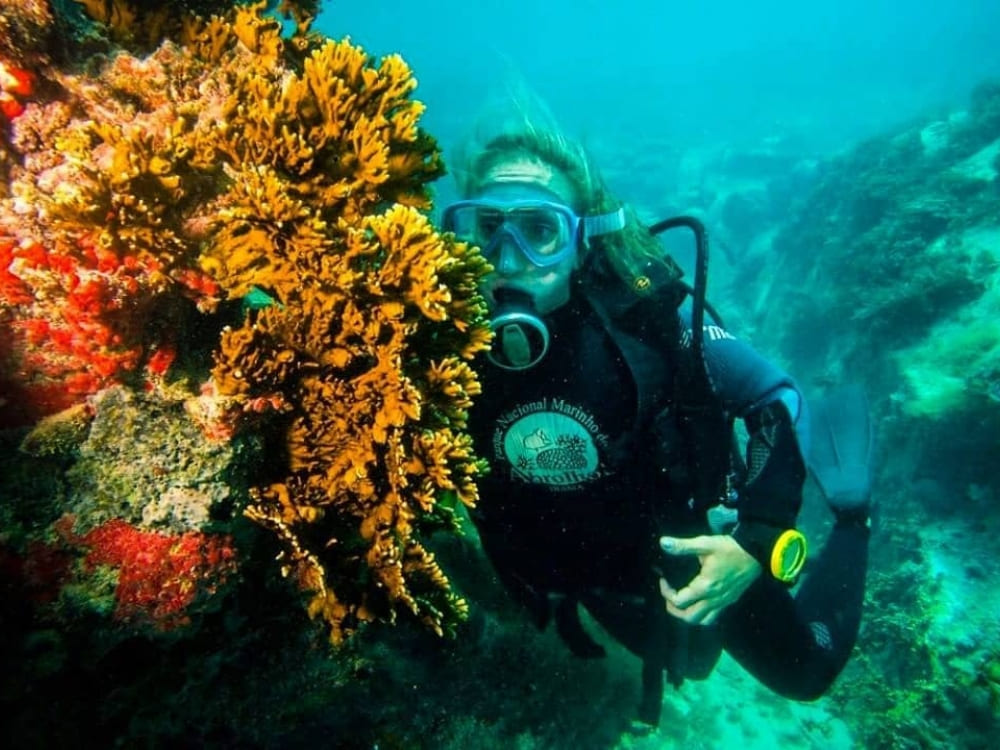
    Diving in Abrolhos Bahia
    Photo: @maysasantoro

    Diving and snorkeling 

    This is what people are going here for. The reefs are alive, and visibility is typically great from December through May. 

    Highlights include: 

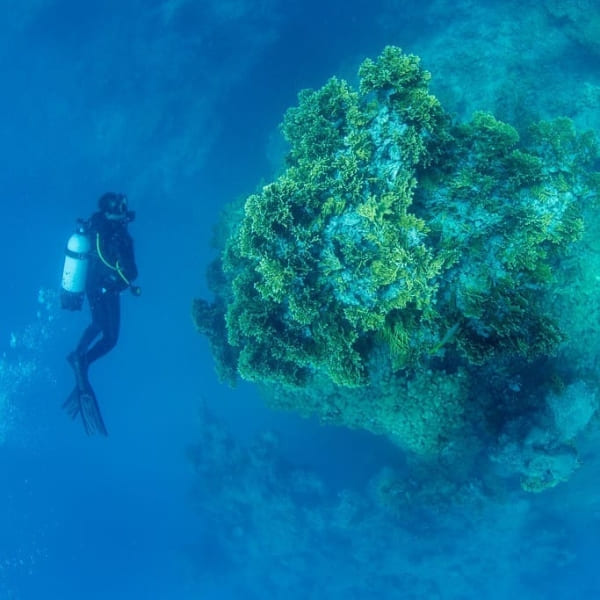
    • Chapeirões: These fantastic coral towers are inhabited by moray eels, turtles, nudibranchs, and all manner of colorful reef fish. 
    • Parcel dos Abrolhos: Massive reef bank suitable for beginner and experienced divers.
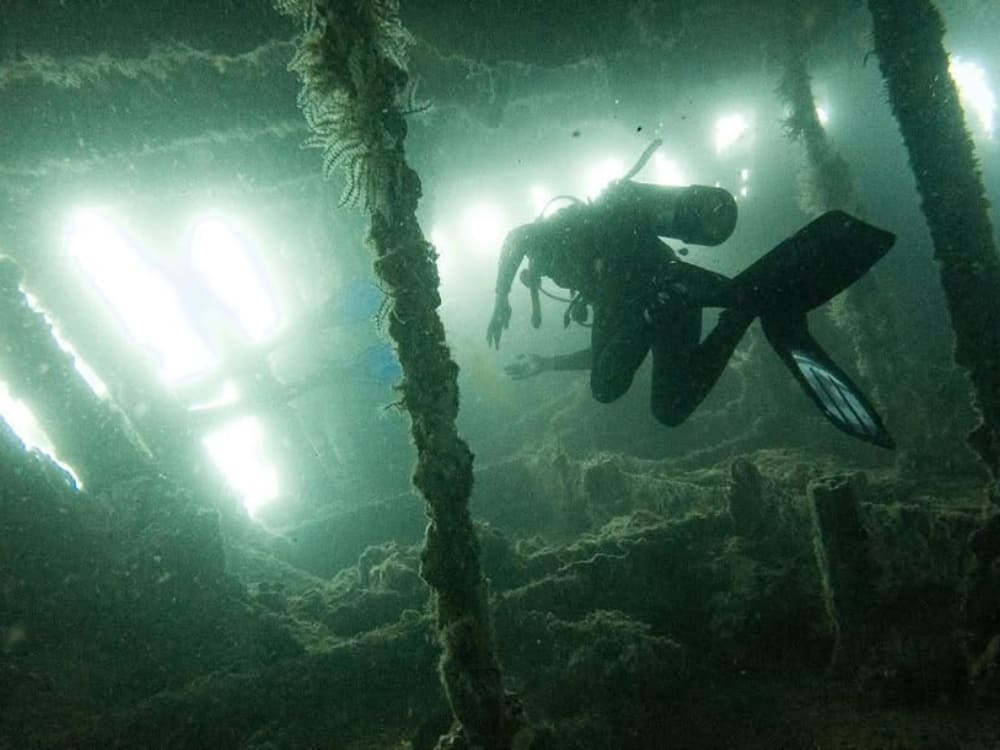
    • Shipwrecks: Several historic dive sites, including a British cargo ship (SS Rosalina, sunk in 1939) that now double as artificial reefs.
    • Night Dives: Occasionally, certified divers have the option of doing a night dive on liveaboard boats. Even nondivers will find fantastic biodiversity snorkeling on the shallow reefs.
    Shipwrecks in Abrolhos Brazil
    Photo: @viviankoblinsky

    Whale watching 

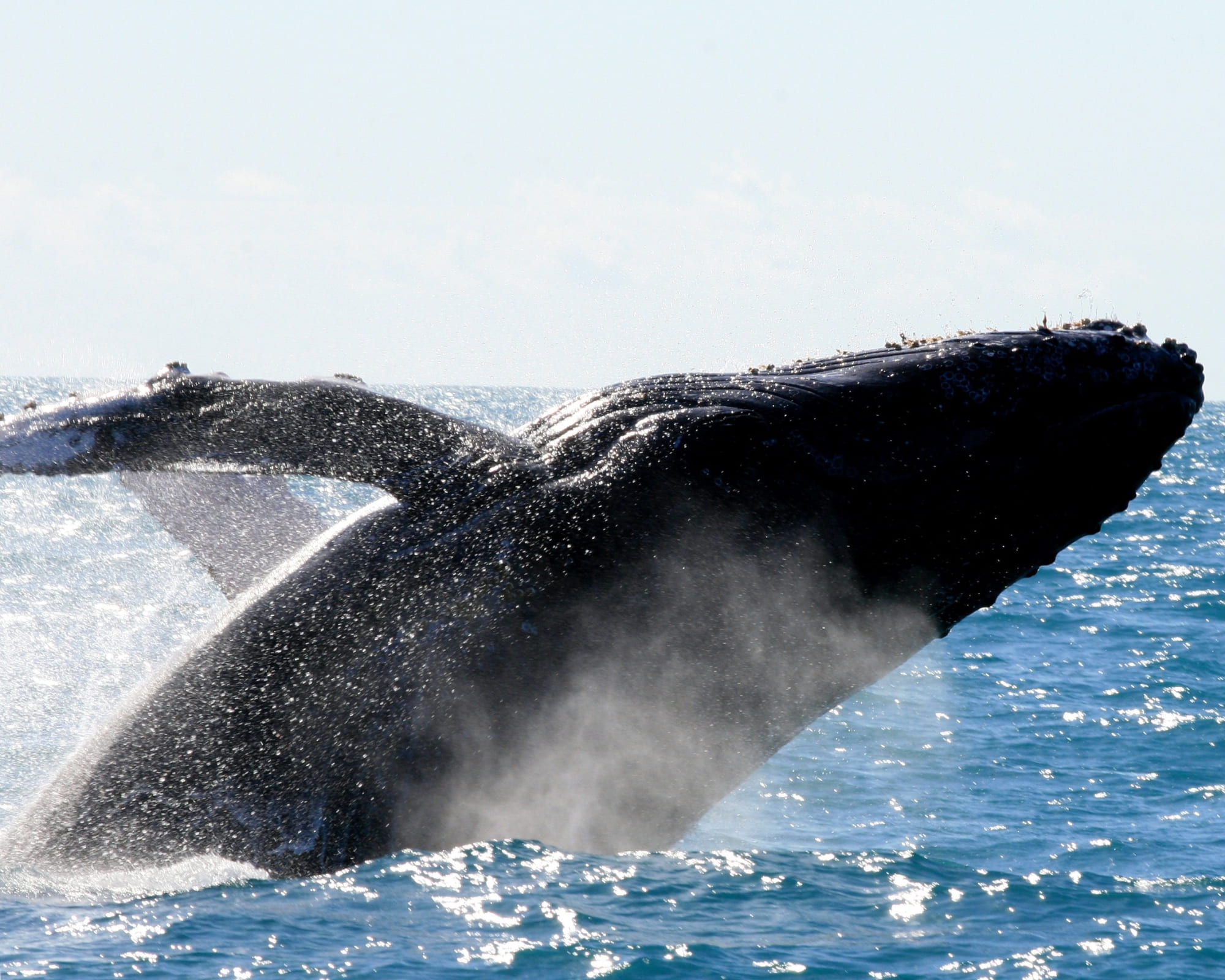
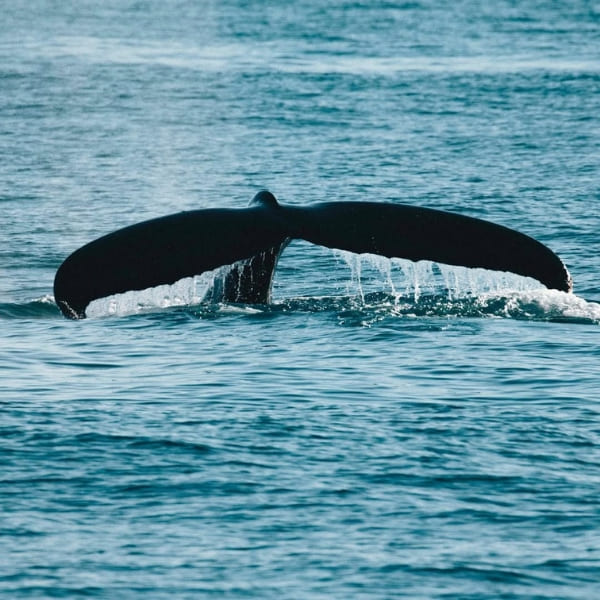
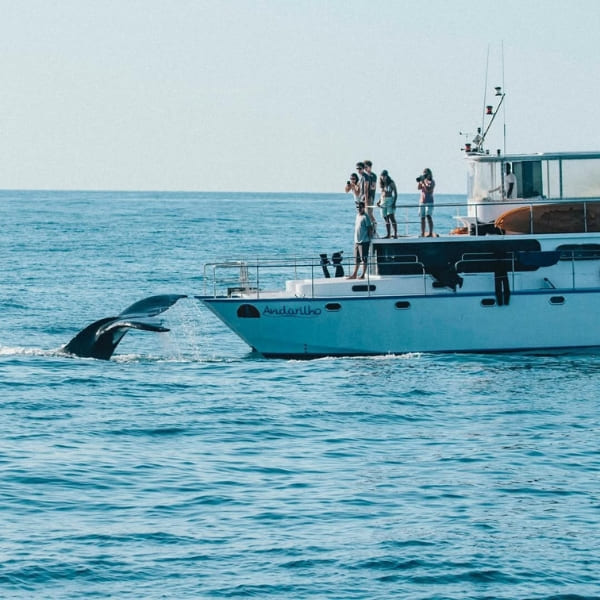
    No surprise that the Abrolhos Archipelago in Brazil is called a humpback whale nursery. These interesting animals of the sea, which are known to be migratory, travel from Antarctica to the Bahian coast from June to November to breed. Its appearance peaks in July to October. 

    During this period, sightings are frequent and often impressive! It is common to see these incredible mammals jumping, slapping their tails, and singing on the surface.

    nursery for humpback whales in Abrolhos
    Photo: @franksantos.photographer

    Hiking on the Siriba Island trails 

    It is the sole island in the archipelago open to the public. Hike along the trail with a park guide and look for seabirds, rock formations, and stunning landscapes. Bear in mind: this is a nature reserve, so respect for nature is crucial. 

    Siriba Island in Abrolhos Brazil
    Photo: @carolbrenck

    When is the best time to visit Abrolhos? 

    The best time to visit Abrolhos Marine National Park depends on what you are looking for. For diving and snorkeling, the best time is between December and February. The warm waters and fantastic visibility in the calm seas make it an understated paradise for activities in the water, so this is said to be the peak underwater season. 

    If you prefer fewer tourists and good diving conditions, plan a trip between March and May. Waters are cooler and remain great for water excursions. From June through November, it’s whale season in Abrolhos. Many people visit to combine diving and whale watching.

    Sunset in Abrolhos Bahia
    Photo: @joaoricardojanuzzi

    Keep in mind that all maritime tours depend on weather conditions, especially wind speed and wave height. Operators typically cancel trips when winds exceed 20 knots, so it’s important to check the forecast before planning your visit.

    How to get to Abrolhos 

    To reach Abrolhos, you first need to travel to Caravelas, a small town on the coast of the state of southern Bahia. It is the primary point of departure for boat tours to the archipelago. Caravelas doesn’t have any major airports, so it takes some time to get there, though the extra effort is worth it. You can fly, drive, or take the bus, whatever suits your style of travel best. 

    How to get to Caravelas? 

    By plane: Best for speed and convenience. The closest large airport is Porto Seguro (BPS), about 145 km away from Caravelas. It is served by direct flights from cities including Salvador and Belo Horizonte. Caravelas is approximately 5 to 6 hours from Porto Seguro by car. Or, you can take a flight to Teixeira de Freitas Airport (TXF), which is approximately 90 km from here. The drive there is 1.5 to 2 hours by car or bus. 

    By car: Best for flexibility and wandering at your own pace. Caravelas is accessible by road from cities in Bahia, Minas Gerais, and Espírito Santo. In Vitória (ES), for example, the trip lasts approximately 8 hours, while traveling from São Paulo takes around 17 hours. 

    Tip: Before you hit the road, check road conditions and plan your stops accordingly. 

    By bus: Best for budget travelers. Caravelas is served by several bus companies such as Água Branca, Rota Transportes, Brasileiro, and Gontijo. Journeys usually take the Teixeira de Freitas route, and vary according to your point of departure. 

    Tip: Purchase tickets in advance, especially in high season, and when visiting to watch the whales. 

    Caravelas in Bahia Brazil
    Photo: @visitecaravelas

    How to get to the islands? 

    Access is by boat only, and various tour operators, with licenses from the city of Caravelas, offer the trip. There are 2 primary options for doing this tour, both are amazing: 

    Day trips: Perfect for those short on time, these tours head out early in the morning and return late in the evening. The itinerary also takes in Siriba Island and stops for snorkeling at reefs nearby, where corals, marine life, and turtles can be spotted. 

    Liveaboards (overnight trips): For travelers who desire a comprehensive experience, liveaboards are the way to go. You spend the nights on board the boat and can go on multiple dives or snorkeling sessions each day, sometimes in further-out and more preserved areas. It’s the best way to get up close and personal with all the beauty of the Abrolhos Marine National Park

    Traveller in Abrolhos Bahia
    Photo: @joaoricardojanuzzi

    Either way, just make sure you choose an operator that is licensed by ICMBio and follows environmental regulations, that’s good for your safety and to preserve this very special ecosystem. 

    Marine life in Abrolhos 

    The marine life of Abrolhos is one of the most diverse in the Atlantic. The area is host to over 1,300 species of coral, many are endemic, that is, found nowhere else! 

    • Coral: accustomed to the world’s largest colonies of Mussismilia braziliensis, endemic in Brazil. 
    • Fish: parrotfish, butterflyfish, angelfish, groupers, reef sharks. 
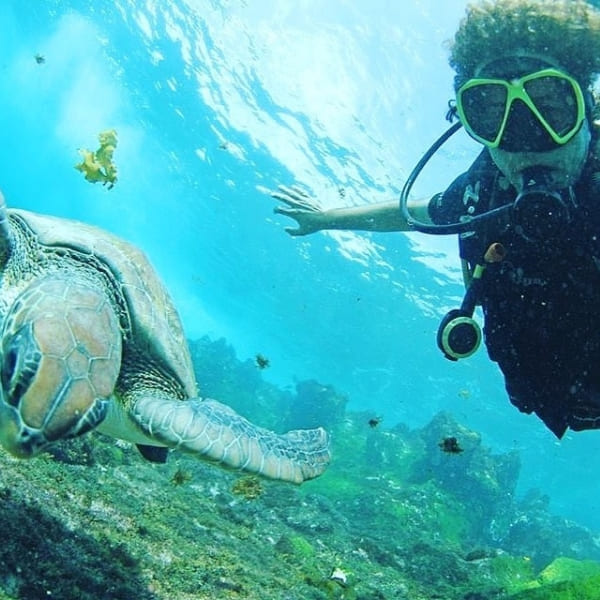
    • Turtles: Green and Hawksbill turtles are commonly sighted. 
    • Sea mammals: Humpback whales (seasonal), dolphins. 
    • Invertebrates: Starfish, octopus, sponges, lobsters, etc. 

    The reefs also act as breeding and nursery grounds for a number of animals and as a breeding ground for rare wildlife. 

    How Many Days to Spend in Abrolhos? 

    You can visit Abrolhos on a day trip from Caravelas, but to truly experience the archipelago, it’s best to stay 3 days. This gives you time for extra dives, more snorkeling, exploring remote reef areas, and a better chance of spotting humpback whales between July and November.

    Staying longer also means you can enjoy the peaceful atmosphere of the region without rushing. Whether you’re sleeping on a liveaboard or staying in Caravelas and joining daily excursions, having a few days allows you to connect more deeply with the unique marine life and natural beauty of the Abrolhos Marine National Park.

    Boat at Abrolhos Bahia
    Photo: @anaabifadel

    Sleeping on a liveaboard also lets you see Abrolhos in a much more serene, whole, and immersive way. 

    👉 A great option is the 3-day package from PlanetaEXO, which includes sleeping on the boat, full board, and diving at the most outstanding points within the marine park. 

    Taxes and fees in Abrolhos 

    Before proceeding towards the Abrolhos Archipelago in Brazil, here are some of the compulsory and additional costs of the marine park visit, you should be aware of. 

    Price of Admission to the Abrolhos Marine National Park 

    The Abrolhos conservation fee for the protected area should be paid by all visitors: 

    • Brazilian visitors: R$ 46 (value approximate) 
    • Foreign visitors: R$ 92 (estimated) 
    • Discounts: valid for children, students, and seniors upon presentation of documentation
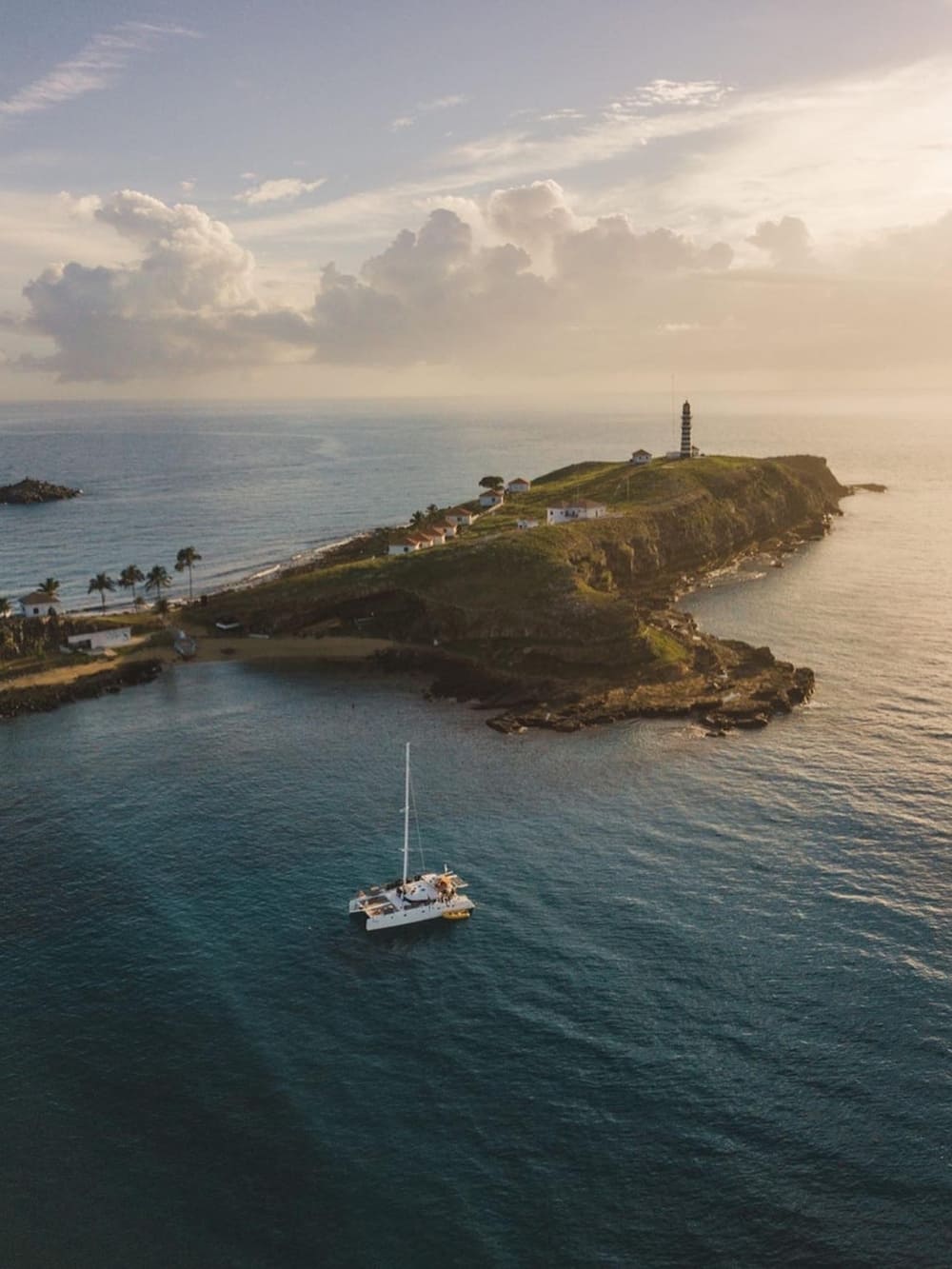
    Lighthouse in Abrolhos
    Photo: @marcosamend

    Additional costs 

    In addition to the park fee, there are other costs: 

    • Boat rides (round trips or liveaboard) 
    • Scuba diving or snorkeling Gear rental (if you don’t have your own) 
    • Whale watching (when in season, July-November) tours 

    👉 Important tip: bring cash. Even though some operators take cards, it is better to pay with cash for small expenses in Caravelas, such as local food, local transport, and extras, especially if you are going to places with poor or no internet signal or card machines. 

    Where to stay in Abrolhos? 

    There is no accommodation on the islands, which are a protected environmental area. For that reason, it’s not possible to stay overnight unless on a registered boat (or liveaboard) or on the mainland in towns like Caravelas, the gateway to the Abrolhos Archipelago in Brazil

    The best way to enjoy this experience is during a liveaboard tour, where you dive and snorkel every day, with the help of professional guides. All boats must be registered with ICMBio and abide by environmental conservation regulations.

    Where to stay in Abrolhos Brazil
    Photo: @saltyroutine

    Where to stay in Caravelas 

    Caravelas is a tranquil town and offers just a few places to stay, but they are all adequate. They’re mostly small inns and simple hotels. 

    If you prefer more comfort or options, staying in Nova Viçosa, which is an hour away, is a good alternative. However, keep in mind the trip to the port for early morning departures.

    Ready to embark on an adventure in the Abrolhos Archipelago? 

    Abrolhos is not a common destination. Don’t expect beach clubs, luxury hotels, or easy access. What you will find here is something much more valuable: an untouched paradise, teeming with marine life, silence, and nature in its raw state.

    The Abrolhos Archipelago in Brazil is somewhere for people who care about conservation, like a real adventure, and are taken by the wild beauty of the ocean. Descend to immense coral reefs, catch sight of humpback whales, or simply switch off in a marine sanctuary. 

    If this adventure is for you, PlanetaEXO can take you there. Discover with us how to live this experience safely, consciously, and unforgettably.

    Adventure in the Abrolhos Archipelago Brazil
    Photo: @piccinibr
  • How was Lençóis Maranhenses formed: understanding Brazil’s sand dunes and lagoons

    How was Lençóis Maranhenses formed: understanding Brazil’s sand dunes and lagoons

    Wind and rain play a fundamental role in the formation of the dunes and lagoons of Lençóis Maranhenses National Park

    Lençóis Maranhenses National Park is a natural wonder where sand dunes and lagoons are formed by a fascinating combination of wind and rain, which creates a unique landscape found nowhere else in the world.

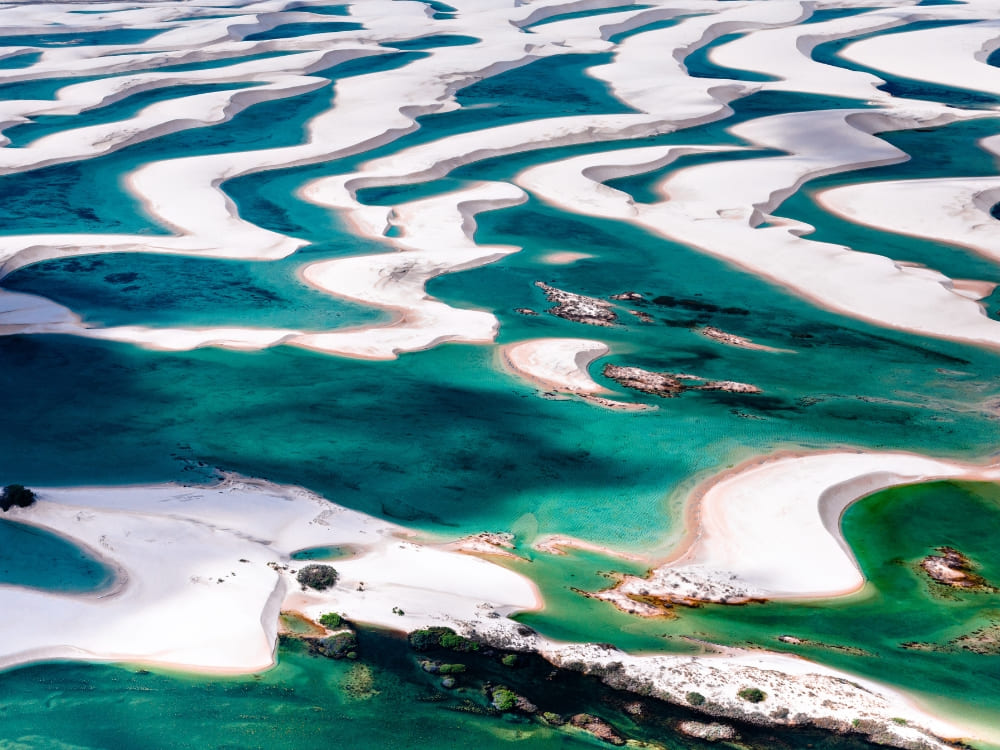
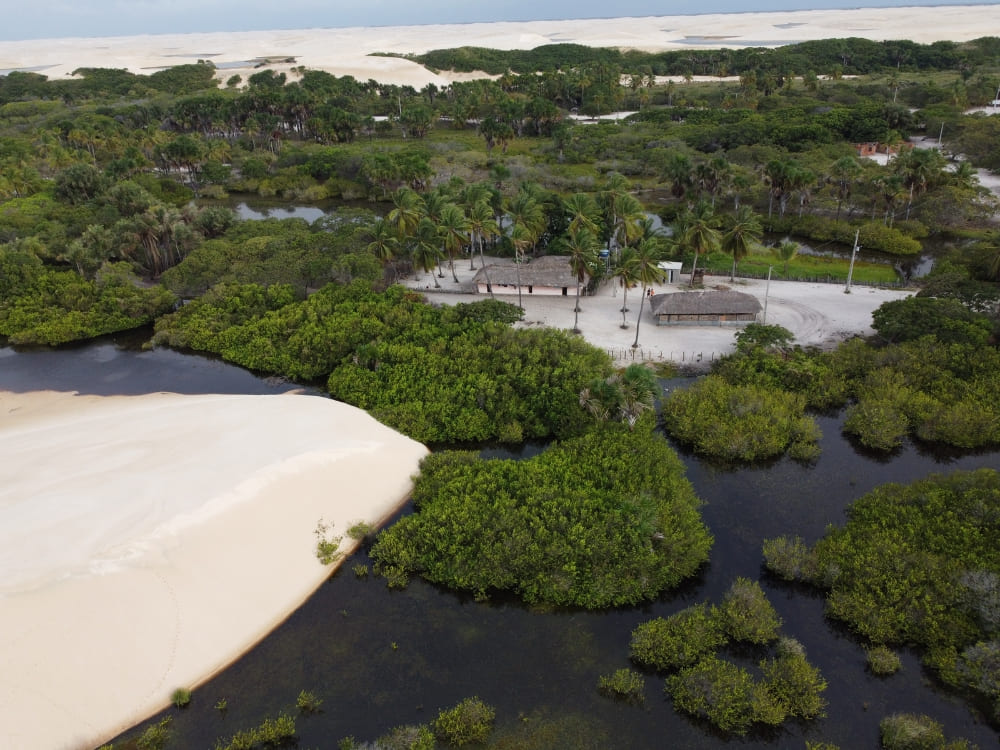
    Aerial view of the white sand dunes and green rainwater lagoons in Lençóis Maranhenses National Park.
    .

    Considering the changing scenery according to season, it’s common to wonder how Lençóis Maranhenses was formed. Around two-thirds of the park are covered in flowing sand dunes that, from above, resemble bedsheets—hence the name in Portuguese, “Lençóis.” The beauty and rarity of the coexistence between a vast field of sand and thousands of lagoons earned the park UNESCO World Heritage status in 2024.

    Want to find out how this phenomenon occurs? Check out the complete guide created by PlanetaEXO, an ecotourism platform specializing in Lençóis Maranhenses tours.

    How are the dunes formed in Lençóis Maranhenses?

    Lençóis’ dunes are the result of aeolian erosion, a natural process where the wind shapes the Earth’s surface by removing, transporting, and abrading soil and rock particles—particularly in arid, coastal, or sparse-vegetation environments.

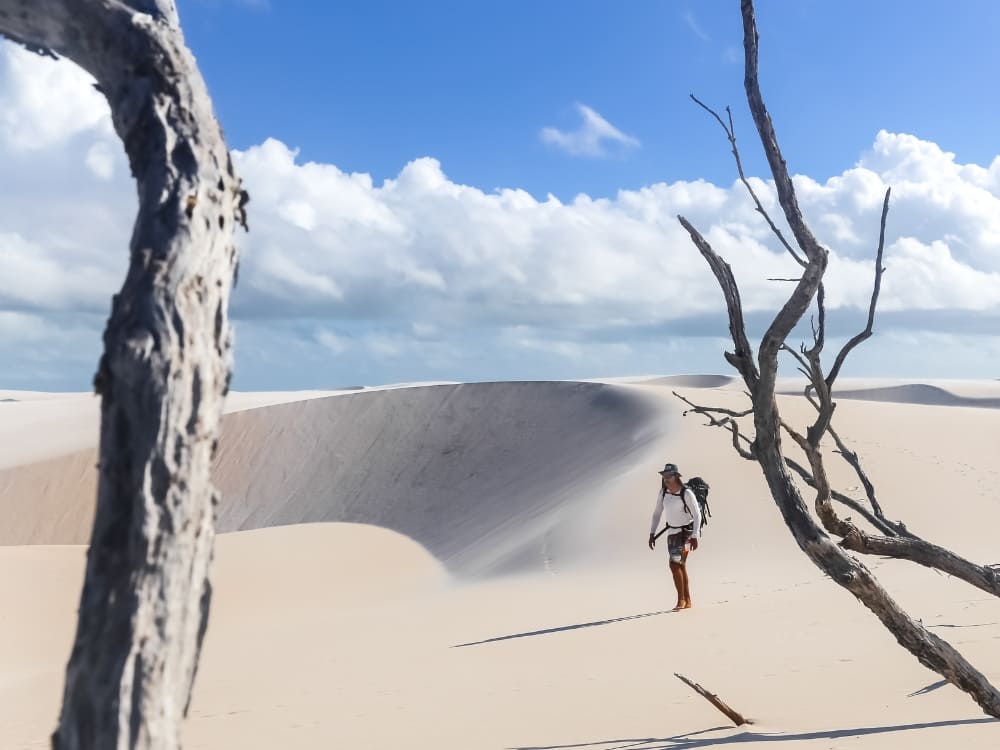
    A hiker explores the massive white sand dunes of Lençóis Maranhenses National Park, framed by dry tree branches.
    Photo: Ma Rabelo

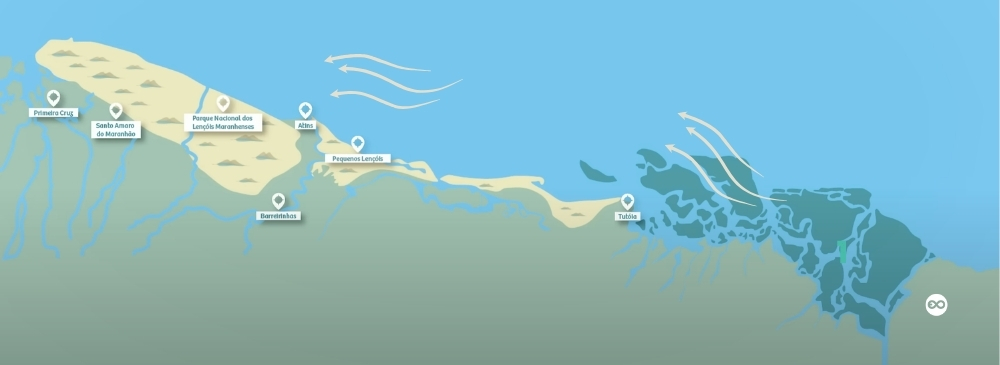
    Powerful coastal winds from the Atlantic Ocean blow fine sand particles inland, where the region’s topography traps and accumulates them. Over time, this sand builds up into massive sandy hills that can reach up to 40 meters in height. Shaped by the constant movement of the wind, these dunes take on smooth, crescent-like forms and are in a state of perpetual motion, giving the landscape a dynamic and ever-changing character.

    Researchers believe that 10,000 years ago, the national park area was covered by the sea. As the ocean gradually receded, it first gave way to mangrove forests and eventually transformed into the vast dune fields we see today.

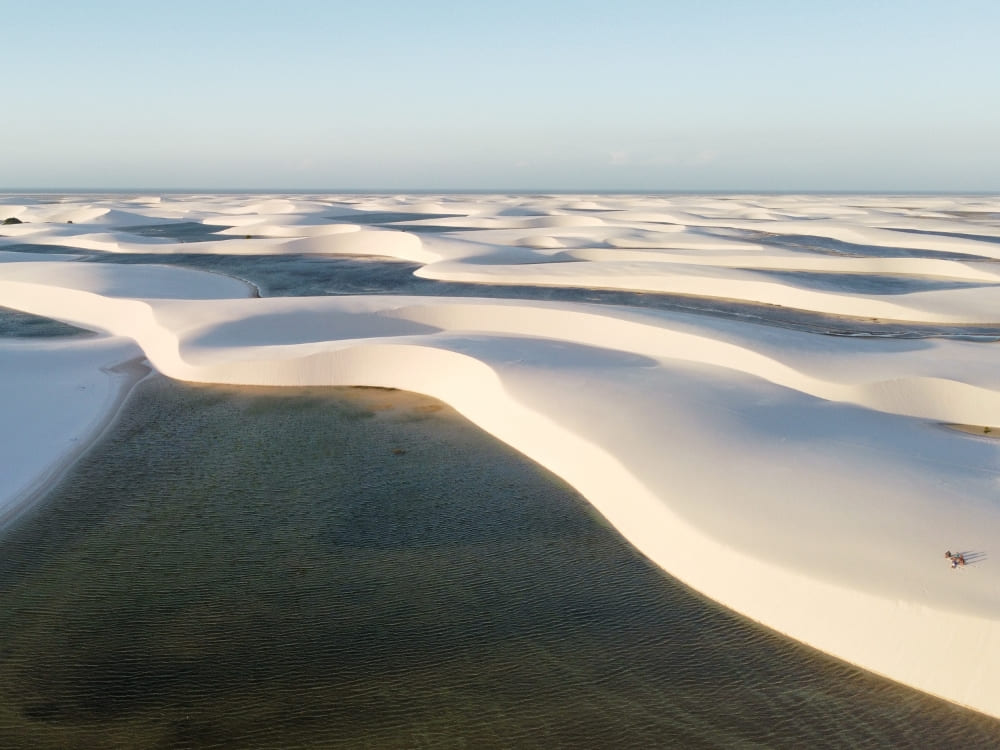
    Aerial view of the active white sand dunes and rainwater lagoons in Lençóis Maranhenses, stretching toward the horizon.
    .

    A significant portion of the sand in the park was brought by the Parnaíba River, which carries sediment towards the sea, while ocean currents push it back toward the shore. This ongoing interaction between river flow, tides, and ocean currents allowed the sand to accumulate, forming the unique ecosystem of Lençóis Maranhenses.

    Illustrative image showing how the dunes are formed in the Lençóis Maranhenses.Far from being static, the dunes are in constant motion. As the wind reshapes them regularly, they perform what locals poetically call the “dance of the dunes.” This phenomenon is especially visible during the dry season (July to December), when stronger winds and lower water levels in the lagoons make the movement even more noticeable.

    Active and inactive dunes of Lençóis Maranhenses, Brazil

    In Lençóis Maranhenses, not all dunes behave the same way. The presence or absence of vegetation is what determines whether a dune is active or inactive.

    Small houses surrounded by lush native vegetation and inactive sand dunes in Lençóis Maranhenses.
    .

    Some dunes are considered inactive, meaning they stay in place thanks to the surrounding vegetation. The native plants help to settle the sand, forming a natural cover that prevents the wind from moving the dune, making it more stable and fixed in place.

    On the other hand, active dunes are in constant movement due to the force of the wind, rainfall, and the absence of nearby vegetation, allowing the sand to “dance.”

    Can the dunes disappear?

    Researchers believe that the complete disappearance of Lençóis’ dunes is unlikely. However, some factors could significantly alter their formation and have serious environmental and social consequences.

    One of the main concerns is the unplanned installation of wind farms, as these structures can alter the wind patterns and directly affect the arrangement of the dunes. In addition, climate change plays a fundamental role, as it can change the behavior of rainfall and wind.

    👉 Read more: How to get to Lençóis Maranhenses?

    How are the lagoons formed in Lençóis Maranhenses?

    The beautiful, crystal-clear lagoons of Lençóis Maranhenses are formed by the significant amount of rainfall the region receives, reaching 2,000 millimeters a year, mainly between January and June.

    Top-down view of a person swimming in a crystal-clear rainwater lagoon in Lençóis Maranhenses, revealing the sandy bottom.
    .

    During the rainy season, the rain is quickly absorbed by the sand, which raises the water table above the ground and fills the temporary lagoons that lie between the dunes.

    But the true secret behind the formation and maintenance of the lagoons is attributed to the mixture of sand and clay found in the soil. Over time, this combination has developed characteristics similar to a sponge-like rock, allowing water to seep out slowly—thus prolonging the lifespan of the lagoons.

    Rainwater accumulates in the low areas between the dunes, forming thousands of crystalline pools that can reach depths of around one meter. Beloved lagoons such as Lagoa Azul and Lagoa Bonita offer a breathtaking view of this unique phenomenon, while the humidity in the air also prevents the dunes from shifting.

    Can the lagoons dry up?

    Brazil’s rainwater lagoons in Lençóis Maranhenses National Park begin to shrink between October and January. As the rain stops and the sun prevails, the water in the smaller lagoons evaporates completely, while the larger, deeper ones can retain it for longer.

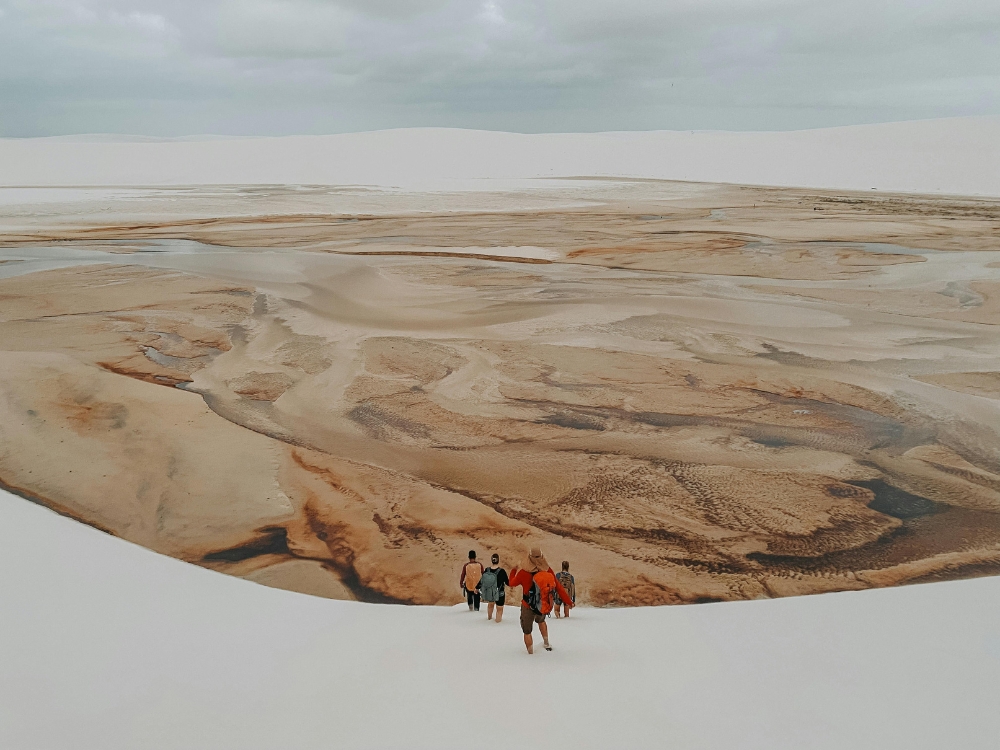
     A group of tourists walks across a dry, brown lagoon bed surrounded by large white sand dunes during the dry season.
    Photo: Glauco de Souza Santos

    This seasonal change not only alters the visual landscape but also affects the climate. During the end of the second semester, the strongest winds return, causing the dunes to grow and move more quickly.

    While it would be fun for the lagoons to be full all year round, it’s essential for the ecosystem that they dry out periodically. Continuous water accumulation, combined with local vegetation and organic matter, would otherwise lead to excessive algae growth, making the water slimy and the lagoons unsuitable for swimming.

    👉 Read more: 10 Facts About the Lençóis Maranhenses

    Weather and seasonality: best time to visit the dunes and lagoons in Lençóis Maranhenses

    The best time to visit Lençóis Maranhenses is from May to September, when the rainy season has just ended and the lagoons are at their peak.

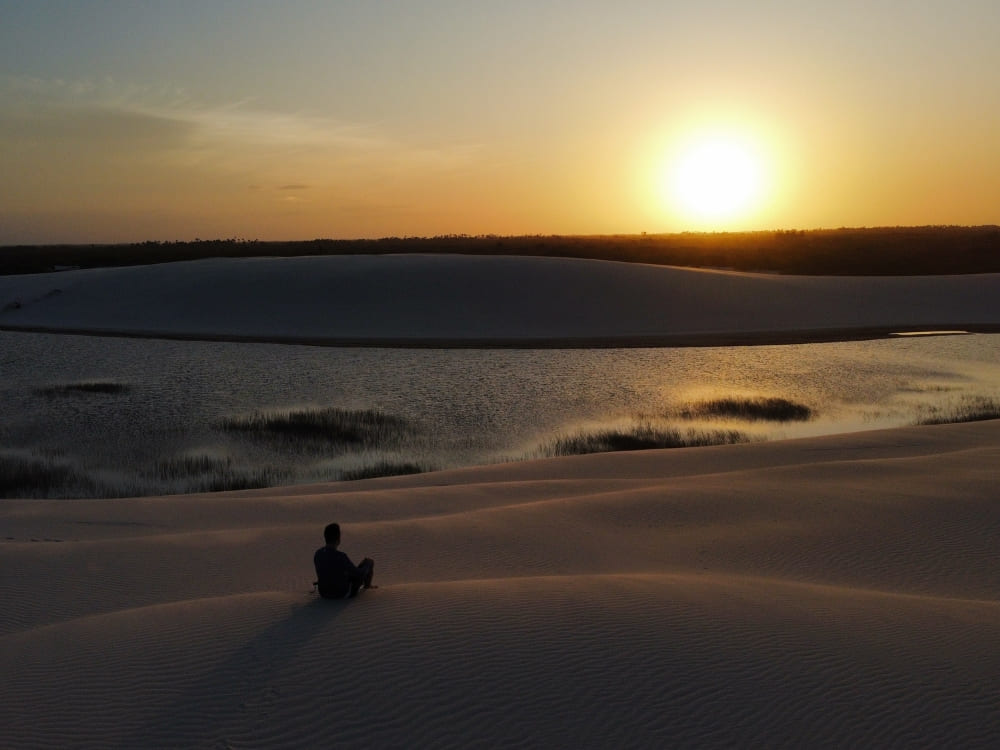
    Silhouette of a person sitting on a sand dune, watching a golden sunset over the lagoons of Lençóis Maranhenses.
    .

    The weather during this period is sunny, free of rain, and marked by pleasant temperatures, perfect for hiking across the park and taking a refreshing dip in the lagoons.

    Although the beginning of the dry season is considered the ideal time for visiting, each month offers a different kind of beauty. Whether it’s the vibrant lagoons of the rainy season or the giant dune formations of the dry period, Lençóis never ceases to amaze.

    👉 Read more: When is the best time to visit Lençóis Maranhenses?

    Visiting Lençóis Maranhenses’ dunes and lagoons with PlanetaEXO

    Now that you know how Lençóis Maranhenses was formed, it’s time to see its surreal beauty up close!

    PlanetaEXO is an ecotourism platform specializing in Lençóis Maranhenses tours. Working alongside the best local operators, our team helps you with hassle-free vacation planning, from bookings to tailor-made experiences. Contact us now!
  • 3 Ways Sustainable Tourism in the Pantanal Protects Wildlife

    3 Ways Sustainable Tourism in the Pantanal Protects Wildlife

    Discover how ecotourism is helping to protect the Pantanal’s wildlife and support local communities.

    The Pantanal, one of the world’s richest ecosystems and home to jaguars, giant otters, and diverse birdlife, is under threat from fires, deforestation, and land misuse.

    In response, a different kind of tourism has emerged, one that protects rather than exploits. Sustainable travel is not only raising awareness but also playing a direct role in conserving the Pantanal’s fragile wildlife and landscapes. 

    Wildlife Pantanal
    Photo: Dg wildlife

    Recognized by UNESCO as both a World Natural Heritage Site and a Biosphere Reserve, the region is seeing the rise of ecotourism as a force for good. At PlanetaEXO, we believe that responsible travel can make a real difference. In this article, we explore three ways ecotourism is helping to protect the Pantanal.

    Environmental Threats to Fauna and Flora in the Pantanal

    Before understanding how sustainable tourism helps protect the Pantanal, it is  important to know what is at stake.

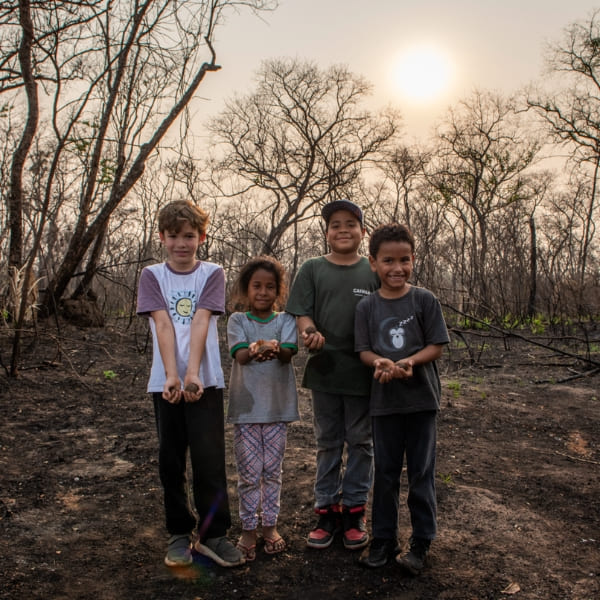
    In recent years, the Pantanal, one of the most biodiverse ecosystems in the world, has come under intense pressure from cattle ranching, monoculture farming, and illegal land-clearing. Fires are one of the most destructive tools used in this process. In the first half of 2024 alone, more than 3,000 wildfires were registered, mainly on private lands, representing a 22-fold increase compared to the same period the year before.

    Deforestation at Pantanal Brazil
    Photo: @lucas_n_morgado

    👉 Discover impactful conservation projects in the Pantanal and learn how you can support them.

    These fires and other forms of environmental degradation are having a severe impact on local wildlife. Jaguars, tapirs, caimans, and countless bird species lose their habitat and often their lives during the dry-season burns. Plant life also suffers long-term damage, and in some areas, the natural balance of flood and drought, vital for the survival of species in the Pantanal, is being lost.

    This kind of exploitation not only harms biodiversity but also increases the risk of droughts and water scarcity, with consequences that extend far beyond Brazil. What happens in the Pantanal affects the entire region.

    Environmental Threats to Fauna and Flora in the Pantanal
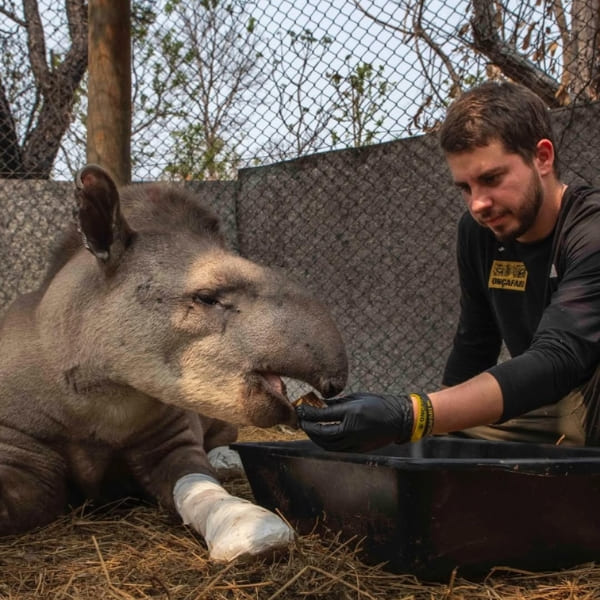
    Photo: Onçafari

    Faced with these threats, it becomes clear that protecting the Pantanal isn’t just a matter of conservation, it is a necessity for the survival of its wildlife and ecosystems.   But not all economic activity in the region leads to destruction. Sustainable tourism in the Pantanal offers a different path: one that values nature instead of replacing it. From supporting local communities to funding research and creating incentives for preservation, responsible travel is already making a difference on the ground. 

    Here are three ways sustainable tourism in the Pantanal is helping save the region’s unique wildlife.

    1. Creating Economic Incentives for Conservation

    Sustainable tourism brings real economic value to protecting natural areas. Many farms and ranches in the Pantanal, traditionally focused on cattle production, have started to invest in ecotourism as a new source of income.

    By welcoming visitors who want to see wildlife rather than farmland, landowners have strong reasons to preserve forests, wetlands, and riverbanks. Instead of clearing land for profit, they now have a financial reason to keep it wild.

    Creating Economic Incentives for Conservation in Pantanal
    Photo: @edu.fragoso_

    Some lodges even fund reforestation projects, anti-poaching patrols, and conservation initiatives directly from the revenue generated by tourism. It’s a simple but powerful equation: more protected nature, more opportunities for sustainable tourism.

    2. Supporting Scientific Research and Wildlife Monitoring

    Tourism in the Pantanal does not  just fund lodges and tours, it also helps pay for research. Several ecotourism operators work closely with scientists to monitor animal populations and study the delicate balance of this ecosystem. Revenue from tours often contributes to long-term research on jaguars, tapirs, birds, and aquatic species.

    In many cases, researchers use sightings from guided tours to track movements of key species over time. Without tourism, much of this fieldwork would be underfunded or even impossible in such a remote area.

    By simply choosing to travel with responsible operators, visitors contribute to sustainable tourism in the Pantanal, indirectly supporting critical scientific work that helps protect its wildlife for the future.

    Sustainable tourism in the Pantanal
    Photo: Reise Graf

    3. Empowering Local Communities to Protect Nature

    Perhaps the most important impact of sustainable tourism in the Pantanal is its effect on local communities. Tourism provides jobs, not only as guides, cooks, and drivers, but also in conservation, hospitality, and nature education. Ecotourism offers a real alternative to industries that harm the environment, such as illegal fishing, mining, or logging.

    Empowering Local Communities to Protect Nature
    Photo: SOS Pantanal

    Tourism initiatives often include educational efforts that equip local communities with knowledge about conservation, sustainable land use, and ecosystem preservation. By gaining skills and witnessing the benefits of a thriving environment, locals are empowered to take an active role in protecting the Pantanal.

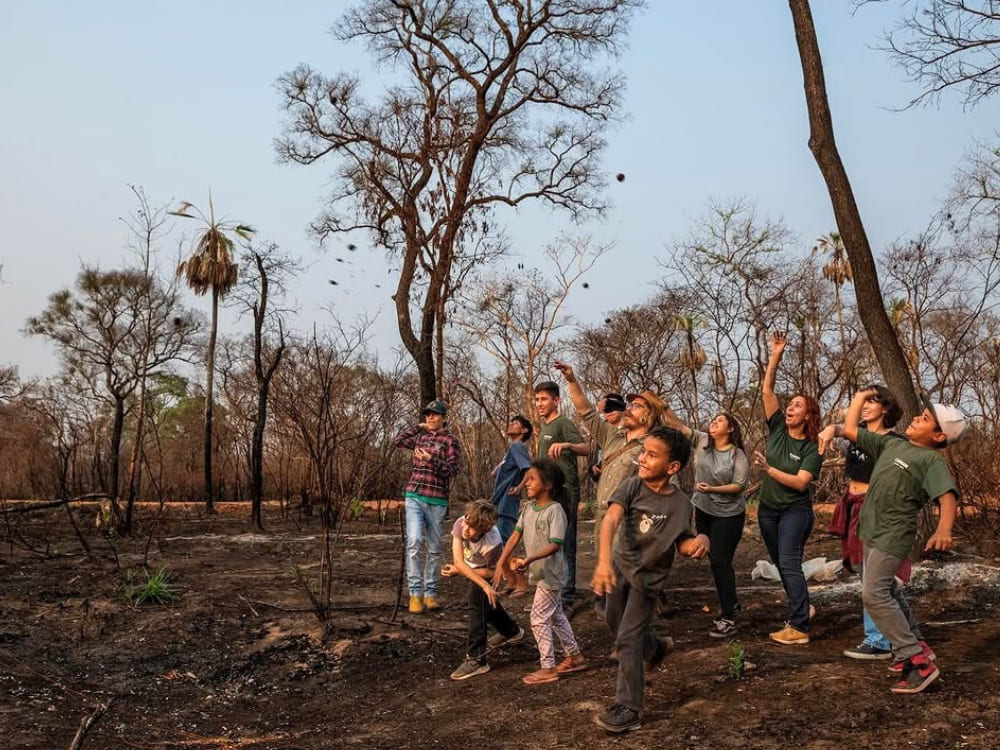
    A standout example is Casa Caiman, a leading eco-lodge that paused operations after last year’s fires to focus on environmental recovery. Upon reopening, it introduced hands-on conservation experiences, from seed dispersal and wildlife refuge construction to meliponiculture and supplementary feeding, that engage local guides, biologists, and visitors in meaningful fieldwork that strengthens both ecological resilience and community involvement.

    Sustainable tourism in the Pantanal
    Photo: @fernando.faciole

    A Future Built on Balance

    Sustainable tourism alone won’t solve all the challenges the Pantanal faces, but it plays a vital role in protecting its ecosystems while supporting local communities. Ecotourism platforms like PlanetaEXO empower travelers to explore responsibly, offering opportunities and guidance to make a positive impact on one of the world’s richest wildlife regions.

    👉 Learn how sustainable tourism is helping protect the environment across different regions of Brazil.

    Read more:

  • 10 Amazon Rainforest Travel Tips to Make the Most of your Adventure

    10 Amazon Rainforest Travel Tips to Make the Most of your Adventure

    Discover how to prepare for your Amazon Rainforest trip with practical tips, local insights, and sustainable travel advice

    Planning a trip to the Amazon in Brazil is no ordinary travel experience. With its immense size, rich biodiversity, and complex logistics, this magnificent place might challenge even the most seasoned travelers.

    This is a destination where preparation matters, both for your safety and for the well-being of the environment and local communities. When you follow certain Amazon Rainforest travel tips, you know exactly what to expect and can make your vacation even better.

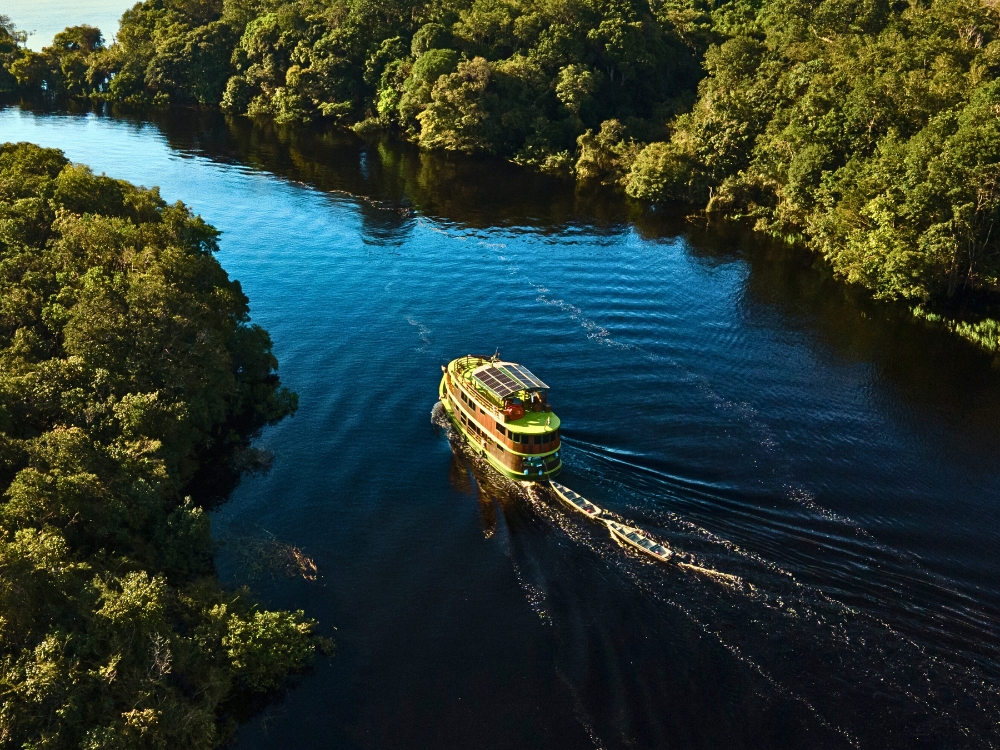
    Aerial view of an Amazon river cruise boat navigating a dark river surrounded by dense green rainforest in Brazil.
    Photo: Katerre Expedição

    PlanetaEXO knows everything about this subject. As experts in Amazon tours in Brazil, our team works with the best local operators to ensure a smooth trip for everyone. See our recommendations below!

    1) Understand the seasons and expect rain

    The Amazon has two main seasons: the wet season (December to May) and the dry season (June to November). Each offers a different experience.

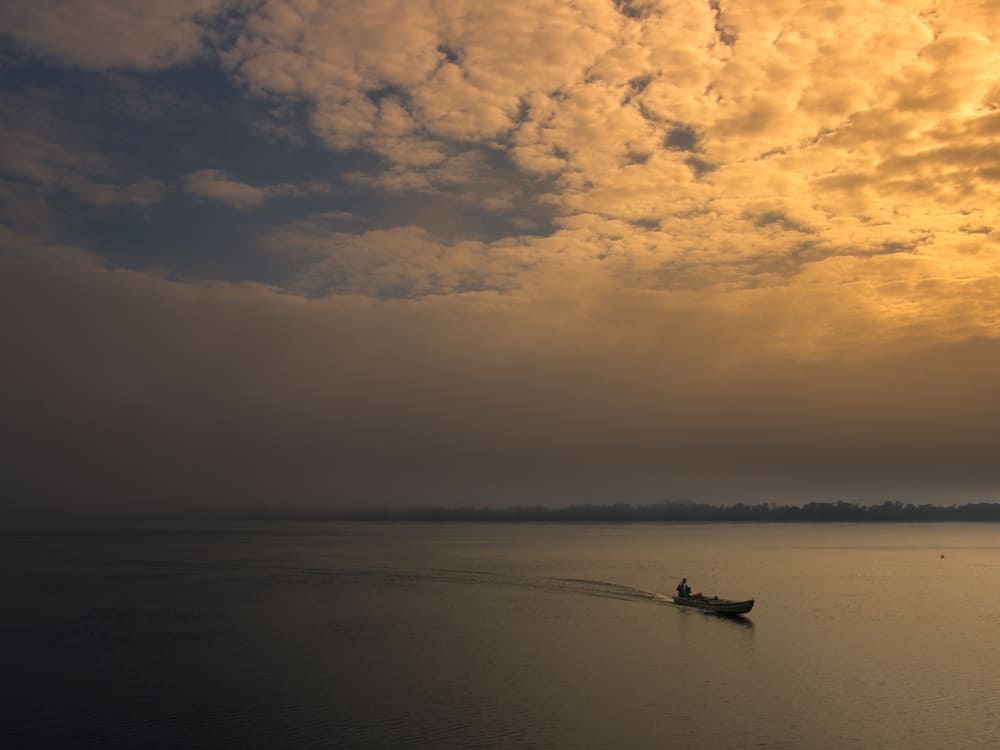
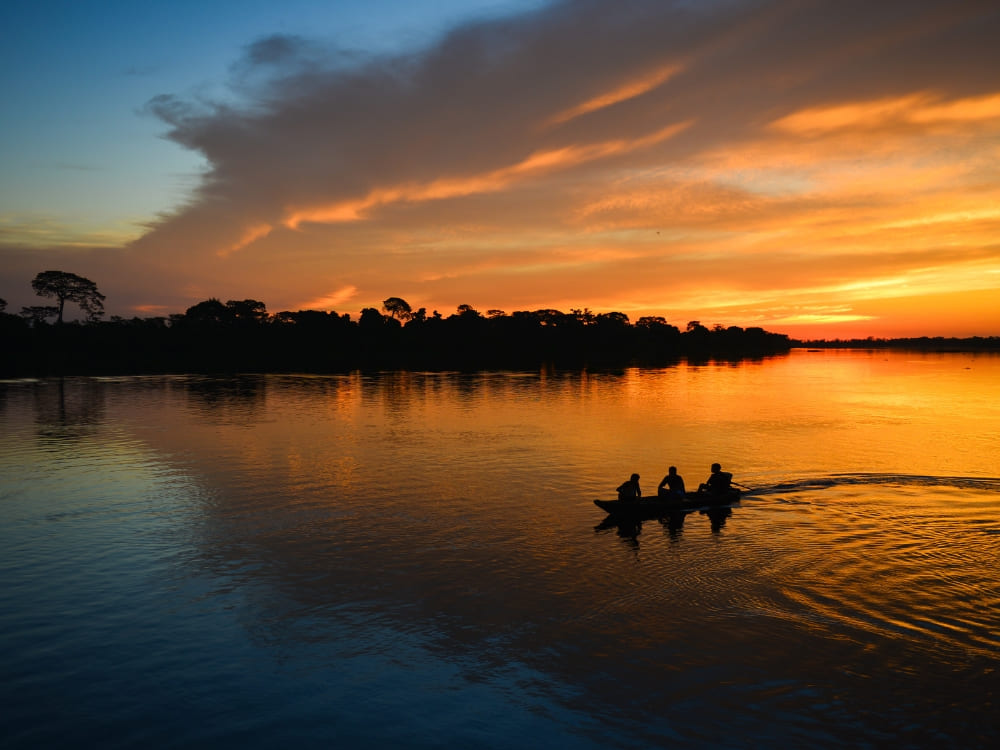
    A small motorized canoe traveling across the wide Amazon River during a golden sunrise under a cloudy sky.
    .

    During the wet season, river levels rise significantly, creating a temporary ecosystem where the flooded forest is only accessible by boat.

    In the dry season, receding waters reveal beaches, trails become more passable, and it’s easier to spot land animals.

    Still, don’t let the term “dry season” fool you. Rainfall volume is significantly high all year round—it is a rainforest after all—which means rainstorms can make sudden appearances. This doesn’t negatively affect your trip at all, but it’s important to be aware. 

    👉 Read more: When is the Best Time to Visit the Amazon Rainforest in Brazil

    2) Travel light, but smart

    You don’t need much, but what you bring matters. Overpacking makes travel heavier and harder to manage, while underpacking can make your experience uncomfortable. Aim for balance—what you carry should serve the journey, not complicate it.

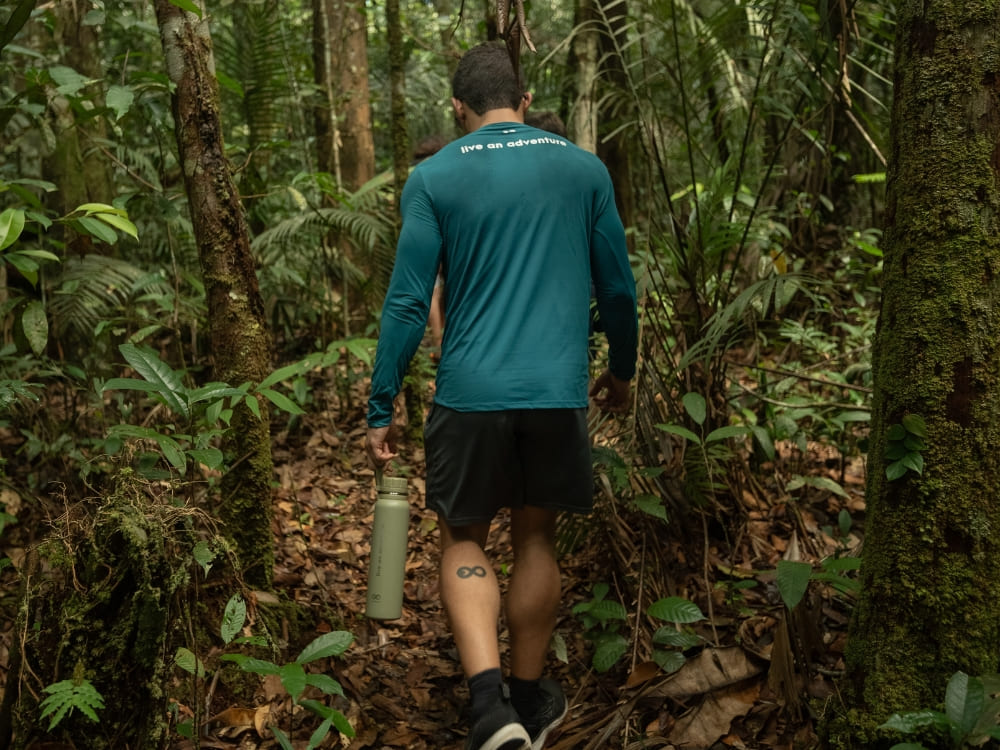
    A traveler carrying a reusable water bottle hikes through a lush green Amazon Rainforest trail.
    Photo: Marcelo Bonifácio

    Check out a list of what you should pack to make the most of your Amazon travel experience:

    • Lightweight, breathable clothes: t-shirts, shorts, pants, long-sleeved shirts (preferably with UV protection), windbreakers, hats or caps, and swimwear.
    • Comfy shoes: sneakers, flip-flops, sturdy hiking boots.
    • Equipment: raincoat, flashlight, personal reusable water bottle.
    • Travel essentials: documents, medication, sunscreen (SPF 30 or higher), insect repellent, sunglasses, and power bank (phones, cameras, laptops, tablets).
    • While larger cities like Manaus or Belém have ATMs and card-friendly establishments, much of the forest region still operates in a cash economy, especially in remote communities and local markets. Bring enough cash (Brazilian real) to cover meals, souvenirs, entrance fees, etc.—store it safely and divide it between bags.

    Another essential item to pack is a universal power adapter, as power outlets vary depending on the location. The voltage in the Amazon area is 127 V. Be careful with your devices!

    3) Protect your electronic devices from humidity

    Humidity in the Amazon ranges from 77% to 88% throughout the year, which can harm your electronics even when there’s no rain, as the humid air can condense inside lenses and devices. 

    To protect phones, cameras, laptops, and tablets, keep them in Ziploc or waterproof bags when you’re not using them.

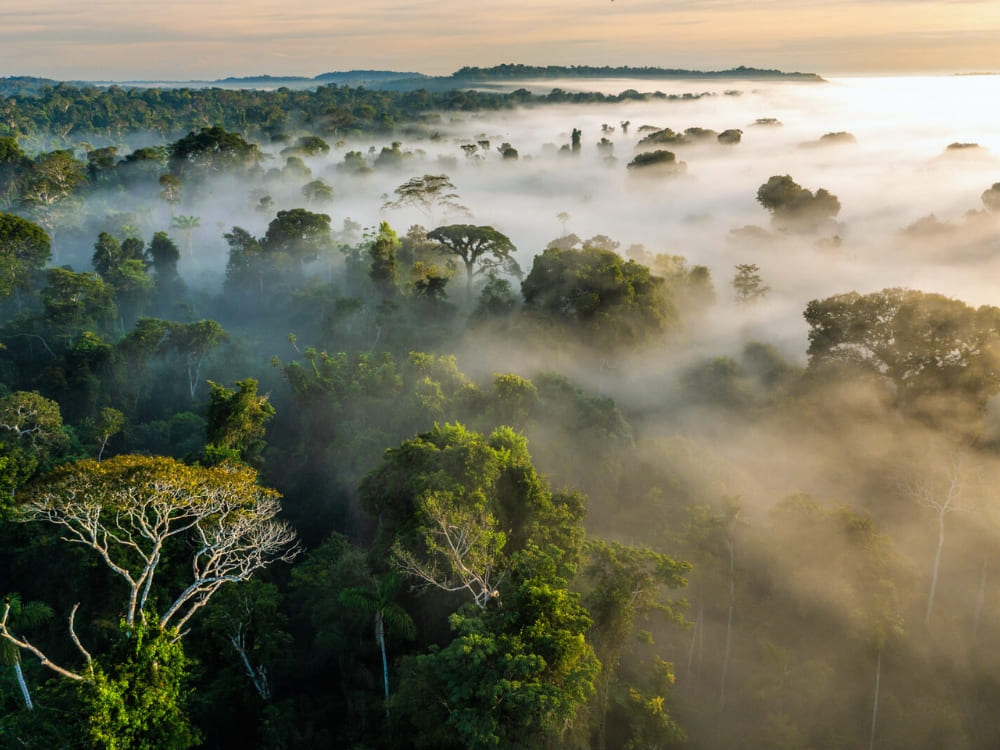
    Aerial view of the dense Amazon Rainforest canopy covered in thick morning mist and fog.
    Photo: André Dib

    4) Keep up with the time zone in the Amazon Rainforest

    The time zone in Manaus and the surrounding areas is UTC-4.

    Amazon Time (AMT) is 1 hour ahead of Eastern Standard Time and 2 hours ahead of Central Standard Time (-4 hours in comparison to Coordinated Universal Time).

    Pay attention to these differences so you don’t get confused when traveling!

    Amazon Rainforest travel Silhouette of three people in a small canoe navigating the Amazon River against a bright orange sunset sky.
    .

    👉 Read more: How to get to the Amazon Rainforest in Brazil?

    5) Health first: vaccines and general precautions

    Medical preparation is a basic Amazon Rainforest travel tip, and it begins before you arrive at your destination. Vaccinations are strongly recommended, particularly for hepatitis A and B, diphtheria, tetanus, polio, and measles. Depending on the region and season, your doctor may advise malaria prevention as well. 

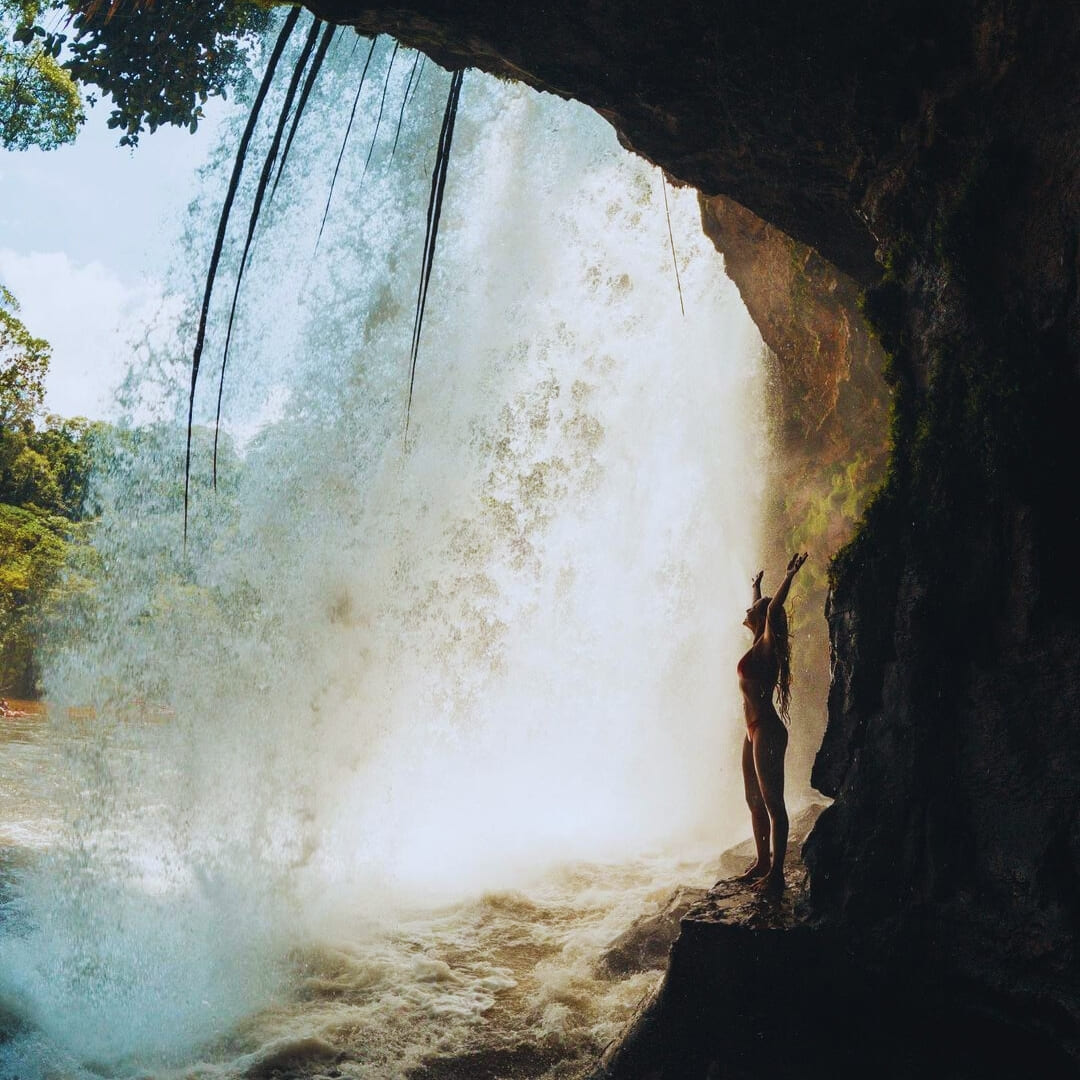
    A traveler stands behind a powerful rushing waterfall in the Amazon Rainforest with their arms raised.
    @ines.lafosse

    Yellow fever vaccines are not obligatory like in other South American countries, but they are highly advised—especially if you’re also traveling to the Amazon in Peru, Colombia, Ecuador, and Bolivia.

    Check the United States government traveler’s health guide and Brazil’s official recommendations for international tourists. If necessary, consult a travel clinic at least a few weeks before your trip.

    Once in the rainforest, simple habits make a big difference:

    • Hydration is essential in the heat and humidity. Carry a reusable water bottle and drink regularly.
    • Pack a small medical kit with essentials, including medication for headaches or stomach discomfort, allergy relief, and plasters or Band-Aids for minor injuries.
    • Apply your sunscreen first, wait 15 minutes for it to absorb, and then apply high-DEET insect repellent on top. If you do it the other way around, the sunscreen can dilute the repellent or even trap insects against your skin.
    • Before putting your shoes on in the morning, give them a vigorous shake and a peek inside. Spiders, scorpions, and the occasional small frog love the dark, damp “cave” of a hiking boot.

    6) Walk with a local guide

    Tourists might wonder if the Amazon Rainforest is dangerous. As this is a wild environment, the jungle can hold its dangers, but only for travelers exploring the biome on their own.

    That’s why following a qualified local guide is crucial. They know where to step, when to stay quiet, and what not to touch. Safety comes first, but respecting instructions also allows for a deeper immersion and the conservation of nature.

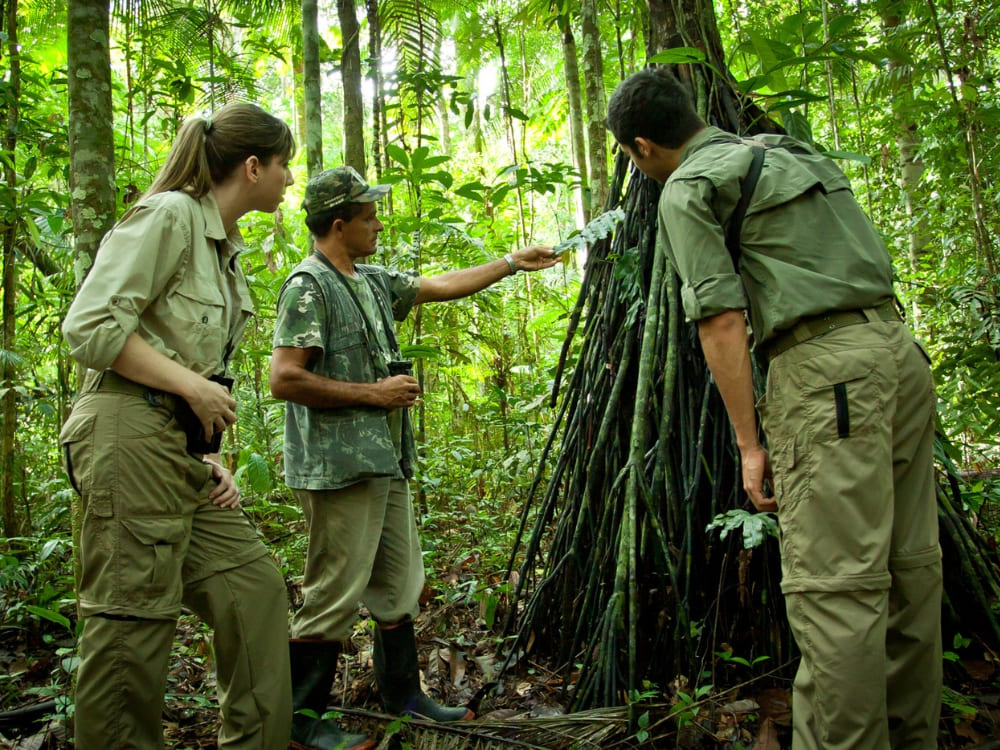
    A local guide shows two tourists the intricate roots of a large tree while hiking through the Amazon.
    Photo: Samuel Melim

    Hiking through the forest with someone who knows the terrain inside out transforms the experience. You’ll learn to spot hidden insects, medicinal plants, camouflaged frogs, and animal tracks you’d never notice on your own, as well as act correctly so as not to disrupt the balance of the ecosystem.

    7) Keep quiet and don’t interfere when you spot an animal

    Though the Pantanal is considered the best place in Brazil for wildlife watching, the Amazon fauna is also incredibly rich, being a fundamental part of one of the most complex ecosystems on Earth.

    A camouflaged caiman rests on a riverbank covered in leaves during a night wildlife tour in the Amazon.
    Photo: Vitor Marigo

    Whether it’s a sloth in the canopy, a caiman along the riverbanks, or a line of leafcutter ants crossing your path, all of this forms a finely balanced environment. Touching, feeding, or approaching animals disrupts that balance, altering natural behaviors and potentially putting both you and the animal at risk.

    Real respect means keeping your distance, moving quietly, and resisting the urge to interact. These are moments of connection with nature as they truly are: wild, unpredictable, and best left undisturbed.

    8) Stay in lodges that care for nature 

    One of the most important Amazon travel tips involves where you stay. Choosing lodges that prioritize sustainability ensures your visit supports both the environment and the community.

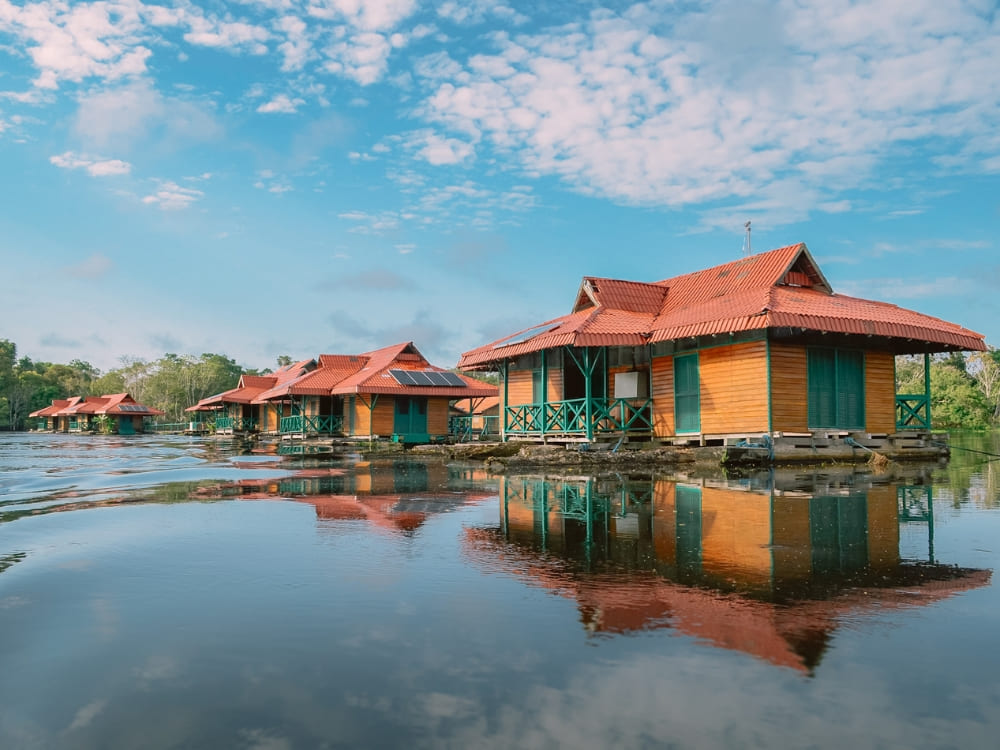
    Sustainable wooden Amazon jungle lodge cabins floating on a calm river reflecting the blue sky.
    .

    Look for accommodations powered by solar energy, with waste management systems and fair hiring practices. Many ecolodges reinvest part of their profits into conservation and education projects, which helps to support local families.

    When you stay in jungle hotels where your trip makes a difference, you contribute directly to the preservation of the forest and the quality of life of those who call it home, making your trip truly meaningful.

    👉 Read more: Best Amazon Jungle Lodges in Brazil

    9) Stay in a “black water” region to avoid bugs

    Here’s an Amazon travel tip you don’t see everywhere: if you are particularly mosquito-prone, look for lodges on “black water” rivers (like the Negro River).

    The high acidity from decomposing organic matter prevents mosquito larvae from developing, making these areas significantly less buggy than “white water” regions (like the Solimões).

    A group of travelers swims in a calm black water Amazon river during a vibrant orange sunset.
    .

    👉 Read more: Best Amazon River Cruises in Brazil

    10) Respect local communities

    The Amazon is home to countless people, including Indigenous and riverside communities who have lived there for generations. Respecting their traditions and way of life is essential.

    An Indigenous man wearing a traditional feather headdress walks through the lush green Amazon jungle.
    Photo: Isadora Sá

    Always ask before taking photos, avoid offering gifts without context, and be open to learning from their stories. Many members of these groups are guides, hosts, and stewards of conservation projects who work every day to ensure the forest’s well-being. 

    When you travel responsibly, you support community-based tourism that protects culture, creates jobs, and strengthens local pride. Do your part and contribute to a better future.

    Here’s your last Amazon Rainforest travel tip: book your experience with PlanetaEXO

    PlanetaEXO is an ecotourism platform that works with the best local operators and specializes in Amazon Rainforest tours in Brazil.

    When you travel with us, you’re making sure your vacation causes a positive impact on small businesses, native communities, and our planet. Let’s live an adventure together. Contact us now!
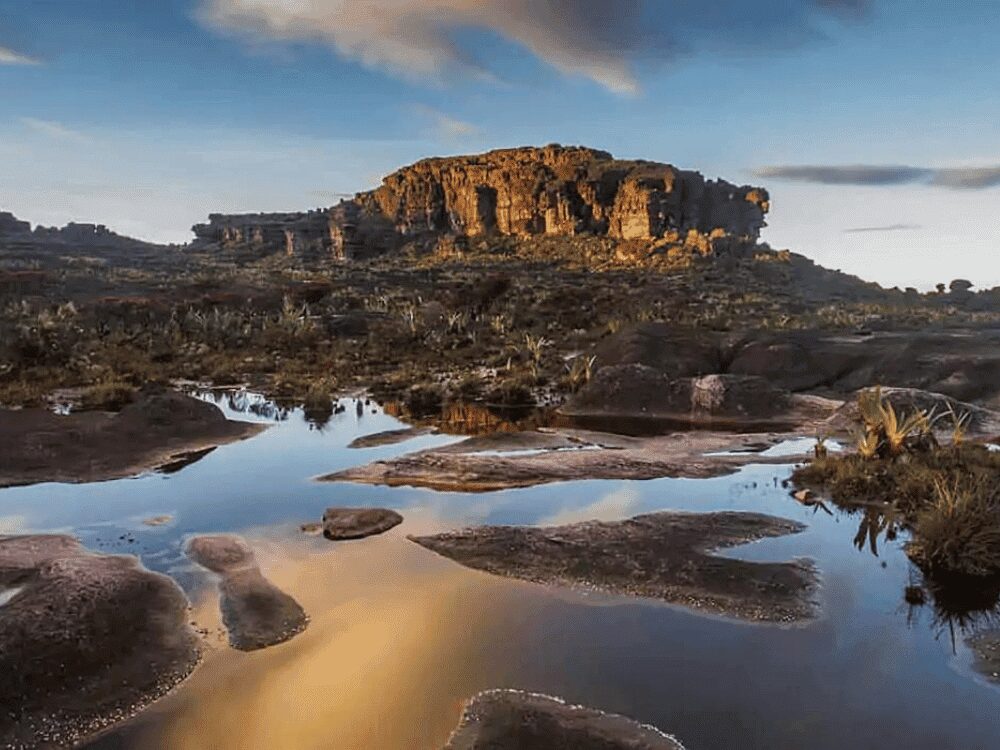
  • PlanetaEXO: First Brazilian Travel Company in The Long Run

    PlanetaEXO: First Brazilian Travel Company in The Long Run

    Conscious and positive-impact tourism has just gained new momentum in Brazil. PlanetaEXO announces its affiliation with The Long Run, one of the leading global networks dedicated to sustainable tourism.

    With this achievement, PlanetaEXO becomes the first Brazilian travel company to join The Long Run, an international network of destinations committed to responsible tourism. In Brazil, the network already includes names such as Refúgio Ecológico Caiman, Pousada Trijunção, and Ibiti Projeto. Now, this commitment also extends to the experiences offered through PlanetaEXO‘s carefully selected partners, all aligned with The Long Run’s 4Cs framework: Conservation, Community, Culture, and Commerce.

    “Being alongside such important initiatives and having the recognition of The Long Run is a milestone for us”, says Lucas Ribeiro, founder of PlanetaEXO. “We’ve always believed that tourism can be a force for positive change, and being part of this global community reinforces the value of our mission.”

    Conservation The Long Run
    Photo: Aleksandrs Orlovs

    What Is The Long Run and Why It Matters

    Founded by the Zeitz Foundation, The Long Run is today one of the most respected global networks promoting tourism that protects nature and supports local communities. Its members commit to four key pillars:

    • Conservation: Protect biodiversity and reduce environmental impact.
    • Community: Involve and benefit local populations.
    • Culture: Promote and respect cultural diversity.
    • Commerce: Encourage long-term sustainable business practices.

    PlanetaEXO’s admission followed a rigorous evaluation process to ensure alignment with these principles.

    Planetaexo The Long Run
    Photo: Lucas Neves

    Who are we?

    Founded in 2021, PlanetaEXO was born from the desire to connect travelers with authentic, responsible adventures led by local guides and communities involved in environmental preservation. The project began in Chapada Diamantina with the iconic Pati Valley trek, but from day one, the goal was broader: to become a global platform for sustainable travel.

    PlanetaEXO does more than organize trips, it curates immersive experiences that prioritize environmental respect and community leadership. A significant share of the revenue generated by tours goes directly to local families, guides, and small businesses.

    Our model was designed to have a positive impact from the start, not just for travelers, but for everyone involved. We believe extraordinary adventures can go hand in hand with preserving and strengthening the places we visit.”

    Lucas Ribeiro

    The Long Run
    Photo: Clovis Cruvinel

    The Value of Global Collaboration

    In a world where mass tourism often harms ecosystems and erases cultural identities, The Long Run stands out as a model for transformative and inclusive tourism. The network goes beyond buzzwords and fosters deep, long-term benefits for nature and local communities.

    By joining this global movement, PlanetaEXO not only commits to best practices but also gains access to knowledge exchange, training, and international collaboration, tools that are key to improving impact-driven tourism while respecting local realities.

    Looking Ahead: What’s Next for PlanetaEXO

    Joining The Long Run signals a new chapter in PlanetaEXO’s journey. The company is currently expanding its itineraries to new regions across Brazil and Latin America, focusing on destinations with high ecological and cultural value. 

    It also plans to invest in training programs, partnerships with conservation projects, and technological improvements to make sustainable travel more accessible and efficient.

    “We want to show that adventure tourism can be a real catalyst for environmental and social change”, concludes Lucas Ribeiro. “Our journey is just beginning.”The Long Run

    About The Long Run

    Founded in 2009 by the Zeitz Foundation, The Long Run is a global initiative supporting tourism enterprises committed to a positive, long-term impact. With more than 40 members across five continents, including lodges, private reserves, and community-led projects, the network currently protects over 20 million acres of biodiversity worldwide.

    👉 Want to know more about our commitment as a member? Visit PlanetaEXO’s profile on The Long Run website.