Category: Pantanal

  • 10 Pantanal Travel Tips for an Unforgettable Trip

    10 Pantanal Travel Tips for an Unforgettable Trip

    Seasons, activities, safety tips, and health precautions. See our recommendations for a fantastic Pantanal safari!

    Traveling to any destination requires preparation, but some specifics are exclusive to the Pantanal due to its location, climate, activities, and overall attributes.

    Following certain Pantanal travel tips is crucial for visitors safety and enjoyment, but they’re also important for the well-being of locals and the ecosystem.

    As an ecotourism platform specializing in Pantanal tours that works with the best local operators, PlanetaEXO has created a guide to help you savor every single moment of your vacation. Check it out below!

    1) Time your trip strictly by season and the Pantanal weather

    The Pantanal is a primarily warm place, with temperatures up to 29°C (84°F), depending on the season (rainy, wet, intermediate, and dry).

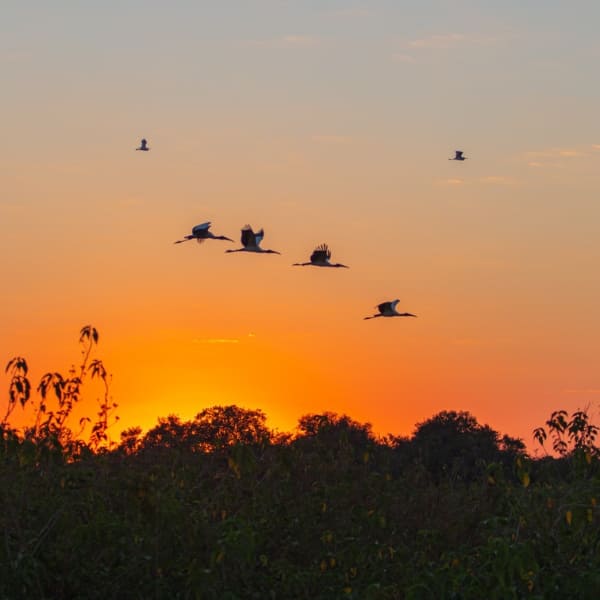
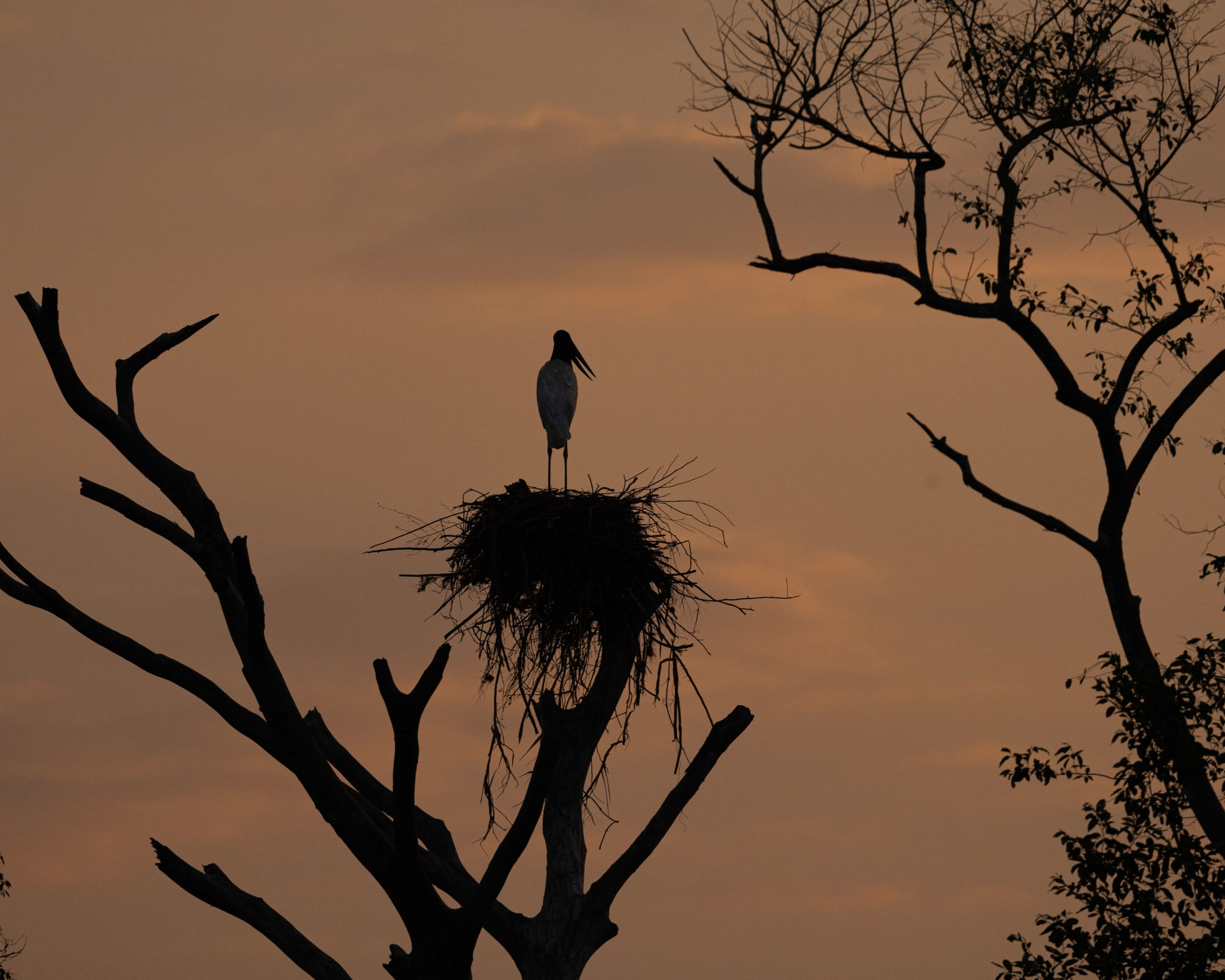
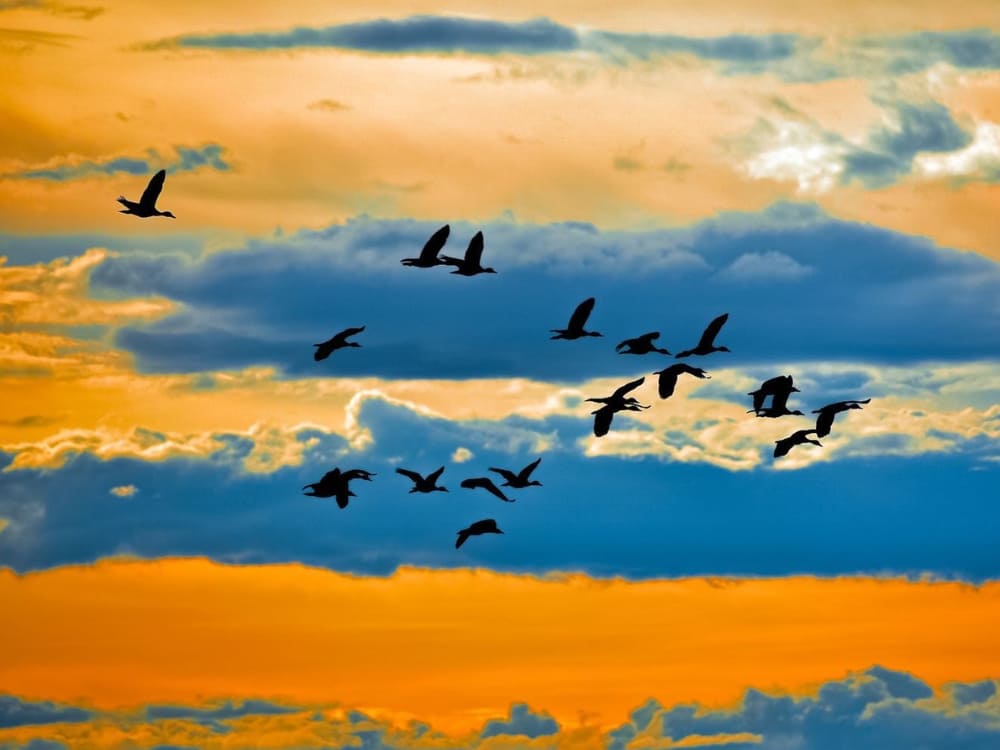
    Silhouette of a large tree and flying birds against a vibrant orange and yellow sky during a warm Pantanal sunset.
    .

    The biome is heavily influenced by climate. Higher or lower rainfall volumes cause drastic changes in the landscapes, altering the activity schedules for tourists. That’s why it’s so important to understand the Pantanal weather and seasons before booking your trip—so you know what to expect:

    • Dry season (July to October): Animals congregate around shrinking water holes, and vegetation is sparse, making spotting jaguars, anteaters, and caimans much easier.
    • Wet season (December to March): The landscape floods and becomes a lush green mirror. Beautiful for birdwatching and scenery, but many mammals disperse, mosquitoes are particularly abundant and agitated, and road access can be cut off.

    👉 Read more: When is the best time to visit the Pantanal?

    2) Choose the right region: North vs. South

    The Pantanal is so massive it’s divided into two sides: North and South. By understanding what each region has to offer, you can plan your trip more effectively.

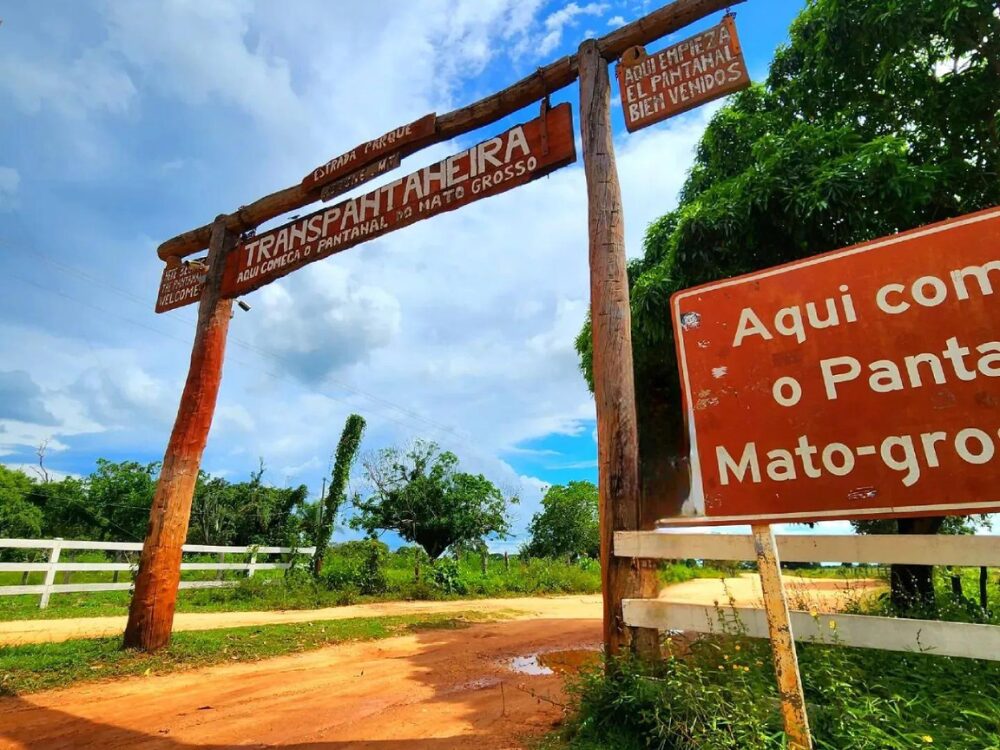
    • North (via Cuiabá): Best for jaguars—the Transpantaneira Highway leads to Porto Jofre, where boat safaris offer the highest density of jaguar sightings in the world.
    • South (via Campo Grande): Best for variety and culture—it offers a mix of wildlife (anteaters, macaws, ocelots) and stronger “Pantaneiro” traditions. It’s also easier to combine with a trip to Bonito (famous for river snorkeling).
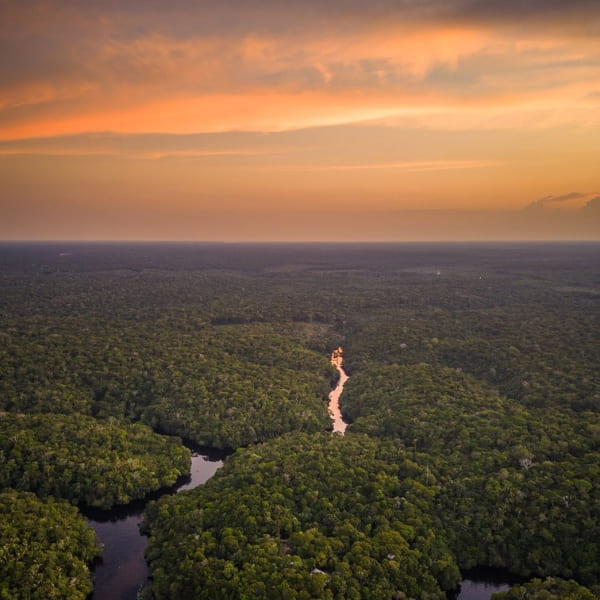
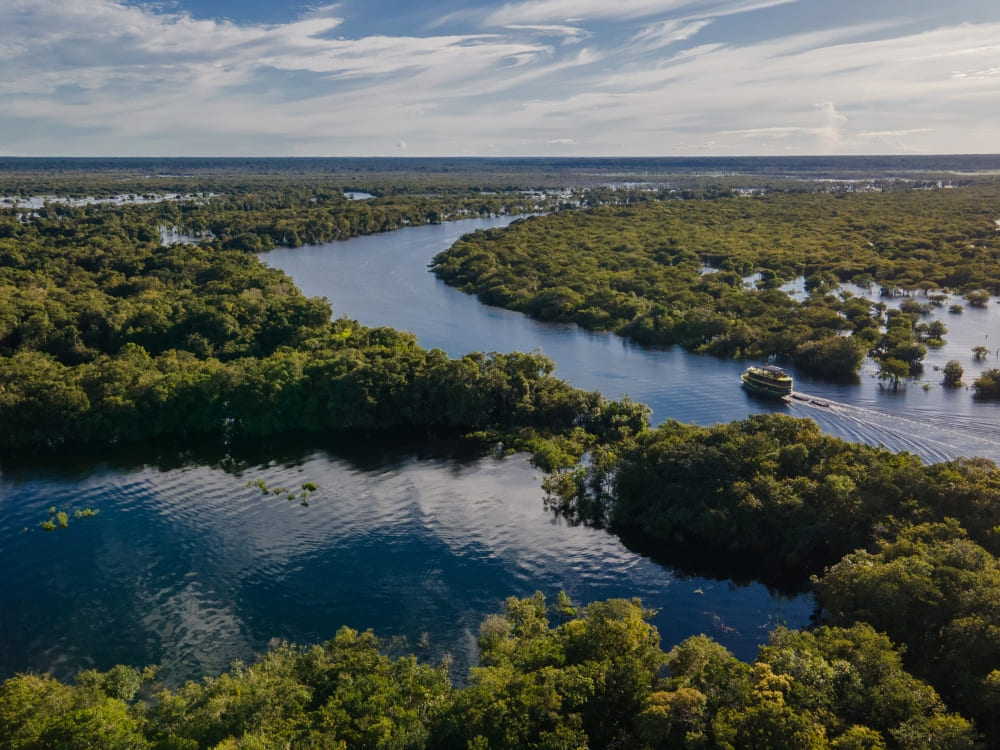
    Aerial view of a winding river flowing through the vast wetlands, reflecting the pink and orange evening sky.
    .

    👉 Read more:

    3) Pack smart to make the most of your safari

    Surely one of the most valuable Pantanal travel tips, packing smart is fundamental in any trip. If you bring too much, your bags will be heavy and difficult to move around. If you bring too little, your experience might be tarnished by some very uncomfortable situations. Always aim for balance and mind your own preferences and needs.

    Person wearing lightweight clothes and a backpack walks on a wooden boardwalk surrounded by tall vegetation.
    Photo: Layla Motta

    Not sure what to pack for the Pantanal? Here’s a list with a few suggestions on what to pack for your Pantanal tour:

    • Lightweight, breathable clothes: t-shirts, long-sleeved shirts, pants, shorts, windbreakers, khaki or natural-colored clothing for safaris, hats or caps, and swimwear.
    • Comfortable shoes: sneakers, flip-flops, sandals, hiking boots.
    • Equipment: flashlight, binoculars, personal reusable water bottle, cameras, and extra lenses (especially for photo safaris).
    • Essentials: documents, medication, sunscreen (SPF 30 or higher), insect repellent, sunglasses, power bank, chargers (phones, cameras, laptops, tablets).

    Most lodges accept credit/debit cards and other forms of digital payment, but it’s always a good idea to have some cash (Brazilian real) for food, drinks, souvenirs, and tipping your guide or hotel staff. 

    Universal power adapters are also very important, as power outlets vary according to location. Before plugging in your devices, please notice that the voltage in the Pantanal area is 127V.

    4) Health: vaccines, hydration, and insect repellent

    The Brazilian government doesn’t require foreign tourists to be vaccinated, but the Ministry of Health advises that visitors arrive in the country with a complete vaccination schedule for diphtheria, tetanus, polio, and measles.

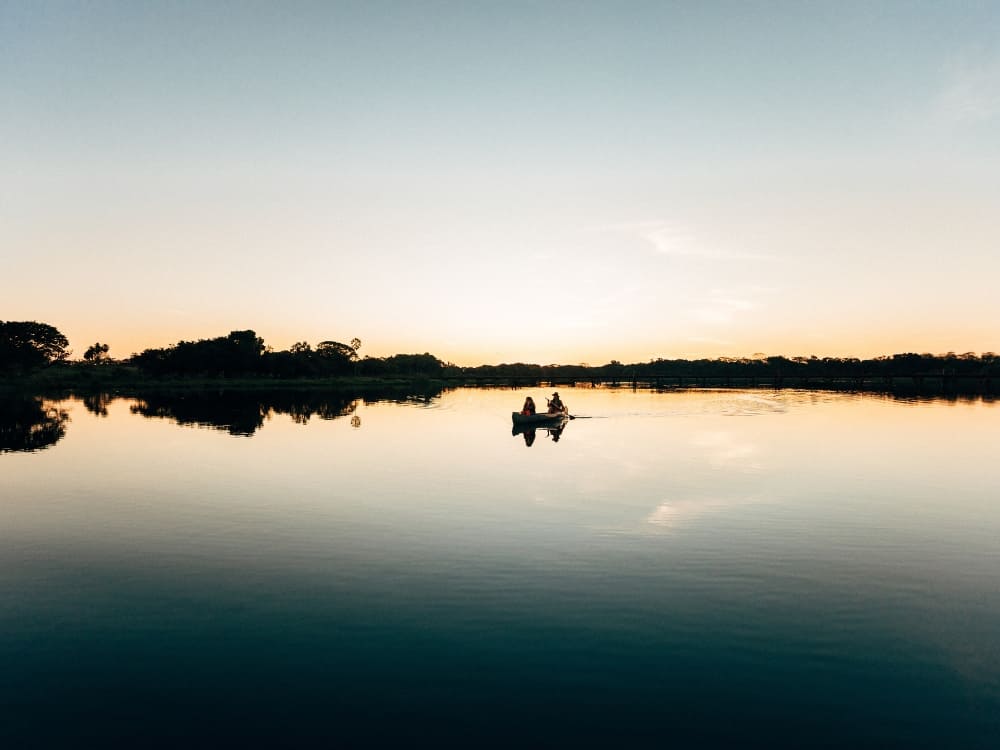
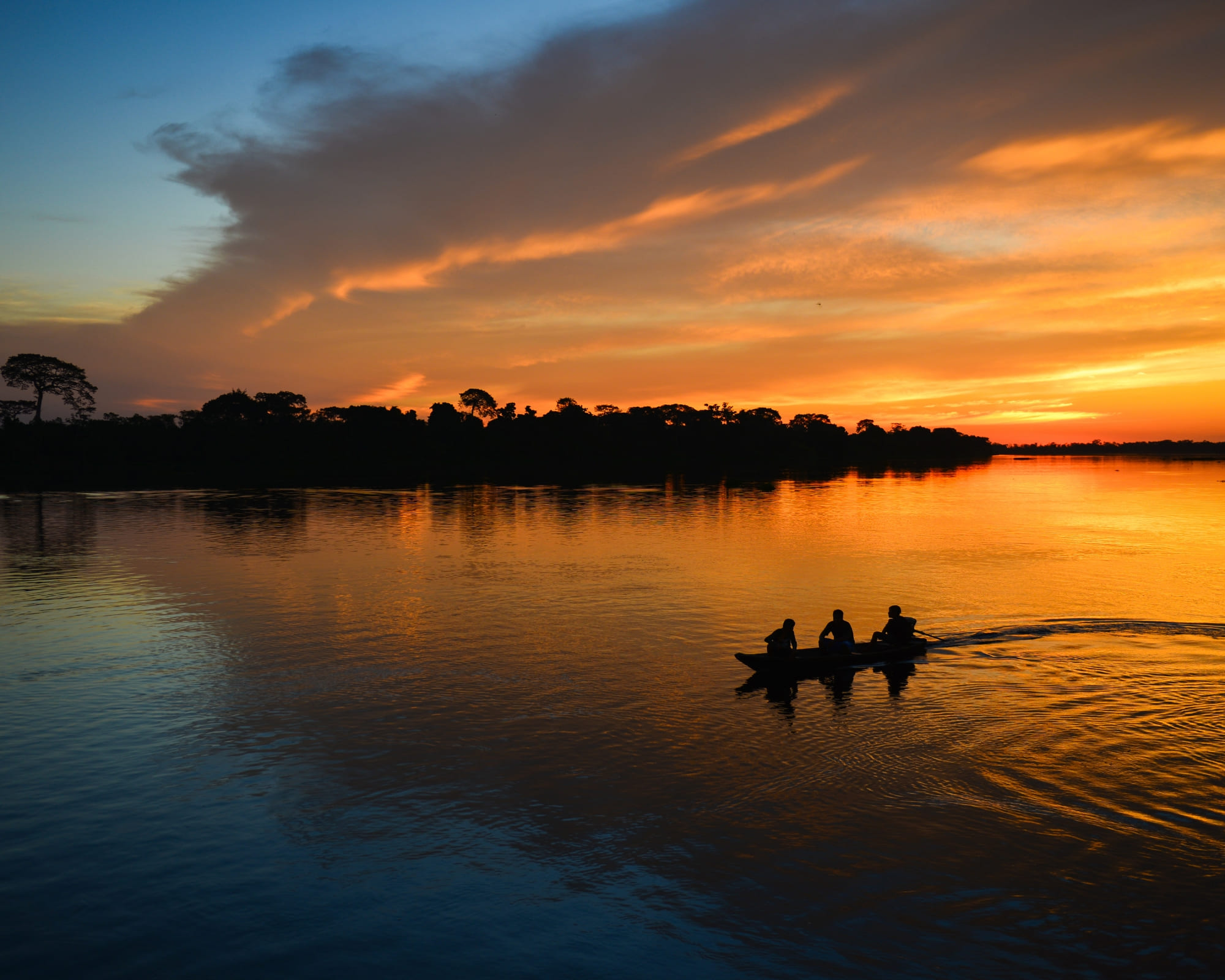
    Silhouette of a person paddling a canoe on the calm waters of a river during a peaceful sunset.
    Photo: Felipe Castellari

    For extra safety, getting shots for yellow fever and hepatitis A and B is also recommended. See more information in CDC Travelers’ Health (USA) and Vaccine for Travelers (Brazil).

    After arriving in the Pantanal, don’t forget about hydration. The weather is warm, and you will be doing some physical exertion on safaris and other outdoor activities. Always keep a water bottle nearby!

    Bring high-strength insect repellent (DEET or Icaridin) and apply it frequently to avoid itching, allergic reactions, and mosquitoes infected with diseases, such as dengue.

    5) Choose your adventure

    The abundance of the Pantanal is not limited to its natural wealth but also extends to the variety of activities it offers. Don’t know what to do in the Pantanal? Check it out:

    • Jaguar sightings
    • Wildlife watching
    • Night spotlighting
    • Pantanal safaris (boat or land)
    • Ecological walks
    • Horseback riding
    • Boat trips

    Each ecolodge offers these and other experiences that may vary depending on the region, travel package category, and season.

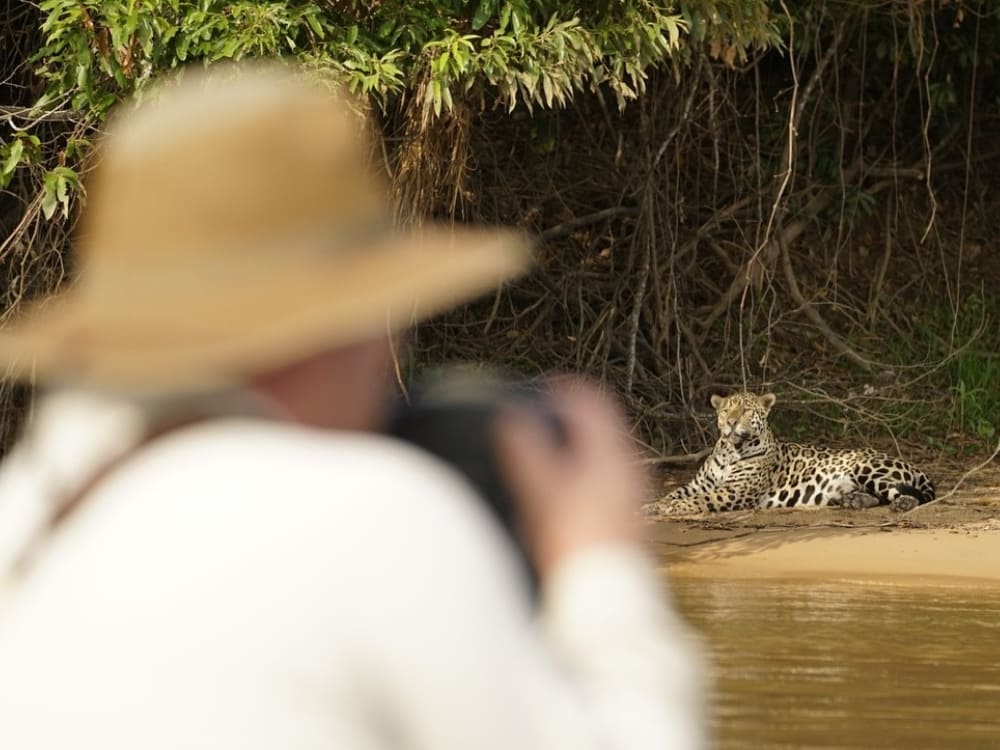
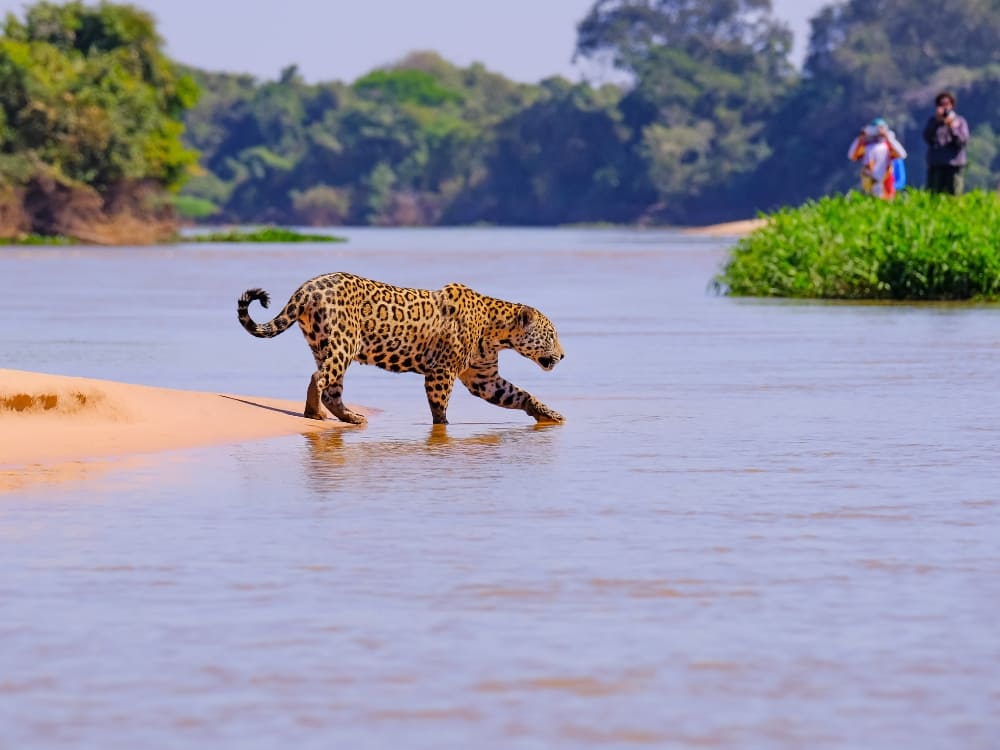
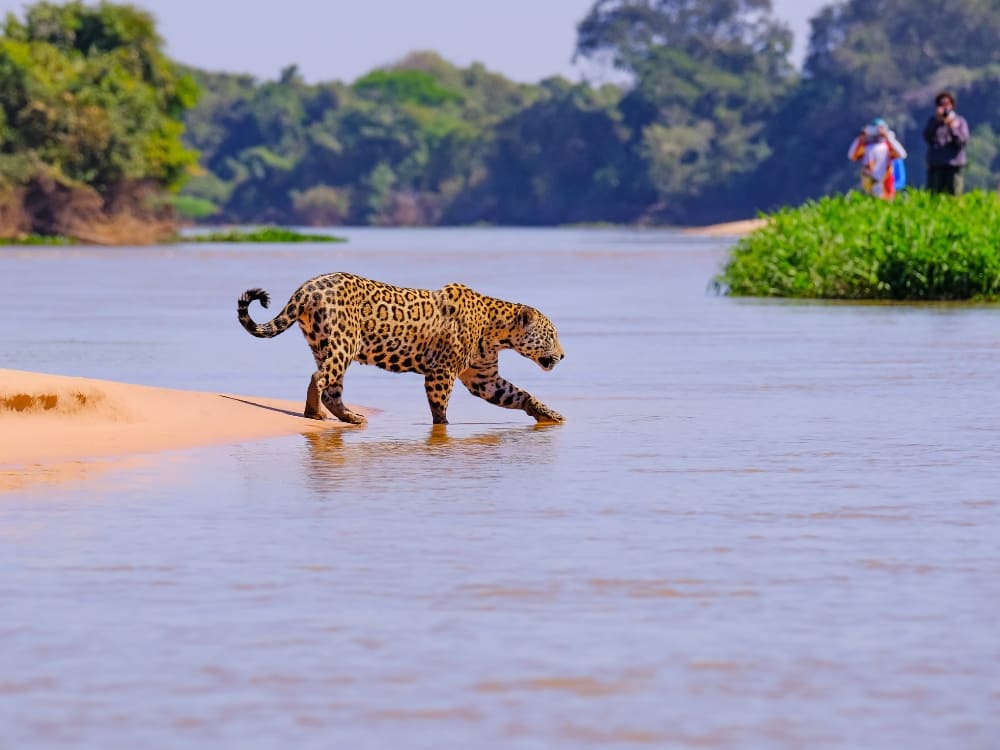
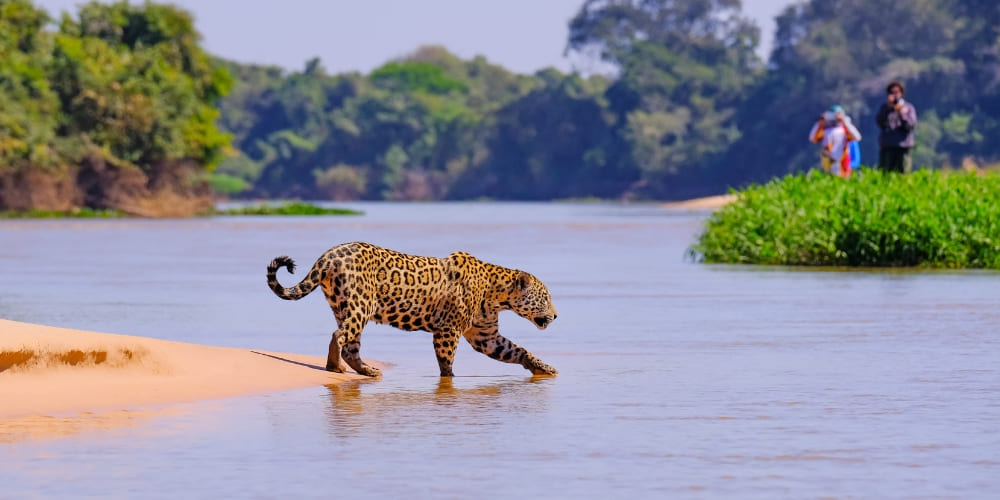
    A jaguar walks carefully through the shallow waters of a river while tourists observe from the riverbank during a Pantanal tour.
    .

    Guests also have the option to customize their own itineraries, though it’s necessary to check the conditions with the accommodations’ staff first.

    6) Pack your gear for Pantanal photo tours

    Photo tours are some of the most beloved experiences in the Pantanal. Drawn by the beauty of the biome and the impressively rich fauna and flora, professional and amateur photographers from different countries travel all the way to Mato Grosso and Mato Grosso do Sul.

    Many guides have extensive experience with wildlife photography. During safaris, not only do they point out the best places to find animals, but they also share techniques to capture the most stunning shots.

    Two blurred photographers in the foreground capture a giant anteater walking through low vegetation during a Pantanal photo tour.
    Photo: Felipe Castellari

    Even if you aren’t a pro photographer, a smartphone camera will likely disappoint you. Recommended equipment:

    • At least two cameras
    • Telephoto lens (35 to 200 mm and 500 to 600 mm range)
    • Polarizer filters
    • Tripod and/or monopod
    • Binoculars (invest in a high-quality pair, like the 8×42 model)

    👉 Explore the adventure: Pantanal Jaguar Photography Tour

    7) Be aware of the best moments for wildlife watching

    Following nature’s schedule is some of the most helpful Pantanal travel tips if you want to witness its wonders.

    Pantanal animals tend to leave their hiding places in the early morning or late afternoon to search for food, so be prepared to wake up bright and early or explore the biome when night falls!

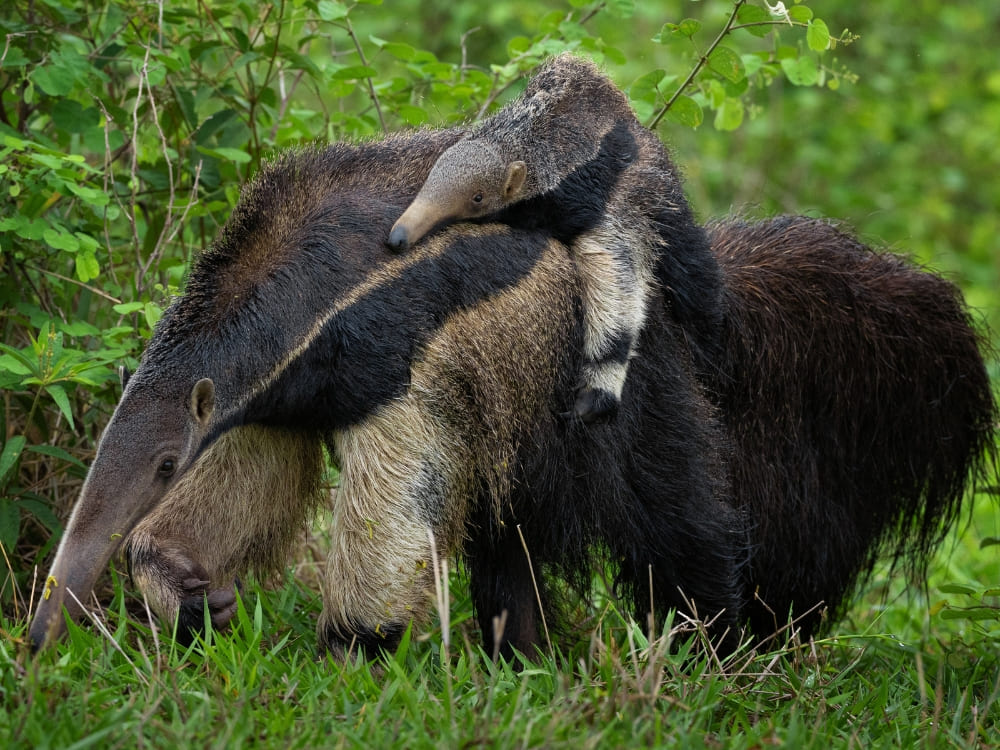
    A giant anteater walks through green grass carrying its baby on its back, showcasing the diverse Pantanal fauna.
    Photo: Keith Ladzinski

    Remember to keep your distance and stay silent in the presence of wild animals, especially predators like jaguars, maned wolves, and caimans. This ensures longer encounters for a deeper appreciation of the Pantanal fauna and, of course, your safety.

    👉 Read more: Where is the best place to see jaguars in the Pantanal?

    8) Watch the road if you’re driving to the Pantanal

    Some travelers decide to take the road to the Pantanal to further enhance the experience. On the North side, you should travel along the Transpantaneira, while the Estrada Parque leads to the South. Both are dirt roads with wooden bridges that tend to get slippery, muddy, and flooded during the rainy season.

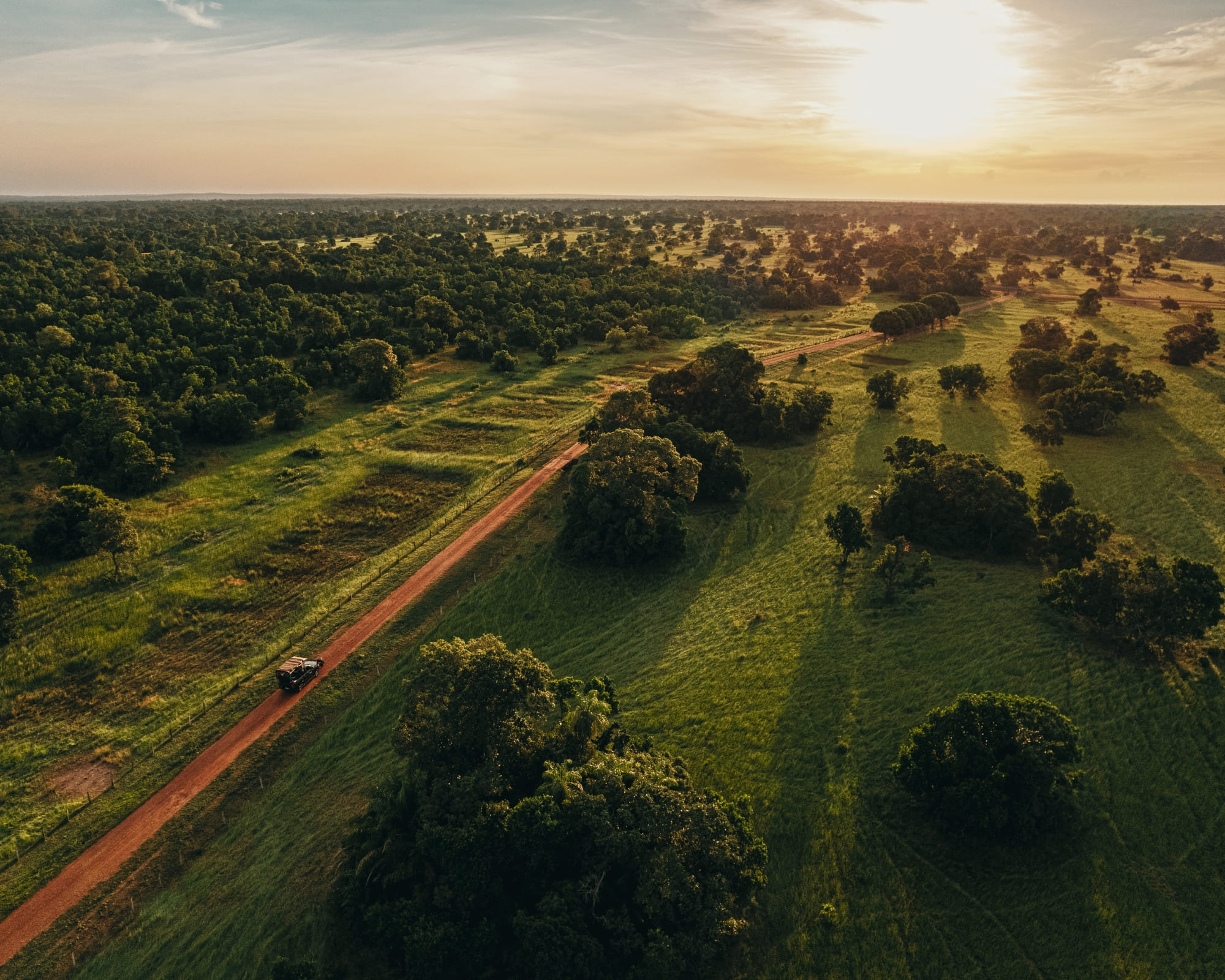
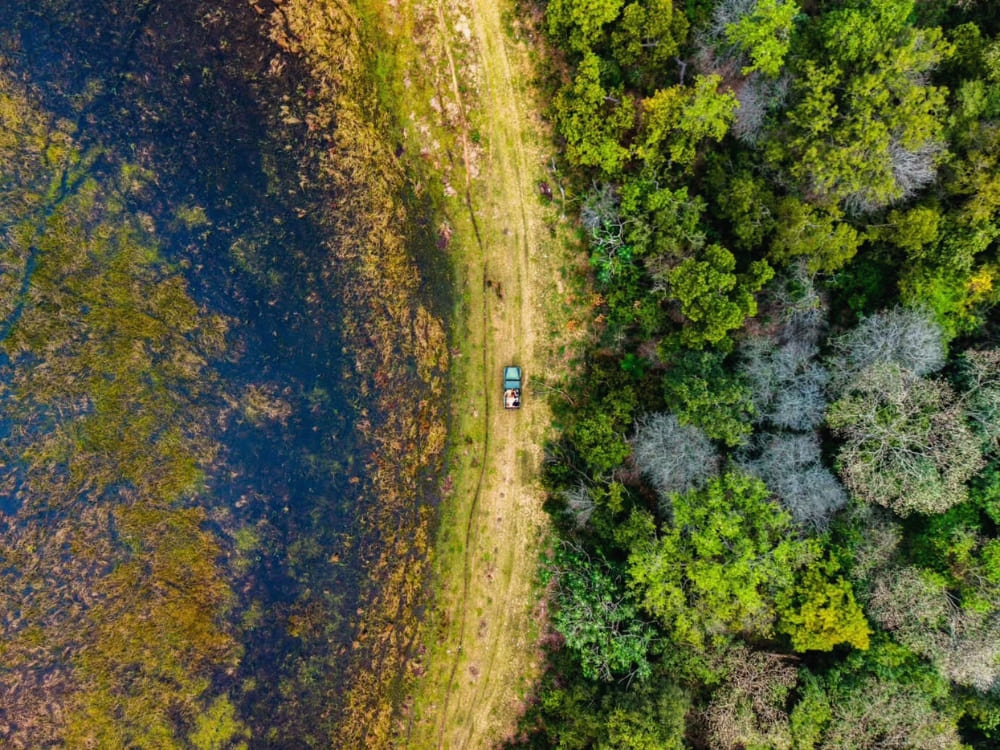
    Aerial view of a 4x4 vehicle driving along a long dirt road surrounded by dense trees and vegetation.
    Photo: Felipe Castellari

    The uneven ground requires 4×4 vehicles. Make sure to fill up your tank in base cities such as Cuiabá, Campo Grande, PoconĂ©, and Miranda. The deeper you get into the wetlands, the rarer gas stations become.

    Finally, avoid driving at night. In addition to low visibility, many animals often cross the roads when the sun sets, which increases the risk of accidents.

    The overall recommendation is that only people who are familiar with the area should get behind the wheel. Booking a transfer service with local operators is the best alternative for your safety and convenience!

    9) Stay in accommodations that respect the environment

    Staying in accommodations that respect and care for the Pantanal is crucial for ecotourism. Fortunately, there are incredible ecolodges that implement responsible practices, like recycling, solar energy, rainwater harvesting, and supporting conservation projects.

    Aerial view of a person standing at the edge of a wooden deck over the water, surrounded by the green flooded areas of the biome.
    Photo: Matias Ternes

    These ecolodges also look out for the community by employing locals, empowering small businesses, and allowing the Pantaneiro culture to flourish.

    👉 Read more: Where to stay in the Pantanal?

    10) Listen to your tour guide

    Your tour guide is your guardian. These highly qualified professionals know the Pantanal like the back of their hands, including the best spots to watch animals, how to capture the perfect shot, and the overall behavior of the biome.

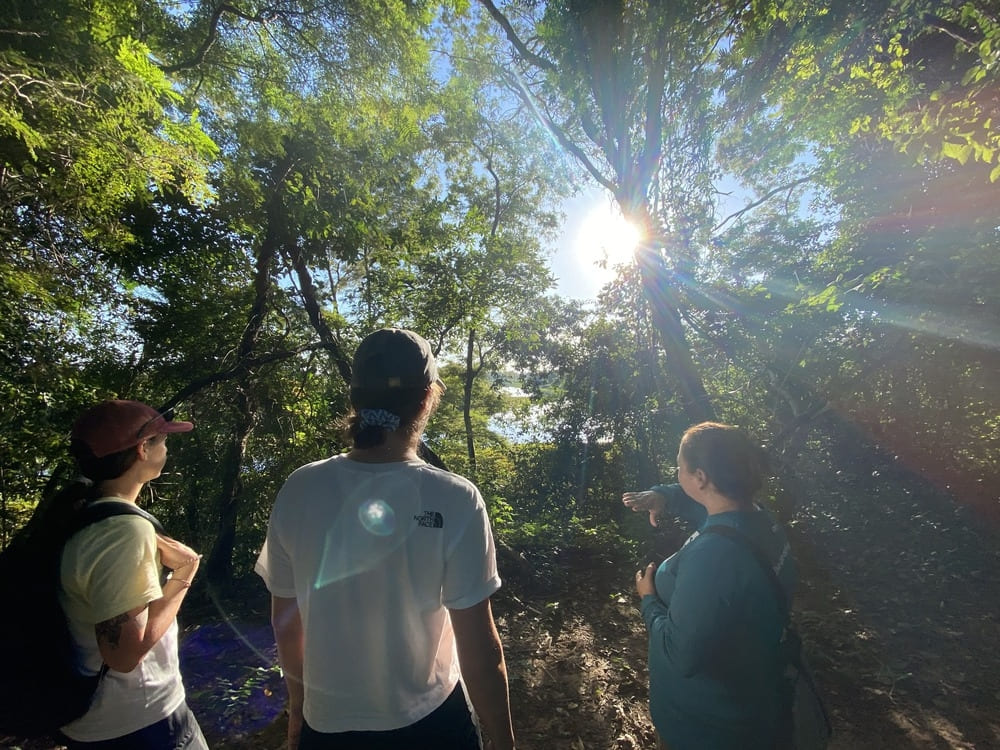
    Two tourists wearing backpacks on an ecological walk point up to observe the tree canopy in a sunlit forest.
    Photo: Felipe Castellari

    Following your guide’s instructions is important for your enjoyment, but also for everyone’s safety—yours, the animals’, and the environment’s.

    Booking with PlanetaEXO is the ultimate Pantanal travel tip

    PlanetaEXO is an ecotourism platform specialized in Pantanal tours that works with the best local operators. Our talented team is here to help with everything you need, from bookings to choosing tailor-made itineraries.

    Positive impact and your dream vacation in one single adventure. Contact us now!

  • How to Visit the Pantanal in Brazil: Travel Guide

    How to Visit the Pantanal in Brazil: Travel Guide

    Are you wondering what the best way to visit the Pantanal is? In this travel guide, you’ll find everything you need to plan your trip to Brazil’s wildlife haven.

    Home to the greatest population of jaguars in the world, and the best wildlife watching destination in Brazil, the Pantanal has hundreds of different species of birds and mammals. Its vast expanse and unique ecosystem offer an unparalleled experience for nature enthusiasts, making it a must-visit place for those seeking adventure and connection with nature.

    As a platform specialized in Pantanal tours that works with the best local operators, PlanetaEXO has put together a comprehensible travel guide with essential information for your trip, such as when is the best time to visit, how to get there, what to do and where to stay. Check it out below!

    Table of contents:

    1. About the Pantanal
    2. Where is the Pantanal?
    3. What is the wildlife like in the Pantanal?
    4. How to get to the Pantanal in Brazil?
    5. When is the best time to visit the Pantanal?
    6. What to do in Pantanal? 
    7. Where to stay in the Pantanal, Brazil?
    8. How many days should I stay in the Pantanal?
    9. What is the best Pantanal safari? 
    10. What should I pack for a Pantanal trip in Brazil?
    11. What makes the Pantanal so special?
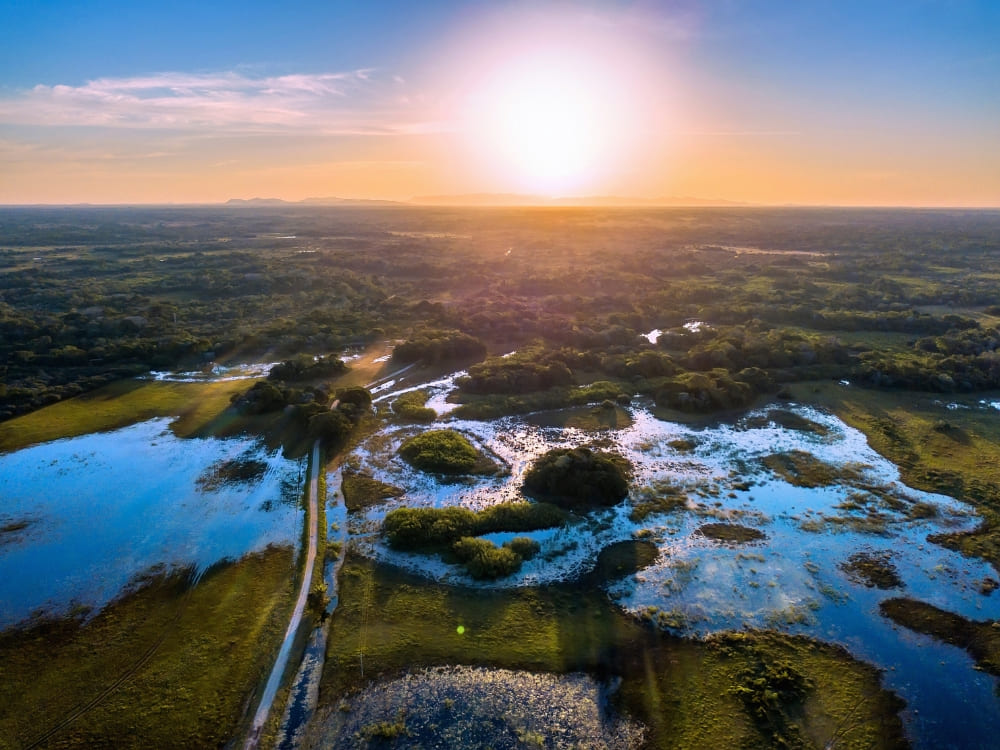
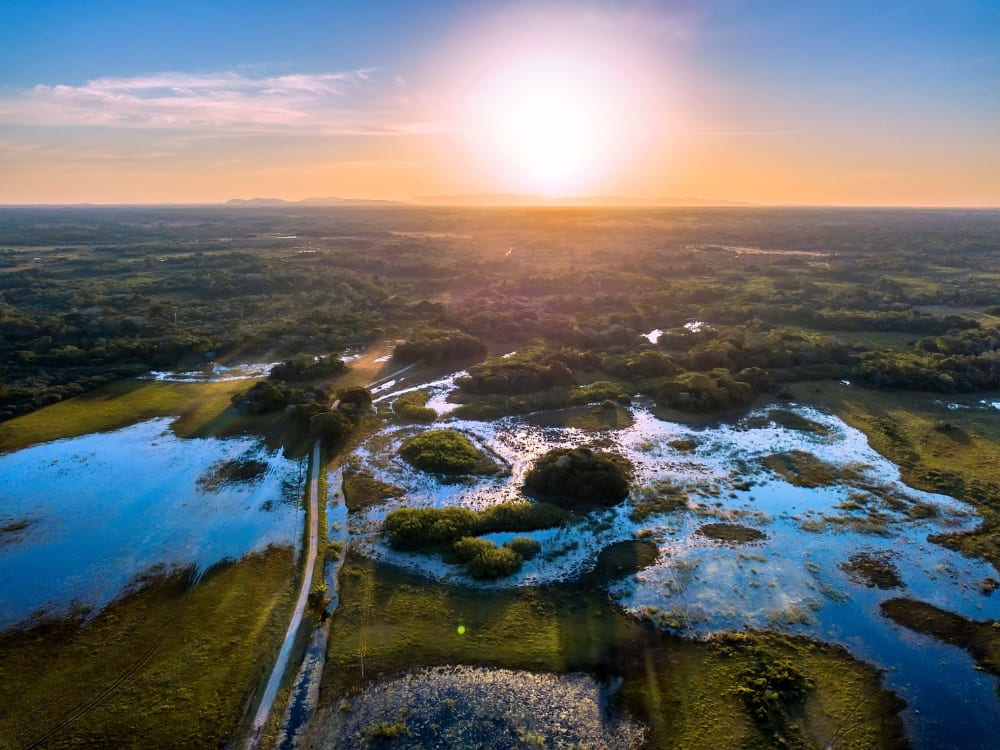
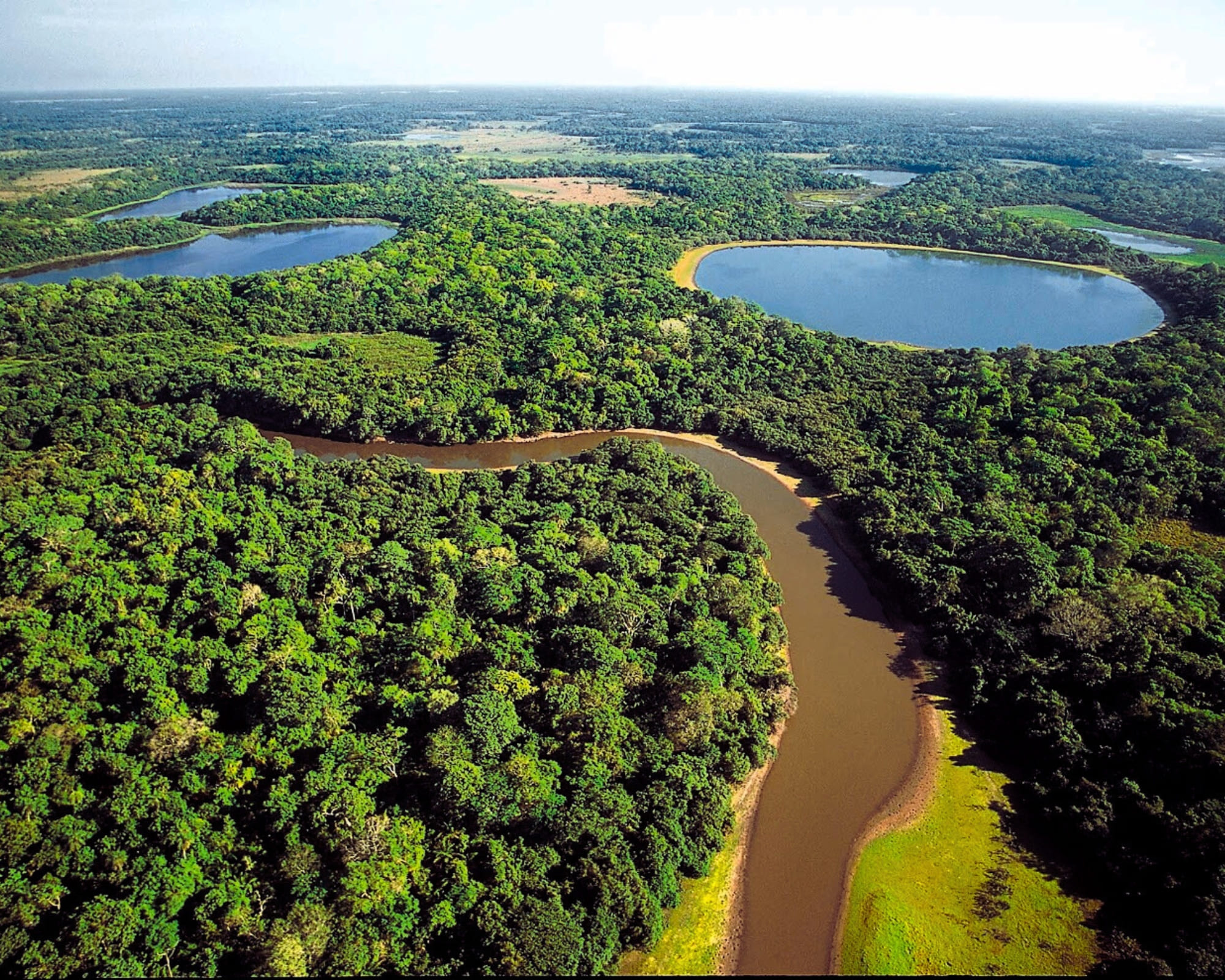
    Panoramic aerial view of flooded plains, winding rivers, and green forests of Pantanal, Brazil under a bright sun.
    .

    About the Pantanal

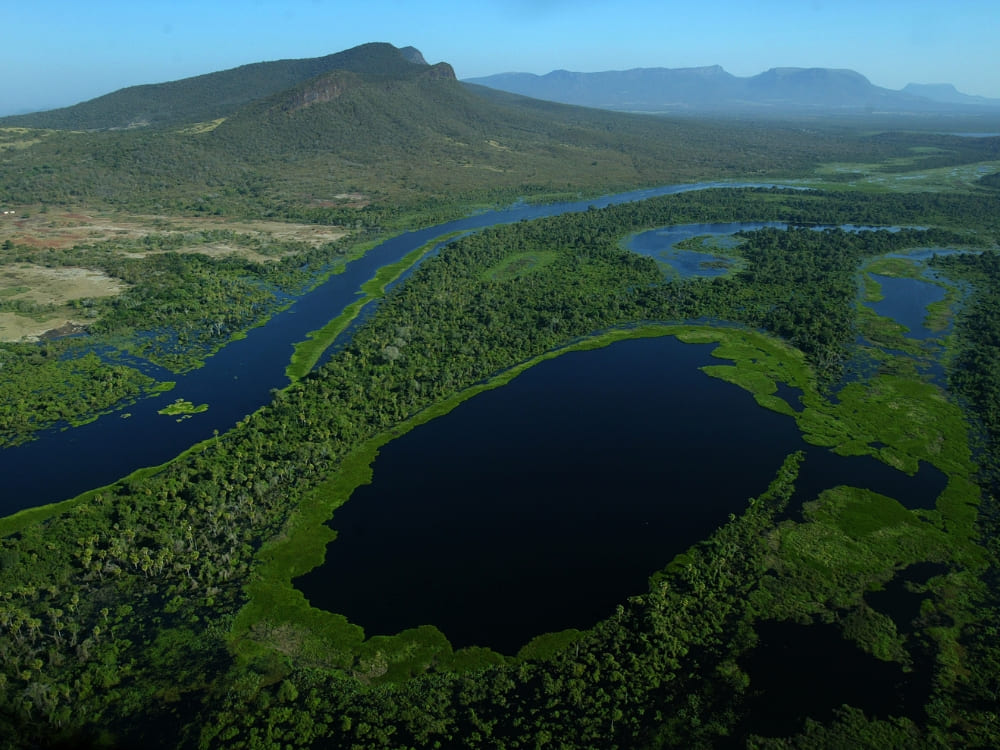
    The largest wetland on the planet and a UNESCO World Heritage site, the Pantanal harmoniously combines fauna, flora and water. Fed by the Paraguay, Cuiabá, Miranda and Taquari rivers, it’s characterized by seasonal flooding and directly influenced by three major Brazilian biomes: Amazon Rainforest, Cerrado and the Atlantic Forest.

    The Pantanal’s rich biodiversity is complemented by its cultural significance, allowing visitors to immerse themselves in the traditional lifestyle of local communities that have coexisted with this ecosystem for generations.

    Economically, the Pantanal thrives on fishing activities, tourism, and cattle farming, all with a strong commitment to conservation. Over the years, efforts to educate locals and tourists about the socioeconomic benefits of preserving the biome have been successful, fostering a balanced, imperative relationship between wildlife and human activities. 
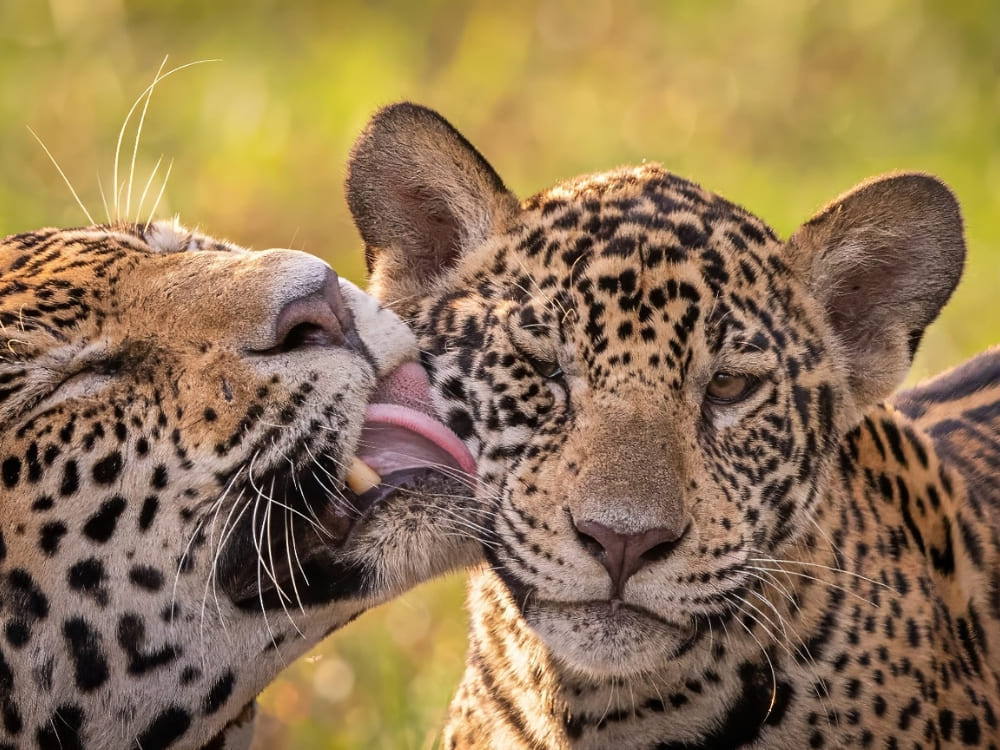
    Close-up of an adult jaguar licking and grooming a cub in the wild, showcasing the rich biodiversity of Pantanal, Brazil.
    @matthias_kern_photography

    👉 Read more: 10 facts about the Pantanal

    Where is the Pantanal?

    The Pantanal is so massive it extends itself across Brazil, Bolivia and Paraguay, but most of its territory is located within Brazilian borders, in the states of Mato Grosso and Mato Grosso do Sul.

    Divided by Northern and Southern Pantanal, the biome spans over 210,000 square kilometers — only a bit smaller than the entire territory of Guyana (214,969 km²)!

    What is the wildlife like in the Pantanal?

    Despite being often overshadowed by the Amazon, the Pantanal hosts the continent’s highest concentration of wildlife. It’s a haven for wildlife observers and photographers, boasting around 325 species of fish, 656 birds, 159 mammals, 53 amphibians and 98 reptiles.

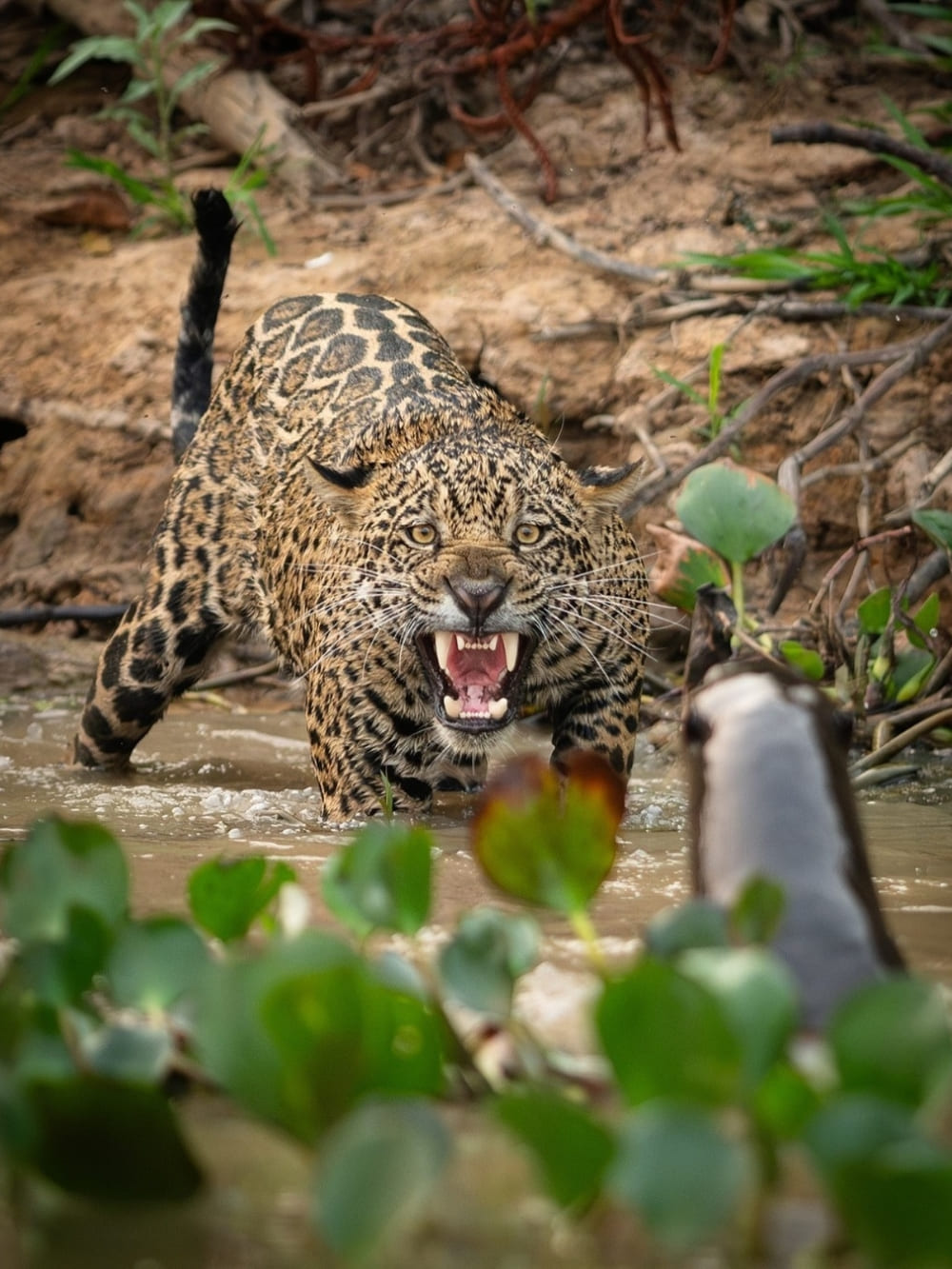
    Jaguars are the stars of Brazilian wetlands, but other native animals are often spotted roaming around, like capybaras, giant otters, jabiru storks, mash deer and the mysterious maned wolf. 
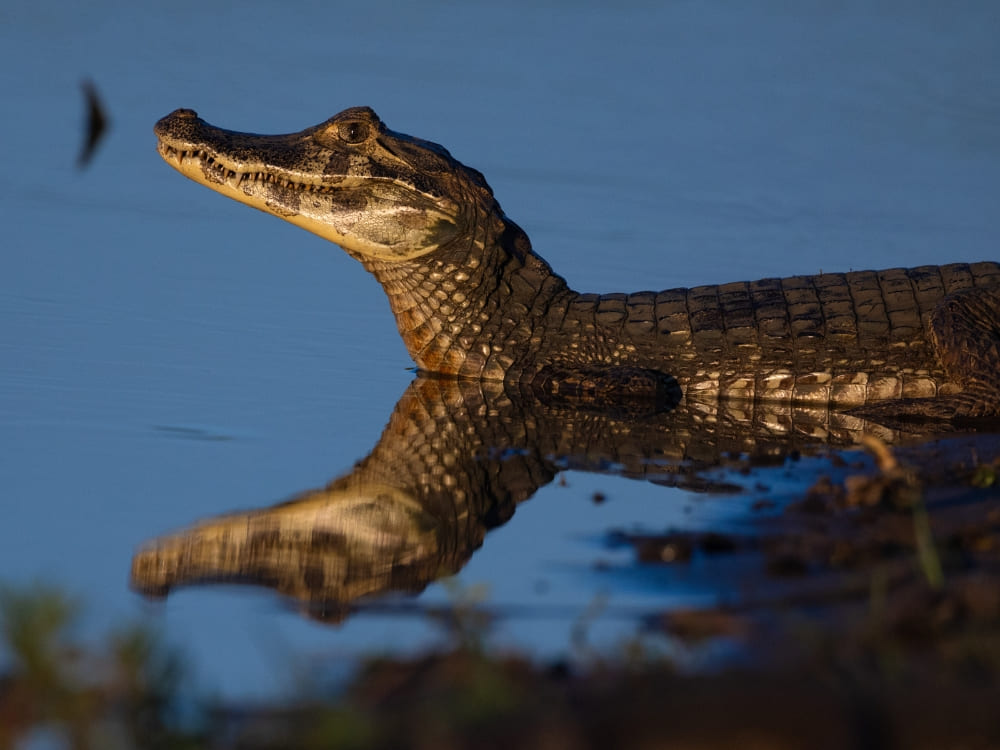
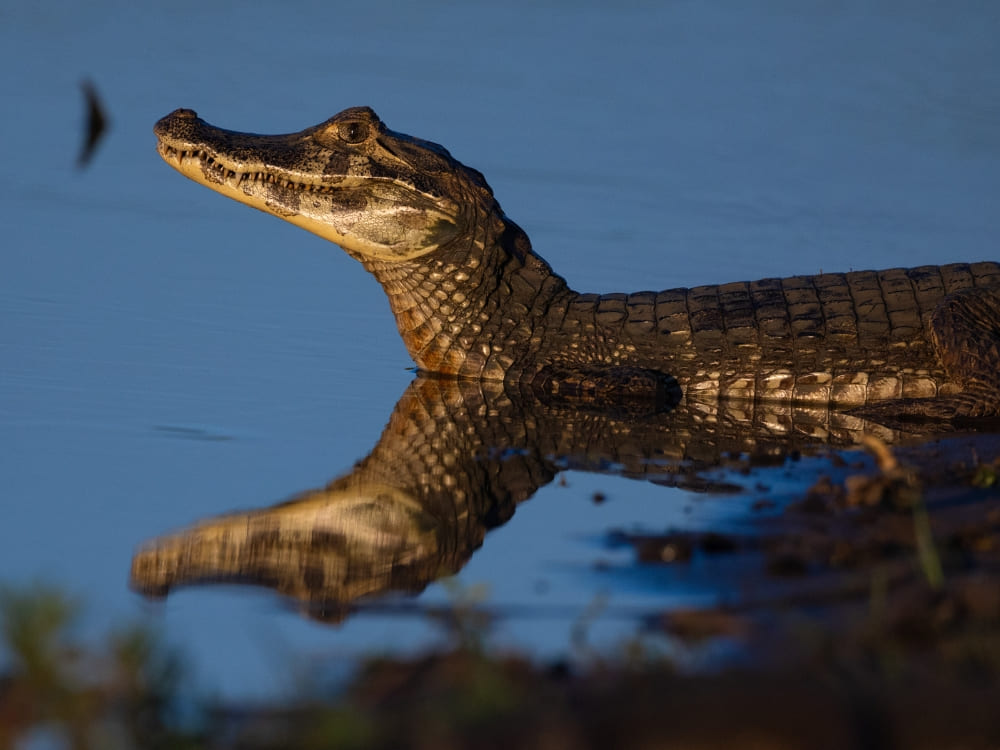
    A caiman resting in calm water with its head reflected on the surface during a boat trip in Pantanal, Brazil.
    Photo: Keith Ladzinski, Caiman

    👉 Read more:

    How to get to the Pantanal in Brazil?

    When planning your trip, it’s important to understand if you’re going to the North or South Pantanal. Naturally, different routes should be considered.

    For adventurers exploring the Northern Pantanal, the gateway is Cuiabá, capital of Mato Grosso, accessible via Marechal Rondon International Airport (CGB) and served by direct flights from Brazilian capitals (São Paulo, Rio de Janeiro, Belo Horizonte, Brasília, etc). If you’re going to Porto Jofre via Poconé, the journey continues along the Transpantaneira Highway.

    Campo Grande, capital of Mato Grosso do Sul, is the starting point for traveling to Aquidauana, Miranda, and Corumbá — cities that surround the Southern Pantanal. Campo Grande International Airport (CGR) offers direct flights from São Paulo, Rio, Campinas, Brasília, etc.
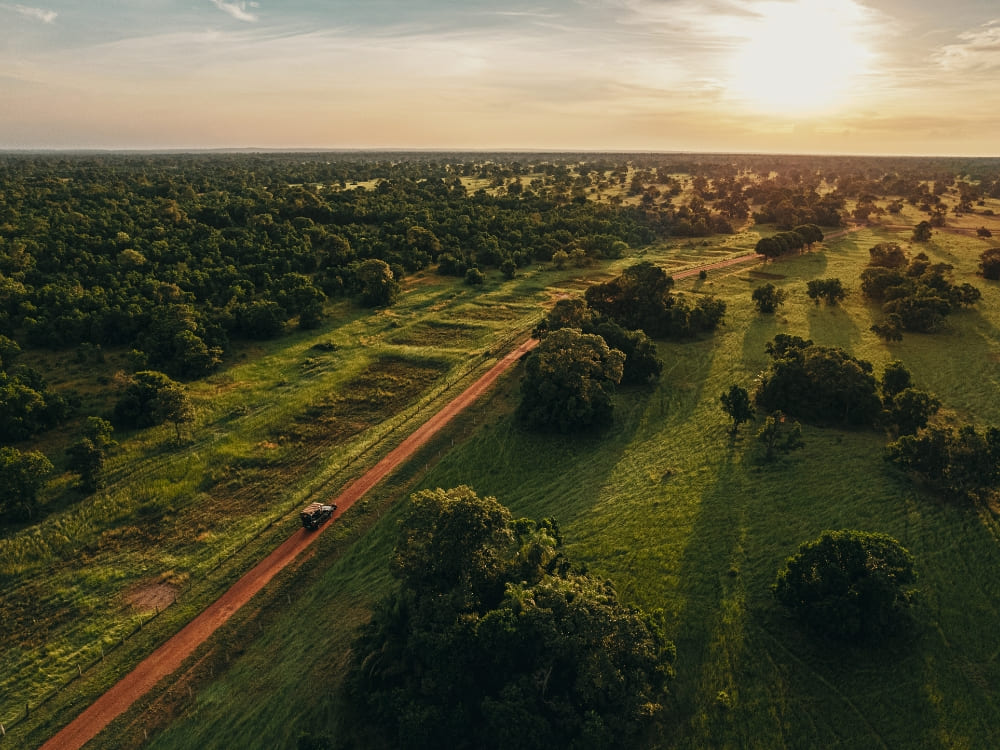
    A 4x4 safari vehicle driving along a dirt road through the lush wetlands of Pantanal, Brazil.
    Photo: Felipe Castellari, Caiman

    👉 See more details: How to get to the Pantanal, Brazil

    When is the best time to visit the Pantanal?

    The Pantanal is a year-round destination. Each season has its own unique charm and opportunities for exploration.

    The rainy season (November to December) turns the vegetation into a vibrant green, while the wet season (December to March) is known for the plain floods and river overflows — perfect for boat tours and birdwatching. 

    During the intermediate season (April to June), the water levels start to drop, making it a great time for the fauna. The dry season (July to October) is even better for wildlife watching, as well as horseback riding and hiking.
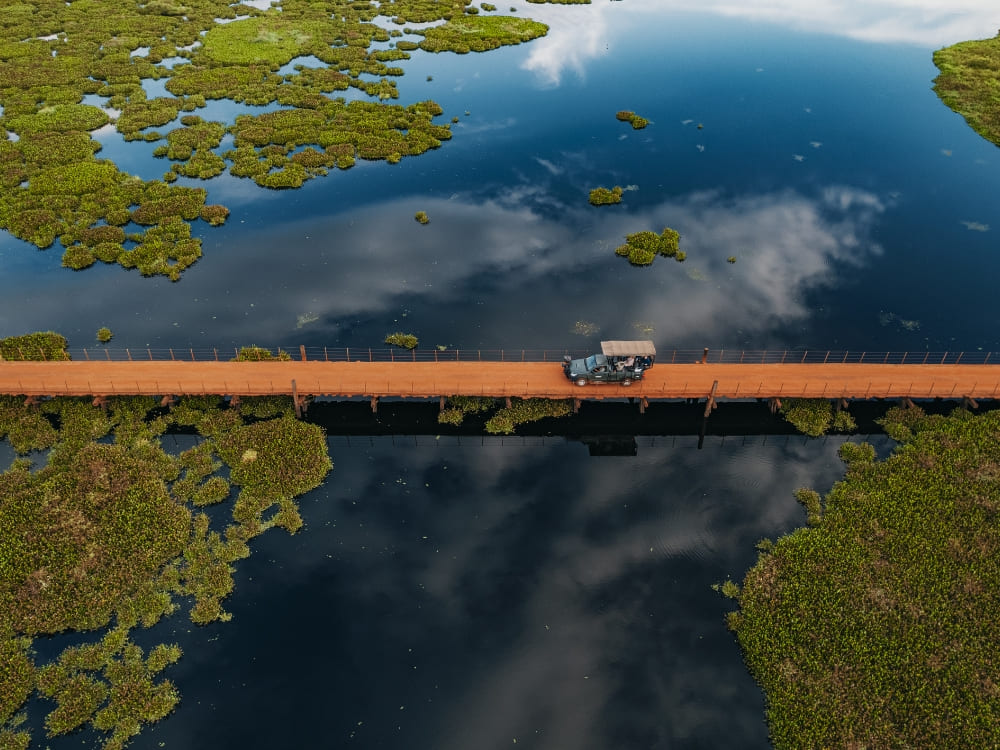
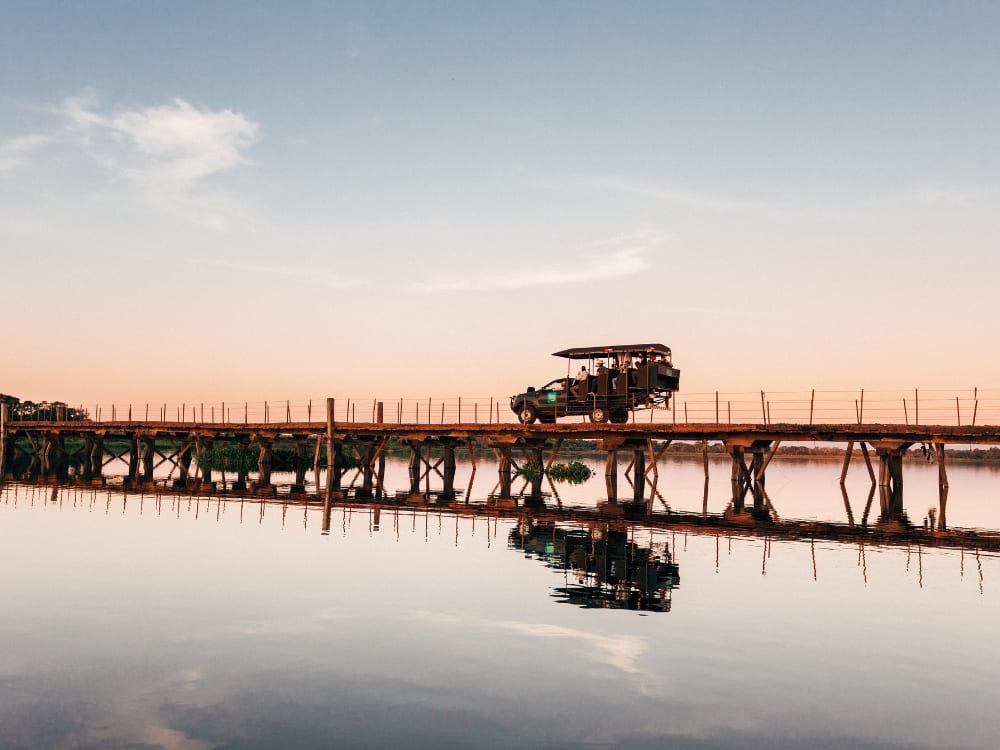
    An aerial view of a safari vehicle crossing a long wooden bridge over the flooded wetlands during a Pantanal safari in Brazil.
    Photo: Felipe Castellari, Caiman

    👉 See more details: When is the best time to visit the Pantanal?

    What to do in the Pantanal? 

    Pantanal experiences are as abundant as the biome itself. See the main activities below!

    Horseback riding

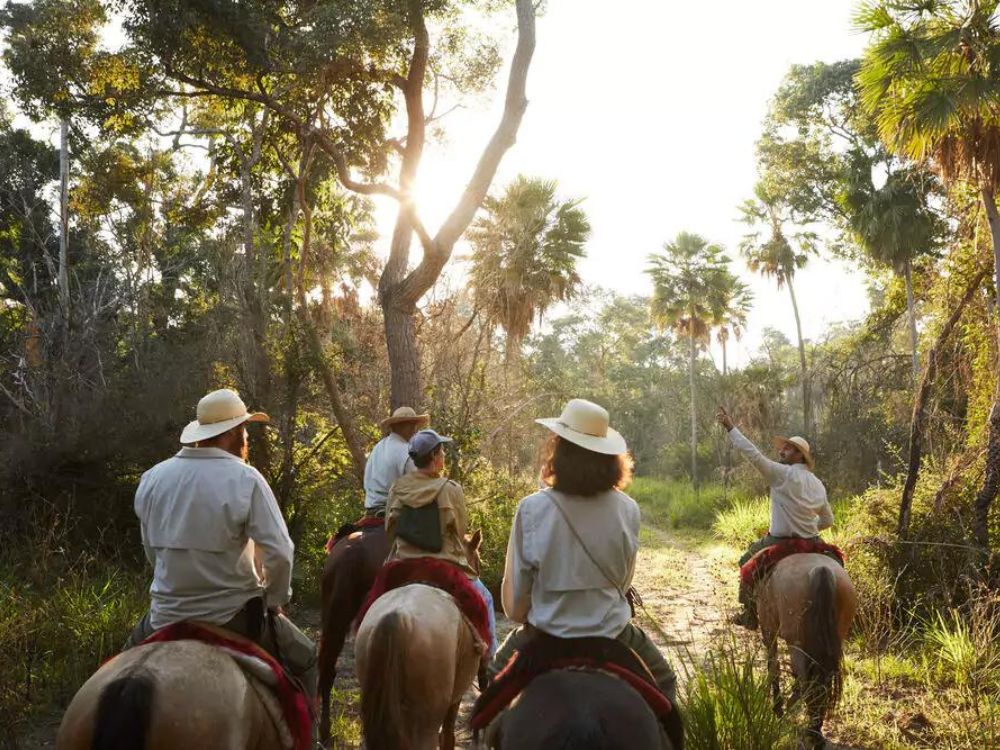
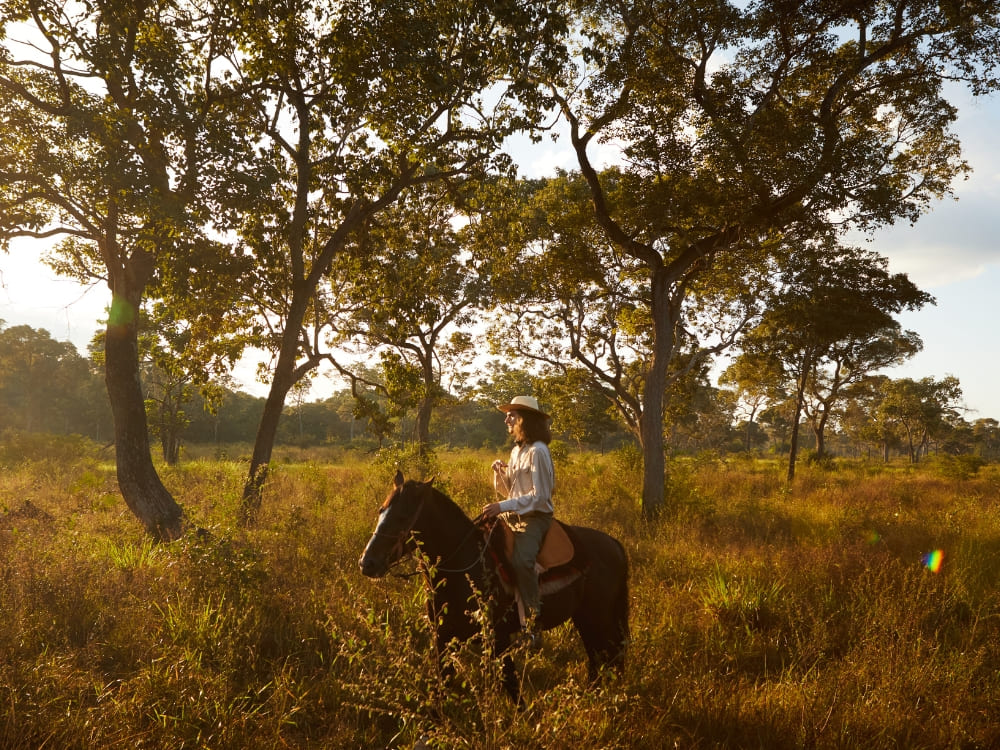
    Horseback riding is a traditional way of exploring, allowing visitors to cross flooded areas and access hard-to-reach places. That’s how you dive deep into the true Pantanal lifestyle!
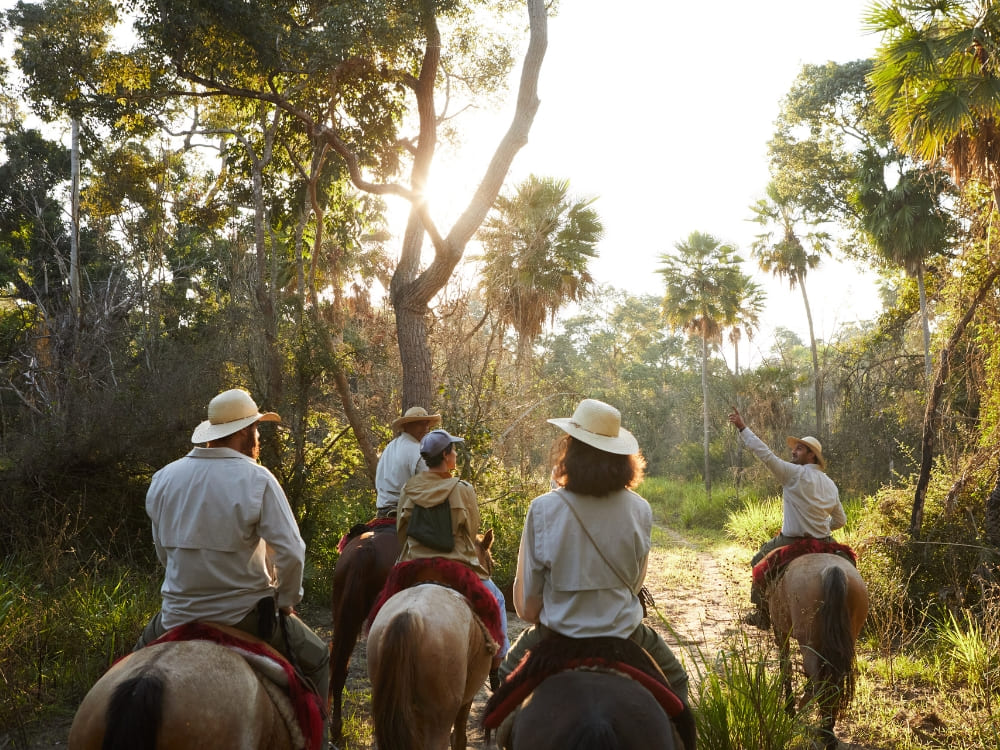
    A group of travelers on horseback led by a guide through a sunlit forest trail in the Pantanal.
    Photo: Layla Motta, Caiman

    Jaguar sighting

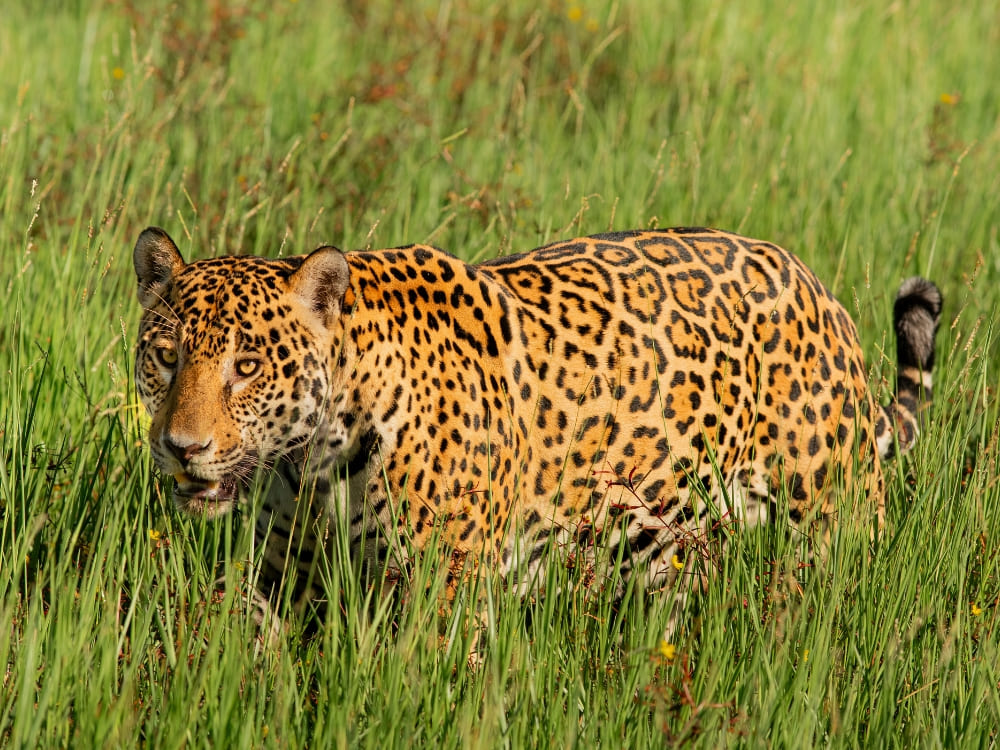
    The Pantanal is the best place in the world to see jaguars in their natural habitat. In the Northern Pantanal, particularly around Porto Jofre, jaguar sightings are frequent along the banks of the Cuiabá River. Most lodges offer boat safaris that provide excellent opportunities to observe and photograph the largest feline of the Americas.

    Spotting jaguars in South Pantanal is less likely, but definitely not impossible. Casa Caiman, in Miranda, is the only place in the area where these animals can be seen.
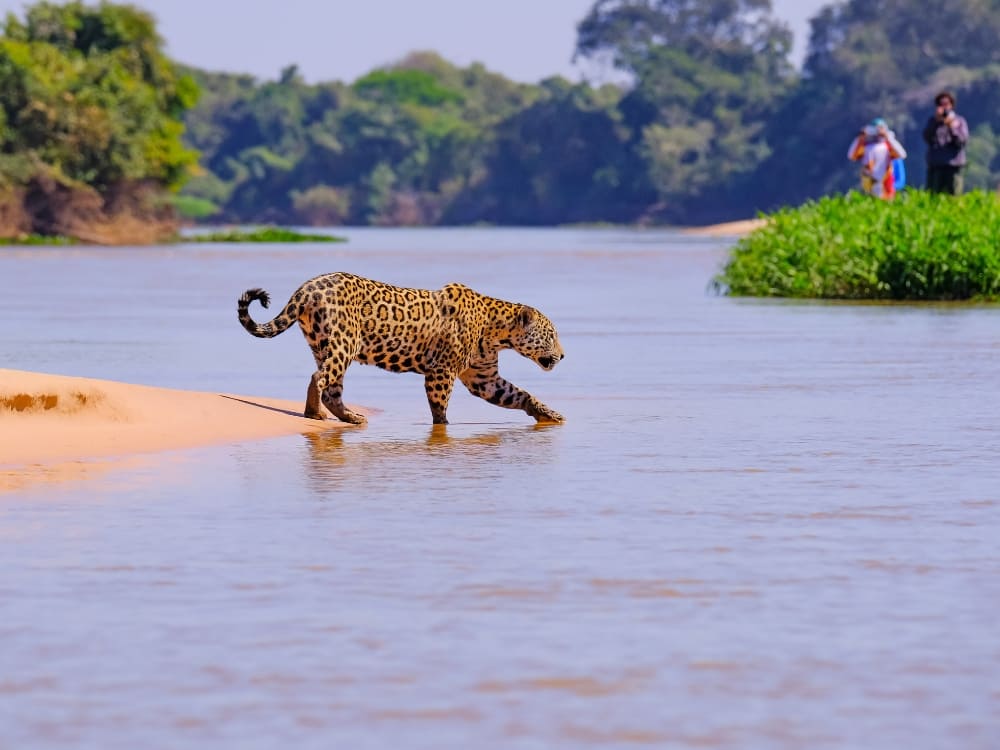
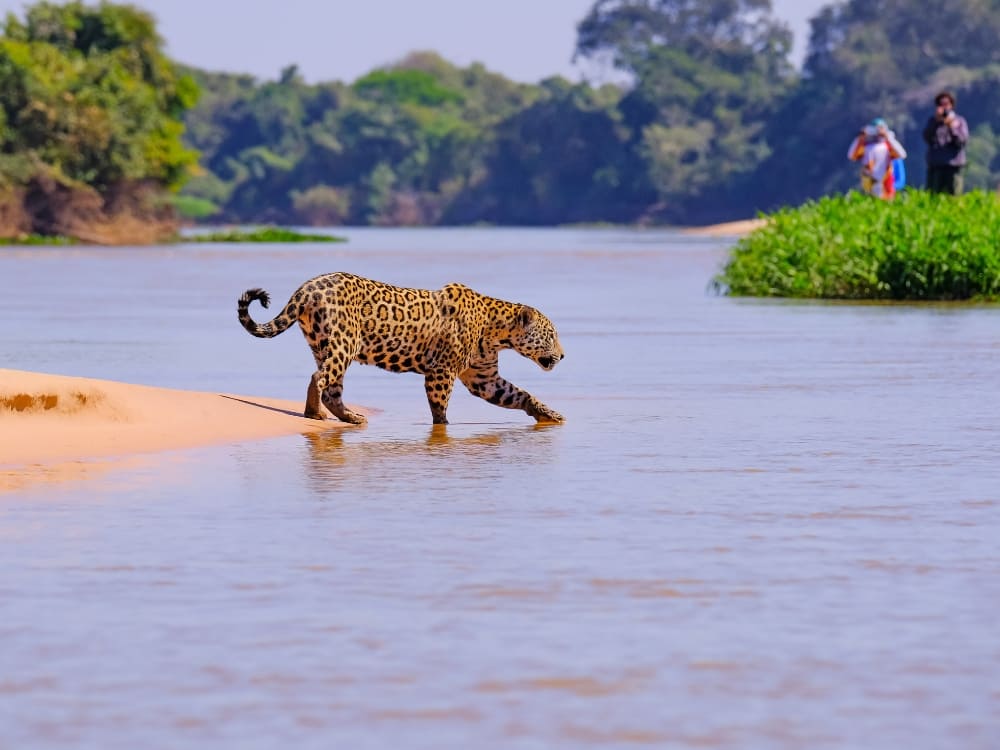
    A wild jaguar walking into the river from a sandbank with observers in the distance in Pantanal, Brazil.
    .

    Photo safaris

    Pantanal photo safaris are conducted in 4×4 vehicles, which allow visitors to explore diverse landscapes and capture stunning images of the wildlife, while also enabling access to remote areas. Naturally, this increases the chances of encountering rare species and getting close-up shots of the biome’s rich biodiversity.

    To guarantee the best shots, photo safaris are led by experienced guides who know the perfect spots to photograph birds, reptiles, and mammals.
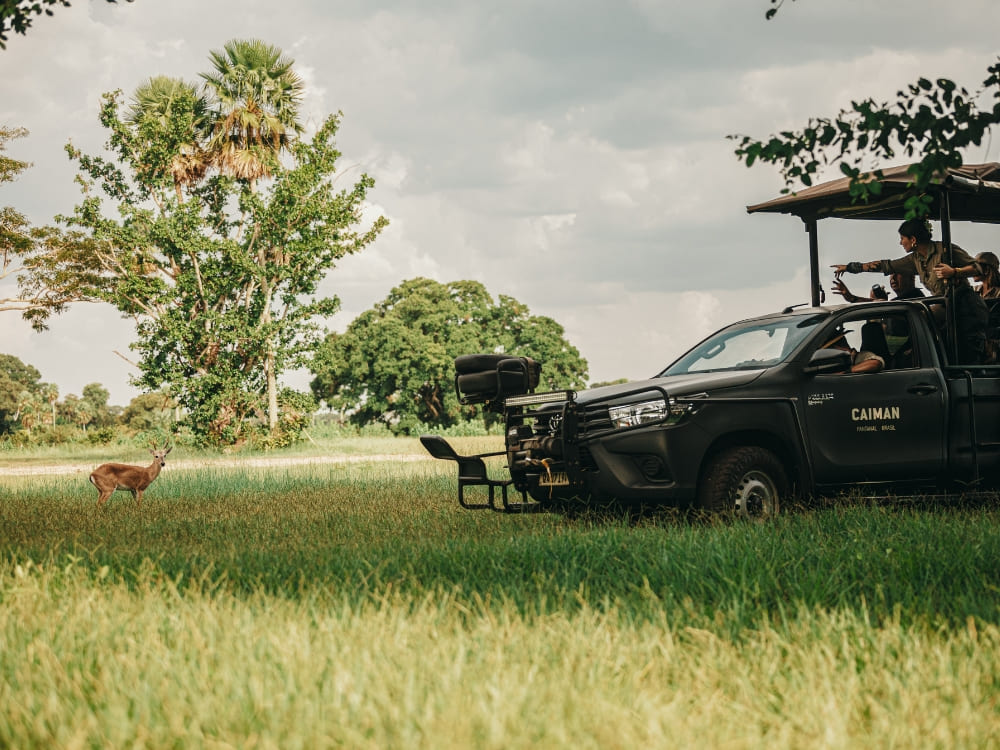
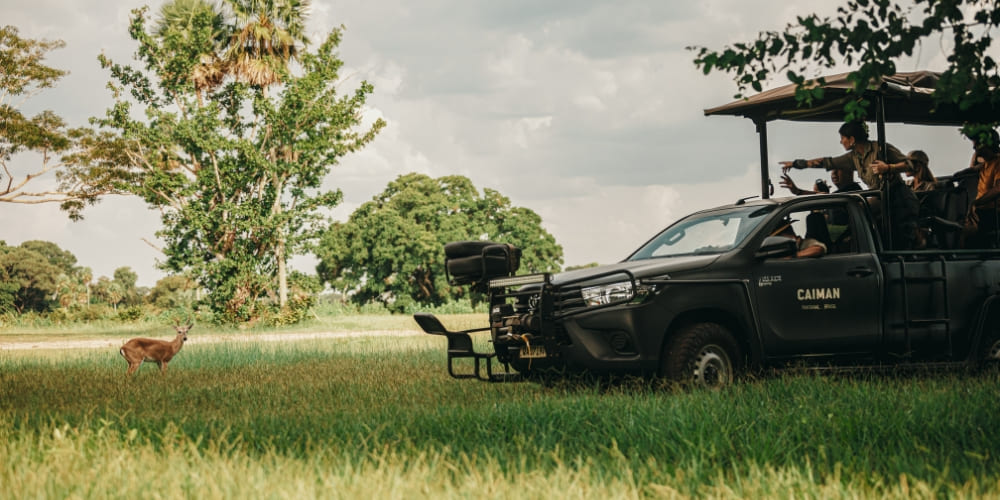
    Travelers in a branded 4x4 safari vehicle observing a marsh deer in a grassy field in Pantanal, Brazil.
    Photo: Felipe Castellari, Caiman

    Boat trips

    Boat trips are incredible options to observe the wildlife from the water. As you navigate the rivers, you can spot a wide variety of Pantanal animals, including capybaras, caimans, giant otters, and numerous bird species. 
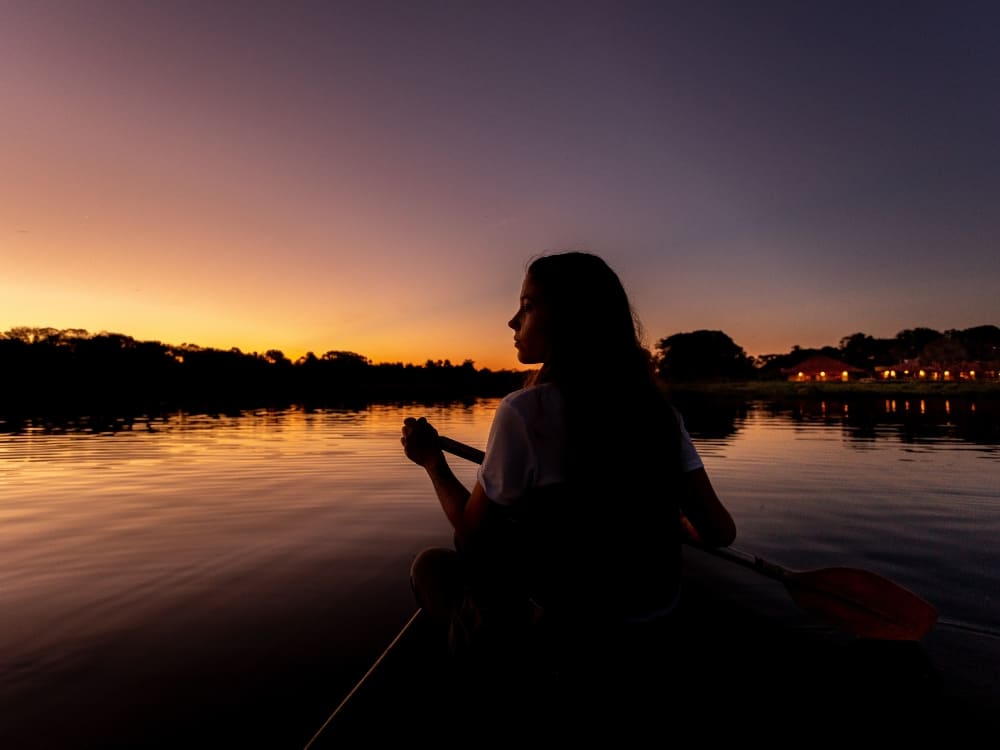
    A woman paddling a canoe on a calm river at sunset, highlighting the peaceful nature of a Pantanal trip.
    Photo: Felipe Castellari, Caiman

    Night spotlighting

    When night falls, tour guides take visitors to the wetlands to watch nocturnal animals, like owls and caimans. Using spotlights and flashlights, experiencing the Pantanal come alive at night is unforgettable, as many species are more active and easier to see under the cover of darkness.
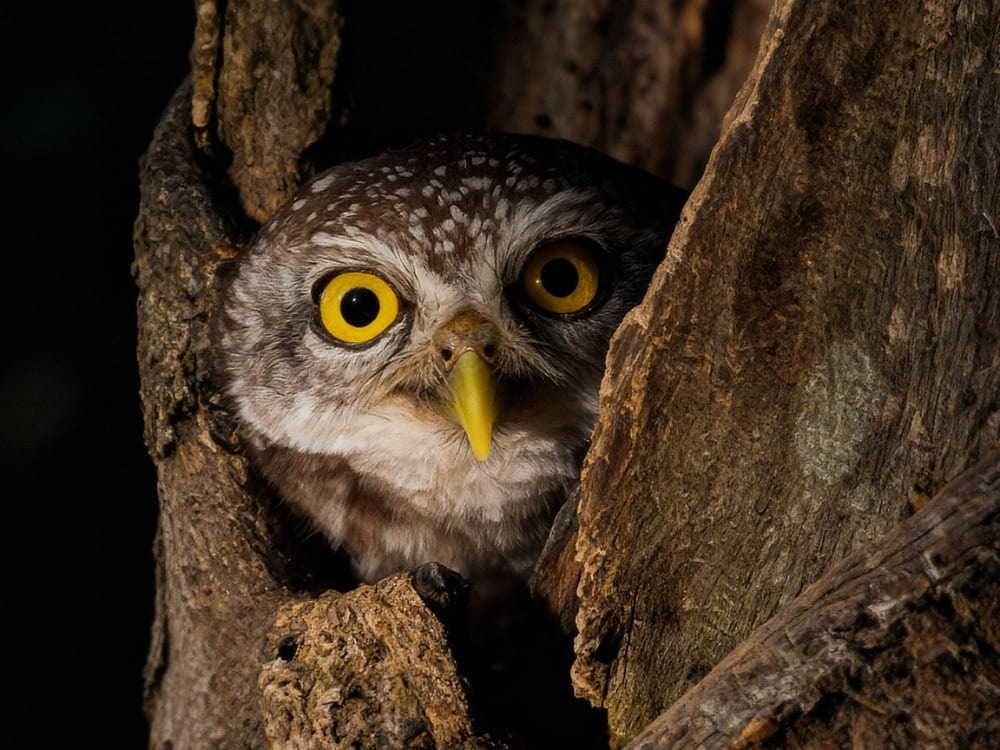
    Close-up of a small owl peering from a tree hollow during a night spotlighting tour in Pantanal, Brazil.
    @allecgomes.jpg

    Ecological walks

    Ecological walks across the Pantanal are guided hikes that allow visitors to discover the area’s flora and fauna on foot. These walks are led by seasoned guides who share insights about the ecosystem, plant species, and animal behaviors.
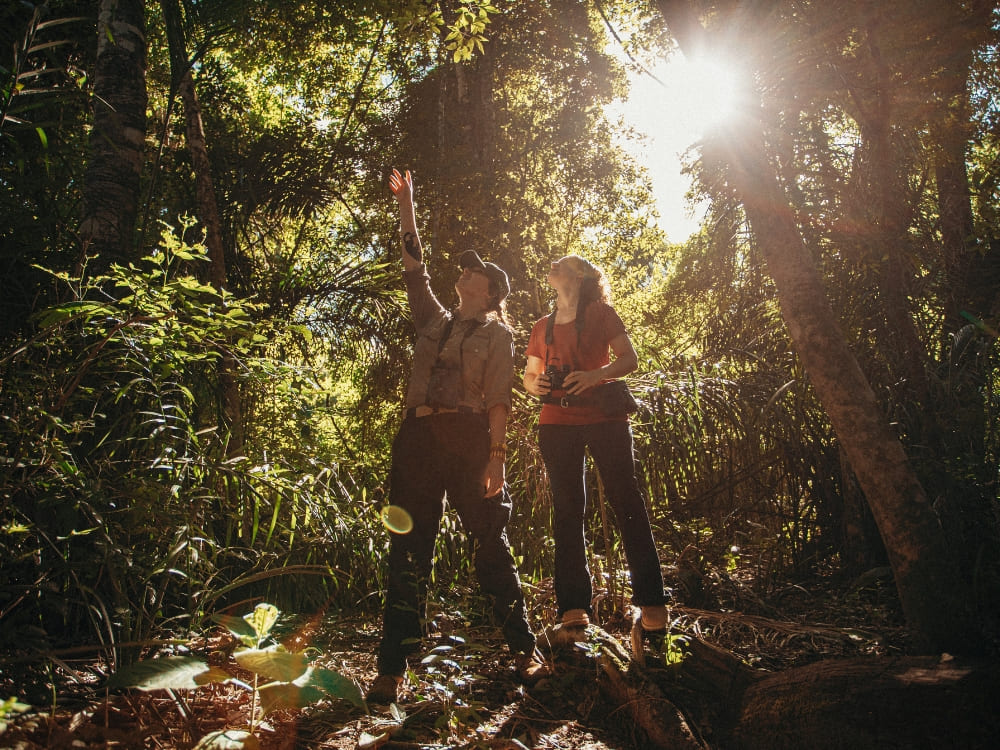
    Two hikers looking up and pointing at the forest canopy during a guided ecological walk in the Pantanal.
    Photo: Felipe Castellari, Caiman

    👉 Check our Pantanal tours and enjoy these incredible experiences!

    Where to stay in the Pantanal, Brazil?

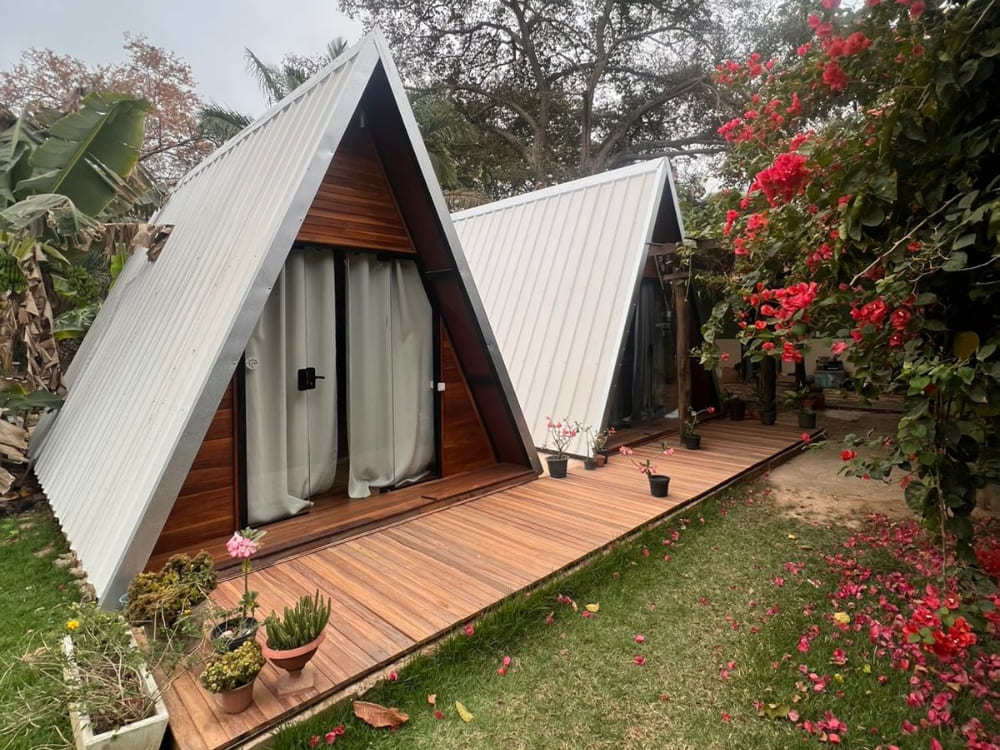
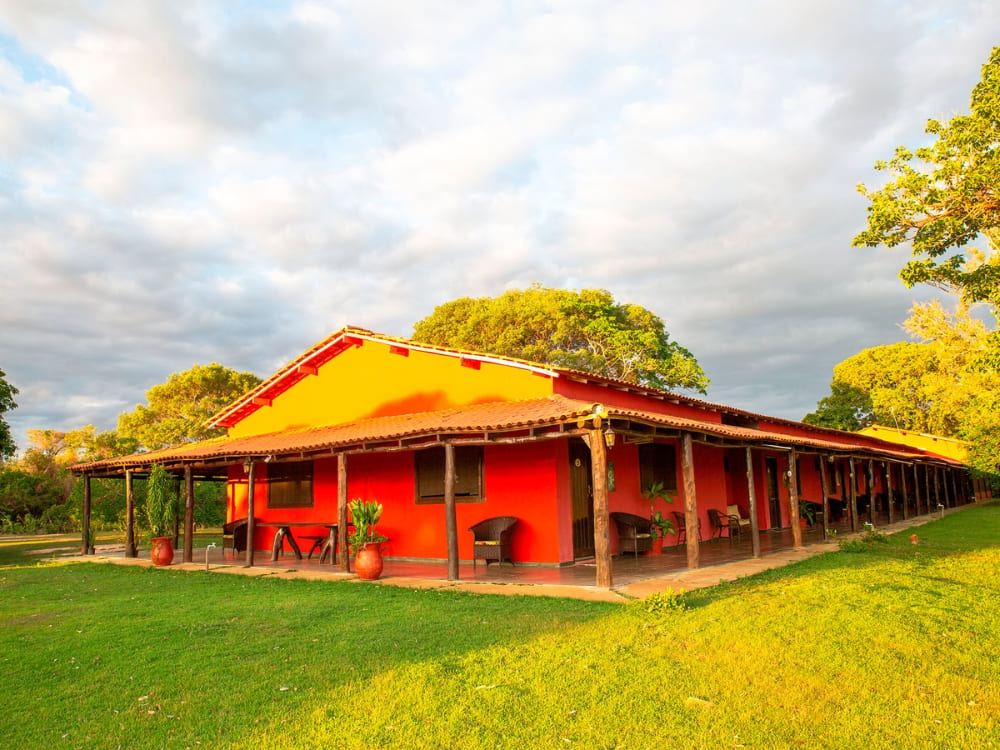
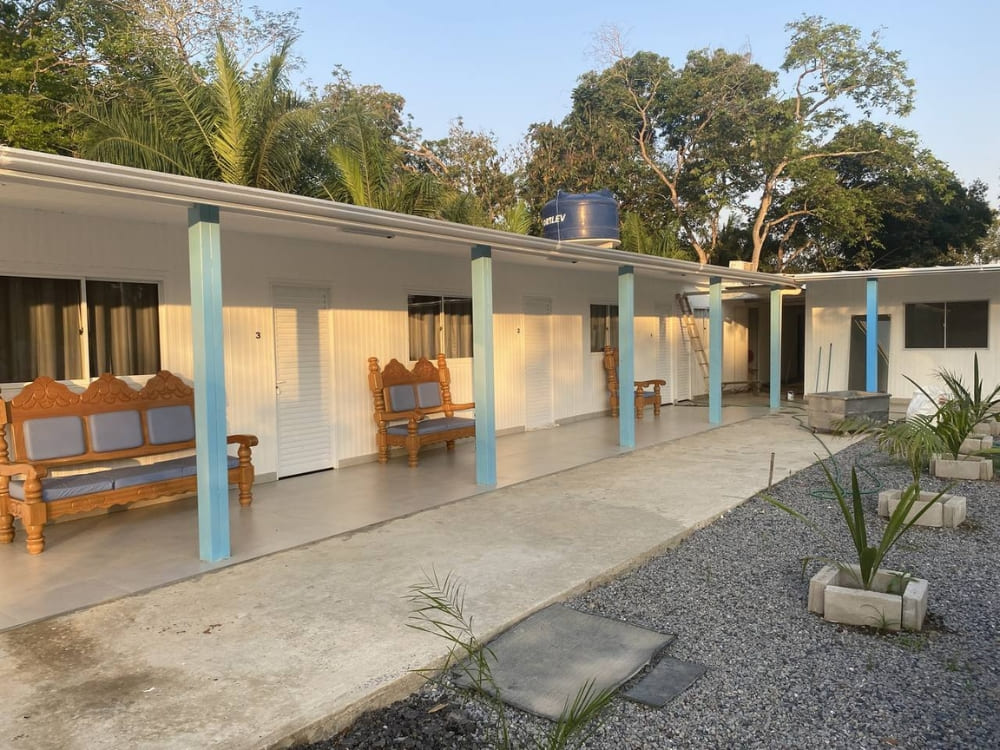
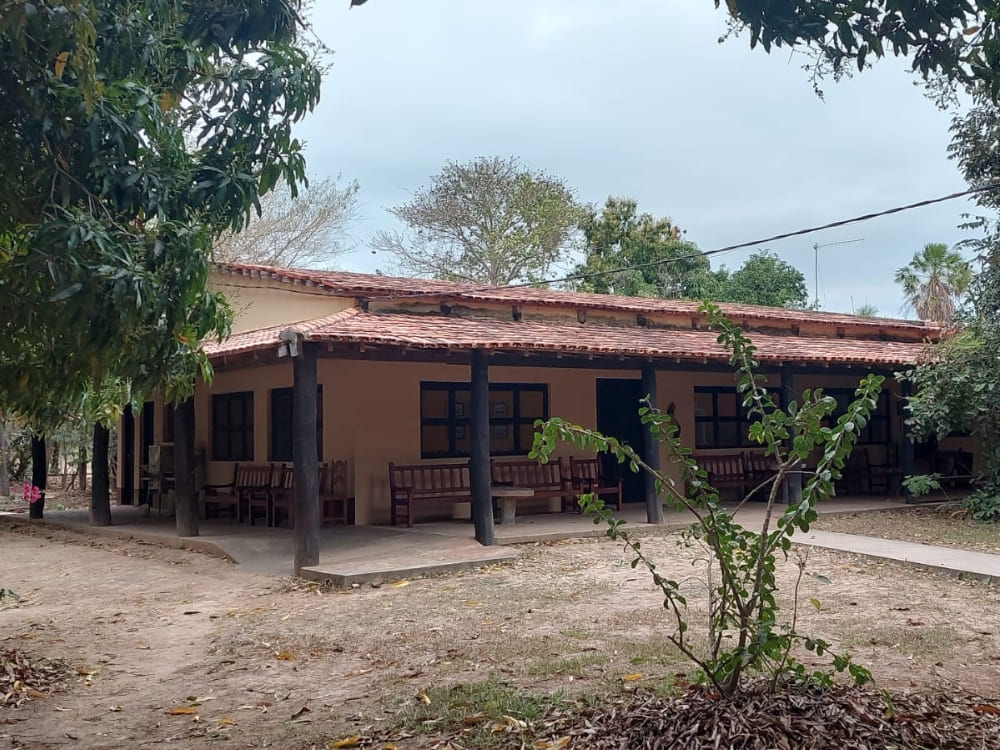
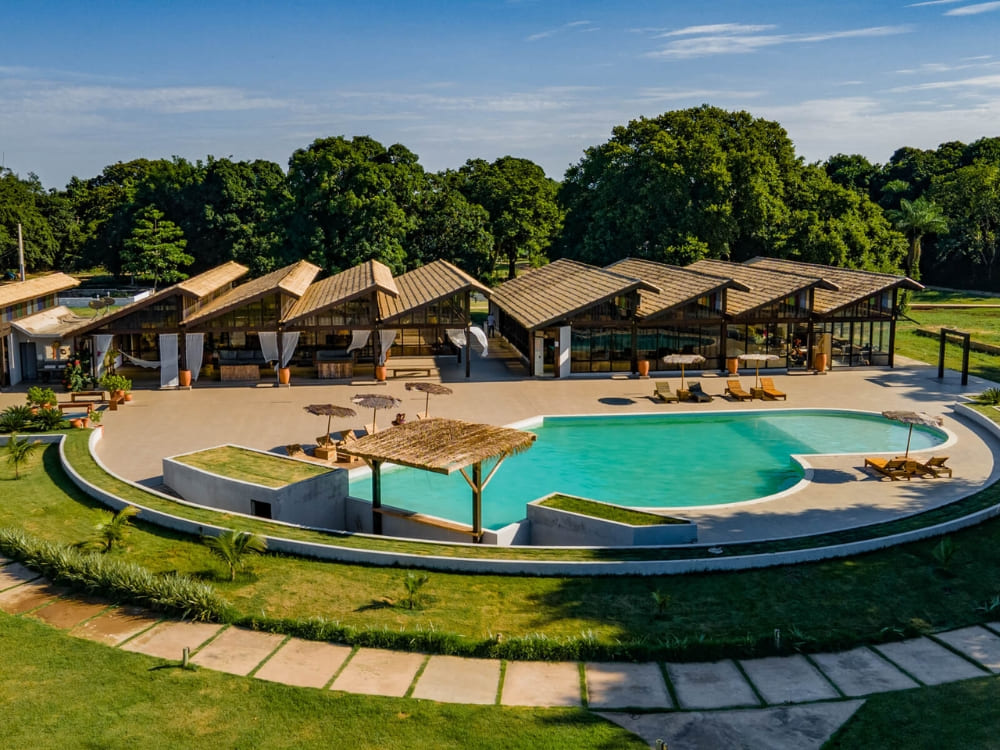
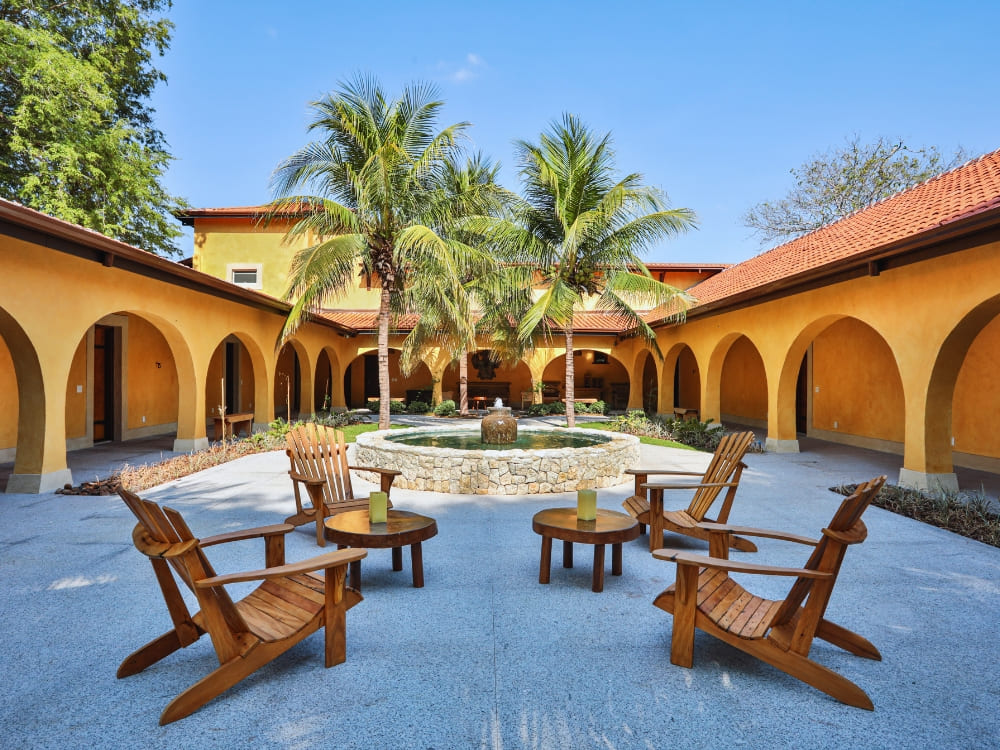
    In general, the accommodations in the Pantanal are typically found on traditional farms that have been transformed into conservation areas due to ecotourism efforts. This provides an authentic taste of the Pantaneiro lifestyle while you enjoy a wonderful stay experience with delicious meals, comfortable rooms and premium services.

    If you’re heading to Northern Pantanal, book your stay in Porto Jofre, Poconé, Barão de Melgaço or Cáceres. You’ll find simple, yet cozy accommodations with a charming rustic style that reflects directly into local day-to-day life.

    Miranda, Aquidauana and Corumbá, in Southern Pantanal, have a great variety of accommodations, from modest to luxury. Regardless of the category, they all combine hospitality, comfortable facilities and sustainability.
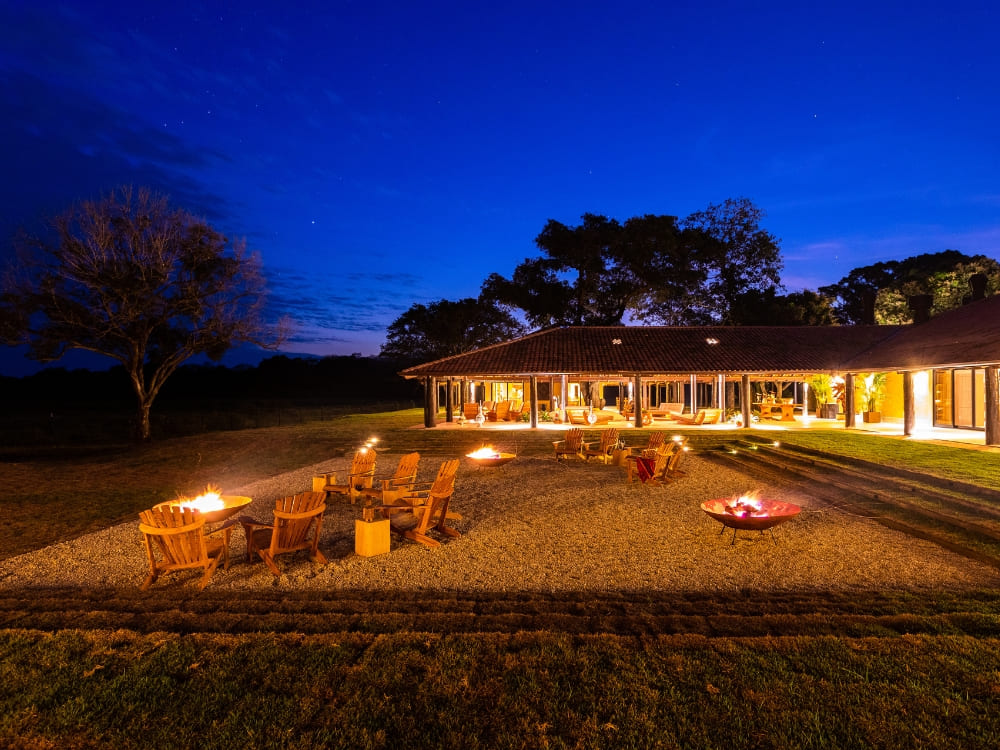
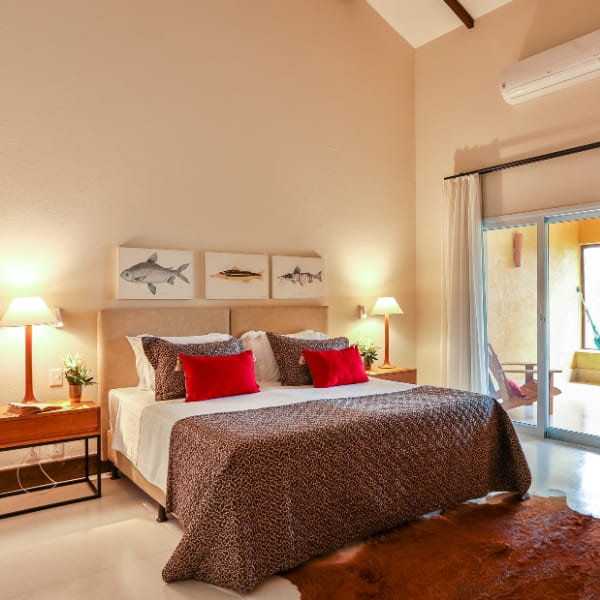
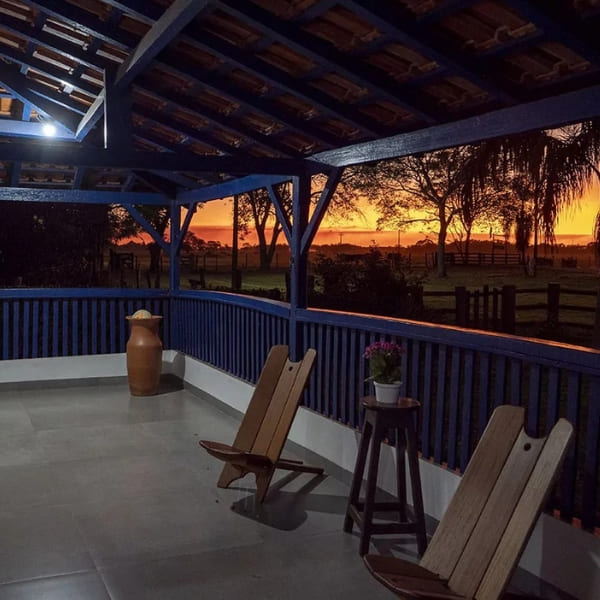
    The exterior lounge of Casa Caiman at night, featuring fire pits and wooden chairs under a deep blue starry sky.
    Photo: Felipe Castellari, Caiman

    👉 Read more: Where to stay in the Pantanal?

    How many days should I stay in the Pantanal?

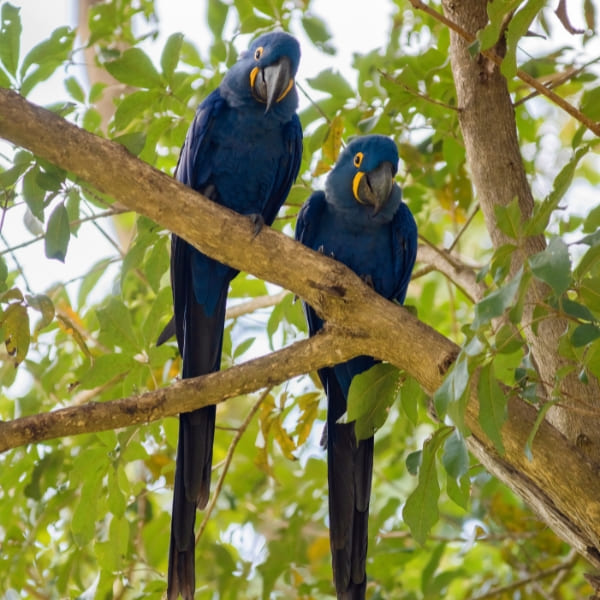
    You need at least 4 days to truly enjoy the richness of the Pantanal with safaris at sunrise and sunset, explore different habitats, and increase your chances of seeing species like jaguars, giant otters, hyacinth macaws, capybaras, etc.

    By staying 5 days or more, you’ll have the opportunity to visit more remote regions, join specialized activities (jaguar tracking, birdwatching expeditions, photography-focused tours), and engage more closely with local conservation projects.

    Don’t forget: reaching one of the biome’s gateway towns requires a considerable amount of time on the road due to the distances involved, so be prepared to set aside at least 3 hours. The drive itself is a mini-adventure that offers great opportunities for wildlife spotting. Enjoy this journey as a part of your Pantanal trip!
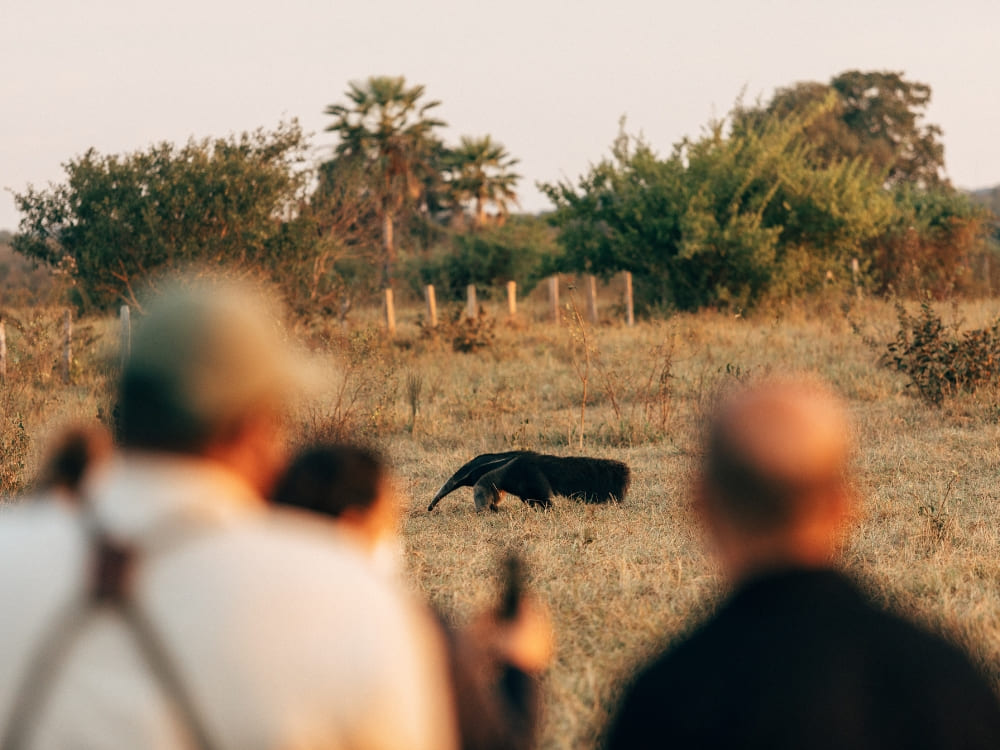
    Travelers observing a giant anteater foraging in an open field during a Pantanal trip at dusk.
    Photo: Felipe Castellari, Caiman

    👉 See more details: How many days should you spend in the Pantanal?

    What is the best Pantanal safari? 

    When choosing your Pantanal safari, several factors come into play: type of wildlife, comfort level, preferred activities and budget.

    The Northern Pantanal, especially around Porto Jofre, is perfect for wildlife watching. Boat safaris often sail across Cuiabá River in search for jaguars and other native species. Check it out: Pantanal Jaguar Safari in Porto Jofre, Cuiabá.

    Alternatively, the Southern Pantanal also offers remarkable safari experiences. If you have a larger budget, the best option is the ecological refuge for jaguars, notable for its conservation and education efforts that help sustain local wildlife and promote eco-friendly tourism.

    This is also the only place in the South that guarantees a 98% chance of jaguar sightings while also providing luxury accommodations. Check it out: Pantanal Luxury Safari.

    For those on a limited budget, there are other options for safaris in the Southern Pantanal, including Pantanal tours from Campo Grande. Adventures like this provide an incredible wildlife viewing experience with horseback riding, boat tours, jeep safaris, and ecological walks. Accommodations are simple, yet incredibly cozy.
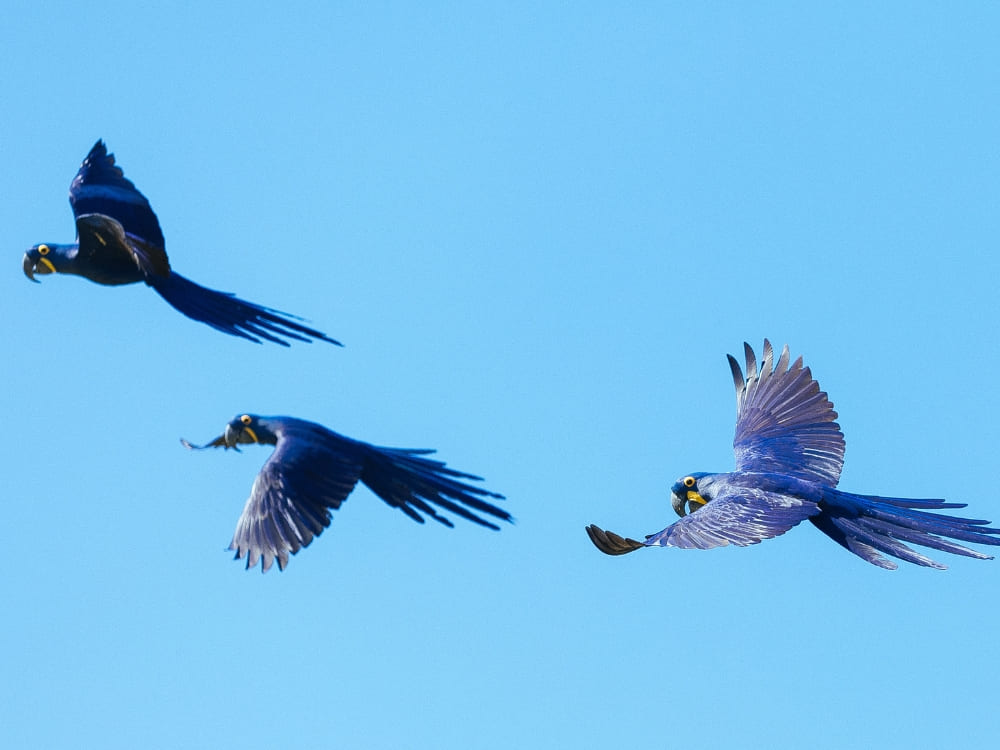
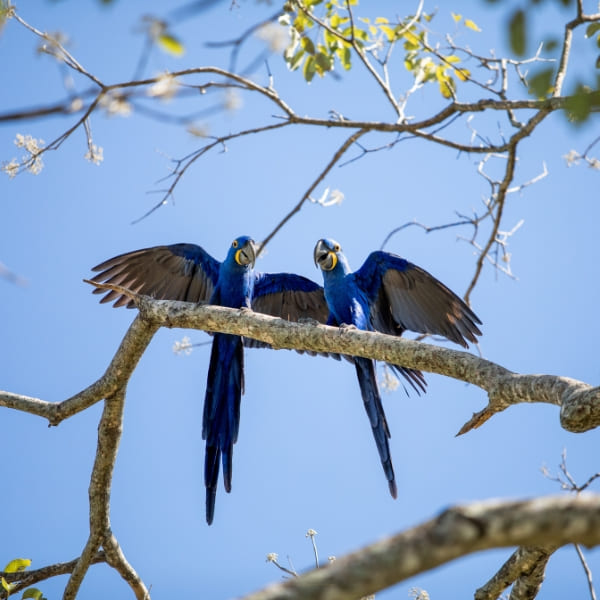
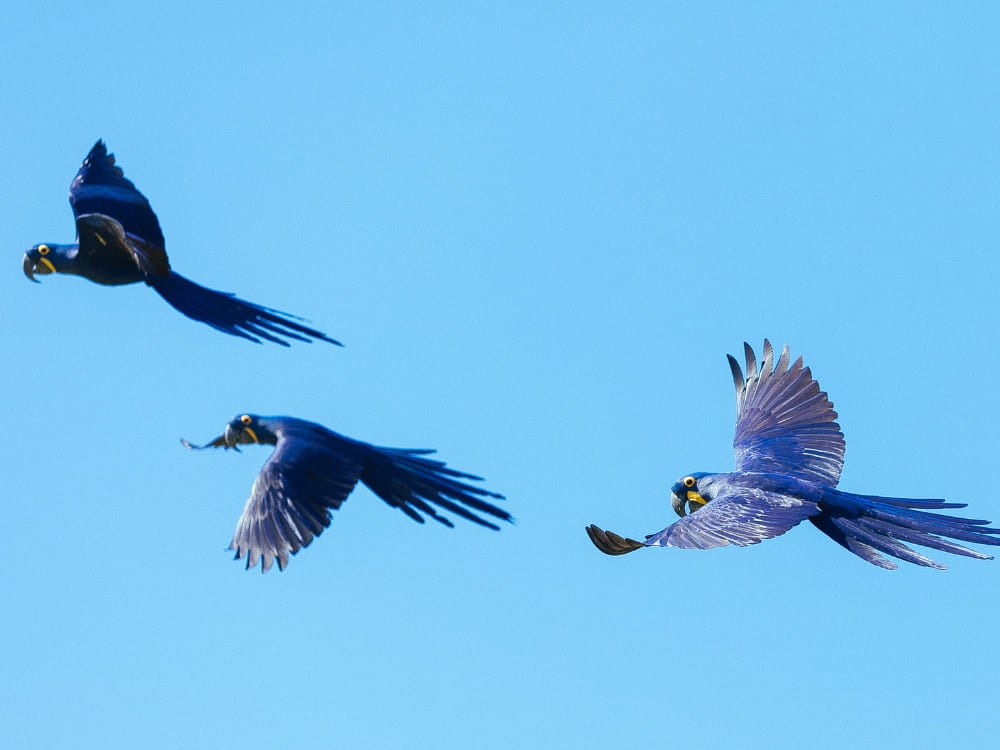
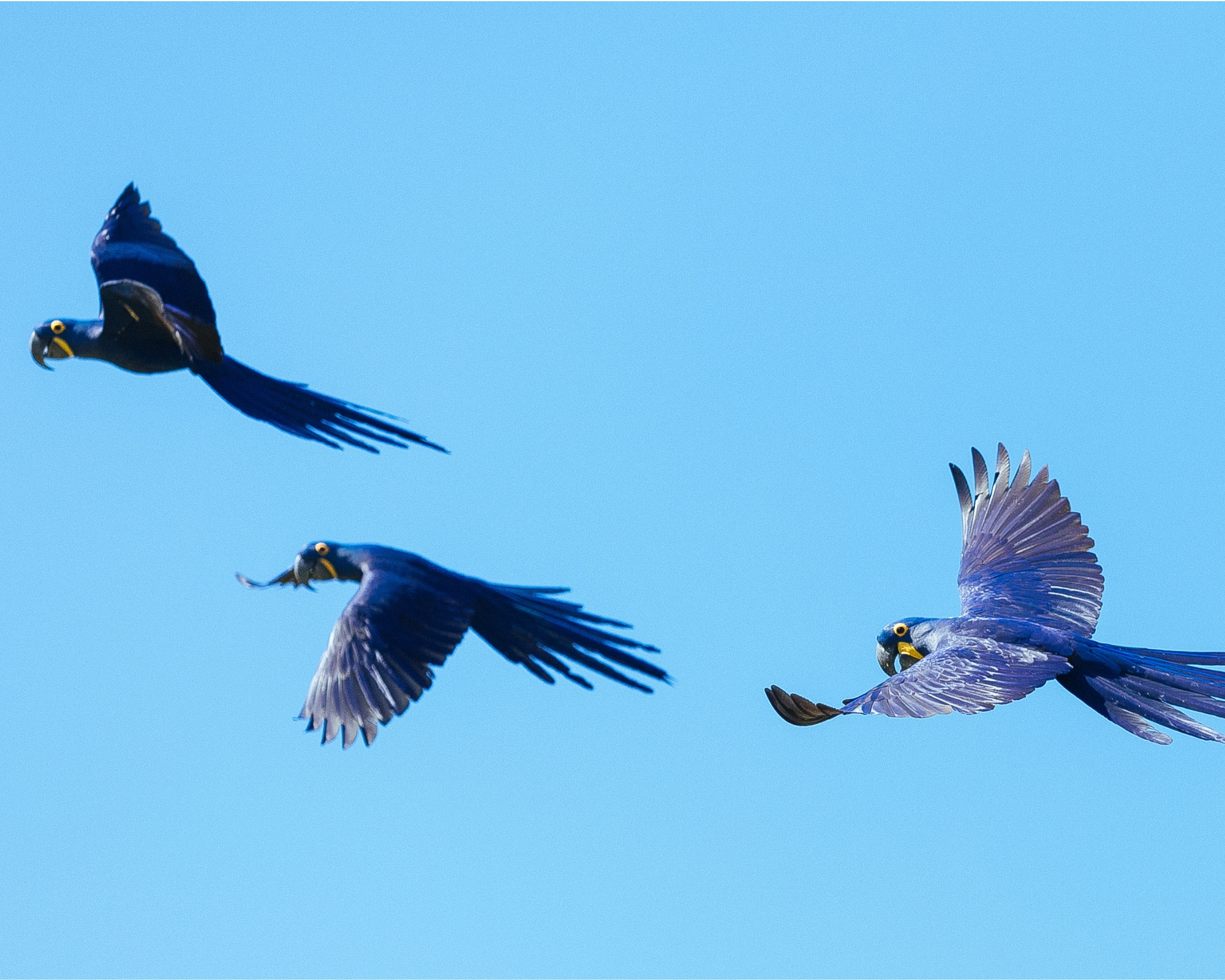
    Three vibrant hyacinth macaws with deep blue feathers flying across a clear sky during a Pantanal safari in Brazil.
    Photo: Felipe Castellari, Caiman

    👉 Read more: Which is the best Pantanal Safari Tour in Brazil?

    What should I pack for a Pantanal trip in Brazil?

    When preparing for a trip to the Pantanal, packing the right gear is essential to ensure comfort and safety. Here’s a list of must-bring items to make the most of your experience:

    • Light clothes, including at least one UV long-sleeved shirt and shorts/pants (earth or light colors)
    • Lightweight jacket
    • Windbreaker or rain jacket
    • Swimming suit
    • 2 pairs of shoes (sneakers/walking shoes and hiking boots)
    • Sandals (or water shoes)
    • Socks
    • Hats
    • Sunglasses
    • Waterproof sunscreen (SPF30+)
    • Insect repellent
    • Bath towel and washcloth
    • Camera, batteries/battery charger for cameras (underwater camera is also highly recommended)
    • Headlamp or flashlight + extra batteries
    • Dry-bag for cameras and personal gear
    • Daypack for hiking and short outings
    • Binoculars
    • Non-perishable snacks
    • Non-breakable reusable water bottle
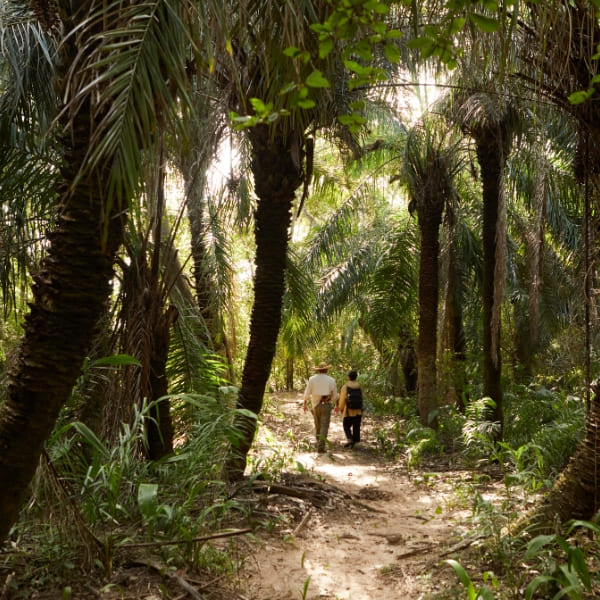
    Three travelers guided through a dense forest path with sunlight filtering through the trees in the Pantanal
    .

    What makes the Pantanal so special?

    Traveling to one of the world’s most fascinating ecosystems not only allows for an escape from the urban pace, but it also provides an authentic immersion in untouched nature.

    The Pantanal is a one of a kind destination, offering the opportunity to witness rich biodiversity while encouraging local tourism, supporting communities, and helping conservation efforts.

    Local customs also add an enriching cultural layer to the journey. Through ecotourism activities, visitors dive deep into the unique blend of tradition and nature to live experiences found nowhere else on Earth.
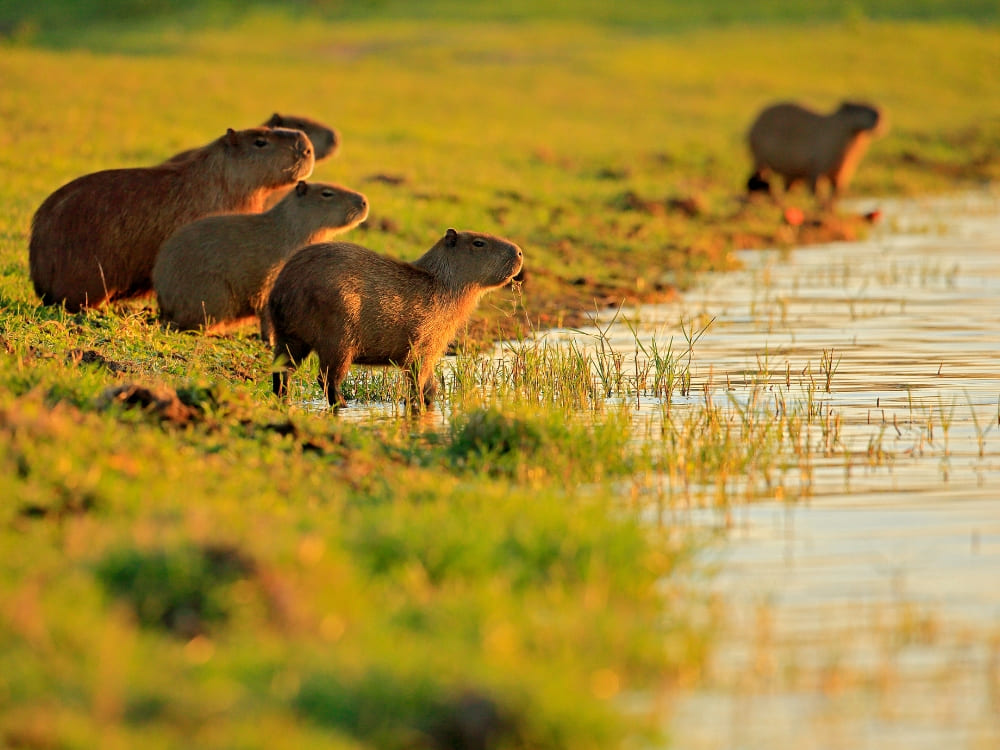
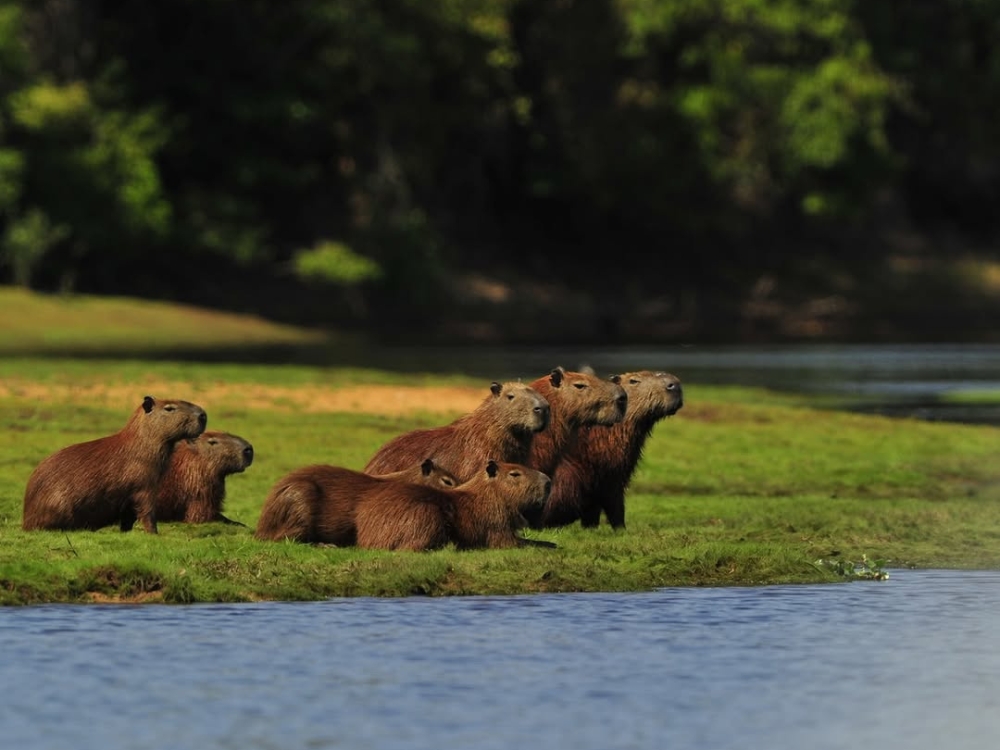
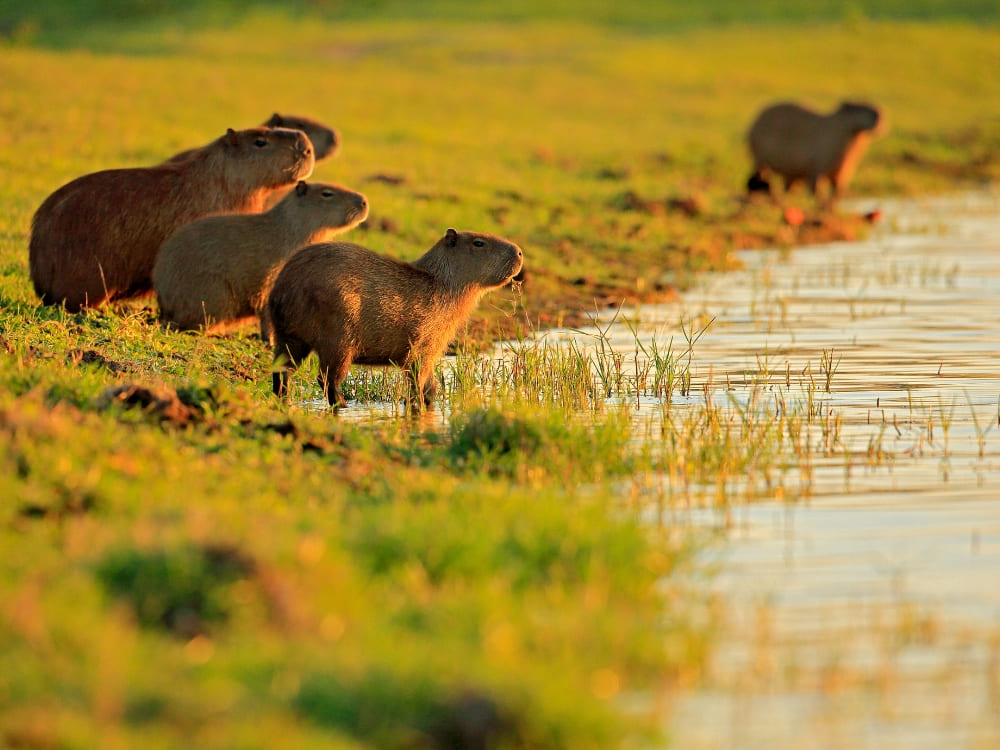
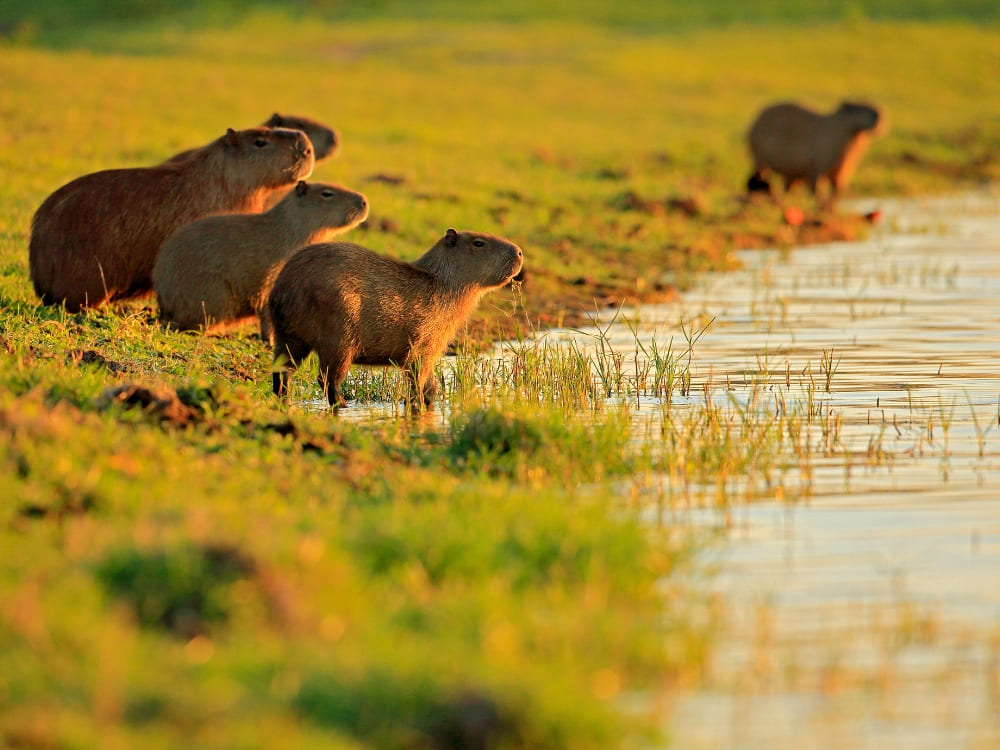
    A group of capybaras standing in the grass by a riverbank in the early morning light of Pantanal, Brazil.
    .

    Book your trip for the Pantanal in Brazil with PlanetaEXO

    We hope you’ve enjoyed our Pantanal travel guide! Now that you know everything about this incredible place, it’s time to start vacation planning.

    PlanetaEXO specializes in Pantanal tours and connects you with the best ecotourism operators while assisting with tailor-made itineraries, transfer options and much more. Book now!
    Read more!

  • Pantanal or the Amazon: Which One Should you Choose?

    Pantanal or the Amazon: Which One Should you Choose?

    Both incredible Brazilian biomes, the Pantanal is home to jaguars and other fantastic animals, while the Amazon Rainforest allows for unbelievable jungle experiences

    When planning an adventure into Brazil’s wildest landscapes, two destinations may come to mind: the Pantanal or the Amazon. Both are ecological powerhouses teeming with biodiversity, but they offer different experiences.

    Aerial view of a tour boat navigating a winding river through the lush green landscape of the Amazon.
    .

    Simply comparing travel itineraries is not enough, since both destinations are among some of the planet’s richest biomes in terms of biodiversity and untouched beauty. In their own unique ways, they provide incredible activities for those who wish to connect with nature in its most exuberant form.

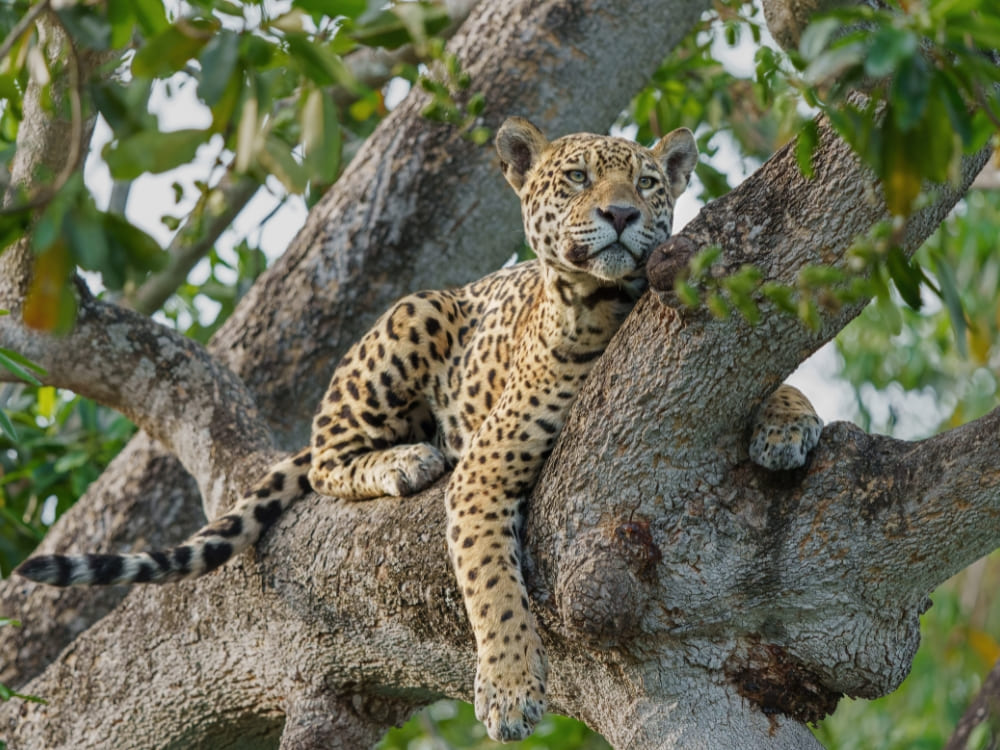
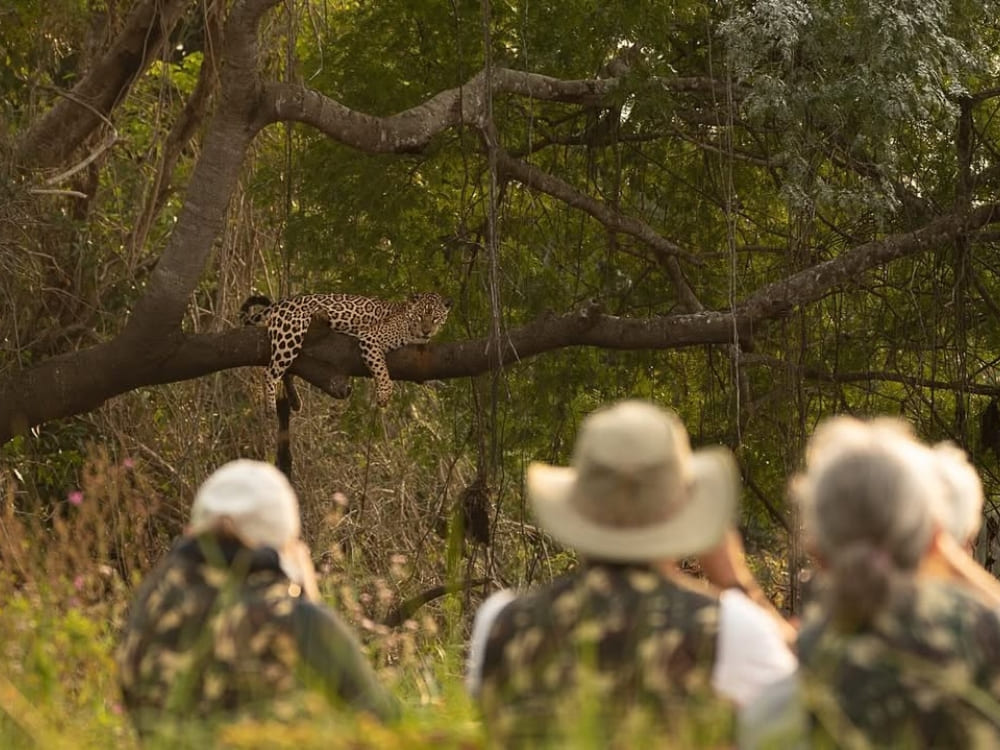
    Tourists watching a jaguar resting on a tree branch during a wildlife safari tour in the Pantanal.
    Photo: @larissa_pantanal

    As an expert in Pantanal tours and Amazon Rainforest tours in Brazil, PlanetaEXO has put together a guide to help you choose where you should spend your next vacation. See more below!

    Is the Pantanal part of the Amazon?

    No, the Pantanal is not part of the Amazon Rainforest. Although neighboring biomes in Brazil, they have fairly different ecosystems.

    Spanning the states of Mato Grosso and Mato Grosso do Sul, the Pantanal is considered the world’s largest wetland.

    Meanwhile, the Amazon is the largest tropical rainforest on Earth, covering areas of eight different states: Amazonas, Pará, Mato Grosso, Acre, Amapá, Rondônia, Roraima and Maranhão.

    Pantanal safaris: wildlife watching at its finest

    If your dream is to see wildlife up close, the Pantanal is the perfect destination. Besides the incredibly rich fauna, the open landscapes make it much easier to spot animals in their natural habitat compared to anywhere else in Brazil.

    By boat or four-wheel drives, Pantanal safaris allow visitors some of the best wildlife watching experiences in the world. With the help of expert guides who know just the right places to spot animals, you might see capybaras, giant otters, caimans, macaws, etc.

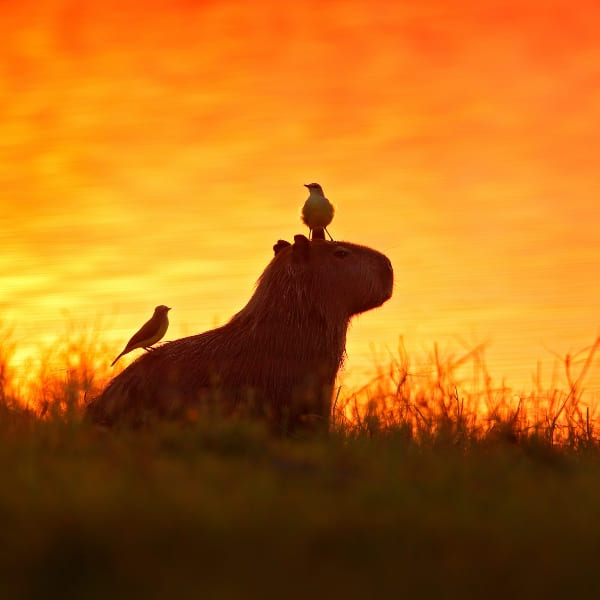
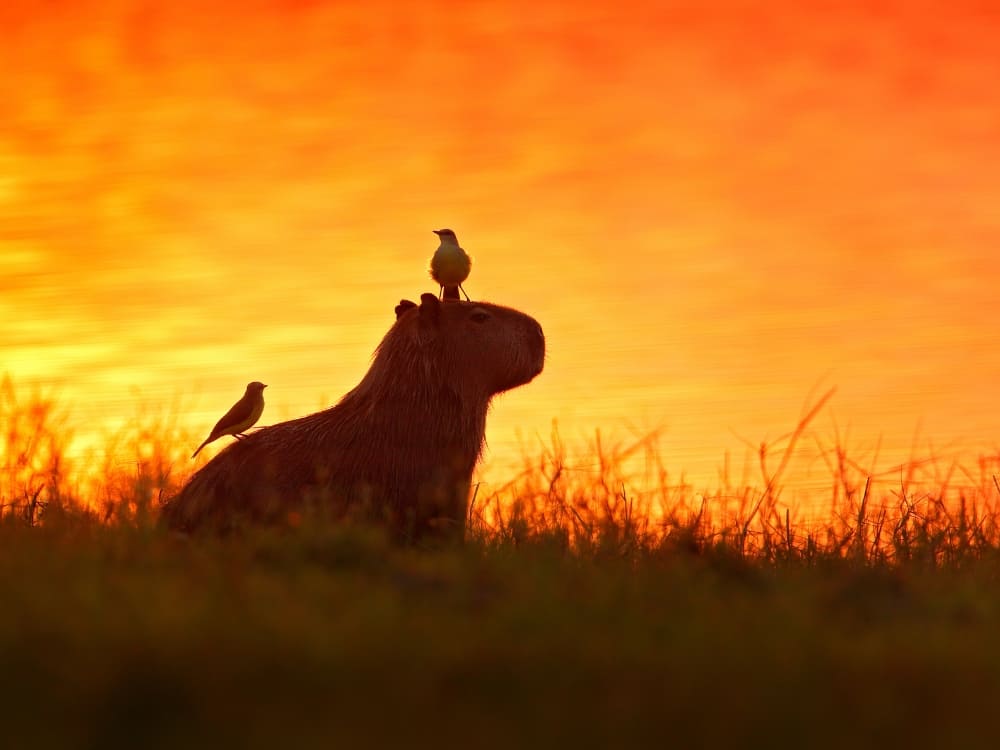
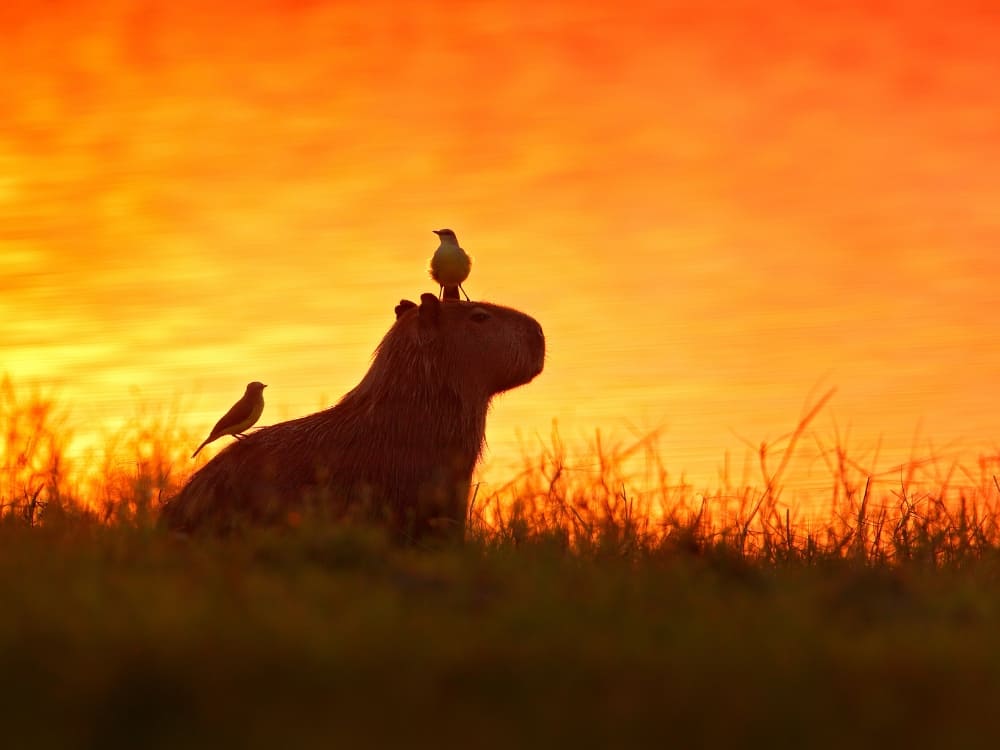
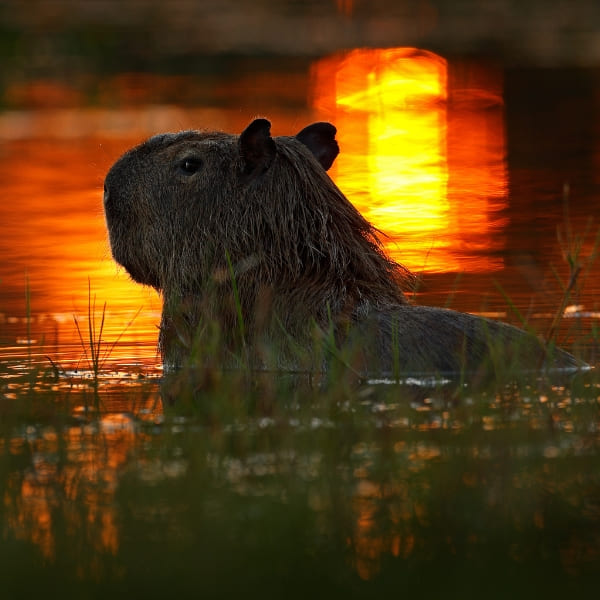
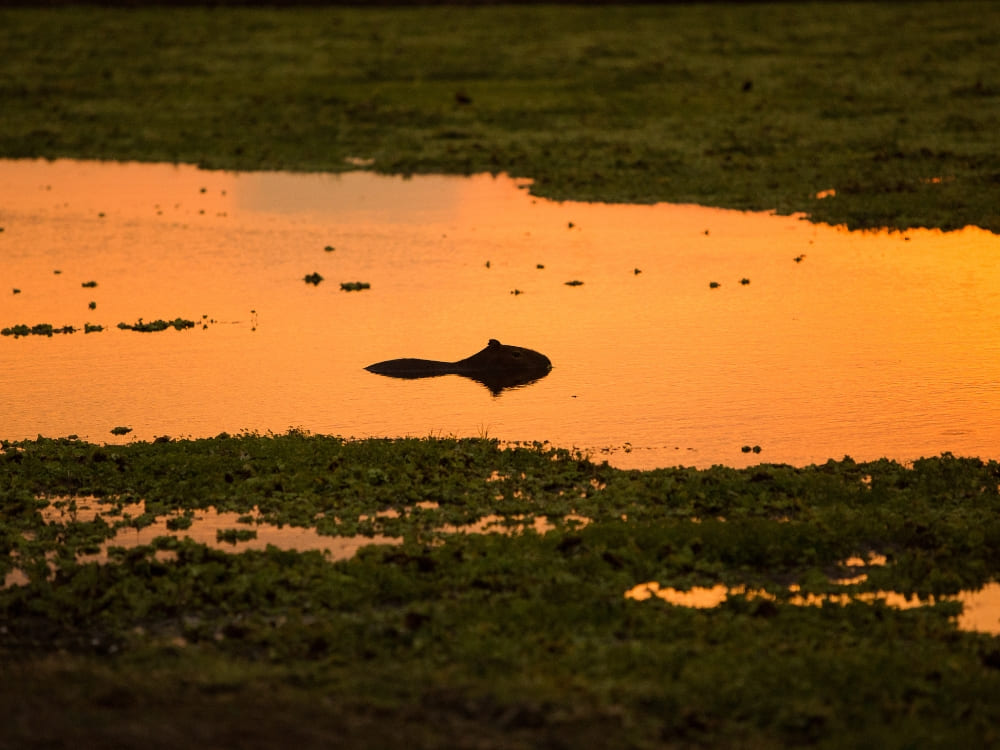
    Silhouette of a capybara with birds perched on its back against a vibrant orange sunset in the Pantanal.
    Photo: Ondrej Prosicky

    All species are fascinating, but it’s safe to say that the largest feline in the Americas is the star of the show. The Northern region, especially near the town of Porto Jofre, is considered the best place in the world to see jaguars.

    The Pantanal’s abundance of wildlife is a striking highlight compared to other biomes. Amazon jungle tours in Brazil are wonderful for a total immersion in nature, but spotting animals there requires more patience and a bit of luck.

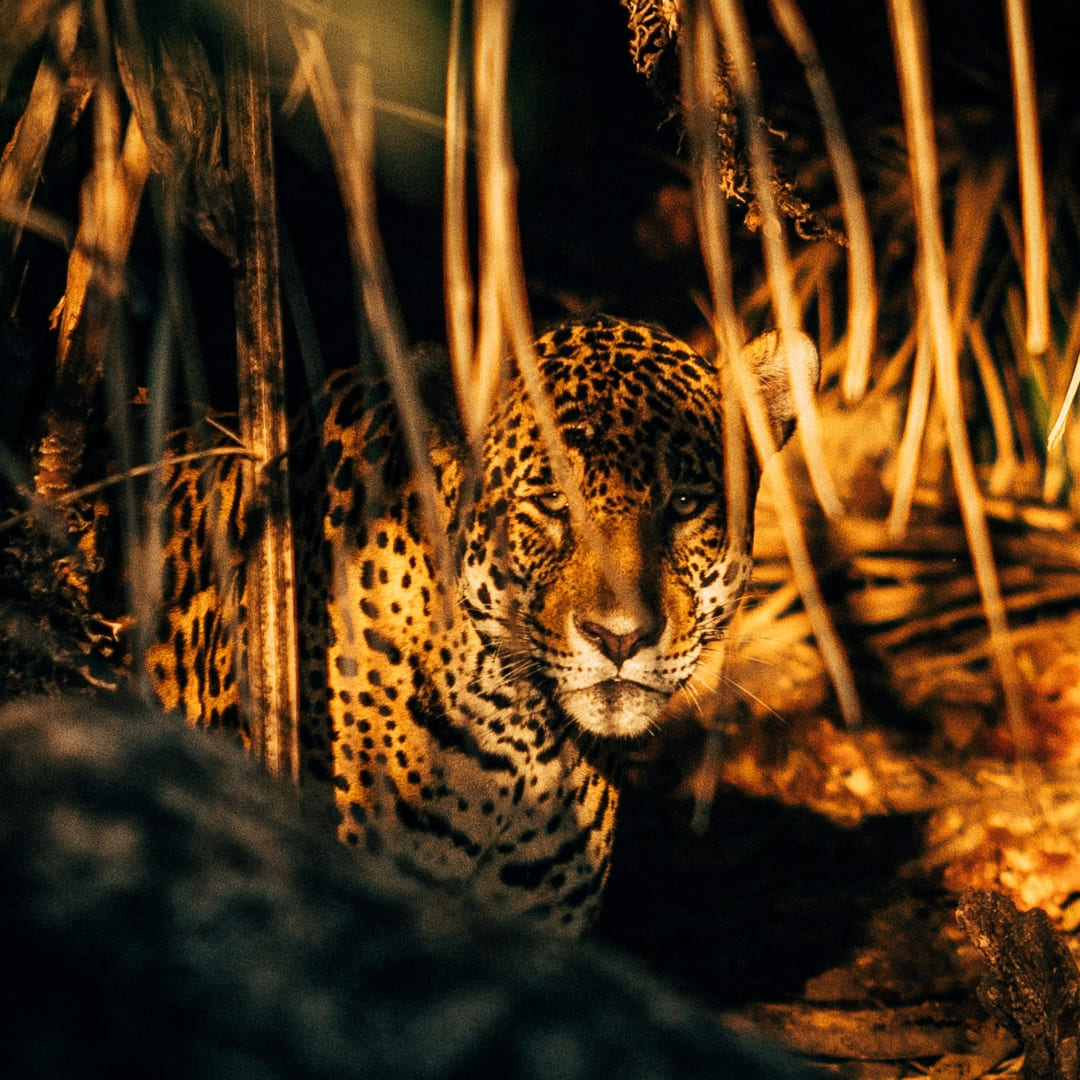
    Close-up of a jaguar engaging in natural camouflage amidst dense foliage in the Brazilian wetlands.
    Photo: Felipe Castellari

    👉 Read more:

    The immensity of the Amazon Rainforest

    The Amazon Rainforest  is an endless sea of green. With trees that reach over 40 meters in height, the forest creates a closed, humid environment where sunlight barely touches the ground, and houses thousands of plant and animal species.

    Hiking in the Amazon is almost mystic. Different sounds and aromas are enveloped by the forest grandeur and a constant sense of mystery. Such an atmosphere can make anyone very aware of the warm, yet relentless power of Mother Nature.

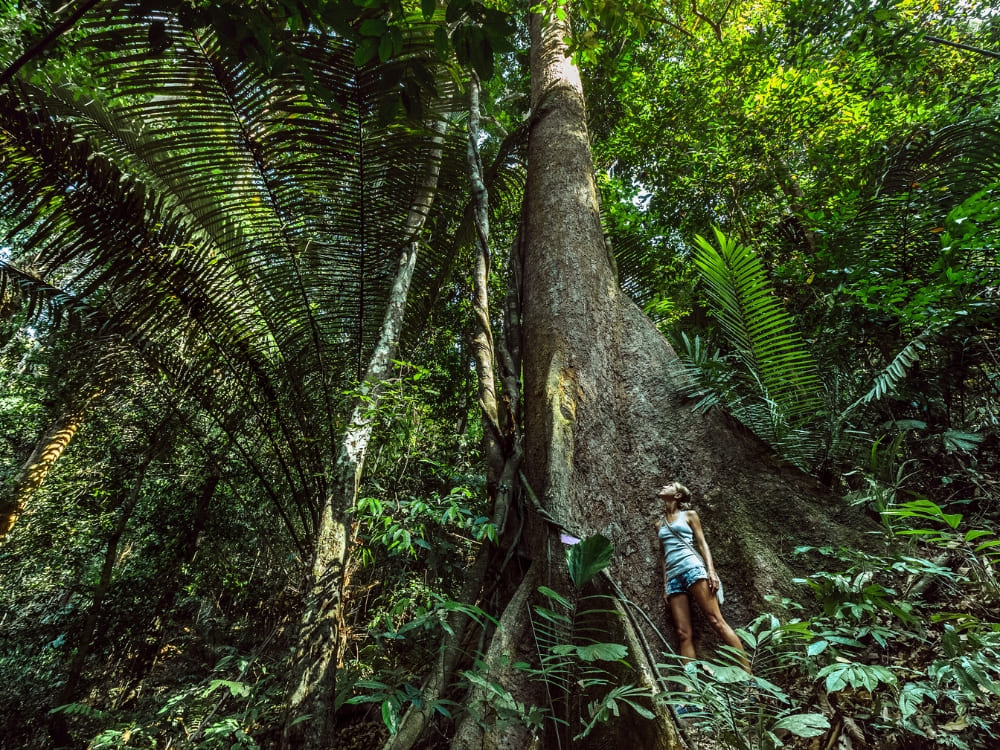
    A traveler stands at the base of a massive tree trunk wrapped in vines, gazing up into the dense, green canopy of the Amazon rainforest.
    .

    By joining Amazon tours in Brazil, travelers witness the importance of the rivers, which determine the local way of life as natural highways that connect riverside communities and grant proper access to deeper parts of the forest.

    Negro, Solimões and Amazonas are just some of the rivers that cut through the vegetation and form igarapés (small bodies of water), igapós (flooded forests) and breathtaking views of immeasurable value for the fauna, flora and locals. 

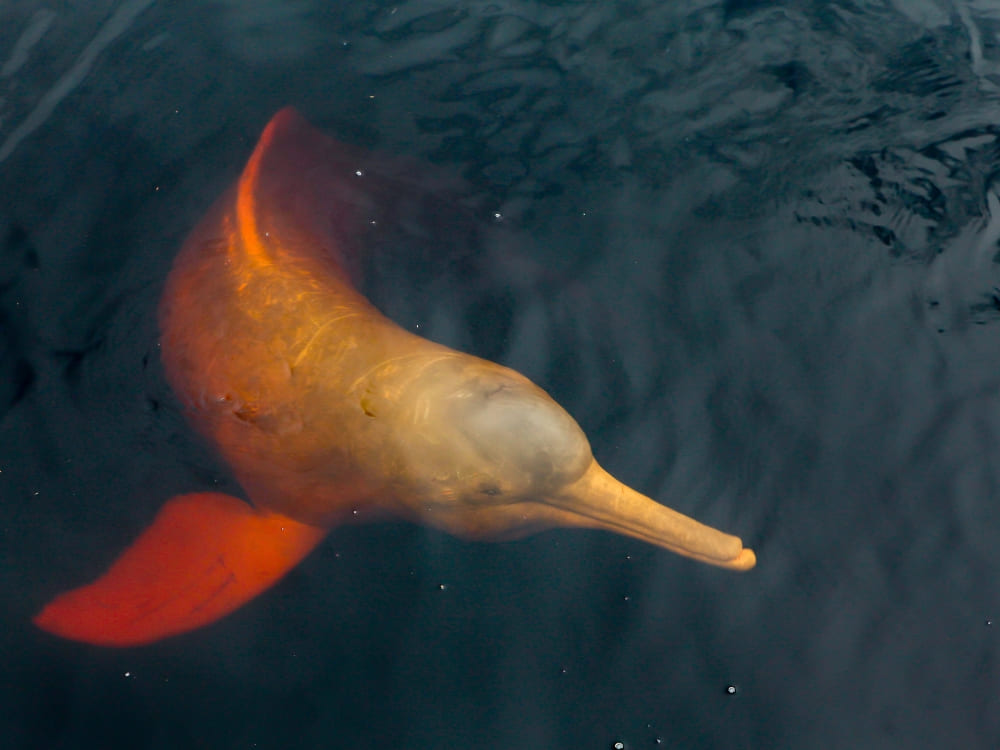
    A pink river dolphin surfaces to breathe, showing its distinct color against the dark, black waters of the Rio Negro.
    .

    Wildlife is rich, but discreet. Except for pink river dolphins, most animals live in the tree tops, are camouflaged by the jungle or only make themselves known at night. The focus is on immersion: smelling the wet earth, listening to the music of nature, breathing fresh air and understanding the privilege of being surrounded by the most complex ecosystem on the planet.

    👉 Check our travel packages: Amazon Rainforest tours, Brazil

    Experiences in the Amazon and the Pantanal

    Both the Pantanal and the Amazon are spectacular. There is no better destination — only the better option for your preferences.

    While the Amazon stands out for the vastness of its closed forest, imposing rivers and the constant sounds of the jungle, the Pantanal mesmerizes with its flooded fields, open vegetation and the spectacle of wildlife on view. Despite the contrasting differences, these two wild destinations represent the richness of Brazilian biodiversity and sustainable travel.

    Besides understanding what makes each biome so great, it’s also important to point out how the experiences are influenced by their distinctness.

    Two jaguars grooming each other in their natural habitat in the Pantanal.
    @matthias_kern_photography

    Pantanal tours activities

    Book your trip to the Pantanal if you love:

    • Photo safaris: explore the wetlands by boat or 4×4 car to spot some of the most beautiful Brazilian animals, including jaguars, anteaters, tapirs, toucans, and many more.
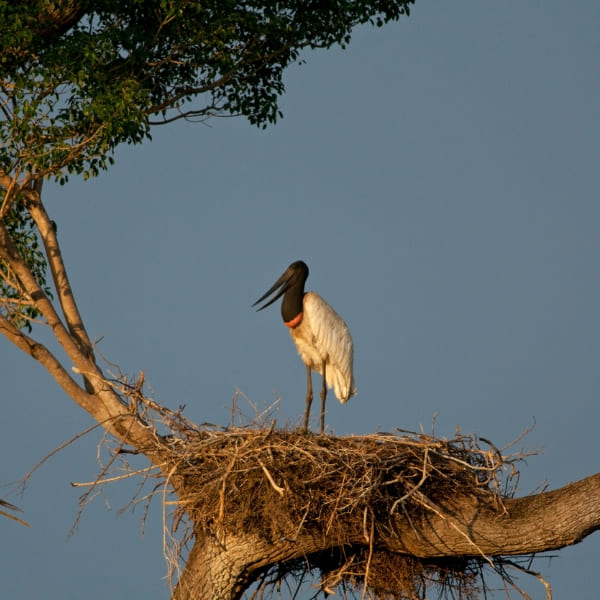
    • Birdwatching: keep your eyes open to spot some of the native birds, including toucans, macaws and the enigmatic jabiru stork.
    • Horseback riding: delve into the flooded plains on horseback like a true Pantaneiro.
    • Trekking: accompanied by qualified guides, trek across open fields and immerse yourself in nature.
    • Boat rides and catch-and-release fishing: discover the wetlands by joining boat tours and fish for typical Pantanal species, like pacu and dorado.
    • Farm life: some lodges are actually adapted farmhouses, but day-to-day life is still heavily based on ranch culture — which guests are more than welcomed to participate in.
    • Cinematic sunrises and sunsets: wide-open skies offer unforgettable views when dawn breaks or when the sun sets.

    Keep in mind: itineraries vary in North and South Pantanal. Make sure to learn the differences of both regions before booking your trip!

    Group of tourists horseback riding through the Pantanal wetlands guided by local experts.

    Brazil Amazon tours activities

    Plan your vacation in the Amazon if you can’t get enough of:

    • Forest hiking: immerse yourself in the forest by hiking with expert guides to explore the fauna, flora and local traditions.
    • River cruises: high-end vessels provide a one of a kind sailing experience across the rivers in Anavilhanas and JaĂş national parks.
    • Boat trips: smaller boat and canoes sailing through igarapĂ©s and igapĂłs are some of the most authentic activities in the forest.
    • Night expeditions: animals (caimans, snakes, frogs, owls…) tend to roam around the forest more freely when night falls, making it an ideal time for wildlife watching in the Amazon.
    • Pink dolphins sightings: unlike other native animals, the iconic pink river dolphins aren’t shy and are often spotted during boat rides across Solimões and Negro rivers.
    • Lodging in the forest and floating houses: rustic or sophisticated stay experiences, always integrated with nature.
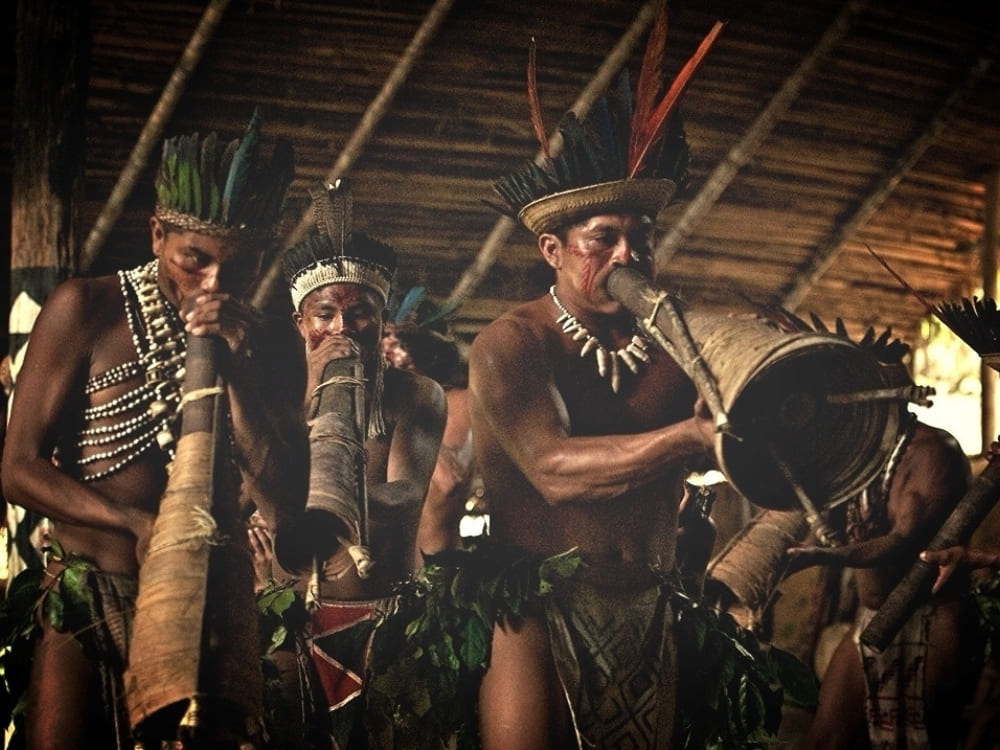
    • Visiting riverside and indigenous communities: contact with local cultures, traditional cuisine, handicrafts and even ceremonies conducted by indigenous leaders.

    👉 Read more: Top things to do in the Amazon Rainforest in Brazil

    Indigenous men playing traditional wind instruments during a cultural ceremony in the Amazon.

    How to get to the Pantanal and the Amazon in Brazil?

    The Pantanal and the Amazon Rainforest are located in remote regions, with logistical challenges that can directly influence the tourist experience. However, with the growth of ecotourism in Brazil and the development of local infrastructure, these trips have become increasingly viable.

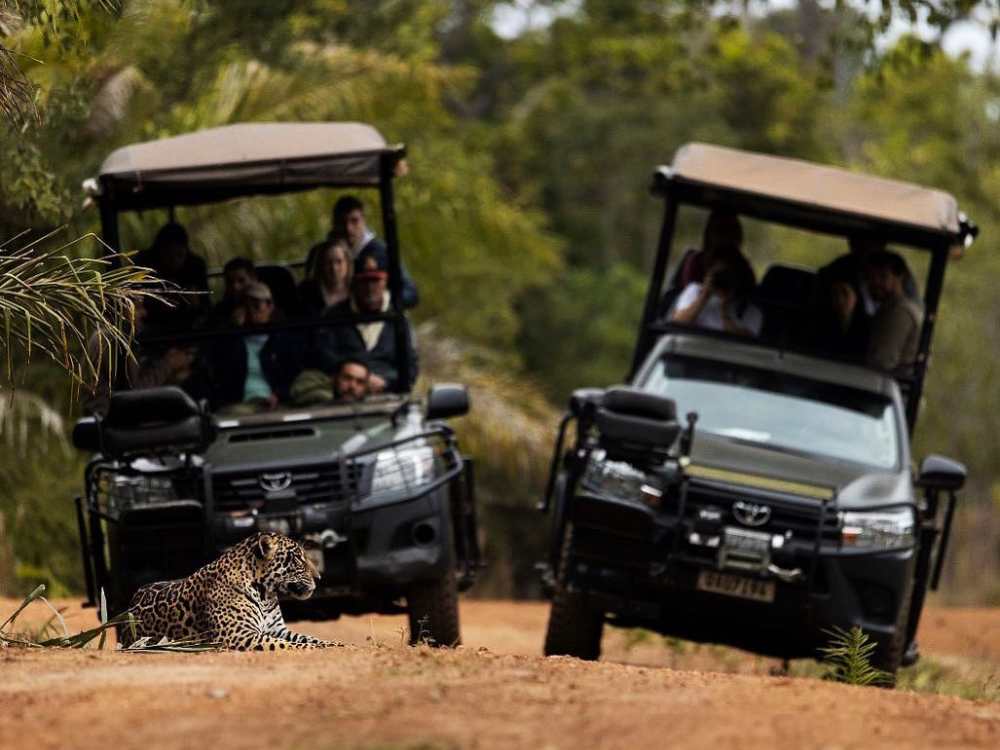
    Divided between North and South, the Pantanal is assessable via Cuiabá (Mato Grosso) or Campo Grande (Mato Grosso do Sul), both capitals connected by dirt roads to the lodges and ranches. The dry season (May to October) is a great time for wildlife watching and other outdoor activities due to the decrease in water level.

    👉 Read more:

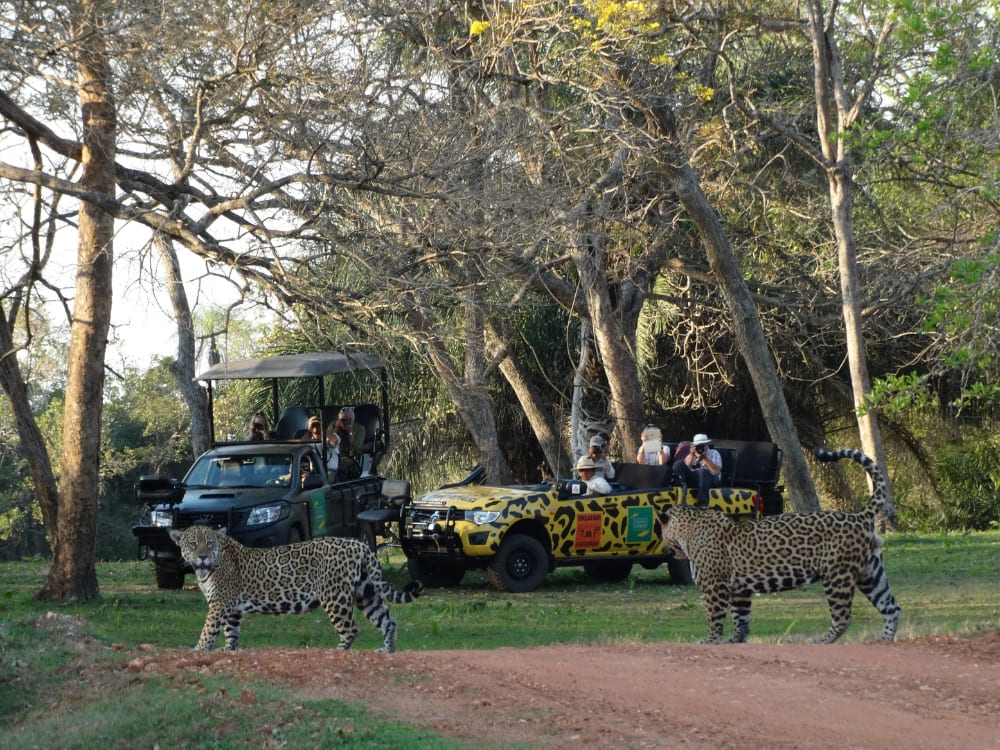
    Two open-air safari vehicles stopping on a dirt road to observe a jaguar lying on the ground.

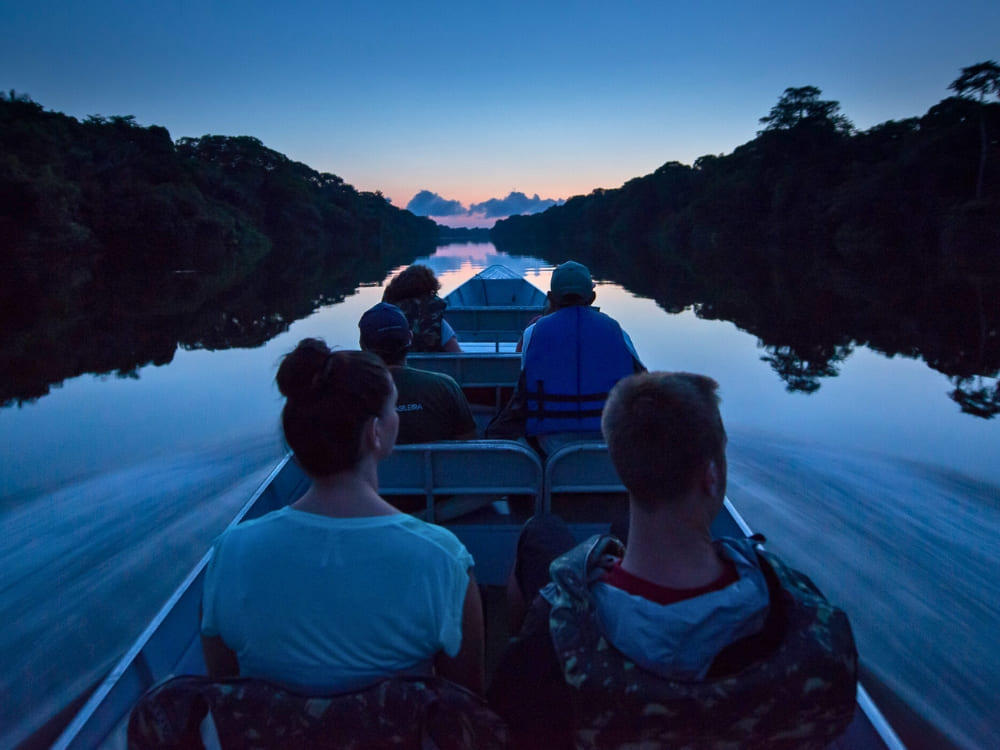
    If you’re traveling to the Amazon, the route depends on which areas you’re visiting. Manaus, capital of Amazonas, is the main getaway to the forests, served by direct flights from major Brazilian cities, but there are also tours in the states of Pará and Mato Grosso.

    River levels vary greatly between the wet and dry seasons, so activities can change depending on the time of year. The rainy season (December to May) is best for canoeing, while the dry season (June to December) allows for longer hikes.

    👉 Read more:

    Tourists on a small motorized canoe navigating an Amazon river at twilight.

    Sustainability and local impact

    Both the Pantanal and the Amazon are biomes of global importance for environmental conservation. Sustainable travel has proven to be a powerful tool for preserving these regions and supporting local communities. 

    By choosing responsible lodging, hiring local guides, opting for operators that follow sustainable practices and taking part in activities focused on environmental education, tourists contribute directly to maintaining communities and enhancing biodiversity.

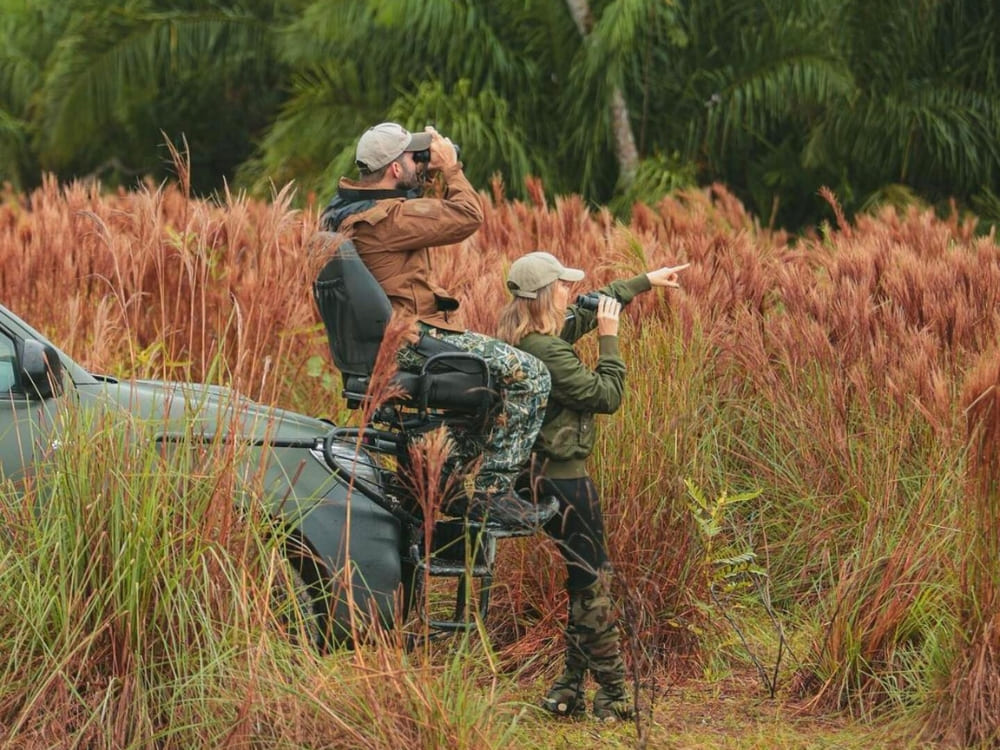
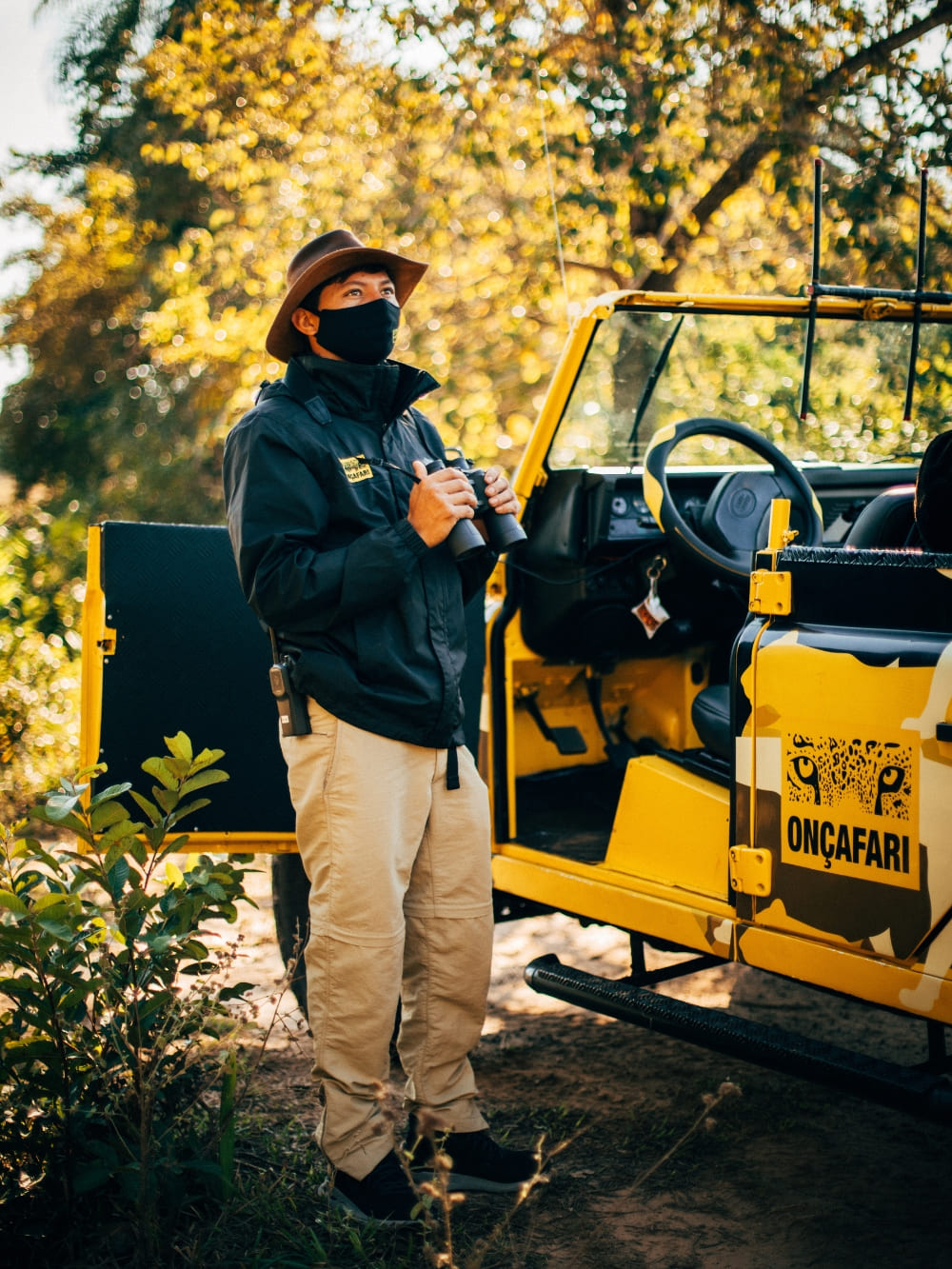
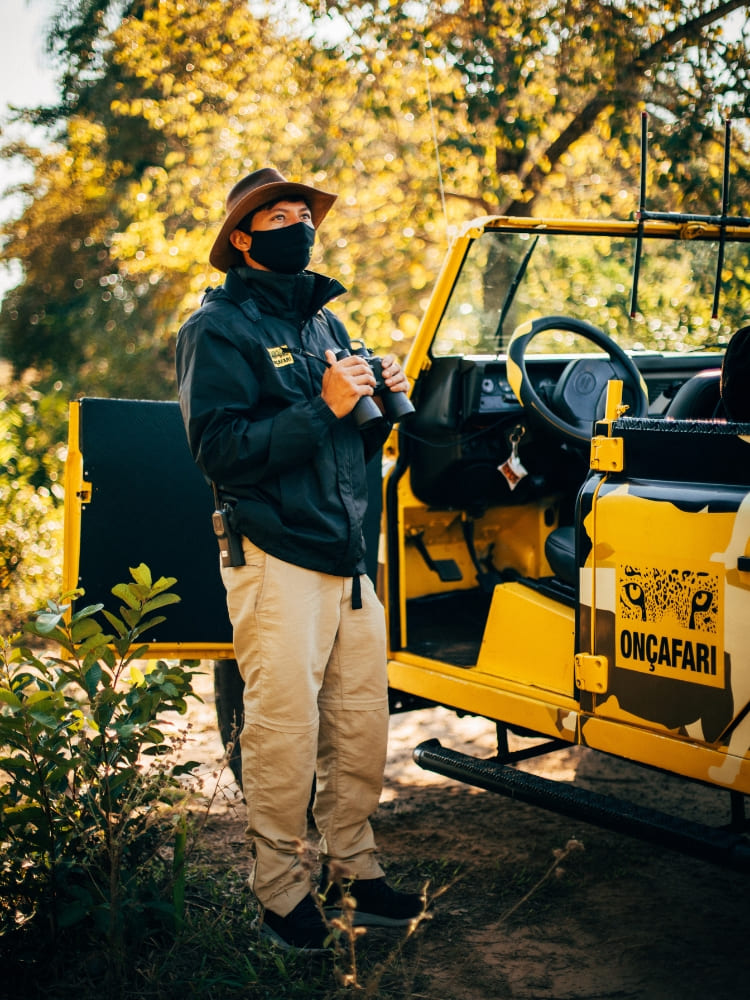
    An ecotourism guide holding binoculars standing next to an Onçafari project vehicle.

    Ecotourism efforts, such as ecological lodges in the Amazon, or adapted farms in the Pantanal, help generate income for local populations and create alternatives to deforestation, poaching and predatory exploitation of natural resources.

    Prioritizing experiences that respect the rhythms of nature, limit the number of visitors and are committed to sustainable practices is essential to ensure that these landscapes continue to exist for generations to come. 

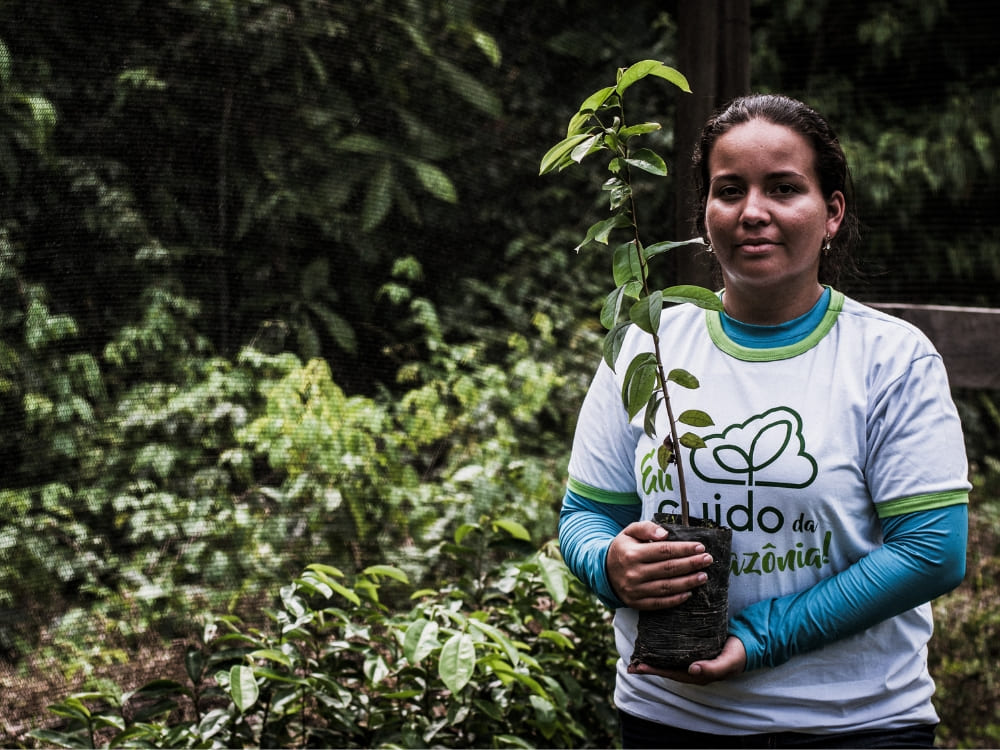
    A woman holding a native tree sapling for a sustainability and reforestation project in the Amazon.

    👉 Learn more and support:

    In conclusion, should you choose the Amazon Rainforest or the Pantanal?

    Go to the Pantanal for easier wildlife watching, open landscapes and safari-style experiences, or choose the Amazon if you’re looking for immersive jungle exploration, cultural encounters, and the feeling of being in the middle of a tropical rainforest.

    Better yet: plan your trip to both destinations, since each reveals a unique side of Brazil’s untamed beauty. 

    There’s no wrong choice here, just different kinds of adventures!

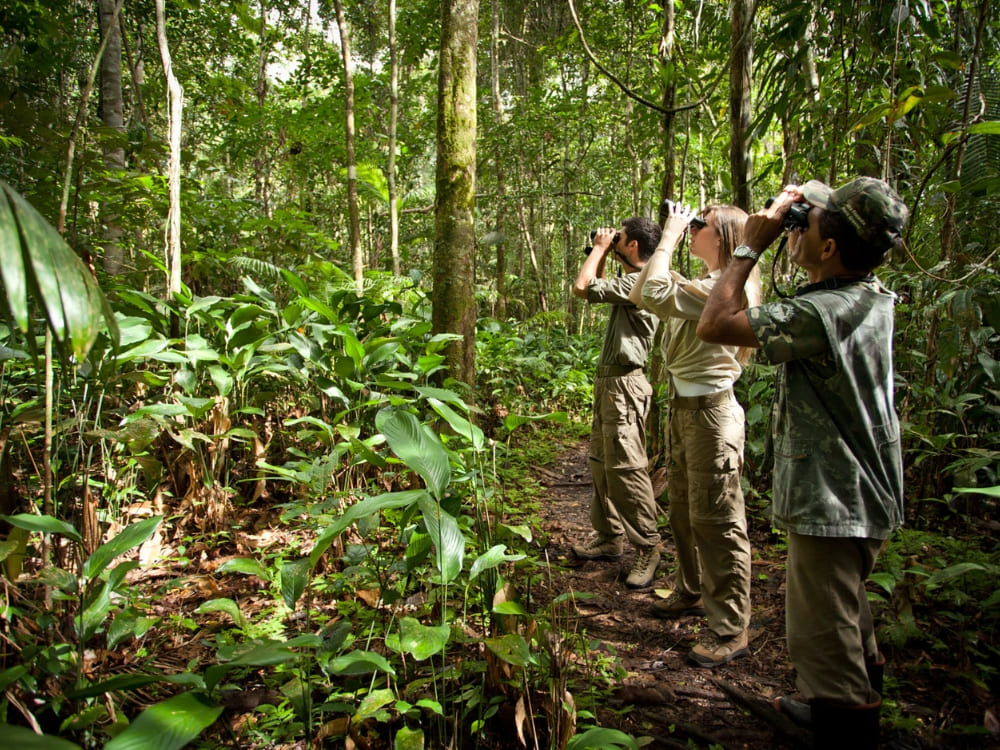
    Travelers using binoculars to spot wildlife while hiking through the Amazon jungle.
    Photo: Samuel Melim

    Travel to the Pantanal or the Amazon with PlanetaEXO

    PlanetaEXO is an ecotourism platform specialized in Pantanal tours and Amazon Rainforest tours in Brazil, so why choose just one destination when you can do both?

    We work with the best local operators to make sure your travel experience is unlike any other. From bookings to itineraries, our team will be with you every step of the way. Contact us now!
  • How many days should you stay in the Pantanal, Brazil?

    How many days should you stay in the Pantanal, Brazil?

    Planning your trip depends on several factors, such as logistics, seasons, and travel style

    To truly experience the wetlands, it’s recommended to stay at least 4 full days. But how many days you should stay in the Pantanal depends on your travel goals, whether you’re looking for wildlife safaris, family-friendly experiences, or slow-paced ecotourism.

    Two safari vehicles with tourists closely observing a jaguar lying on a dirt road in the Pantanal.
    Photo: Edu Fragoso

    Besides the activities, it’s also important to think about logistics, as the biome is vast and located in a fairly remote region that can take a few hours to reach. When you’re traveling to nature destinations, every minute counts!

    To help with your decision-making, PlanetaEXO, an ecotourism platform specializing in Pantanal tours, has created a guide detailing everything you have to consider when planning your trip. Check it out below!

    What determines how long you should stay in the Pantanal?

    Before deciding how many days to spend in the Pantanal, a few practical factors should lead your planning:

    Logistics

    The Pantanal is remote, which means accessing its wild areas can be quite time-consuming. Most travelers arrive via Cuiabá (Mato Grosso) or Campo Grande (Mato Grosso do Sul), but reaching lodges, especially in the north, often requires long drives and even additional boat trips, depending on the location.

    From Cuiabá to Poconé—particularly in Porto Jofre, the best place for jaguar safaris—the drive takes approximately 2 hours. To reach the Southern Pantanal via Campo Grande, the journey to base cities Aquidauana and Corumbá can take 2–3 and 5–6 hours, respectively.

     Aerial view of a vast green Pantanal landscape showing a safari vehicle driving on a dirt road next to a river.
    Photo: Caiman

    Pro tip: When planning your visit to the Pantanal, always consider the transfer time (round trip). It’s also important to decide whether you want to explore the North, the South or both, as this will impact your itinerary.

    👉 Read more:

    Seasons and weather

    Like most nature destinations, the Pantanal offers different experiences according to the seasons. From May to October, the dry season brings better access and great wildlife viewing, especially of jaguars, capybaras, and caimans. This is also a good time for land activities, such as hiking and horseback riding.

    Tour guide observing a giant anteater on the plains during the dry season in the Pantanal.
    Photo: Felipe Castellari

    From November to April, the rainy season floods large portions of the plains, transforming the landscape into a vast wetland. This period is ideal for boat safaris and birdwatching, with thousands of migratory birds—though access to some lodges may become limited.

    Between seasons (April/May and October/November), you’ll find a mix of both worlds: accessible trails and diverse wildlife activity. Wonderful period to book your trip!

    Finally, don’t forget to pay attention to the Pantanal weather. Temperatures range from 25°C to 35°C year-round, but the northern side tends to be warmer and more humid.

    👉 Read more: When is the best time to visit the Pantanal?

    Travel style and goals

    Understanding your travel style and the experiences you’re looking for will surely help you decide how many days you should stay in the Pantanal.

    Those looking for in-depth wildlife observation, jaguar tracking, or nature photography can benefit from longer stays of at least 5 days in remote areas, where animals tend to roam around more freely.

    Group of tourists on a boat navigating the crystal-clear waters of a river surrounded by lush vegetation in Bonito.
    .

    5 days or more is also ideal for an adventure in Bonito, an ecotourism hub in Mato Grosso do Sul known for its jaw-dropping rivers, waterfalls, natural pools, and caves. Only 2 and a half hours away from the Southern Pantanal, it’s a wonderful destination for people able to extend their vacation or who wish to witness more of Brazil’s nature.

    For families, proximity and comfort are probably best, so staying in areas like Poconé can be a great option. 3 to 4-day trips offer a good balance of safaris and relaxation.

    👉 Explore the adventure: 5-Day Pantanal Bonito Tour in Brazil

    Best Pantanal tours in Brazil

    Not sure whether to explore the north, the south, or both? Understanding how many days you should spend in the Pantanal and comparing real tour options can help you decide.

    Here are some of PlanetaEXO’s Pantanal safaris you just can’t miss:

    TOUR HIGHLIGHTS DURATION STARTING PRICE*
    Budget Pantanal Tour South Pantanal. Affordable experience, wildlife watching, boat rides, canoeing, fishing, horseback riding, night tours. 4 days US$ 660
    Luxury Jaguar Safari in the Pantanal South Pantanal. High-end experience, wildlife watching (jaguar-focused), night tours, hiking, canoeing. 4 days US$ 3,230
    Pantanal Wildlife Tour from Cuiabá North Pantanal. Wildlife watching, photo safaris, night tours, boat trips, horseback riding, hiking. 4 days US$ 1,365
    Pantanal Jaguar Budget Safari North Pantanal. Affordable experience, wildlife watching (jaguar-focused), night tours, boat trips, hiking, sunrise/sunset contemplation. 4 days US$ 1,875
    Wild South Pantanal: Remote Wetland Adventure South Pantanal. Adventure in Nhecolândia (wildest area of the Pantanal), photo safari, horseback riding, canoeing, fishing, night tours, hiking, wildlife watching. 4 days US$ 2,280
    Pantanal Bonito Tour in Brazil Wildlife watching and night safaris (South Pantanal); cave exploring and snorkeling in natural pools (Bonito). 5 days US$ 1,405
    Pantanal Jaguar Photography Tour North Pantanal. Boat and land safaris to photograph jaguars and other animals (accompanied by guides with extensive knowledge in wildlife photography). 6 days US$ 3,730

    *Per person, based on double occupancy in group departures. Prices may vary depending on season and availability. Exchange rate as of March 10th, 2026; subject to change.

    Exploring the Pantanal with PlanetaEXO

    No matter how many days you decide to stay in the Pantanal, we are ready to help you plan the vacation of your dreams!

    PlanetaEXO is an ecotourism platform specializing in Pantanal tours. Working with the best local operators, our team is ready to lead you into an immersive adventure while making a positive impact on the environment and small communities. Contact us now!
  • What is the best Pantanal safari in Brazil?

    What is the best Pantanal safari in Brazil?

    Looking forward to exploring Brazil’s natural wonders? Discover the best tours for your Pantanal trip!

    The best Pantanal safaris are the ones that allow for total immersion in this fascinating biome, with plenty of activities focused on exploring its impressively rich biodiversity.

    Spanning an area of over 210,000 km², the Pantanal is the greatest place in Brazil for wildlife watching. Some of the country’s most celebrated animals call this territory their home, such as caimans, capybaras, macaws, and the greatest felines in the Americas: the jaguars.

    PlanetaEXO specializes in Pantanal tours and handpicks the best local operators to make sure your trip includes diverse itineraries, great stay options, eco-friendly practices and unforgettable moments. Check it out!

    A wild jaguar walking on a river sandbar observed by tourists on a boat during a Jaguar safari in the Pantanal Brazil.
    .

    Pantanal safaris in the North and the South

    Before you start planning your trip, it’s important to know that the Pantanal is so extensively rich it’s divided into two sides: the North, in the state of Mato Grosso (accessible via Cuiabá), and the South, in Mato Grosso do Sul (via Campo Grande). Naturally, experiences in each region are different and should be considered before booking your trip.

    The Northern Pantanal is ideal for jaguar spotting and boat safaris. The abundance of wildlife makes this area ideal for photographers and nature enthusiasts who can’t wait to see some of the most fascinating species of Latin America.

    Meanwhile, Southern Pantanal is known for total culture immersion and traditional ranch experiences that mix cattle farming with ecotourism activities, such as horseback riding and canoeing. Seeing jaguars is a lot harder in the South — although not impossible — wildlife watching is still a must!

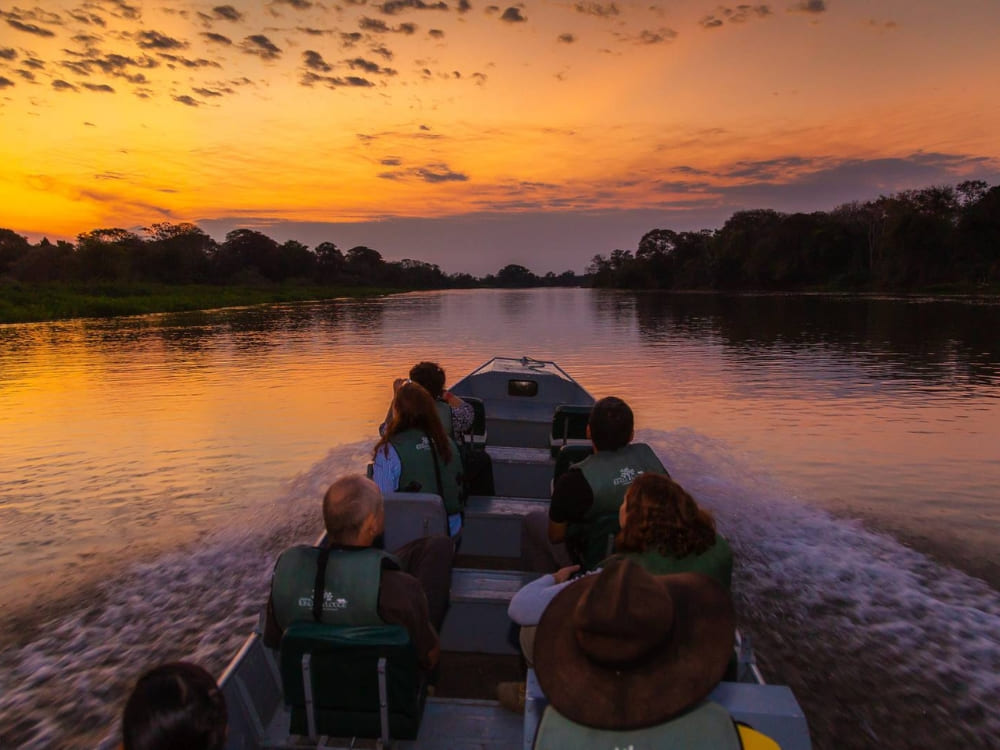
    Travelers on a motorboat navigate a calm river during a vibrant orange sunset in the Pantanal
    .

    👉 Learn more about the Pantanal:

    Jaguar Pantanal safaris

    As the best place in the world to see jaguars, the North Pantanal is the main destination — although not the only one — for travelers whose main goal is spotting this magnificent feline. 

    Additionally, jaguar safaris tend to be a bit more expensive than other expeditions due to specific techniques required to make sure travelers can thoroughly enjoy the experience without stressing out the animals.

    Pantanal Jaguar Safari in Porto Jofre

    One of the main Pantanal safari tours from Cuiabá, this experience takes place in Porto Jofre, in the municipality of Poconé, by the end of the Transpantaneira Highway. It offers incredible activities for nature lovers who are dying to see jaguars roaming around their natural habitat.

    Sailing across the calm waters of the Cuiabá River, you’ll be able to see jaguars peacefully napping on top of trees, strolling on the riverbanks, swimming or even hunting for prey. Local guides will be with you during the boat safari to lead you to strategic spots to watch the wildlife and share their knowledge about the Pantanal.

    This tour includes cozy accommodation, delicious meals, round-trip transfers between Cuiabá and Porto Jofre, English-speaking guides, and daily boat safaris to see jaguars and other Pantanal animals, like giant anteaters, caimans, and hundreds of different species of birds.

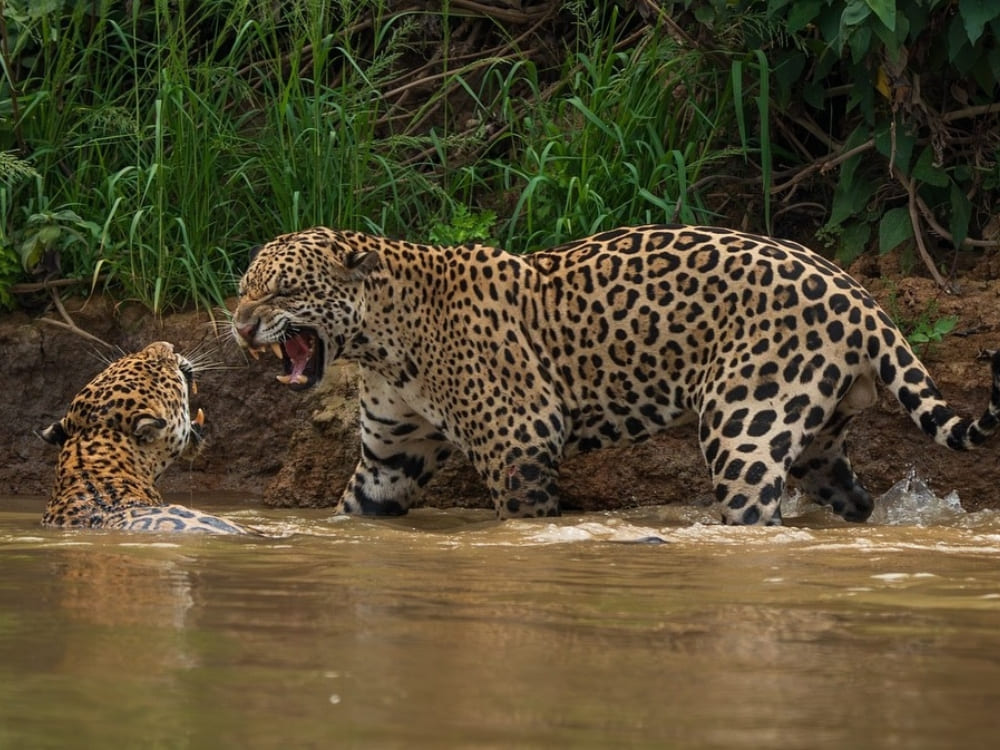
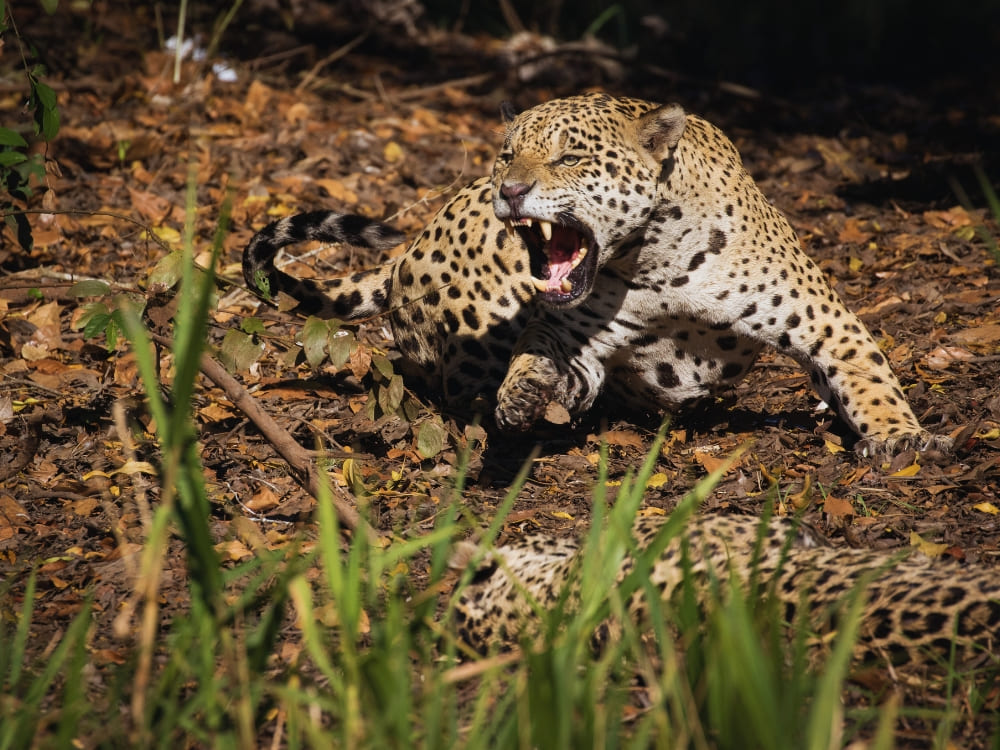
    Two jaguars fighting in a river, a rare and intense wildlife sighting on a Jaguar safari.
    @larissa.pantanal

    👉 Book now: Pantanal Jaguar Safari in Porto Jofre

    Pantanal Jaguar Photography

    Ideal for professional and amateur photographers, this Pantanal photography tour from Cuiabá takes you on a trip to the heart of the biome to capture and immortalize its breathtaking beauty.

    You’ll be accompanied by local guides with extensive background in wildlife photography to help you with the best techniques to take gorgeous pictures of jaguars, macaws, brocket deer, jabiru storks, and much more.

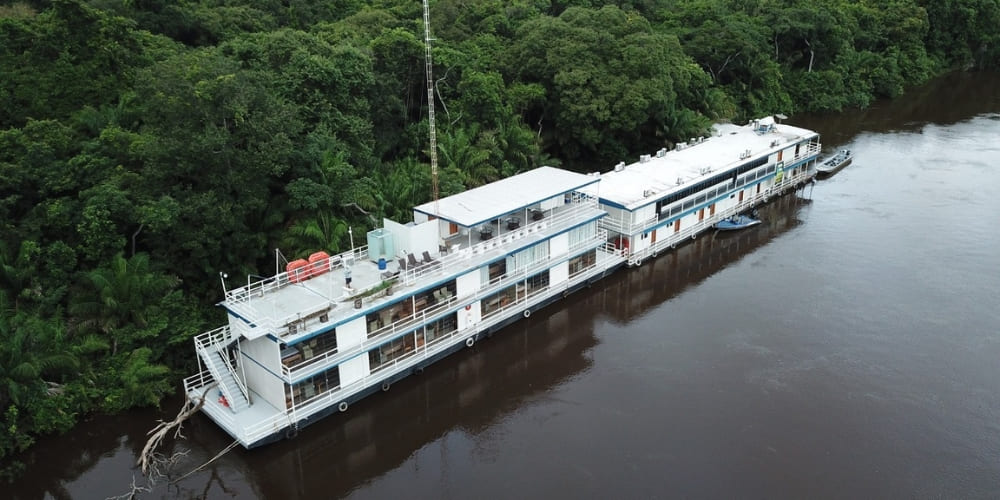
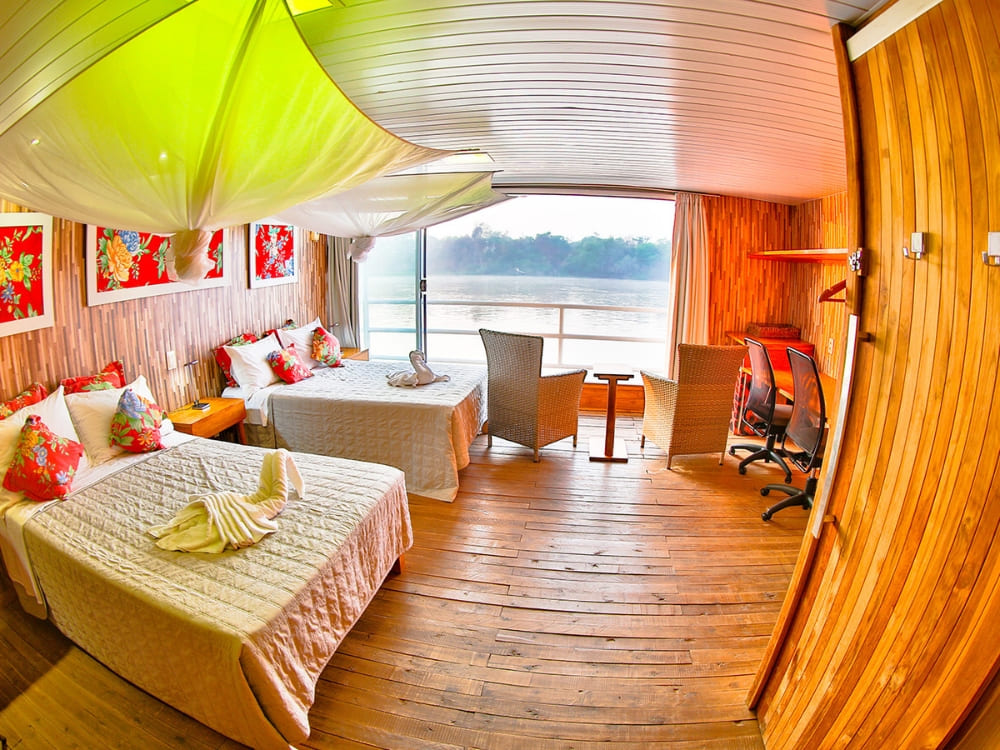
    Regarding accommodation, there are two available options: Flotel, a floating hotel at the entrance of the Meeting of Waters State Park, and Berco Lodge, a classic Pantanal lodge.

    A wildlife photographer capturing a jaguar on a riverbank during a specialized Pantanal safari.
    @larissa.pantanal

    👉 Book now: Pantanal Jaguar Photography

    Luxury Jaguar Safari in the Southern Pantanal

    Surely one of the most outstanding Pantanal tours from Campo Grande out there, this experience is the perfect mix between nature immersion and a high-end stay experience.

    Although this tour takes place in the South, 100% of visitors who have booked it in the past years have spotted jaguars. This is all thanks to Casa Caiman and Onçafari, a conservation project whose goal is to make animals used to the presence of humans, which consequently raises awareness on environmental issues and helps to develop the area’s ecotourism.

    Aside from the unparalleled experience of spotting jaguars, activities also include canoe trips, ecological hikes, and nocturnal expeditions for more wildlife watching. 

    By staying in Caiman, one of the highest-rated lodges in the Pantanal, your vacation is taken to the next level. Guests enjoy air-conditioned rooms with private bathrooms and balconies, sophisticated decor, sauna, gym, fire pit, swimming pool, sun decks, restaurant and a bar. It’s everything you need in luxury accommodation!

    Safari vehicles parked on a dirt road observing jaguars crossing the path during a sustainable wildlife tour.
    Photo: Edu Fragoso

    👉 Book now: Luxury Jaguar Safari

    Pantanal Wildlife Safari

    Wildlife safari are also a fantastic way to explore the native fauna. Since most of them take place in the South, the chances of spotting jaguars are slim, but you’ll still see amazing Pantanal animals. For the same reason, these experiences are more affordable, making them a great option for travelers on a tighter budget.

    Led by expert guides, these Pantanal trips are perfect for those who wish to dive deep into one of the most captivating ecosystems in the world.

    Pantanal Wildlife Trip from Campo Grande

    Photo safaris, night excursions, and boat rides in Aquidauana River are incredible activities to spot the Pantanal wildlife, while horseback riding, hiking, and piranha fishing allow you to get a deeper glimpse into the local life. You’ll feel like a true Pantaneiro!

    English-speaking guides will be with you throughout the entire trip to pick the best locations to observe tapirs, giant anteaters and the imposing jabiru stork.

    At the lodge, fill your belly with amazing food made with fresh ingredients, and have fun at the entertainment areas — including a beach volleyball court! — and just revel in this exceptional stay experience!

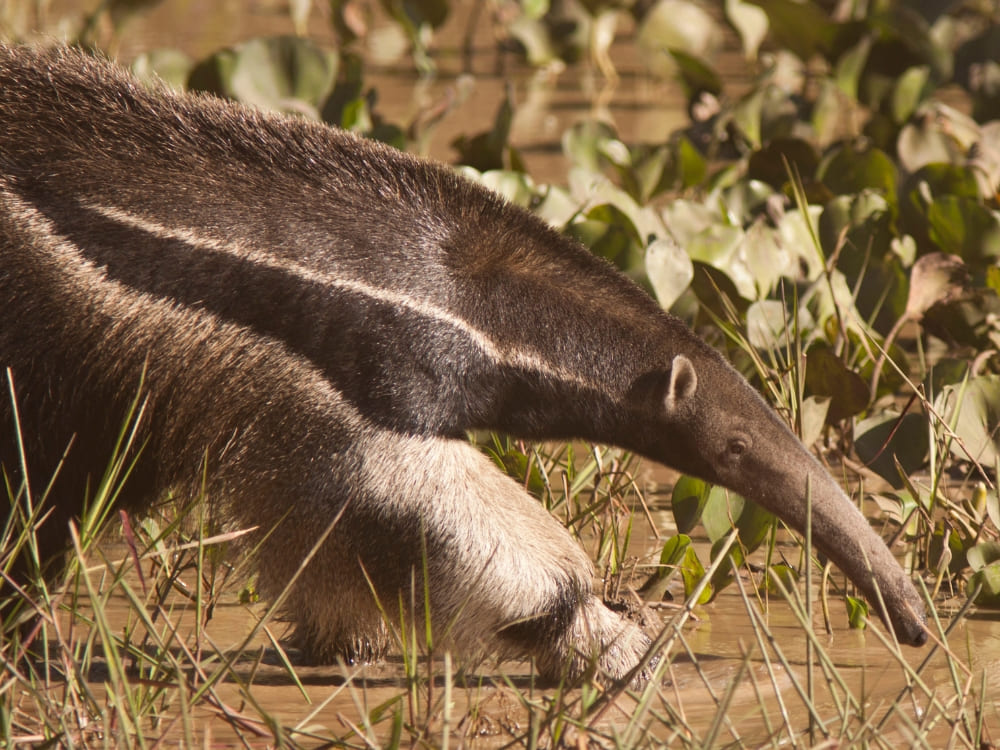
    A giant anteater with its distinctive long snout and black-and-white striped fur walks through shallow water and green aquatic plants in the Pantanal wetlands.
    Photo: Samuel Melim

    👉 Book now: Pantanal Wildlife Trip from Campo Grande

    Wild South Pantanal: Remote Wetland Adventure

    Nhecolândia is one of the Pantanal’s most iconic microregions, famous for its open fields, forest patches and seasonal lagoons near Negro River. This untouched land is perfect for travelers who thirst for adventure and seek for experiences deep into nature.

    While wildlife safaris are generally cost-effective, this one stands out for its exclusivity, high-end services and authentic activities in a remote area. Explore the wetlands to spot (and photograph) some of the most beautiful species in Brazil: giant armadillos, macaws, capybaras, toucans, and many more. 

    Aside from photo safaris, the itinerary also includes canoeing, fishing and horseback riding. When crossing the flooded plains on horseback, you’ll understand what Pantaneiro life is really about. Don’t forget your cowboy hat!

    By nightfall, relax in beautiful ecolodges equipped with comfy beds, air-conditioning, private bathrooms, charming decor and premium amenities. In the common areas, enjoy your stay in the lounge, library, garden or the orchard. Both accommodation options (BaĂ­a das Pedras and Barranco Alto) allow for gorgeous views of the Pantanal that will surely make your jaw drop.

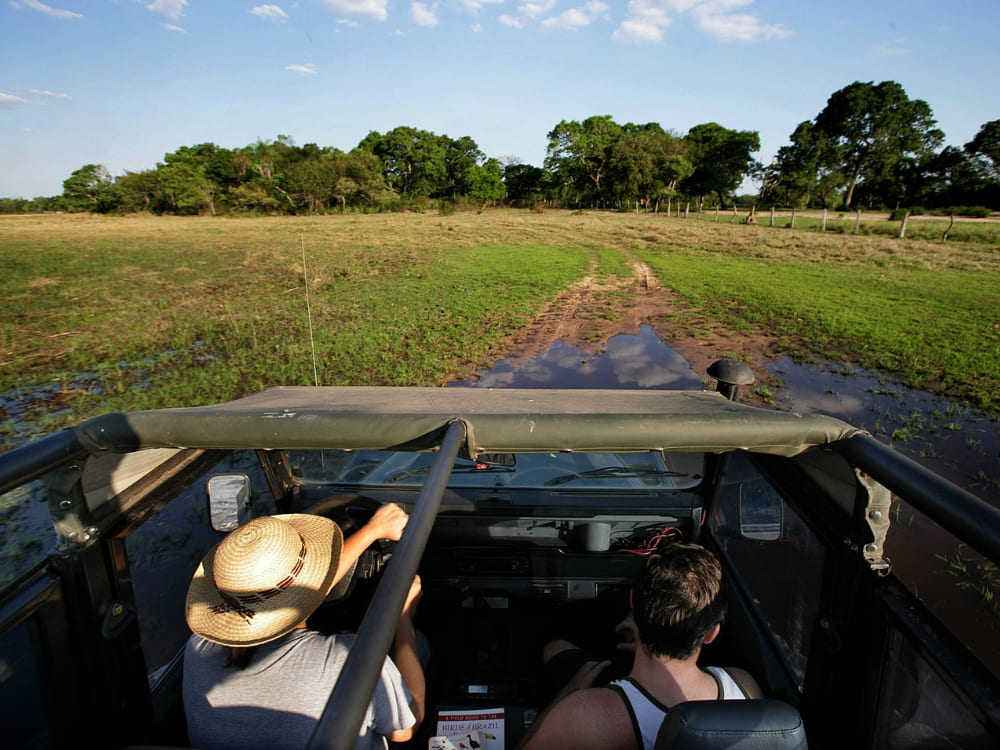
    View from inside a jeep traversing wet terrain, typical of an authentic Pantanal safari adventure.
    .

    👉 Book now: Wild South Pantanal: Remote Wetland Adventure

    Pantanal & Bonito Trip in Brazil

    Mato Grosso do Sul is blessed with the diverse natural beauty of Brazilian biomes, including the Pantanal, the Cerrado and the Atlantic Forest. 

    In this 5-day Brazil Pantanal safari, explore the largest wetlands on Earth with boat rides, horseback riding and wildlife tours on 4×4 vehicles to see ocelots, caimans, giant otters and deer in their native home.

    By the third day, you’ll hit the road towards Bonito (2-hour drive) where you’ll experience some of Brazil’s most beautiful scenarios, such as São Miguel Cave, Anhumas Valley Ecological Park, Barra do Sucuri and Formoso River. Hiking, swimming in natural pools and river floating are just a few of the amazing activities included in this trip.

    Choose your accommodation for both destinations based on your preferences and needs. All hotel options offer excellent services, delicious meals — full board in the Pantanal and half board in Bonito —, and facilities appropriate for couples, families or solo travelers.

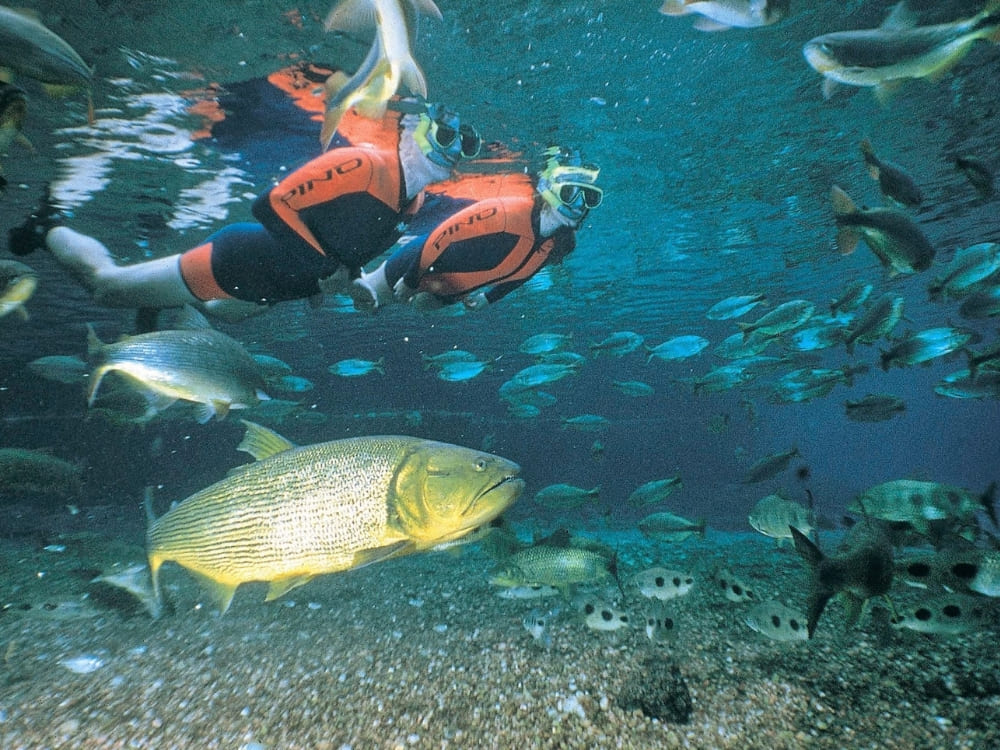
    Tourists snorkeling in a clear river with Dorado fish, a unique underwater Pantanal experience.
    .

    👉 Book now: 5-Day Pantanal Bonito Trip in Brazil

    Pantanal Wildlife Trip from Cuiabá

    If you are planning to travel to the Northern Pantanal, an excellent option is this Pantanal experience from Cuiabá. In Poconé, join nocturnal excursions, boat rides, horseback riding and hiking.

    Spotting jaguars can be difficult here — although not impossible —, but you’ll still have a thrilling experience in photo safaris to watch jabiru storks, marsh deer and capybaras. Make sure to capture the beauty of the flora, too: water lilies, wild orchids, bromeliads and ipês (Brazil’s national flower).

    Take advantage of the premium services of your accommodation and let your tiredness and problems melt away. Dive into the pool, get a tan on the sun deck, and appreciate the breathtaking natural view.

    A silhouette of a capybara in tall grass during a golden sunset, with two small birds perched on its head and back
    .

    👉 Book now: Pantanal Wildlife Trip from Cuiabá

    How much does a Pantanal safari cost?

    The average cost of a Pantanal safari is US$ 2,020 per person. Prices vary according to accommodation category, season, trip duration, etc

    See the main information below and choose your favorite!

    SAFARI HIGHLIGHTS STARTING PRICE*
    Pantanal Jaguar Safari in Porto Jofre (Cuiabá) Jaguar sightings, wildlife watching, boat rides, night spotting. US$ 2,645
    Pantanal Jaguar Photography Visit strategic areas to capture gorgeous shots of jaguars and other animals. Perfect for professional and amateur photographers. US$ 3,700
    Luxury Jaguar Safari High-end ecolodge with great chances of spotting jaguars in South Pantanal (the only one outside the North). US$ 3,200
    Pantanal Wildlife Trip (Campo Grande) Night and photo safari, piranha fishing, boat rides, horseback riding. US$ 1,150
    Pantanal Wildlife Trip (Cuiabá) Night and photo safaris, trekking, horseback riding, boat rides in Aquiauana River. US$ 1,355
    Wild South Pantanal: Remote Wetland Adventure Wildlife spotting, guided walks, canoeing and horseback riding in one of the Pantanal’s wildest areas. US$ 2,275
    Pantanal Bonito Trip Safaris and boat trips in South Pantanal followed by snorkeling and swimming in Bonito’s rivers and natural pools. US$ 1,395

    *Per person, based on double occupancy in group departures. Prices may vary depending on season and availability.

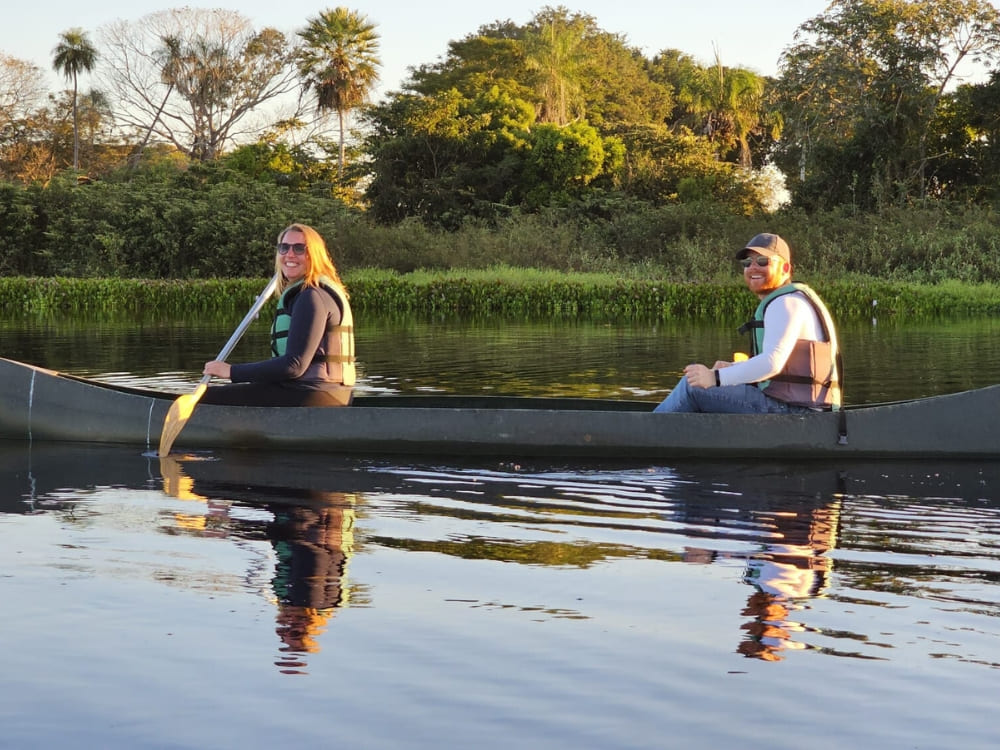
    Two travelers paddling a canoe through calm waters, an immersive way to explore the wetlands during a Pantanal tour.
    .

    Pantanal safari reviews

    It’s clear that the Pantanal in Brazil is one of the most spectacular ecotourism destinations on the planet, but what do travelers say? With the finest tour operators in the business, PlanetaEXO has taken hundreds of tourists to this paradise over the years.

    See what our customers think about some of our Pantanal safaris

    Book your Pantanal trip with PlanetaEXO

    PlanetaEXO is an ecotourism platform specialized in Pantanal tours. We’re committed to turning your dream vacation into a reality by assisting with bookings, tailor-made itineraries and everything else you might need.

    We also connect you with the best Pantanal tour operators to create authentic travel that will forever be engraved in your brain — and your heart. Contact us now!
  • When is the Best Time to Visit the Pantanal?

    When is the Best Time to Visit the Pantanal?

    As a destination heavily influenced by climate conditions, learn everything you need to know about seasons and the weather before you plan your Pantanal trip!

    The best time to visit the Pantanal is from May to October, covering the intermediate and dry seasons. However, this is an all-year round destination, since its seasons present different opportunities for activities amongst ever-changing landscapes.

    Just like other wetlands around the world, the annual rise and fall of water levels in the Pantanal provides the foundation for its ecological system. Although the region’s climate and wildlife behavior is heavily influenced by these seasons, they’re becoming more unpredictable each day due to climate change — which can cause variations in forecasts.

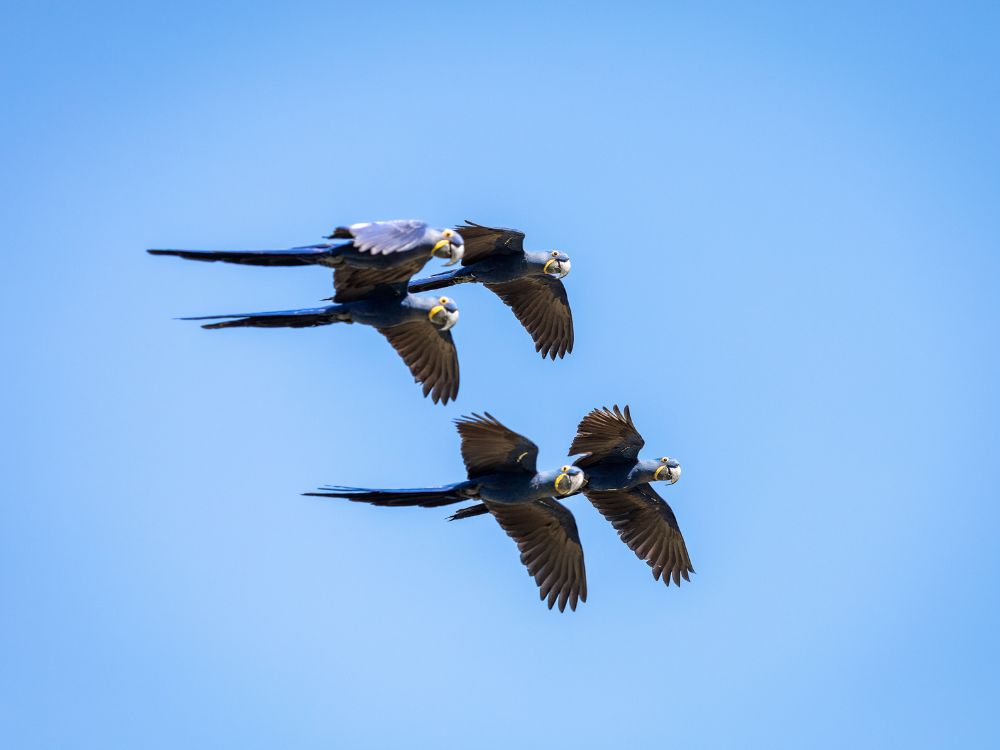
    Three Hyacinth Macaws flying in formation against a clear blue sky, a common sight during a Pantanal safari trip.
    Photo: Felipe Castellari, Caiman

    Seasons and the Pantanal weather by month

    The Pantanal has four well-defined main seasons: rainy, wet, intermediate and dry seasons.

    Due to its location in the Brazilian Highlights, temperatures remain relatively consistent year-round, averaging 27°C (80°F). In this guide, we’ll explain the differences between each season and the best time to book your Pantanal safari.

    Pantanal Rainy Season (November and December)

    The rainy season begins in November and lasts until December, bringing the first rains and transforming the landscape into a vibrant green. It marks the start of the regeneration cycle, with the flora growing and wildlife beginning to spread out again.

    The abundant food sources draw in hundreds of bird species, who take the opportunity to teach their young how to fly. Flocks of macaws and storks are often spotted, but sightings of mammals have become less frequent.

    The average temperature in November and December in the Pantanal ranges from 23°C to 28°C (73°F to 82°F), with increasing humidity as the rains commence​​.

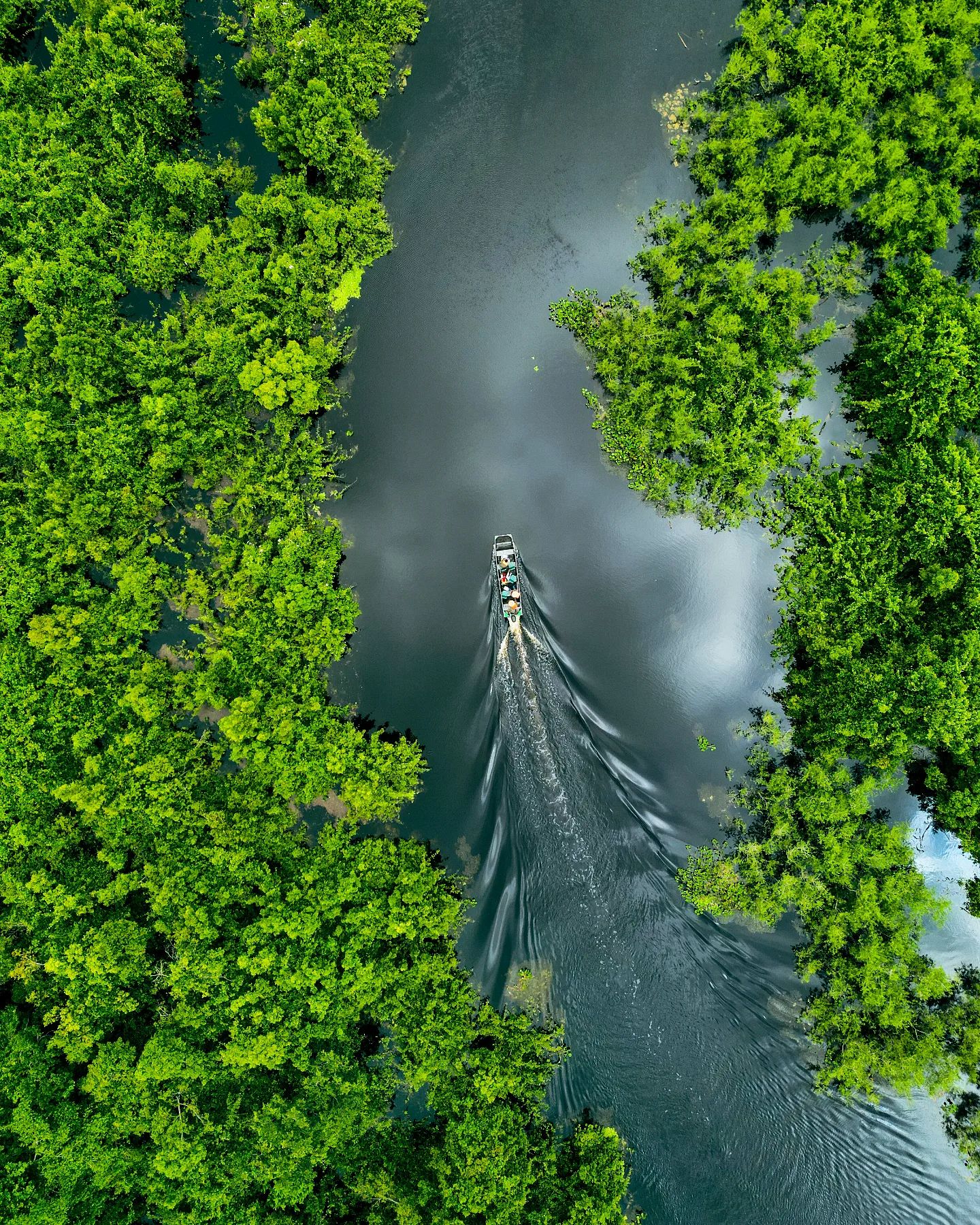
    An aerial view of a boat navigating through lush green waterways during the wet season, the best time to visit the Pantanal for landscape photography.
    .

    Pantanal Wet Season (December, January, February and March)

    The wet season in the Pantanal is also characterized by rainfall. During this period, the plains flood and the rivers overflow, creating a vast aquatic environment.

    January and February in the Pantanal are the months with the most rainfall during this season, making the landscapes even more dynamic and lush. It’s an ideal time to explore the biome by boat, as the waterways expand and offer access to remote areas.

    The wildlife — including caimans, capybaras, and countless species of birds — thrive in this atmosphere, but access to some areas may be limited due to high water levels. 

    With high humidity, the average temperature during the wet season ranges from 24°C to 29°C (75°F to 84°F).

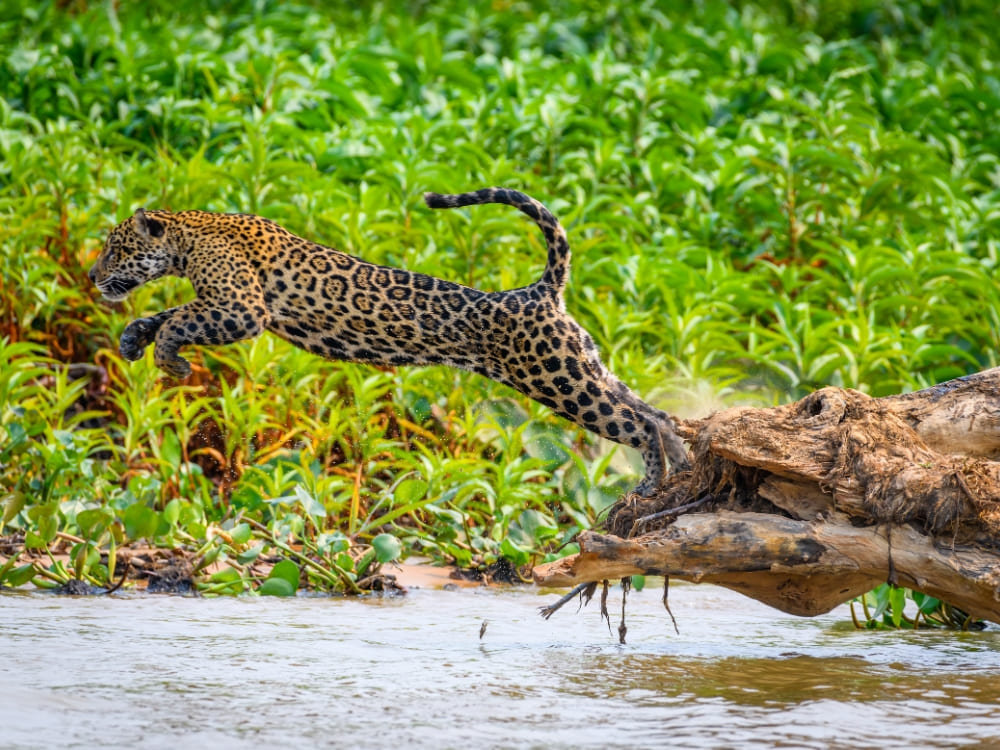
     A jaguar leaping from a log into the water, capturing the intense wildlife action seen on Pantanal tours.
    Photo: Aleksandrs Orlovs

    Pantanal Intermediate Season (April, May and June)

    From April to June, the intermediate season marks the transition from the wet to the dry season. As the water levels start to drop and more land is exposed, the animals that had scattered with the flood return to the plains once again.

    This time is excellent for birdwatching, as many species gather in the remaining waters. The landscape begins to dry, but the vegetation remains lush and green, offering a beautiful visual contrast.

    April brings starry skies and a milder weather that can make night expeditions even more delightful. By May, temperatures are consistently pleasant — great for Pantanal safaris during the day!

    Average temperatures range from 22°C to 27°C (72°F to 81°F), providing a slightly fresh, yet comfortable climate for exploration​​.

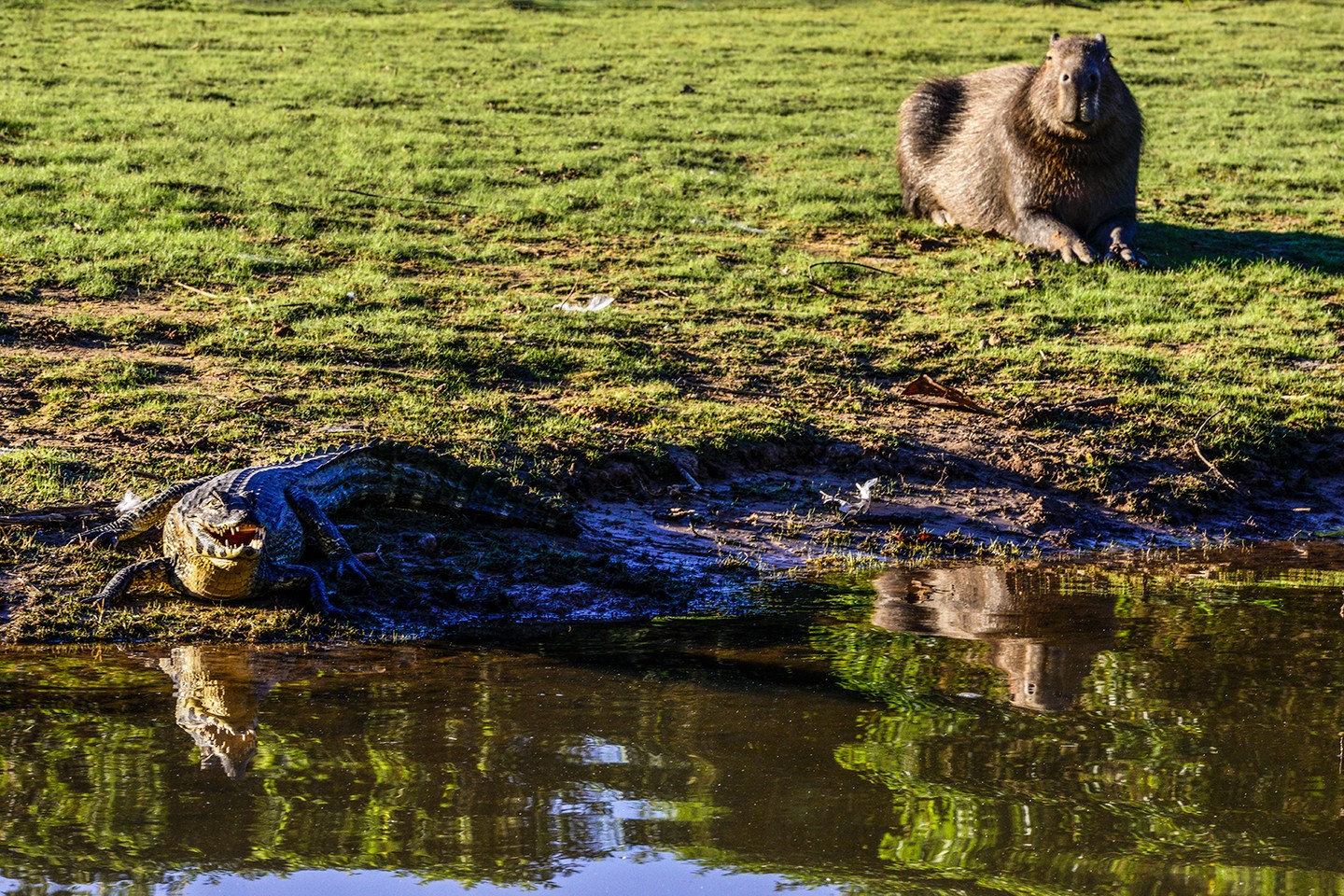
    A capybara resting on the grass near a caiman by the water's edge, typical of the diverse wildlife in the Pantanal wetlands.
    .

    Pantanal Dry Season (July, August, September and October)

    The dry season is arguably the best time for wildlife watching. As water sources diminish, Pantanal animals tend to cluster around the remaining watering holes, making them easier to spot.

    August, in particular, is known for clear skies and very little rain, ideal for safaris and photographic tours. It’s also a great time for horseback riding and walking tours, as the dry paths make exploration more accessible.

    The average temperature during ranges from 20°C to 26°C (68°F to 79°F), making it the most pleasant season for outdoor activities.

    A traveler horseback riding through shallow wetlands, a popular activity when exploring the Pantanal.
    Photo: VisitMS

    When is the best time to see jaguars in the Pantanal?

    In North Pantanal — aka the best place in the world to see jaguars —, the animals begin to concentrate on the riverbanks as the water level starts to drop, between the intermediate season (May to June), and continue to gather until October, during the dry season.

    This significantly increases the chances of spotting jaguars, making this the best time to go to the Pantanal for many travelers, who can enjoy unforgettable moments on boat safaris in Porto Jofre to watch these magnificent creatures in their natural habitat.

    However, in South Pantanal, there is a hidden gem: an ecological refuge that offers the Luxury Jaguar Safari. Here, visitors can see jaguars at any time of the year, regardless of the season, as they are protected in preserved areas and are accustomed to the presence of humans. Safaris are done by 4×4 vehicles, providing an exciting and immersive experience.

    A jaguar resting on a tree branch in the North Pantanal, observed during the dry season which is the best time to visit the Pantanal for big cats.
    Photo: Henk-Bogaard

    👉 Read more: North or South Pantanal: which is best to visit?

    North Pantanal weather

    Porto Jofre, in the municipality of Poconé, Mato Grosso, is the Northern Pantanal main town, where most of the lodges are located. See what the weather is like right now:

    South Pantanal weather

    Corumbá, in Mato Grosso do Sul, is one of the surrounding towns of the Southern Pantanal. Aquidauana and Miranda are also important getaways for the wetlands. This is the current weather:

    👉 Read more: How to get to the Pantanal, Brazil

    Book your Pantanal trip with PlanetaEXO

    Now that you know when is the best time to visit the Pantanal in Brazil and learned a little more about the weather and the seasons, let’s start planning your vacation!

    PlanetaEXO specializes in Pantanal tours and works with the best local operators to make sure your travel and stay experiences are unlike any other. Contact us now!
  • 5 Pantanal Conservation Projects Making a Real Impact

    5 Pantanal Conservation Projects Making a Real Impact

    Conservation projects in South America  make a real difference to ensure protection for the area’s rich biodiversity, including the Pantanal in Brazil

    The Pantanal is a vast floodplain covering around 210,000 km² of Brazilian territory. One of the most abundant ecosystems on the planets, it spans across the states of Mato Grosso and Mato Grosso do Sul. With over 4,000 cataloged species, it stands out as a vital sanctuary for South American wildlife.

    Yet, despite its richness, it faces increasing threats. Deforestation, agricultural expansion, uncontrolled fires, and the growing impact of climate change put immense pressure on this delicate biome. The good news is that there are numerous efforts to ensure its protection, such as environmental laws, sustainable travel, and Pantanal conservation projects.

    A firefighter equipped with a blower works to control flames during a vegetation fire in the Pantanal.
    @diego_baravelli

    PlanetaEXO, an ecotourism platform specializing in Pantanal tours, has selected 5 non-profits known for their impact and commitment to preserving natural habitats, promoting sustainable land use and continuous work to ensure that the wildlife thrives for many years to come. Learn more below!
    1. Onçafari Project

    Onçafari is one of the most important wildlife conservation efforts in South America. Its mission is to safeguard Brazil’s biodiversity by protecting natural areas and supporting the socioeconomic development of local communities.

    In the Pantanal, it focuses on raising awareness on importance of jaguars and promoting ecotourism as a sustainable income-generating alternative. Since 2011, the Onçafari Project has operated in partnership with Caiman, an ecological refuge situated in Miranda (MS). 

    An Onçafari project guide wearing a mask holds binoculars while standing next to a yellow Pantanal safari vehicle.
    Photo: Felipe Castellari

    Through ongoing work to familiarize the animals with humans and vehicles, guests at Caiman can enjoy privileged and safe sightings of jaguars and other species. While the North Pantanal is the best place to see jaguars, this is the only location in the South where they’re often observed.

    Ecotourism helps to boost conservation values and the local economy, but Onçafari also acts on scientific research, animal reintroduction to the wild, environmental education, social inclusion, and forest management.

    How to help the Onçafari Project

    Support Onçafari by visiting Caiman through responsible tourism, following their conservation activities, or making a donation. 

    👉 Read more: What is the best Pantanal safari in Brazil?


    2. SOS Pantanal

    Operating since 2009, SOS Pantanal plays a key role in protecting the biome’s biodiversity while promoting sustainable land use practices. The mission is clear: to preserve the ecological and cultural richness of the region, ensuring a balanced future for both nature and local communities.

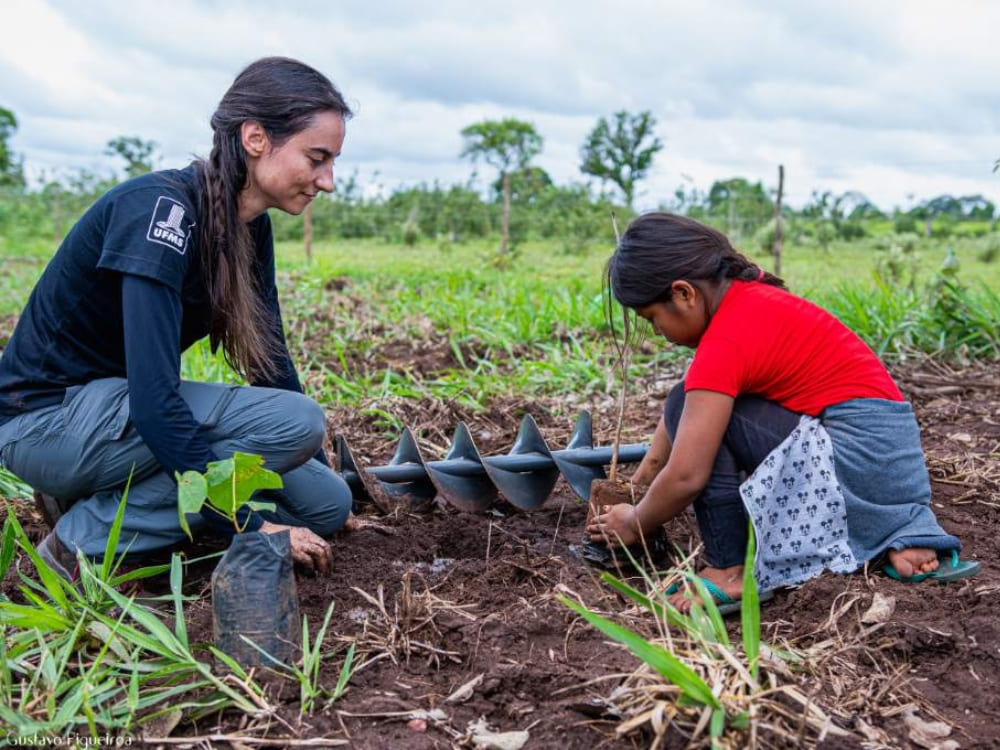
    A woman from the SOS Pantanal project and a young local girl use an earth auger to plant a tree seedling together.
    Photo: SOS Pantanal Project

    The activities of this Pantanal conservation project are built around three pillars:

    1. Governance and water security
    2. Environmental protection and restoration
    3. Forest fire prevention and control

    By engaging with landowners, researchers, authorities, and local organizations, SOS Pantanal strengthens public policies, encourages sustainable production, and restores degraded areas. Environmental education and social engagement are also crucial aspects of their work, making conservation a shared responsibility across the region.

    How to help SOS Pantanal

    Raise awareness about sustainable practices, promote products from local producers, engage with the project’s official channels on social media, or make a donation.

    3. Jaguar Identification Project

    The Jaguar Identification Project is dedicated to the long-term study and conservation of jaguars in Brazil’s Pantanal by using non-invasive techniques like spot pattern recognition and camera traps.

    A large jaguar walks past a motion-activated camera trap strapped to a tree for the Jaguar Identification Project.
    Photo: Jaguar Identification Project

    The project builds a detailed database of identified individuals, helping researchers understand the animals’ behavior, territoriality, and preservation needs.

    Beyond studies, it promotes environmental education for residents and visitors, strengthening support for the biome’s protection and highlighting the role of the jaguar as a symbol of a healthy Pantanal.

    How to help the Jaguar Identification Project

    When visiting the Pantanal conservation areas, choose companies that support scientific research initiatives, share the Jaguar ID Project’s content to raise awareness, and donate or buy official merch.

    👉 Read more: When is the best time to visit the Pantanal?

    4. Blue Macaw Project

    The Blue Macaw Project is a powerful example of how science and community engagement can bring a species back from the brink of extinction.

    Biologist Neiva Guedes smiles while gently holding a blue hyacinth macaw outdoors.
    Photo: Blue Macaw Project

    Focused on the hyacinth macaw (Anodorhynchus hyacinthinus), the project was founded in 1990 by biologist Neiva Guedes. Its main activities include monitoring natural and artificial nests, tracking reproduction, and collecting data on other bird species, which include scarlet macaws, toucans, hawks, owls, and other Pantanal animals that share the same habitats.

    Thanks to the dedicated Pantanal biodiversity protection efforts, the hyacinth macaw population has grown significantly, improving its conservation status on the IUCN Red List from “endangered” to “vulnerable” in 2014.


    How to help the Blue Macaw Project

    Avoid and report illegal pet trade, help spread awareness about the protection of native species, sponsor a nest or a chick, buy official merch or make a donation. Learn more about how to support the Blue Macaw Project.

    5. Giant Otter Project

    The giant otter (Pteronura brasiliensis) is the largest mustelid in South America. This species lives in cohesive family groups throughout the rivers and lakes of the Pantanal, the Cerrado, and the Amazon. Despite its role in aquatic ecosystems, it’s classified as critically endangered due to habitat degradation, human conflict, and illegal hunting.

    Two giant otters rest closely together on a wooden log in their natural aquatic habitat.
    .

    Since 2019, the Giant Otter Project has been dedicated to safeguarding the species and its habitats through population monitoring, scientific research, environmental education, and the promotion of sustainable tourism.

    In 2024, the non-profit monitored over 190 km of Pantanal rivers and identified 82 otters in 13 family groups.

    A team of researchers carefully examines a giant otter on a blue medical table as part of a wildlife monitoring project.
    Photo: Giant Otter Project

    How to help the Giant Otter Project

    Choose responsible tourism companies, join educational activities on aquatic conservation, buy official merch or make a donation.

    👉 Read more: How to get to the Pantanal, Brazil

    Why do supporting Pantanal conservation projects and sustainable travel matter?

    Initiatives aimed at protecting wildlife and conservation areas in the Pantanal are imperative to maintaining the well-being of the biome.

    Through research, species cataloging, and educational programs, fauna and flora are protected and restored to ensure that the ecosystem has a chance to survive and thrive in the face of problems such as global warming and deforestation.

    Sustainable tourism is also fundamental, as it increases the public’s interest and knowledge about the importance of environmental preservation and boosts the local economy to benefit the financial health of families and small businesses.

    Responsible travel in the Pantanal with PlanetaEXO

    PlanetaEXO is an ecotourism platform specializing in Pantanal tours that works with the best local operators to ensure experiences that cause a positive impact on the environment, the local communities and, of course, the travelers.

    Besides following responsible tourism practices, we help plan your vacation according to your preferences and needs when it comes to comfort, immersion in nature and tailor-made itineraries. Contact us now!
  • North or South Pantanal: Which One Should you Visit?

    North or South Pantanal: Which One Should you Visit?

    North Pantanal is ideal for jaguar sightings and photo safaris, while South Pantanal is great for wildlife watching and cultural immersion. Let’s find out what’s the better option for you!

    The Pantanal in Brazil is divided into two distinct regions: North and South. While both are stunning and worth the visit, they’re accessed through different states/cities and offer contrasting styles of safaris and ecotourism experiences.

    Understanding the differences between North and South Pantanal is crucial to your vacation planning so you can know exactly what to expect regarding experiences, transfer options and accommodation.

    PlanetaEXO, an ecotourism platform specialized in Pantanal tours that works with the best local operators, has put together a comprehensive guide outlining the key differences between these two regions to help you decide which destination best matches your travel style. Check it out below!

    What Is the Pantanal?

    The Pantanal, located in the Central-West region of Brazil, is the largest wetland in the world, as well as the most well-preserved biome in the country, with 84% of its original landscape still intact, according to the Brazilian Agricultural Research Corporation. Due to its environmental significance, it was designated a UNESCO World Natural Heritage Site and a Biosphere Reserve in 2000.

    Panoramic aerial view of flooded plains, winding rivers, and green forests of Pantanal, Brazil under a bright sun.
    .

    Spanning over 210,000 km², it’s so big it’s split into two states: Mato Grosso and Mato Grosso do Sul. If you’re wondering about whether you should go to North or South Pantanal, the answer depends on what you’re looking for: jaguar sightings, cultural immersion or easier access.

    North Pantanal: jaguar safaris and remote adventures

    • Main access: Cuiabá (Mato Grosso)
    • Top destination: Porto Jofre, via Transpantaneira Highway
    • Best time to visit: July to October (dry season)
    • Main highlight: Jaguar spotting tours by boat
    A wild jaguar walking along a riverbank during a North Pantanal safari, the premier region for jaguar sightings and wildlife tours.
    .

    The North Pantanal is strongly influenced by the Amazon Rainforest, presenting denser and more closed vegetation, as well as floodplains, rivers and lakes. It’s also one of the best places in the world to see jaguars, especially between June and October, along the banks of the Cuiabá River.

    If your priorities include wildlife watching, engaging in cultural experiences, or enjoying water-based activities, a Pantanal safari in the North is likely the best choice for you!

    Tourists and photographers observing a jaguar in a tree, a highlight of a Pantanal trip focused on wildlife photography in the Northern Pantanal.
    @larissa_pantanal

    👉 Read more:

    Pros and cons of Northern Pantanal

    Pros:

    • High chances of spotting jaguars.
    • Chances to see birds and species influenced by the Amazon that do not descend to the South.
    • Great for photographers and wildlife lovers — especially during the dry season, from July to October, when the wildlife is even more diverse.

    Cons:

    • Remote location, long transfers.
    • Less interaction with the day-to-day life of the farm or the Pantaneiro cowboy.
    • Jaguar safaris are usually more expensive due to high demand, limited availability and complex logistics.
    A family of capybaras on a grassy bank, a common wildlife sighting on a Pantanal tour in both the North and South regions.
    Photo: Ondrej Prosicky

    South Pantanal: classic ranch experience and family-friendly safaris

    • Main access: Campo Grande (Mato Grosso do Sul)
    • Top areas: Aquidauana, Miranda, Corumbá
    • Best time to visit: May to September (dry season)
    • Main highlight: Stay at traditional fazendas (ranches) and explore on land

    The South Pantanal features a landscape of savannas and forested areas influenced by the Cerrado and the Paraguayan Chaco. This results in more open landscapes and clear fields, which offer great opportunities for land-based activities and close encounters with wildlife in a well-preserved environment.

    Tourists in an open-air vehicle enjoying a South Pantanal adventure, ideal for land-based Pantanal safaris and exploring the savanna.
    .

    Most of the lodges are active or former cattle farms that have been converted into smaller, more intimate accommodations, with a strong focus on Pantanal-related experiences and ranch traditions. Canoeing, land safaris, horseback riding and wildlife observation are common activities.

    Traditional cowboys riding horses in the Southern Pantanal, offering cultural immersion often included in a Pantanal road trip or farm stay.
    Photo: Samuel Betkowski

    Southern Pantanal also pairs well with a trip to Bonito, one of Brazil’s top ecotourism destinations, known for snorkeling in crystal-clear rivers and cave exploration.

    👉 Learn more and book now: 5-Day Pantanal Bonito Tour in Brazil

    For travelers prioritizing ease of travel and comfort, South Pantanal offers a more relaxed and accessible experience!

    Pros and cons of Southern Pantanal

    Pros:

    • Easier access from Campo Grande.
    • Cultural immersion with the Pantaneiro routine and local traditions.
    • Stay experience based on comfort and exclusivity, including luxury lodges like Caiman.
    • Varied land activities, like hiking, horseback rides and wildlife watching.
    • Great for travelers looking forward to exploring the Pantanal on a budget.
    • Easy access to Bonito (MS).

    Cons:

    • Lower chances of seeing jaguars — they exist and are seen in certain areas, but in smaller quantities and frequency compared to the North.
    • Wildlife is more dispersed than in the North, meaning land safaris require more patience for wildlife watching.

    A scenic sunset with palm trees in the Southern Pantanal, known for its open landscapes and accessible Pantanal tours.

    North vs. South Pantanal in Brazil: What’s the most suitable for you?

    Here’s how to choose the ideal region for your Pantanal trip, depending on the experience you’re looking for.

    Choose the North Pantanal in Brazil if you want to:

    Book your tour to North Pantanal if you want:

    • Jaguar safaris and wildlife photography: best place for jaguar watching, especially from July to October.
    • Boat safaris and wildlife viewing: boat rides are also great for spotting other Pantanal animals, including caimans, capybaras, giant anteaters, hyacinth macaw, etc.

    Book your tour to South Pantanal if you want:

    • Activities on land: guided hikes, horseback rides and wildlife safaris.
    • Extended vacation in Bonito, Mato Grosso: popular destination for snorkeling in crystal-clear rivers and underground natural pools;
    • Immersion in rural traditions: experience local life and learn everything about traditional music, food and other Pantanal cultural aspects.
    A flock of birds flying at sunset during the dry season, which is often cited as the best time to visit the Pantanal for wildlife viewing.
    .

    How much does a Pantanal tour cost?

    The average cost of a Pantanal tour is US$ 1,995 per person. Prices vary according to accommodation category, season, trip duration, etc.

    Still not sure if you should go to the North or South Pantanal? Compare our handpicked tour options in both regions!

    Northern Pantanal tours

    TOUR HIGHLIGHTS DURATION STARTING PRICE*
    Pantanal Jaguar Photography Tour Capture breathtaking shots of the rich wildlife (recommended for professional and amateur photographers). 6 days US$ 3,700
    Pantanal Jaguar Safari in Porto Jofre, Cuiabá Visit Porto Jofre, home to the world’s largest jaguar population. 4 days US$ 2,650
    Pantanal Jaguar Budget Safari Multiple chances to spot jaguars, capybaras, caimans, and exotic birds. 4 days US$ 1,860
    Pantanal Tour from Cuiabá Wildlife watching, horseback riding through open fields and floodplains. 4 days US$ 1,355

    Southern Pantanal Tours

    TOUR HIGHLIGHTS DURATION STARTING PRICE*
    Luxury Jaguar and Wildlife Safari High-end lodge with great chances of spotting jaguars in the Southern Pantanal. 4 days US$ 3,200
    Pantanal Bonito Tour Travel from the wetlands to Bonito through changing landscapes. 5 days US$ 1,395
    Pantanal Wildlife Trip from Campo Grande Activities include photo and night safaris, boat rides, and piranha fishing. 4 days US$ 1,150
    Budget Pantanal Tour Budget-friendly adventure with shared rooms, walking safaris, boat tours and horseback riding. 4 days US$ 660
    *Per person, based on double occupancy in group departures. Prices may vary depending on season and availability. Exchange rate as of February 2nd, 2026; subject to change.

    Can you visit both the Northern and Southern Pantanal?

    Yes, but it requires time and good logistics. The two areas are more than 1,000 km apart, and there’s no direct road between them.

    If you’re planning a longer itinerary and want to experience both, flying between Cuiabá and Campo Grande is your best option.

    Close-up of a jaguar resting in the North Pantanal, the best destination for travelers seeking intense Pantanal safari experiences.
    .

    👉 Read more: How to get to the Pantanal, Brazil

    Should you choose the North or South Pantanal?

    The Northern Pantanal is your best bet if you’re after jaguar sightings, boat safaris, wildlife photography or a wilder, more remote experience.

    Meanwhile, the Southern Pantanal is a better fit if you’re looking for easier access, comfortable ecolodges, wildlife viewing not focused on jaguars and a broader mix of land-based activities. It’s also the ideal choice if you want to combine your trip with a visit to Bonito.

    Keep in mind: regardless of the region, the water cycle rules. A greater concentration of animals happens in the dry season when they seek out the remaining rivers and lagoons.

    Tourists canoeing near an ecolodge, a sustainable activity for a Pantanal trip that combines adventure with nature preservation.
    .

    Book your Pantanal tour with PlanetaEXO

    Whether you choose the North or the South, PlanetaEXO specializes in Pantanal tours in both areas. We work closely with the best local operators and ecolodges committed to sustainable practices and preserving the Pantaneiro way of life.

    Contact us and let’s start planning your Pantanal safari right now!
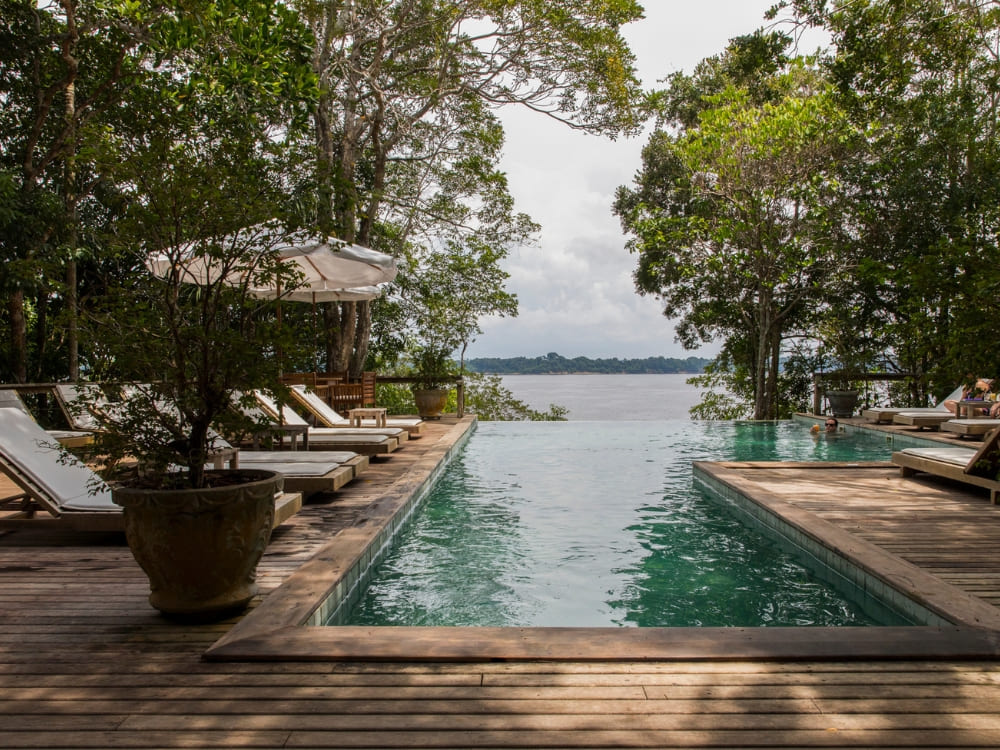
  • How to Get to the Pantanal, Brazil

    How to Get to the Pantanal, Brazil

    Find out how to reach North or South Pantanal and experience the adventure of a lifetime on the planet’s largest wetland!

    The easiest way to get to the Pantanal is by flying to Brazil’s Cuiabá (North Pantanal) or Campo Grande (South Pantanal), the two main gateways to the region. From there, travelers continue by car, private transfer, or small-plane flight to lodges located in the states of Mato Grosso and Mato Grosso do Sul.

    Covering more than 210,000 square kilometers, the Pantanal is the world’s largest tropical wetland. Its immense floodplains and interconnected rivers host over 650 bird species and hundreds of mammals. Whether you arrive by road or air, the journey offers scenic views and your first glimpses of wildlife before you even reach your final destination.

    A rustic wooden gate marks the entrance to the Transpantaneira Highway. This landmark is essential for those learning how to get to the Pantanal from the North Pantanal side.
    @mateusrauber

    To help with your vacation planning, PlanetaEXO, an ecotourism platform specialized in Pantanal tours that works with the best local operators, created a guide on how to get to the Pantanal. Check it out below!
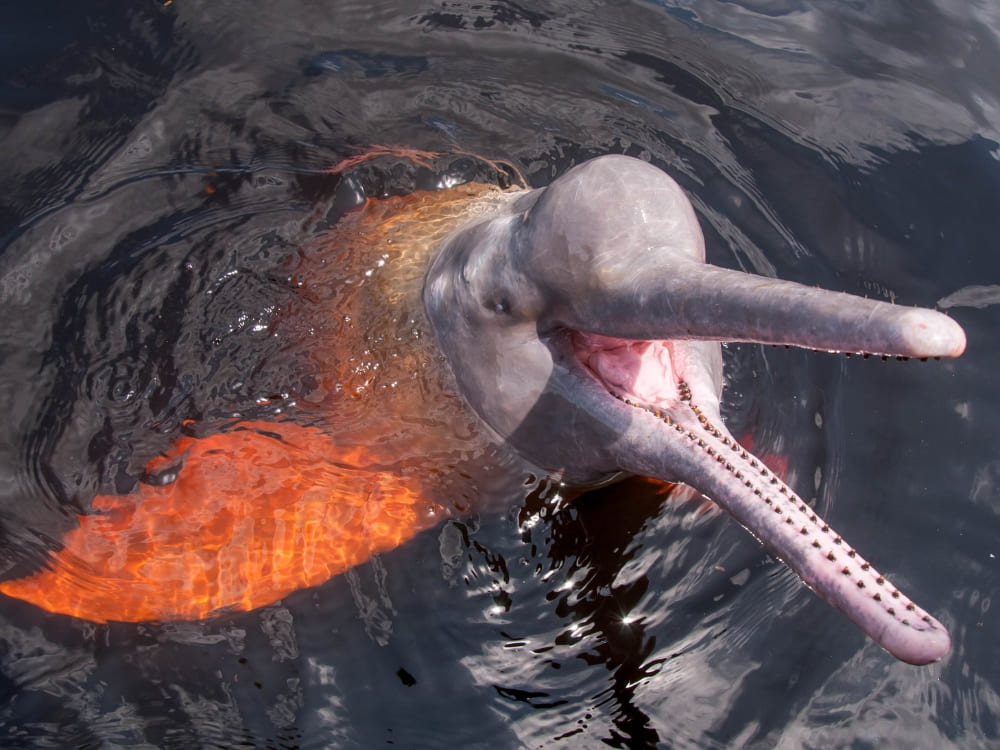
    How to get to Northern Pantanal?

    The Northern Pantanal is accessed through Cuiabá (CGB Airport), capital of Mato Grosso. This airport receives daily flights from São Paulo, Brasília, and other major cities, making it the main entry point for travelers heading north.

    From Cuiabá, it takes about 2 hours by car to reach Poconé, the last town before the wetlands and the gateway to most northern lodges. The adventure continues along the Transpantaneira Highway, a 147-kilometer dirt road connecting Poconé to Porto Jofre.

    Depending on where your accommodation is located, transfers can take 4 to 6 hours. Lodges near Poconé are easier to access year-round, while those closer to Porto Jofre are fairly remote and ideal for jaguar watching.

    If you prefer speed and comfort, charter flights from Cuiabá to Porto Jofre are available, offering breathtaking aerial views of this magical place.

    Close-up of a jaguar snarling in the wild. High wildlife density makes a pantanal safari in the North Pantanal the top choice for photographers.
    Photo: Pedro Ferreira do Amaral

    👉 Book now: Pantanal Jaguar Safari from Porto Jofre

    How to get to the Southern Pantanal?

    Land in Campo Grande Airport (CGR), capital of Mato Grosso do Sul, to get to South Pantanal. Like Cuiabá, Campo Grande receives frequent domestic flights and serves as the starting point for trips to the surrounding towns: Aquidauana, Miranda, and Corumbá.

    From Campo Grande, the road to Aquidauana takes about 2 to 3 hours, while Miranda and Corumbá require 4 to 6 hours of driving. Transfers are typically done in comfortable private vehicles, while some tours even include stops for short photo breaks.

    In rainy months, remote lodges may require 4Ă—4 vehicles or small-plane transfers, while the roads remain accessible during the dry season.

    A safari vehicle crosses a wooden bridge over a reflective river at sunset. A typical scene during an adventurous pantanal trip and pantanal safari.
    Photo: Felipe Castellari

    👉 Book now: Pantanal Luxury Safari from Campo Grande

    How to get to the Pantanal from Rio de Janeiro or SĂŁo Paulo?

    Many foreign tourists land in Rio de Janeiro or SĂŁo Paulo upon arrival in Brazil, since these cities are served by flights from all over the world. From there, you can either get another flight or reach your final destination on the road (by car or bus).

    By air

    From Rio to the Pantanal, 3-hour flights departing from Santos Dumont (SDU) or Galeão (GIG) will take you straight to Cuiabá (CGB), which will lead you to the North Pantanal. In São Paulo, flights from Guarulhos (GRU), Congonhas (CGH), or Viracopos (VCP) should reach the capital of Mato Grosso in 2 hours.

    Going to South Pantanal? Headed to Campo Grande (CGR), 3-hour direct flights depart from Rio’s Galeão or Santos Dumont on selected days. Meanwhile, daily flights from São Paulo’s previously mentioned airports are headed straight to the capital of Mato Grosso do Sul.

    Due to its proximity to the Southern Pantanal, Bonito Airport (BYO) is also an option. There are no direct flights from Rio, only São Paulo (2–3 times a week).

    All flights to Cuiabá, Campo Grande or Bonito are operated by Azul, GOL or LATAM airlines.

    By road (car/bus)

    Getting to North Pantanal from Rio de Janeiro requires a 2,000 km drive (over 26 hours). Meanwhile, it takes 1,531 km (20 hours) from SĂŁo Paulo. Once you’re in Cuiabá, take the Transpantaneira Highway to PoconĂ© (100 km).

    To get to South Pantanal, drive 1,421 km (18 hours) from Rio de Janeiro or 983 km (12 hours) from São Paulo. Upon arrival in Campo Grande, you can continue on your way to Aquidauana, Miranda or Corumbá to finally kickstart your Pantanal safari.

    If you choose to go by bus, depart from Novo Rio Bus Station in Rio de Janeiro or Tietê and Barra Funda bus stations in São Paulo to get to both Cuiabá and Campo Grande. The journey takes 18 to 32 hours, depending on your final destination, bus schedule, etc.

    Aerial view of a safari vehicle driving on a dirt track between a wetland area and dense green forest in North Pantanal.
    @luiz4mendesreserva

    What is the Pantanal airport?

    There’s no airport near the Pantanal, since its location is significantly isolated. Travelers going to North Pantanal in Mato Grosso land in Cuiabá (CGB), while Campo Grande (CGR) or Bonito (BYO) serve South Pantanal, in Mato Grosso do Sul.

    Meaning “beautiful” in Portuguese, Bonito is a wonderful place known for its impressive rivers, waterfalls and caves. Only a 2 and a half hour drive away from the Southern Pantanal, it’s the perfect place to explore Brazil’s phenomenal nature!
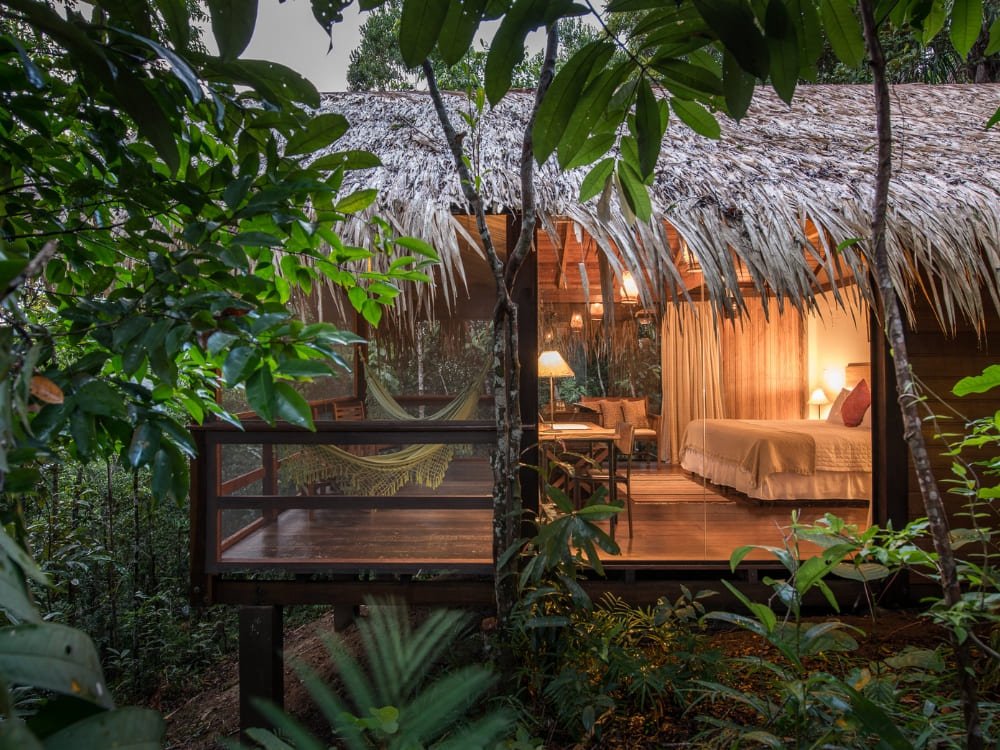
    👉 Book now: 5-Day Pantanal Bonito Tour in Brazil

    Valuable tips for getting to the Pantanal

    The journey to your final destination is an adventure in itself when it comes to Pantanal trips. Here are some valuable tips for a smooth transfer:

    • The best time to move around the Pantanal on land is from May to September, when the weather is drier. During wet seasons, dirt roads tend to become impassable.
    • 4×4 vehicles are highly recommended on the Transpantaneira Highway and Parque Pantanal Road, especially when it rains.
    • Check Google Flights to find affordable flights from Rio de Janeiro or SĂŁo Paulo to the Pantanal. Sometimes, plane tickets can be cheaper than bus fares!
    • Plane tickets and bus fares schedules or prices might change unexpectedly due to high demand, seasonality, availability, etc. Check the conditions with official operators and buy your tickets in advance.
    • You should also book your Pantanal safari in advance — at least 6 months. It all depends on itineraries, your desired experiences, season, etc. But if you’re on short notice, it’s still worth to give it a try!

    PlanetaEXO helps you with the best transfer options for travelers going to the Pantanal. For your comfort, some experiences even include private shuttle services. See more information in our Pantanal tours and book your adventure!

    North or South Pantanal: choose your destination

    Now you know how to get there, but here’s the burning question: should you visit the North or South Pantanal? The answer depends on what kind of experience you’re looking for.

    Northern Pantanal is famous for boat safaris and jaguar spotting along the Cuiabá, Piquiri, and São Lourenço rivers. Wildlife density is higher here, making it the top choice for photographers and nature enthusiasts who want close encounters with animals.

    A jaguar walks through shallow river water during a boat safari. The best time to visit the Pantanal for a pantanal safari is the dry season.
    @reisegraf

    👉 Read more: Where is the best place to see jaguars in the Pantanal?

    Southern Pantanal is better known for its authentic ranch experience and cultural immersion. Activities such as horseback riding, birdwatching, and night safaris offer a peaceful and intimate connection with nature!

    A traveler riding a horse through golden fields. This region of South Pantanal offers an authentic ranch experience for your pantanal trip.
    Photo: Layla Motta, Caiman

    Where to stay in Pantanal?

    Hotels in Cuiabá are good options for people going to Northern Pantanal. Closer to the actual wetlands, travelers can stay near Poconé or along de Transpantaneira Highway.

    In the South, Campo Grande has great urban hotels. For Pantanal lodges immersed in nature, accommodations in Aquidauana, Miranda and Corumbá are the most convenient.

    An elegant courtyard of one of the many Pantanal lodges, featuring yellow arches and wooden chairs around a fountain.
    Photo: Caiman Lodge

    👉 See more details: Where to stay in Pantanal?

    When is the best time to visit the Pantanal in Brazil?

    This is a year-round destination, but many people consider the period from May to October the best time to visit, when the weather is dry and Pantanal animals gather near rivers and lagoons. These months offer clear skies, pleasant temperatures, and the highest chances of observing diverse wildlife across both regions.

    In the dry season (July, August, September and October), travelers in Northern Pantanal also enjoy greater opportunities to spot jaguars along the riverbanks. The landscape floods and transforms into a vibrant mosaic of water and vegetation in the wet season (December, January, February and March).

    A family of capybaras resting on a grassy riverbank during a pantanal safari. Most animals gather near water during the dry season.
    Photo: Ondrej Prosicky

    👉 See more details: When is the best time to visit the Pantanal?

    Book your Pantanal trip with PlanetaEXO

    We hope you’ve enjoyed our guide on how to get to Pantanal in Brazil! Exploring this phenomenal destination with PlanetaEXO, an expert platform in Pantanal tours, means traveling responsibly alongside some of the best operators in the game.

    Each Pantanal safari is designed to minimize environmental impact while supporting the people who preserve the ecosystem every day. Contact our team and let the adventure begin!

  • Where to Stay in the Pantanal?

    Where to Stay in the Pantanal?

    Lodges are a crucial part of the Pantanal travel experience in terms of comfort, safely exploring the wetlands and connecting with nature

    When planning a trip to the Pantanal, it’s important to understand how travel in the region works. Unlike traditional destinations, you don’t stay in a city and go out for activities. Here, the adventure is built around staying in a lodge, often located in remote natural areas.

    These accommodations are spread across two main regions: the North Pantanal (accessed via Cuiabá, in Mato Grosso) and the South Pantanal (via Campo Grande, in Mato Grosso do Sul). From these gateway cities, travelers are transferred to the lodges. Once there, all activities are scheduled and operated directly by their teams, such as wildlife safaris and other experiences adapted to seasons and local conditions. 

    A majestic jaguar walks through the green vegetation during a wildlife safari in the Northern Pantanal.
    Photo: Donal Boyd

    Because of the remoteness and logistics involved, planning this journey requires the assistance of reliable professionals. At PlanetaEXO, an ecotourism platform specializing in Pantanal tours, we work with the best local operators who are responsible for organizing the full experience, including transfers to and from the lodges and the coordination of activities.

    See below for our suggestions on where to stay in the Pantanal!

    Northern Pantanal lodges

    Porto Jofre, in the municipality of Poconé, is the main destination in the Northern Pantanal, located at the end of the Transpantaneira Highway.

    The region is considerably remote but perfect for wildlife observation, photography tours and boat safaris. This is also the best place in the Pantanal to spot jaguars!

    Piuval

    A benchmark for accommodation along the Transpantaneira, Piuval has a complete infrastructure with spacious rooms and leisure areas (swimming pool, lake with paddle boats, volleyball court, playground, games room).

    The lodge’s sustainable practices are also worth mentioning, including water and sewage treatment systems, rainwater reuse, solar energy, recycling, etc.

    • Address: Transpantaneira Highway, km 10 – Zona Rural, PoconĂ©
    • Distance from Cuiabá: 120 km (1h40)
    • Activities: boat safaris, horseback riding, hiking, boat tours.
    • Price range: $$$
    Guests relax near the outdoor swimming pool at Piuval lodge during a colorful sunset in the Northern Pantanal.
    .

    👉 Tours that take place at this accommodation: Pantanal Wildlife Tour from Cuiabá

    Berço Pantaneiro

    In addition to excellent transportation logistics, Berço Pantaneiro features chalets and rooms with great cost-effectiveness and charming rustic decor.

    Enjoy your experience in the common areas (barbecue area and leisure/dining rooms) and the safest and most comfortable boats in the region—all equipped with sun protection.

    • Address: Transpantaneira Highway, km 145 – Porto Jofre
    • Distance from Cuiabá: 250 km (4h20)
    • Activities: boat safaris, boat tours, hiking.
    • Price range: $$$
    Two rustic A-frame wooden chalets sit at Berço Pantaneiro in Porto Jofre, surrounded by bright pink flowers.
    .

    👉 Tours that take place at this accommodation: Pantanal Jaguar Budget Safari

    SouthWild Pantanal Lodge

    SouthWild offers one of the most privileged locations in the Northern Pantanal, situated directly in front of the Cuiabá River. The views are stunning, while the service and food are highly praised by guests.

    This is the ideal Pantanal hotel for those seeking authenticity, as the accommodations can be considerably simple but perfectly comfortable and efficient.

    • Address: Transpantaneira Highway, km 66 – Zona Rural, PoconĂ©
    • Distance from Cuiabá: 170 km (2h50)
    • Activities: boat safaris, boat tours, observation towers, scientific trails.
    • Price range: $$$
    The red exterior of the SouthWild Pantanal Lodge features a shaded wooden porch for guests seeking an authentic stay.
    .

    👉 Tours that take place at this accommodation: Pantanal Jaguar Safari in Porto Jofre, Cuiabá / Jaguar Photography Tour

    Southwild Flotel & Jaguar Suites

    From the SouthWild group, Flotel is a 35-meter-long vessel anchored 4 kilometers up the Piquiri River. Offering an entirely different stay experience in a floating hotel, guests enjoy themselves in 12 lovely cabins with private bathrooms, air-conditioning, and Wi-Fi.

    The large open-air top deck is perfect for admiring the gorgeous view of the Pantanal, but the other common spaces also provide wonderful experiences, including the wet bar and the dining, sunbathing and barbecue areas.

    • Address: Piquiri River (Meeting of Waters State Park)
    • Distance from Cuiabá: 250 km (4h30)
    • Activities: boat safaris (jaguar-focused)
    • Price range: $$$

    👉 Tours that take place at this accommodation: Pantanal Jaguars: Photography Tour

    Dona Onça

    Dona Onça is smaller and without large common areas, but it fulfills its role of welcoming guests in rustic and comfortable accommodations, focusing on the authenticity and simplicity of the Pantanal.

    The highlight is the excellent quality boats driven by great pilots, but the homemade food also receives many praises.

    • Address: Transpantaneira Highway, km 149 – Porto Jofre
    • Distance from Cuiabá: 250 km (4h20)
    • Activities: boat safaris (jaguar-focused), boat tours, hiking.
    • Price range: $$
    The exterior courtyard of Dona Onça lodge shows rustic accommodations with wooden benches in Porto Jofre.
    .

    👉 Tours that take place at this accommodation: Jaguar Budget Safari

    Pouso Alegre

    The territory of Pouso Alegre is enormous, being one of the best places in the region for spotting numerous species of animals. The area is also fully georeferenced, enabling mapping for the implementation of new trails and observation measures of the biome.

    Following the aesthetics of a rustic farm, the accommodations are simple but functional—all including bathrooms, air conditioning, fans, chairs, tables, and shelves.

    • Address: Transpantaneira Highway, km 33 – PoconĂ©
    • Distance from Cuiabá: 144 km (2h30)
    • Activities: boat safaris, night safaris, boat tours, hiking, canoeing, horseback riding.
    • Price range: $$$
    The simple and functional rustic farm architecture of Pouso Alegre lodge is shaded by large green trees.
    .

    👉 Tours that take place at this accommodation: Budget Jaguar Tour

    Santa Rosa

    With excellent infrastructure, modern architecture, and mouth-watering traditional food, Santa Rosa is one of the highest-rated accommodations in the Pantanal. Located on the banks of the São Lourenço River, it also stands out for its privileged location.

    In four different categories, the chalets are comfortable and spacious, with beautiful views of nature, private bathrooms, air conditioning, mini fridges, etc. In the common areas there are green woods, social areas, and a swimming pool.

    • Address: Transpantaneira Highway, km 142 – Zona Rural, PoconĂ©
    • Distance from Cuiabá: 253 km (4h20)
    • Activities: boat safaris (jaguar-focused), night safaris, hiking.
    • Price range: $$$$
    Santa Rosa lodge features a large outdoor swimming pool and modern architecture on the banks of the São Lourenço River.
    .

    👉 Tours that take place at this accommodation: Pantanal Jaguar Photography Tour / Porto Jofre Jaguar Tour

    Jaguar Bay

    Attached to Santa Rosa, Jaguar Bay is a smaller lodge with comfortable suites, air conditioning, and charming wooden architecture. Guests can enjoy the main hotel’s infrastructure, including leisure areas and the swimming pool.

    It also features an observation tower with panoramic views of the Pantanal, perfect for sunset contemplation and bird watching.

    • Address: Transpantaneira Highway, km 142 – Zona Rural, PoconĂ©
    • Distance from Cuiabá: 253 km (4h20)
    • Activities: boat safaris (jaguar-focused), boat tours, hiking, observation towers.
    • Price range: $$$

    A couple walks down a wooden pier toward safari boats during a beautiful sunset over a Pantanal river.

    👉 Tours that take place at this accommodation: North Pantanal – Jaguar Safari

    Aymara

    Recognized as an ecological refuge surrounded by untouched nature, Aymara is a rustic-style lodge with ipe wood architecture and the best of the Pantananeiro lifestyle. In addition to suites with balconies and private bathrooms, it also features a swimming pool, a restaurant, and a bar.

    Its conservation efforts are attested to by several certifications, such as the Tesouro Verde (Green Treasure) seal, the Projeto Floresta+ AmazĂ´nia, and the Pantanal Biosphere Reserve.

    • Address: Transpantaneira Highway, km 25 – Zona Rural, PoconĂ©
    • Distance from Cuiabá: 135 km (2h10)
    • Activities: canoeing, boat tours, hiking, land safaris, night safaris. 
    • Price range: $$$
    Lounge chairs sit beside the outdoor swimming pool at Aymara lodge, an ecological refuge surrounded by untouched nature.
    .

    👉 Tours that take place at this accommodation: Pantanal Wildlife Tour

    Araras Lodge

    Araras is an ecolodge that offers charming and family-friendly environments based on respect for the ecosystem and local culture. With a bar and restaurant, swimming pool, observation towers, and balconies graced with beautiful views, it is one of the best hotels in the Pantanal to relax and connect with nature.

    The rooms balance rustic decor with a touch of modernity in spacious and comfortable areas. All units are equipped with great beds, air conditioning, ceiling fans, and private bathrooms.

    • Address: Transpantaneira Highway, km 33 – Zona Rural, PoconĂ©
    • Distance from Cuiabá: 135 km (2h10)
    • Activities: boat safaris, horseback riding, canoeing, hiking.
    • Price range: $$$$
     Aerial view of Araras Lodge showing the swimming pool and eco-friendly infrastructure surrounded by the Pantanal ecosystem
    .

    👉 Tours that take place at this accommodation: Pantanal Wildlife Safari

    Mato Grosso hotels: Where to stay in Cuiabá?

    The capital of Mato Grosso do Sul, Cuiabá is the fourth-largest city in the Center-West and the access point to the North Pantanal. Tourists arrive from all over Brazil at Marechal Rondon International Airport (CGB). We’ve selected a few options:

    Deville Prime Cuiabá

    • Address: Av. Isaac PĂłvoas, 1000
    • Distance from the airport: 9.8 km 

    Amazon Plaza Hotel

    • Address: Av. Pres. GetĂşlio Vargas, 600
    • Distance from the airport: 8 km

    Delmond Hotel

    • Address: Av. AndrĂ© Maggi, 1980
    • Distance from the airport: 12.7 km

    Southern Pantanal lodges

    Not sure where to stay in the Pantanal to enjoy land-based activities and connect deeper with the Pantaneiro culture?

    The South Pantanal is the best place to contemplate savannas and forested areas influenced by the Cerrado and the Paraguayan Chaco, as well as get a better feel for the rancheiro lifestyle and explore the vastness of the open fields.

    Caiman

    Caiman is one of the most prestigious accommodations in the wetlands for several reasons: its location within a protected reserve, commitment to conservation efforts, respect for local culture, high-end lodging, some of the best Pantanal safaris in the area, and its status as the only place in the Southern Pantanal where it’s possible to spot jaguars—thanks to a partnership with the Onçafari Project.

    The units are divided between Casa Caiman, an old farmhouse with 18 suites, and Baiazinha, a private villa ideal for groups seeking more privacy and exclusivity.

    • Address: Estância Caiman, s/n – Zona Rural, Miranda
    • Distance from Campo Grande: 240 km (3h40)
    • Activities: land safaris, night safaris, bird watching, canoeing, hiking, horseback riding.
    • Price range: $$$$$
    The luxurious interior of Caiman lodge features a wooden roof, comfortable seating areas, and a large jaguar statue.
    .

    👉 Tours that take place at this accommodation: Luxury Jaguar Safari in the Pantanal / 5-Day Pantanal Bonito Tour in Brazil

    Aguapé

    Aguapé is a family-run inn with over 100 years of tradition, located in a rich green area that blends the typical vegetation of the Pantanal and the Cerrado, as well as lakes, streams, and the Aquidauana River.

    The air-conditioned rooms provide comfort and relaxation after a long day of activities, while the common areas include a swimming pool, a barbecue grill, and social areas.

    • Address: Fazenda SĂŁo JosĂ© Zona Rural (MS-171, km 54) – Zona Rural, Aquidauana
    • Distance from Campo Grande: 195 km (3h20)
    • Activities: land safaris, night safaris, bird watching, canoeing, hiking, horseback riding.
    • Price range: $$$
    Aerial view of Araras Lodge showing the swimming pool and eco-friendly infrastructure surrounded by the Pantanal ecosystem
    .

    👉 Tours that take place at this accommodation: Pantanal Wildlife Trip from Campo Grande / Pantanal-Bonito Tour

    Pequi

    Pequi is a 1920s-farmhouse-turned-lodge that offers a family-friendly structure. Its main distinguishing feature is the preservation of rural traditions, allowing guests to interact with farm animals and participate in ranch activities.

    The air-conditioned rooms of this Pantanal hotel have comfortable beds (singles and doubles), private bathrooms, mini fridges, and TVs, while the common areas include a swimming pool, a playground, a dining room, a hammock area, a TV room, a gift shop, and even a chapel.

    • Address: Estrada MS-171, km 40 – Zona rural, Aquidauana
    • Distance from Campo Grande: 180 km (2h50)
    • Activities: land safaris, night safaris, boat tours, hiking, horseback riding, horse-drawn carriage ride, cattle handling, and milking cows.
    • Price range: $$$$
    Wooden chairs rest on the blue-painted veranda of the historic Pequi farmhouse lodge during a vibrant Pantanal sunset.
    .

    👉 Tours that take place at this accommodation: Pantanal Wildlife Tour

    RefĂşgio da Ilha

    Located in the Salobra Delta area—an ecosystem in the Southern Pantanal formed by the Salobra River flowing into the Miranda River—Refúgio da Ilha is an ecolodge recognized for its authenticity, respect for nature, and highly qualified professionals.

    Social spaces, a dining room, and a lake form the common areas, while the rooms offer rest and comfort with double beds, private bathrooms, air conditioning, and elegant decor.

    • Address: Estrada Parque, s/n – Miranda
    • Distance from Campo Grande: 230 km (3h30)
    • Activities: land safaris, boat tours, canoeing, horseback riding, hiking.
    • Price range: $$$$
    A wooden deck with a table and chairs sits beside a tranquil lake and a massive tree at RefĂşgio da Ilha ecolodge.
    .

    👉 Tours that take place at this accommodation: South Pantanal – Wildlife Safari

    BaĂ­a das Pedras

    In the most remote area of ​​the Southern Pantanal, Baía das Pedras is a secluded and authentic lodge. The main building is a large, elegant farmhouse that accommodates up to 13 guests in five apartments with air conditioning, private bathrooms, and refined decor.

    Guests can also enjoy the spacious veranda, TV room, dining room, and hammock area overlooking the countryside—everything you need for total disconnection from the outside world.

    • Address: MS-228 – Nhecolândia, Aquidauana
    • Distance from Campo Grande: 300 km (7h)
    • Activities: land safaris, boat tours, canoeing, horseback riding, hiking.
    • Price range: $$$$$
     Winding rivers and open green savannas dominate the remote landscape of the Southern Pantanal near BaĂ­a das Pedras.
    .

    👉 Tours that take place at this accommodation: Wild South Pantanal / Southern Pantanal Wildlife Tour

    Barranco Alto

    Barranco Alto is a farm that welcomes tourists at the banks of the River Negro. Following a slow-paced ranch lifestyle, the accommodations are spacious and charmingly rustic, each one equipped with air-conditioning, hot water showers, and Wi-Fi.

    Considering the breathtaking views of the location and the wonderful activities, guests usually stay most of their days outdoors, but they can also sit back and relax in the living room or take a nap on the hammocks.

    • Address: Barranco Alto – Aquidauana
    • Distance from Campo Grande: 260 km (4h20h)
    • Activities: land safaris, boat tours, canoeing, hiking, horseback riding, bird watching.
    • Price range: $$$$$
    Aerial view showing the breathtaking natural lakes and green wetlands surrounding the Barranco Alto farm.
    .

    👉 Tours that take place at this accommodation: Remote Wetland Adventure

    Pantanal Jungle Lodge

    On the banks of the Miranda River, the Pantanal Jungle Lodge is a classic accommodation option in the region, combining comfort, leisure, and authentic experiences amidst nature.

    The infrastructure of this Pantanal hotel is spectacular: swimming pool, restaurant, hammock area, game room, private parking, laundry facilities, and beautiful air-conditioned suites for couples and groups of 3–6 people.

    • Address: MS-184 (Estrada Parque, km 8) – Corumbá
    • Distance from Campo Grande: 312 km (4h50h)
    • Activities: land/boat safaris, canoeing, horseback riding, hiking.
    • Price range: $$$
    Guests swim in the outdoor pool on a wooden deck at the Pantanal Jungle Lodge near the Miranda River.
    .

    👉 Tours that take place at this accommodation: Budget Pantanal Tour

    Mato Grosso do Sul hotels: where to stay in Campo Grande?

    The capital of Mato Grosso do Sul, Campo Grande is the third-largest city in the Center-West and the best route to reach the Southern Pantanal. Around Campo Grande International Airport (CGR), there are excellent hotels where tourists can stay before setting off on their adventures in the Pantanal. Here are a few options:

    Deville Prime Campo Grande 

    • Address: Av. Mato Grosso, 4250
    • Distance from the airport: 10 km

    Hotel Flat Afonso Pena

    • Address: Av. Afonso Pena, 4059
    • Distance from the airport: 8 km

    ibis budget Campo Grande

    • Address: Av. Mato Grosso, 5617
    • Distance from the airport: 12.5 km

    Don’t know where to stay in the Pantanal? PlanetaEXO is here for you!

    Now that you know the best hotels near the Pantanal and in the northern and southern regions of the biome, how about you start organizing your vacation?

    PlanetaEXO is an ecotourism platform specializing in Pantanal tours that helps you with every step of your vacation planning, including finding the best local operators, accommodations, transfer options, tailor-made itineraries, and hiring trusted bilingual guides—everything you need for a smooth experience throughout your trip. Contact us now!