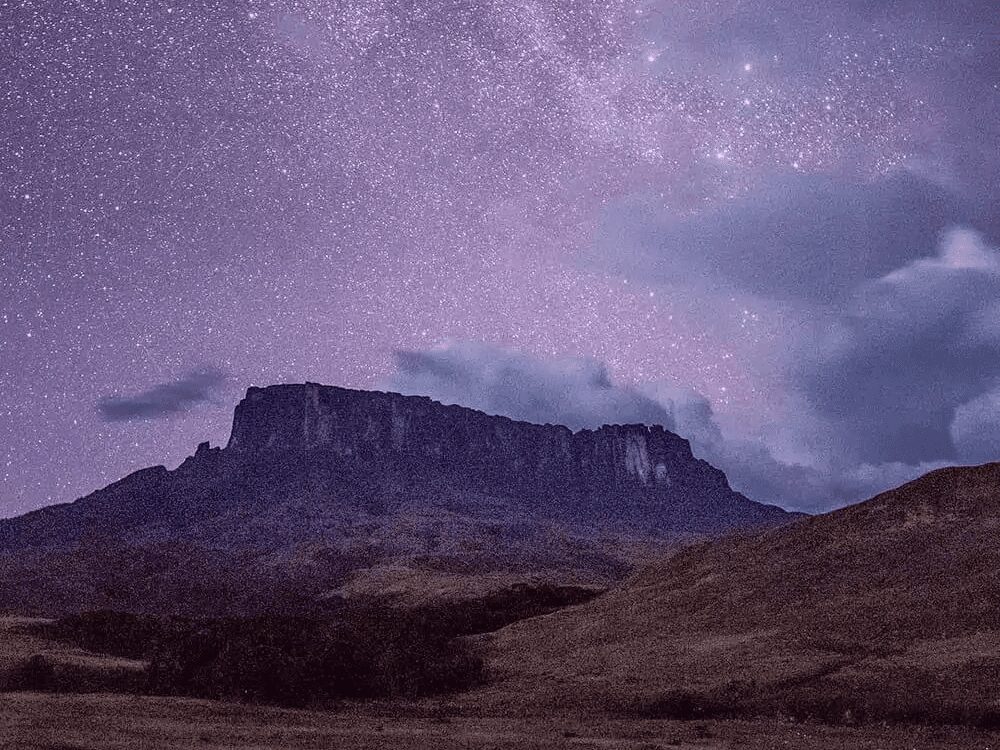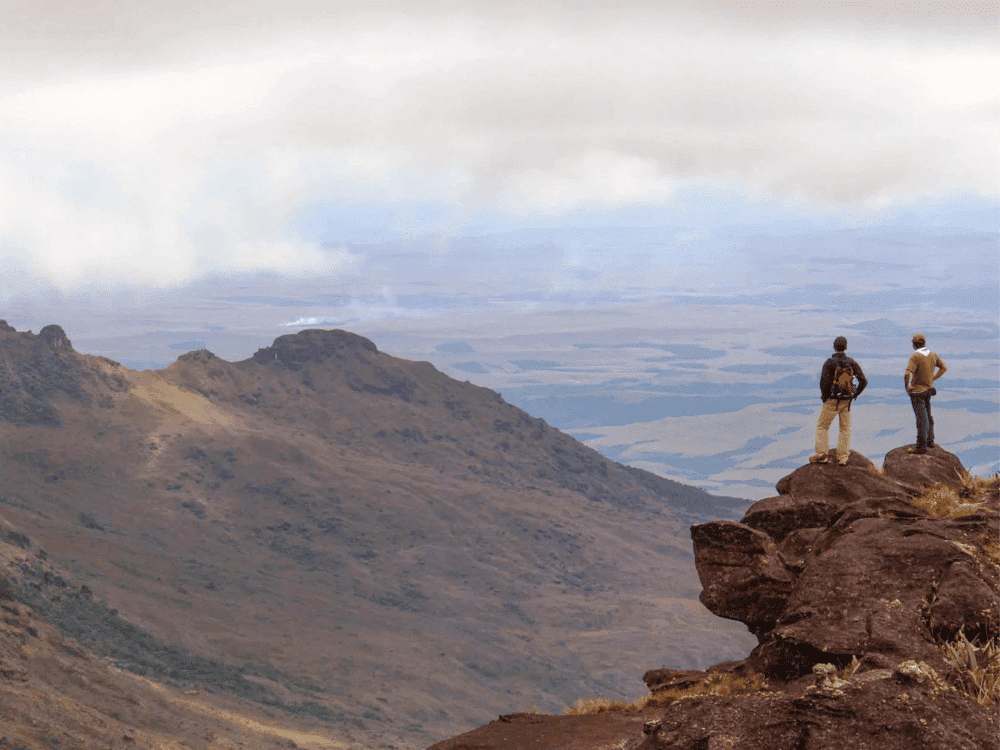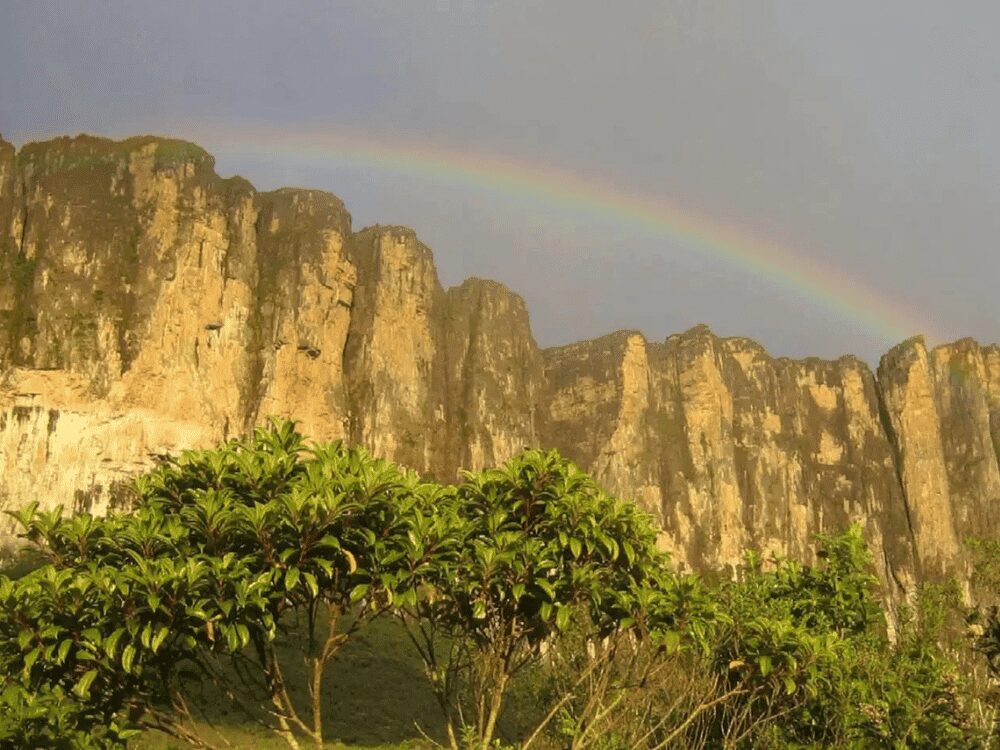
Category: Travel Guide

  • How to Visit the Pantanal in Brazil: Travel Guide

    How to Visit the Pantanal in Brazil: Travel Guide

    Are you wondering what the best way to visit the Pantanal is? In this travel guide, you’ll find everything you need to plan your trip to Brazil’s wildlife haven.

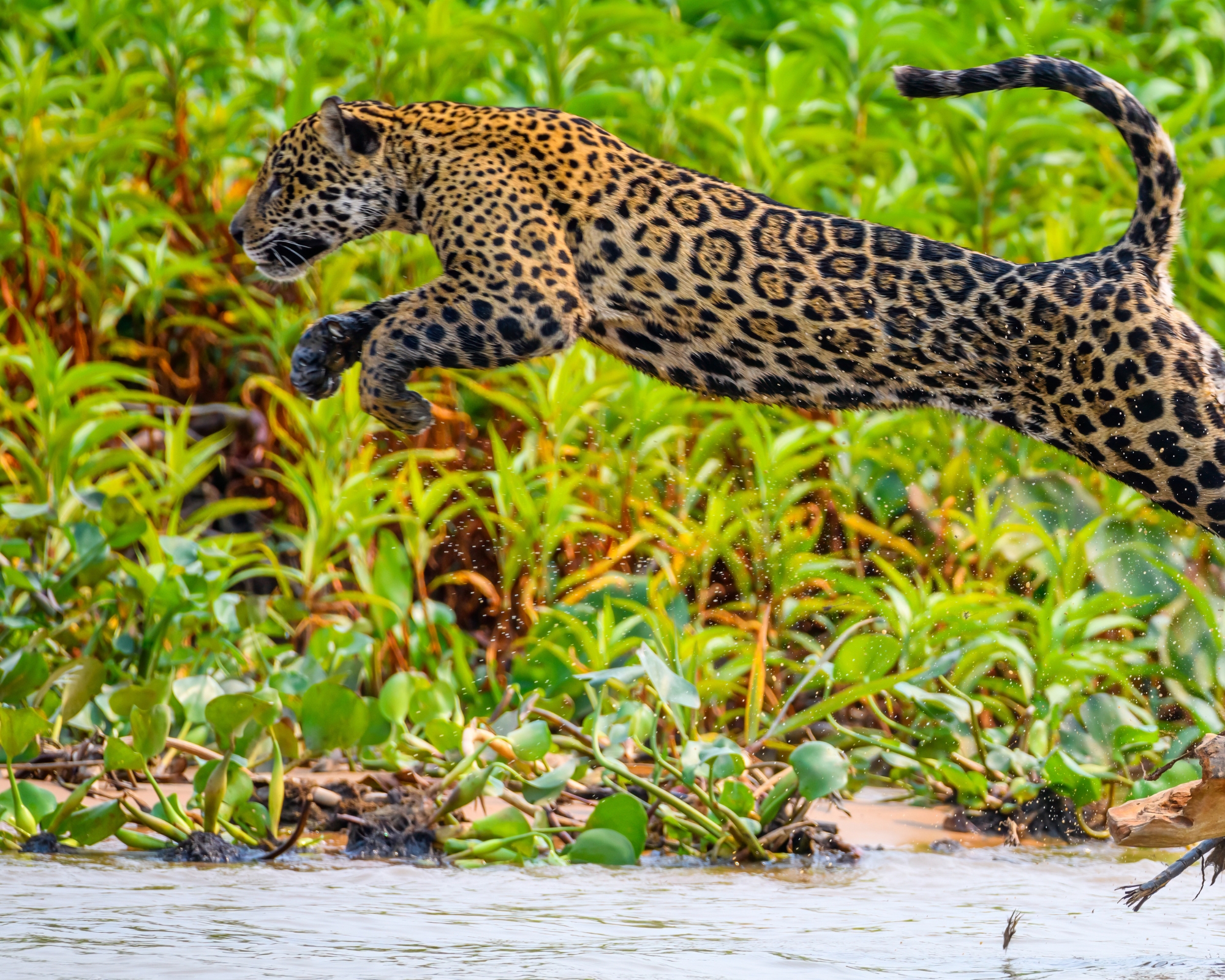
    Home to the greatest population of jaguars in the world, and the best wildlife watching destination in Brazil, the Pantanal has hundreds of different species of birds and mammals. Its vast expanse and unique ecosystem offer an unparalleled experience for nature enthusiasts, making it a must-visit place for those seeking adventure and connection with nature.

    As a platform specialized in Pantanal tours that works with the best local operators, PlanetaEXO has put together a comprehensible travel guide with essential information for your trip, such as when is the best time to visit, how to get there, what to do and where to stay. Check it out below!

    Table of contents:

    1. About the Pantanal
    2. Where is the Pantanal?
    3. What is the wildlife like in the Pantanal?
    4. How to get to the Pantanal in Brazil?
    5. When is the best time to visit the Pantanal?
    6. What to do in Pantanal? 
    7. Where to stay in the Pantanal, Brazil?
    8. How many days should I stay in the Pantanal?
    9. What is the best Pantanal safari? 
    10. What should I pack for a Pantanal trip in Brazil?
    11. What makes the Pantanal so special?
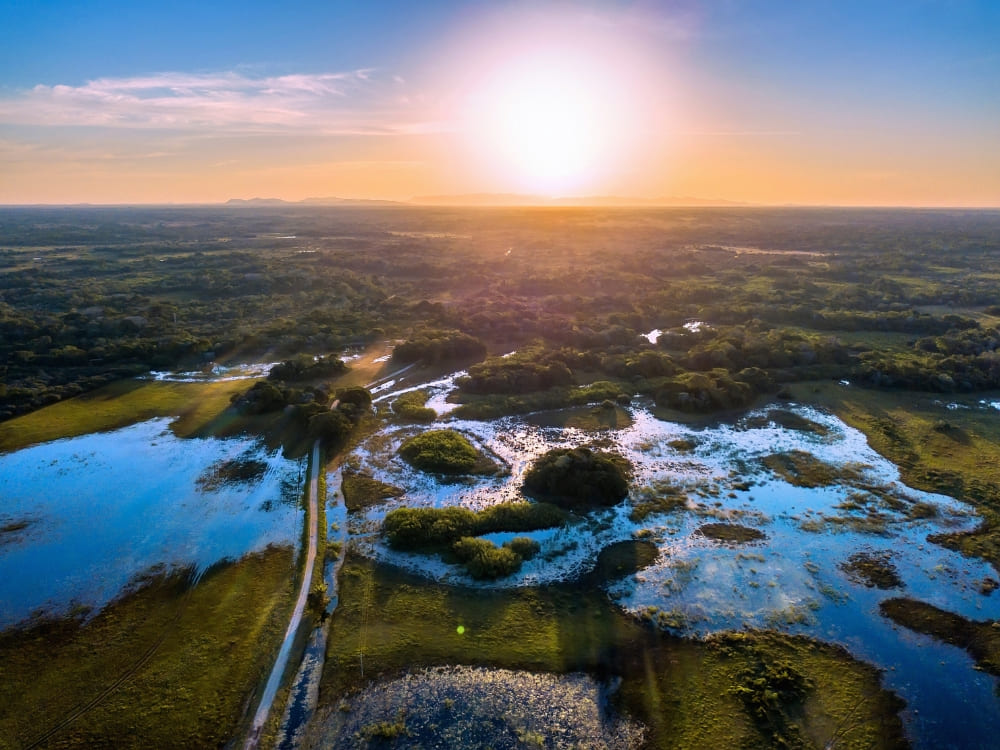
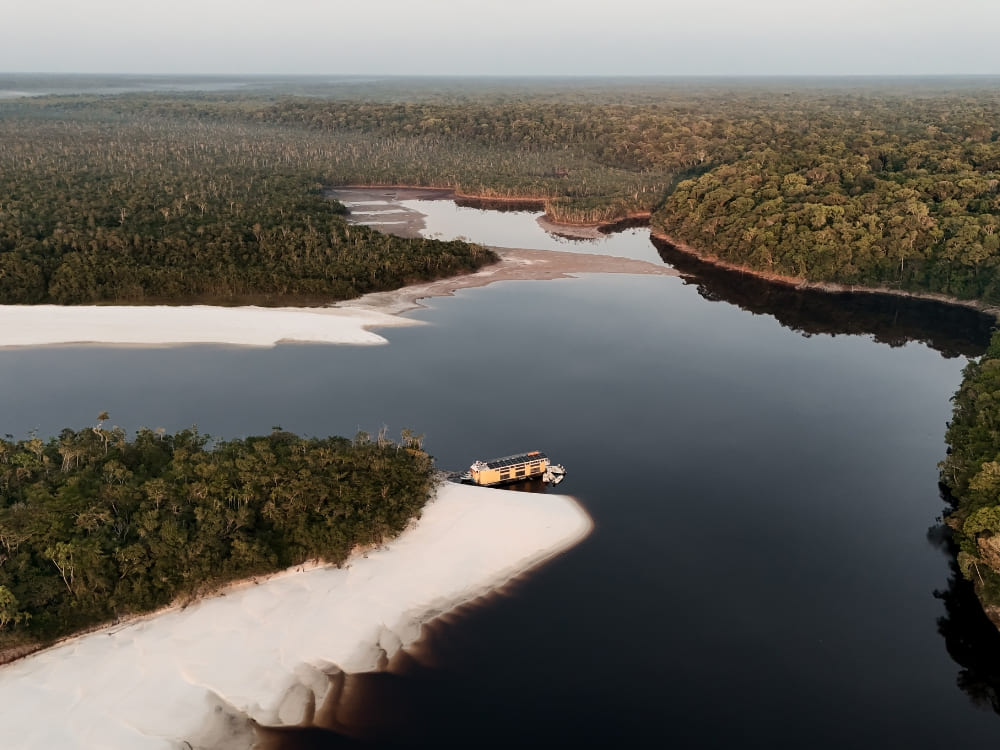
    Panoramic aerial view of flooded plains, winding rivers, and green forests of Pantanal, Brazil under a bright sun.
    .

    About the Pantanal

    The largest wetland on the planet and a UNESCO World Heritage site, the Pantanal harmoniously combines fauna, flora and water. Fed by the Paraguay, Cuiabá, Miranda and Taquari rivers, it’s characterized by seasonal flooding and directly influenced by three major Brazilian biomes: Amazon Rainforest, Cerrado and the Atlantic Forest.

    The Pantanal’s rich biodiversity is complemented by its cultural significance, allowing visitors to immerse themselves in the traditional lifestyle of local communities that have coexisted with this ecosystem for generations.

    Economically, the Pantanal thrives on fishing activities, tourism, and cattle farming, all with a strong commitment to conservation. Over the years, efforts to educate locals and tourists about the socioeconomic benefits of preserving the biome have been successful, fostering a balanced, imperative relationship between wildlife and human activities. 
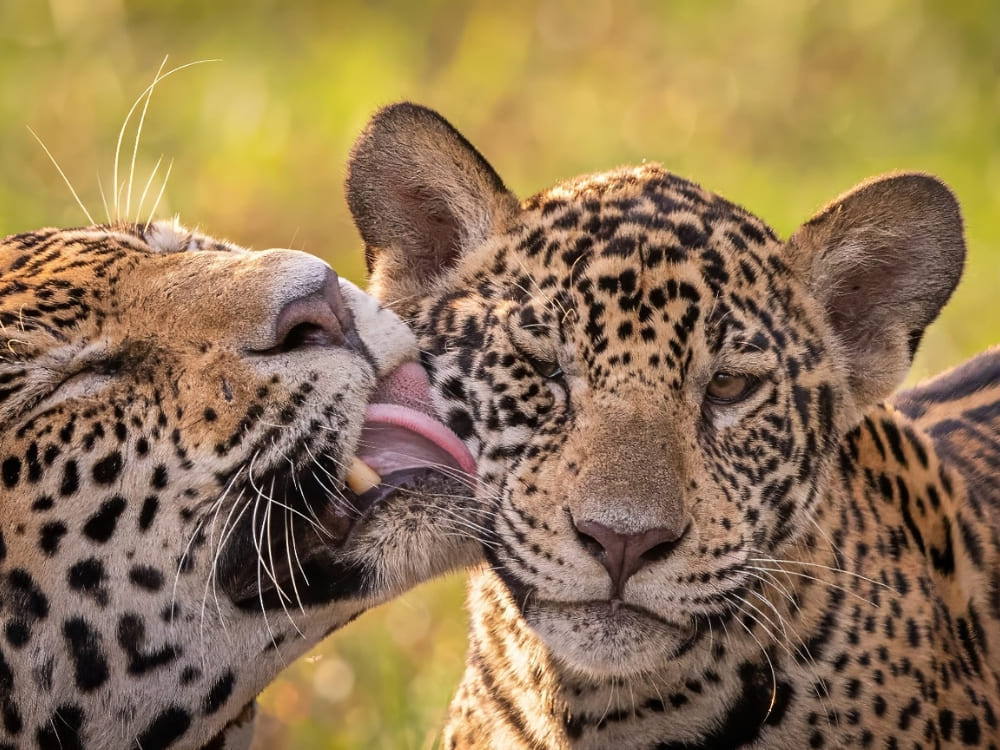
    Close-up of an adult jaguar licking and grooming a cub in the wild, showcasing the rich biodiversity of Pantanal, Brazil.
    @matthias_kern_photography

    👉 Read more: 10 facts about the Pantanal

    Where is the Pantanal?

    The Pantanal is so massive it extends itself across Brazil, Bolivia and Paraguay, but most of its territory is located within Brazilian borders, in the states of Mato Grosso and Mato Grosso do Sul.

    Divided by Northern and Southern Pantanal, the biome spans over 210,000 square kilometers — only a bit smaller than the entire territory of Guyana (214,969 km²)!

    What is the wildlife like in the Pantanal?

    Despite being often overshadowed by the Amazon, the Pantanal hosts the continent’s highest concentration of wildlife. It’s a haven for wildlife observers and photographers, boasting around 325 species of fish, 656 birds, 159 mammals, 53 amphibians and 98 reptiles.

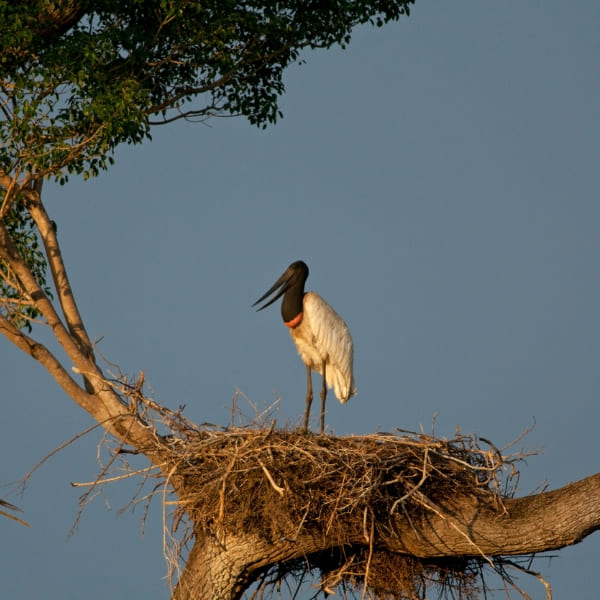
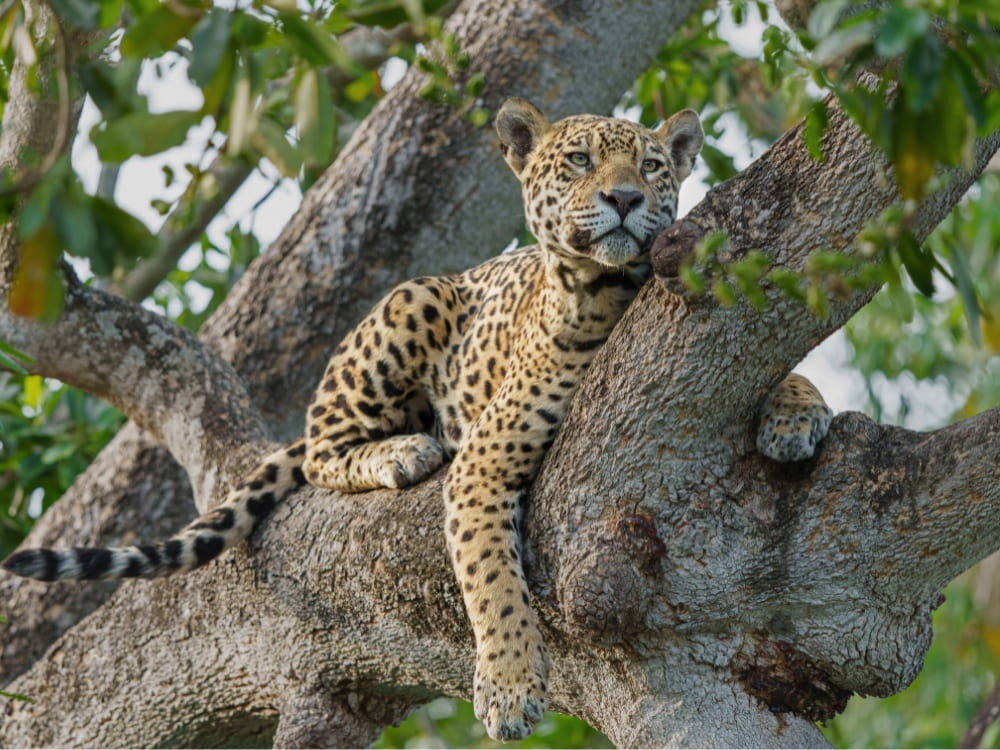
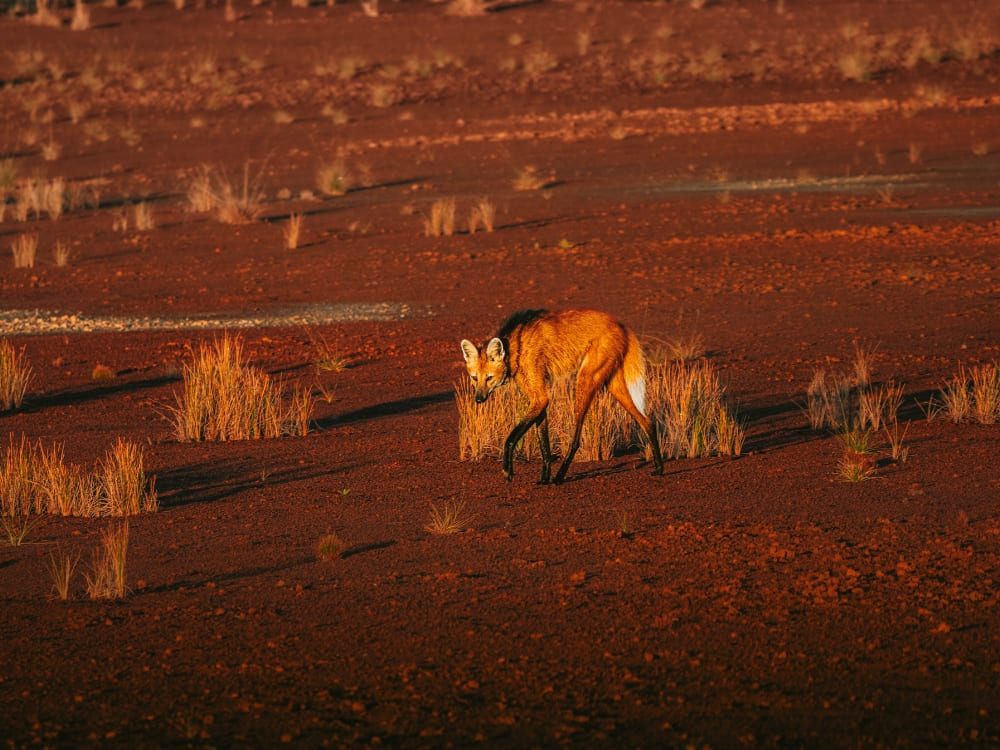
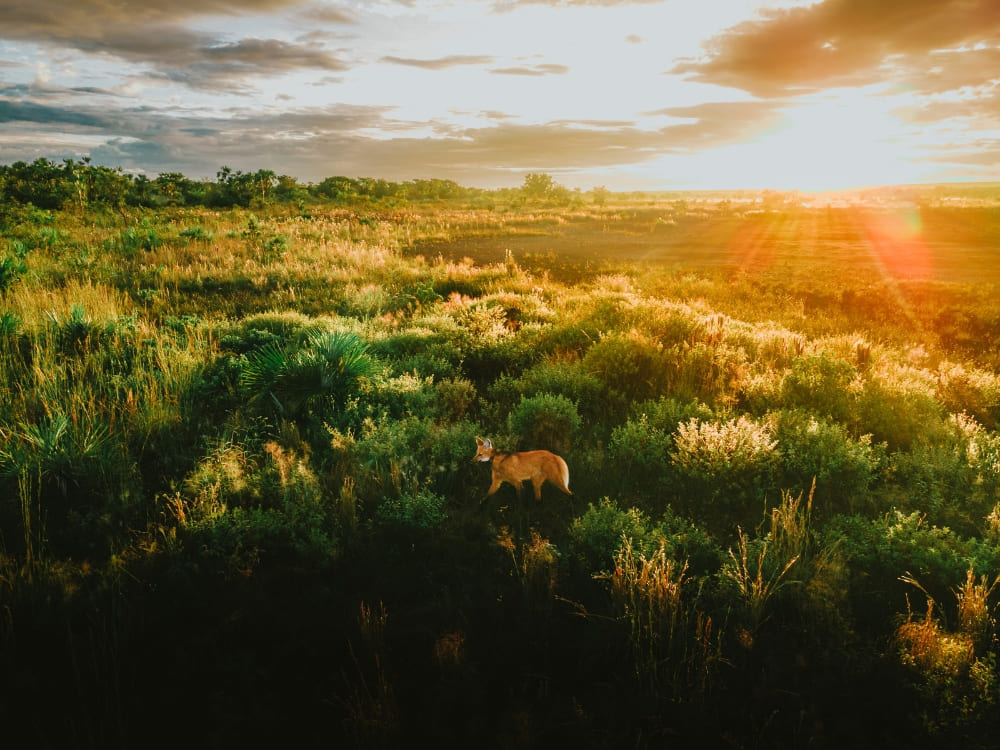
    Jaguars are the stars of Brazilian wetlands, but other native animals are often spotted roaming around, like capybaras, giant otters, jabiru storks, mash deer and the mysterious maned wolf. 
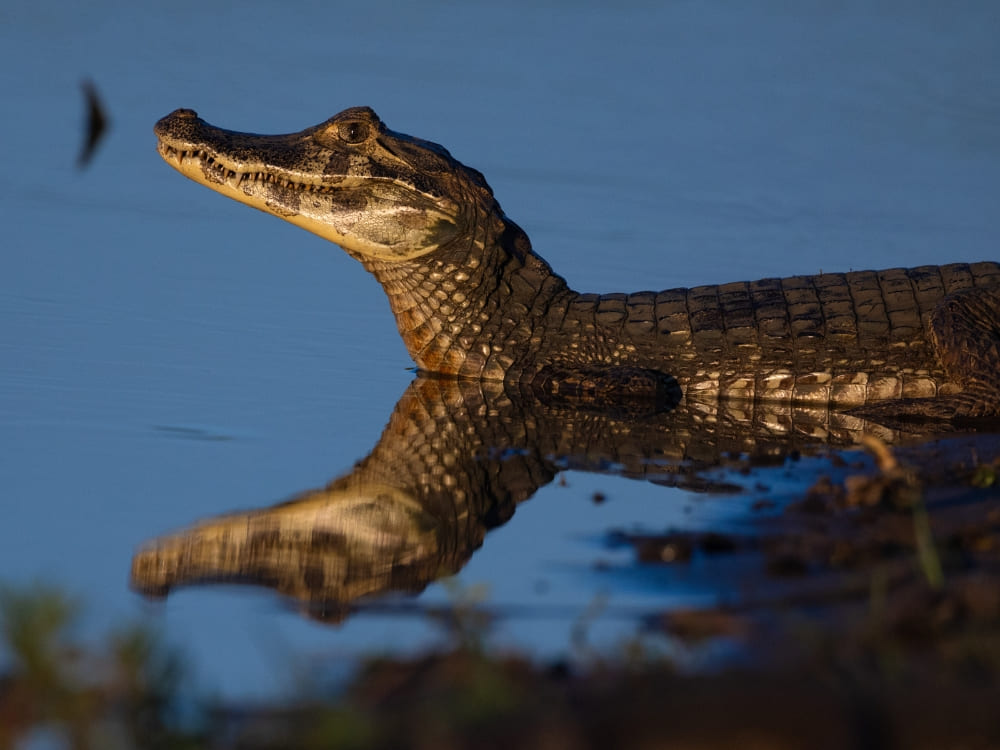
    A caiman resting in calm water with its head reflected on the surface during a boat trip in Pantanal, Brazil.
    Photo: Keith Ladzinski, Caiman

    👉 Read more:

    How to get to the Pantanal in Brazil?

    When planning your trip, it’s important to understand if you’re going to the North or South Pantanal. Naturally, different routes should be considered.

    For adventurers exploring the Northern Pantanal, the gateway is Cuiabá, capital of Mato Grosso, accessible via Marechal Rondon International Airport (CGB) and served by direct flights from Brazilian capitals (São Paulo, Rio de Janeiro, Belo Horizonte, Brasília, etc). If you’re going to Porto Jofre via Poconé, the journey continues along the Transpantaneira Highway.

    Campo Grande, capital of Mato Grosso do Sul, is the starting point for traveling to Aquidauana, Miranda, and Corumbá — cities that surround the Southern Pantanal. Campo Grande International Airport (CGR) offers direct flights from São Paulo, Rio, Campinas, Brasília, etc.
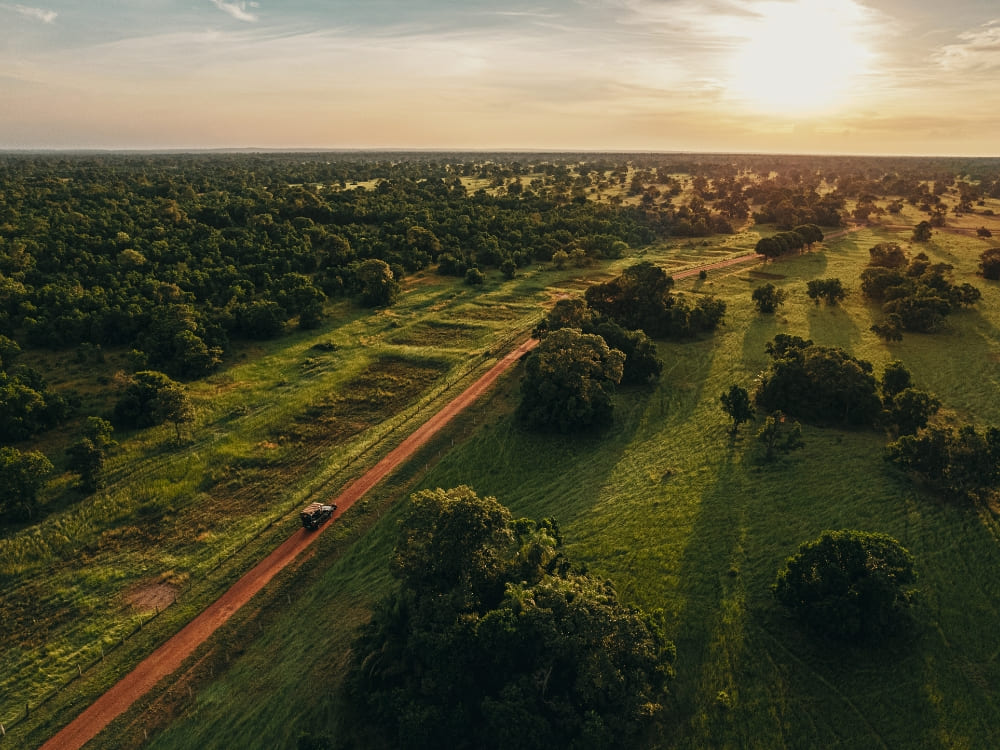
    A 4x4 safari vehicle driving along a dirt road through the lush wetlands of Pantanal, Brazil.
    Photo: Felipe Castellari, Caiman

    👉 See more details: How to get to the Pantanal, Brazil

    When is the best time to visit the Pantanal?

    The Pantanal is a year-round destination. Each season has its own unique charm and opportunities for exploration.

    The rainy season (November to December) turns the vegetation into a vibrant green, while the wet season (December to March) is known for the plain floods and river overflows — perfect for boat tours and birdwatching. 

    During the intermediate season (April to June), the water levels start to drop, making it a great time for the fauna. The dry season (July to October) is even better for wildlife watching, as well as horseback riding and hiking.
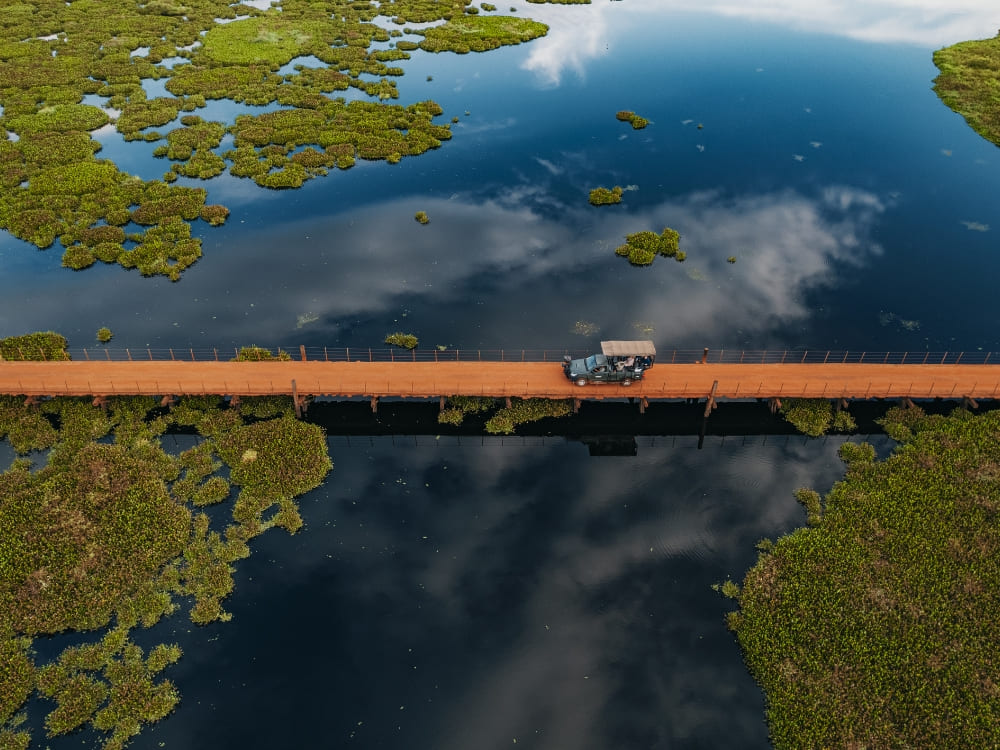
    An aerial view of a safari vehicle crossing a long wooden bridge over the flooded wetlands during a Pantanal safari in Brazil.
    Photo: Felipe Castellari, Caiman

    👉 See more details: When is the best time to visit the Pantanal?

    What to do in the Pantanal? 

    Pantanal experiences are as abundant as the biome itself. See the main activities below!

    Horseback riding

    Horseback riding is a traditional way of exploring, allowing visitors to cross flooded areas and access hard-to-reach places. That’s how you dive deep into the true Pantanal lifestyle!
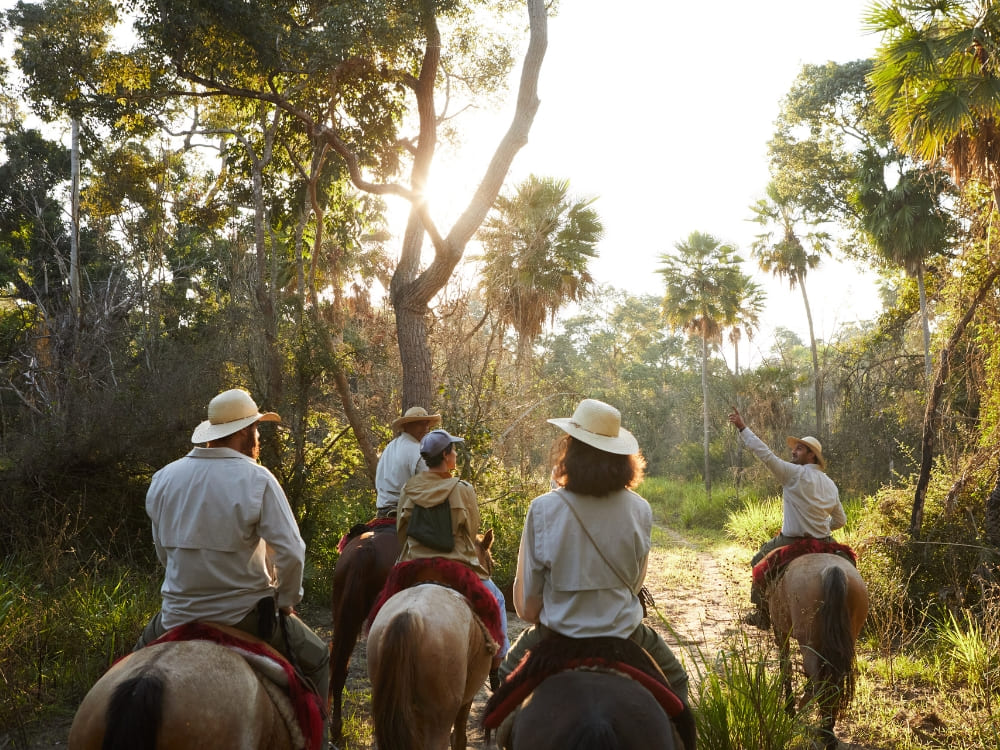
    A group of travelers on horseback led by a guide through a sunlit forest trail in the Pantanal.
    Photo: Layla Motta, Caiman

    Jaguar sighting

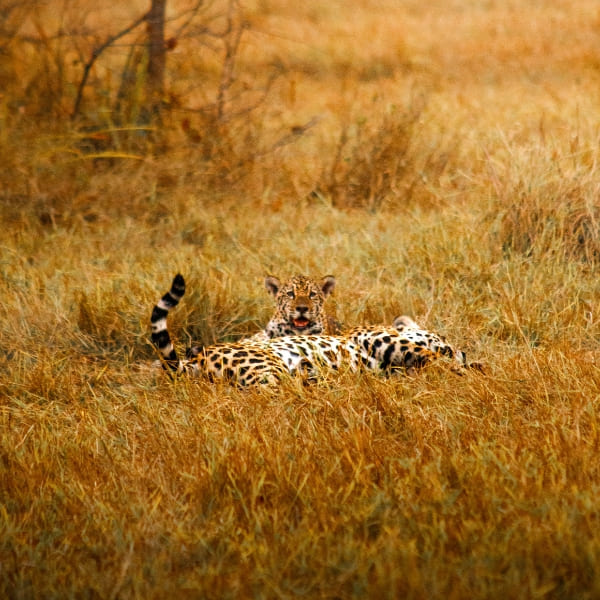
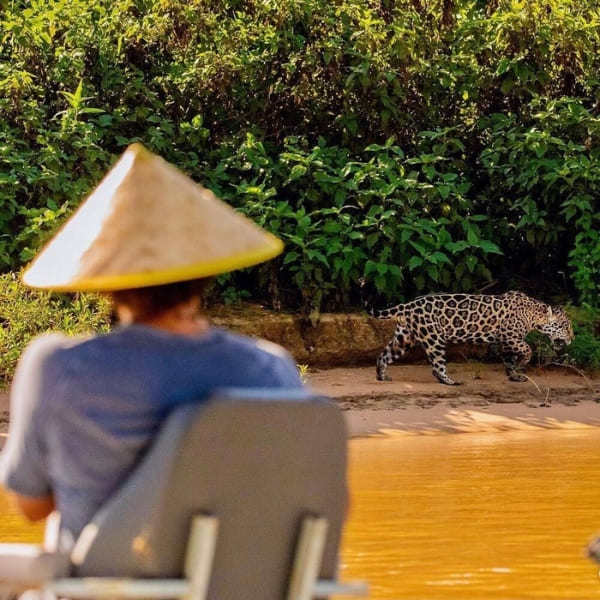
    The Pantanal is the best place in the world to see jaguars in their natural habitat. In the Northern Pantanal, particularly around Porto Jofre, jaguar sightings are frequent along the banks of the Cuiabá River. Most lodges offer boat safaris that provide excellent opportunities to observe and photograph the largest feline of the Americas.

    Spotting jaguars in South Pantanal is less likely, but definitely not impossible. Casa Caiman, in Miranda, is the only place in the area where these animals can be seen.
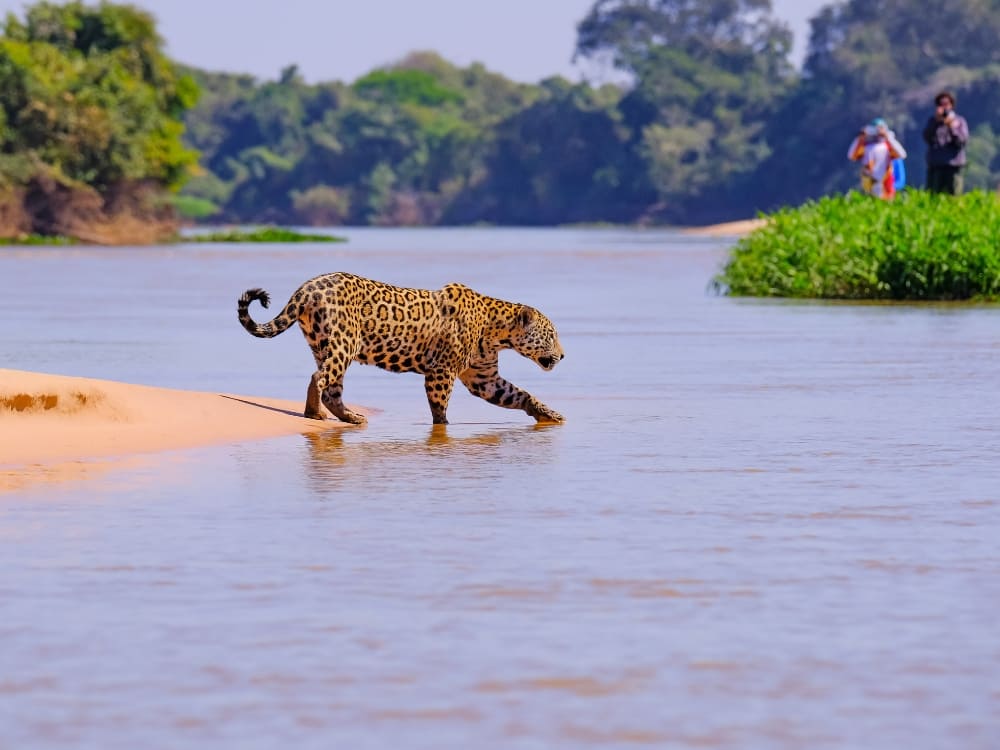
    A wild jaguar walking into the river from a sandbank with observers in the distance in Pantanal, Brazil.
    .

    Photo safaris

    Pantanal photo safaris are conducted in 4×4 vehicles, which allow visitors to explore diverse landscapes and capture stunning images of the wildlife, while also enabling access to remote areas. Naturally, this increases the chances of encountering rare species and getting close-up shots of the biome’s rich biodiversity.

    To guarantee the best shots, photo safaris are led by experienced guides who know the perfect spots to photograph birds, reptiles, and mammals.
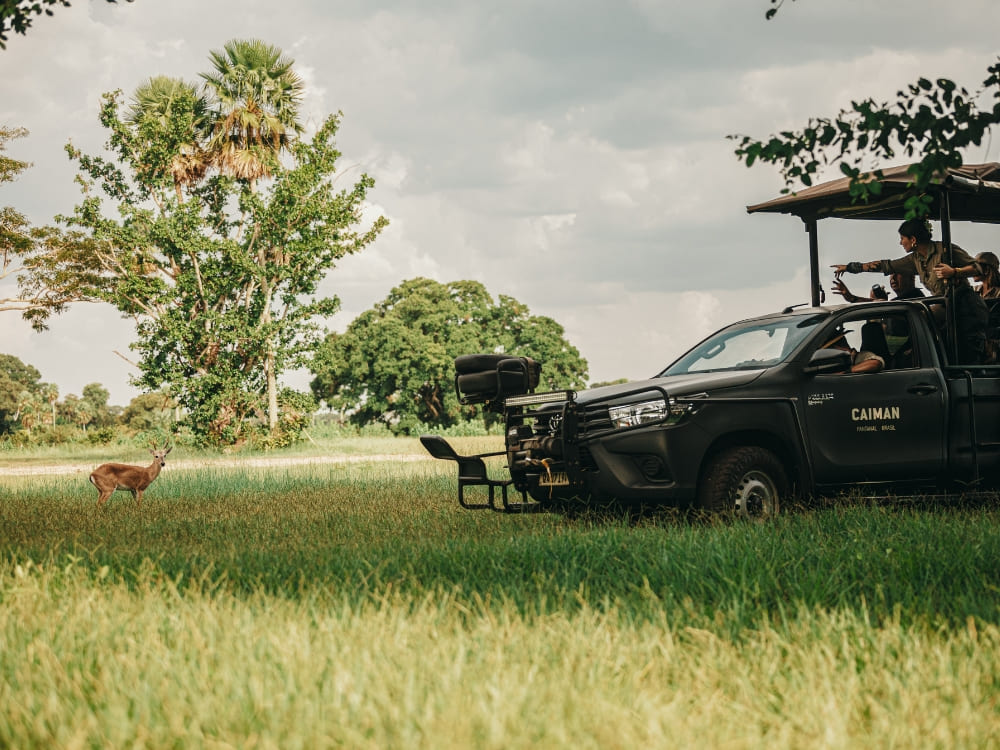
    Travelers in a branded 4x4 safari vehicle observing a marsh deer in a grassy field in Pantanal, Brazil.
    Photo: Felipe Castellari, Caiman

    Boat trips

    Boat trips are incredible options to observe the wildlife from the water. As you navigate the rivers, you can spot a wide variety of Pantanal animals, including capybaras, caimans, giant otters, and numerous bird species. 
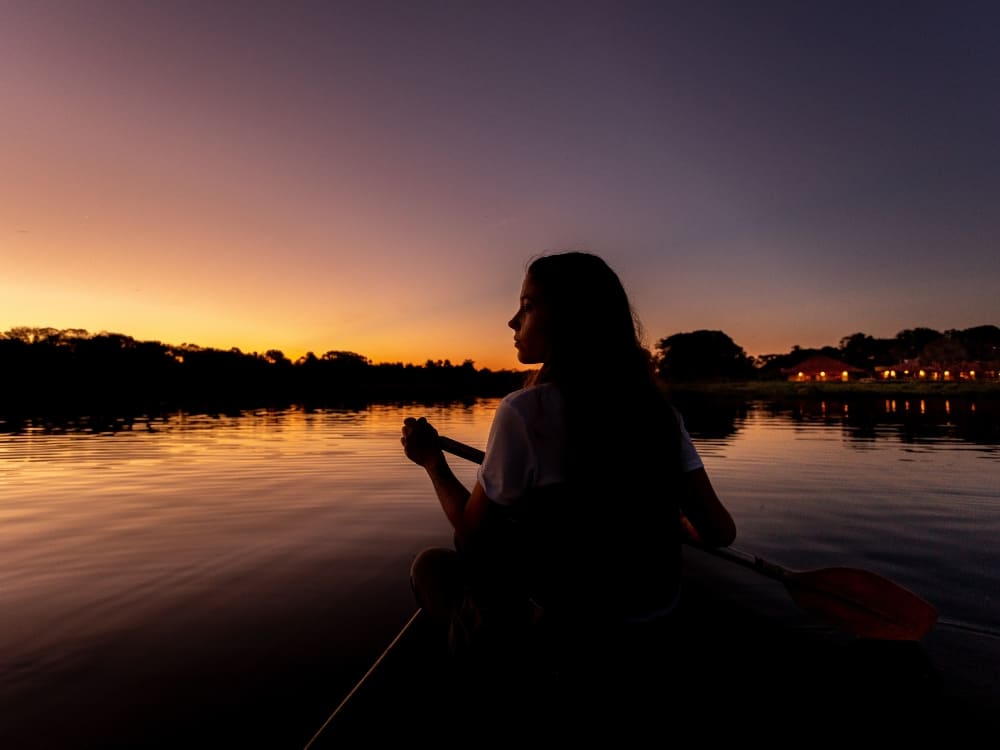
    A woman paddling a canoe on a calm river at sunset, highlighting the peaceful nature of a Pantanal trip.
    Photo: Felipe Castellari, Caiman

    Night spotlighting

    When night falls, tour guides take visitors to the wetlands to watch nocturnal animals, like owls and caimans. Using spotlights and flashlights, experiencing the Pantanal come alive at night is unforgettable, as many species are more active and easier to see under the cover of darkness.

    Close-up of a small owl peering from a tree hollow during a night spotlighting tour in Pantanal, Brazil.
    @allecgomes.jpg

    Ecological walks

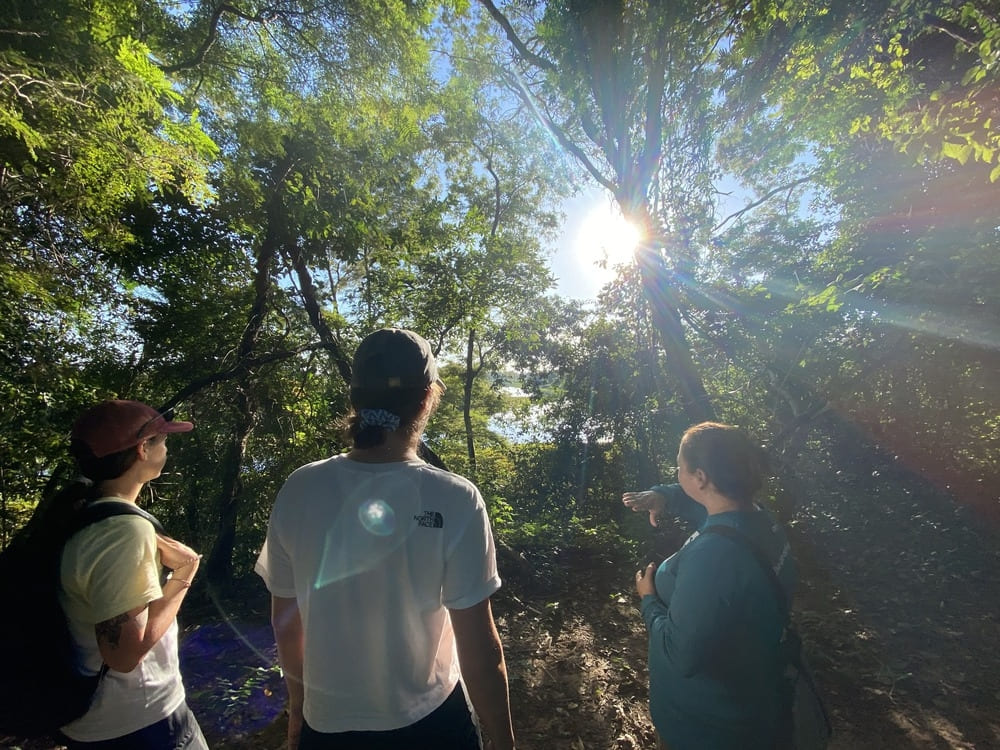
    Ecological walks across the Pantanal are guided hikes that allow visitors to discover the area’s flora and fauna on foot. These walks are led by seasoned guides who share insights about the ecosystem, plant species, and animal behaviors.
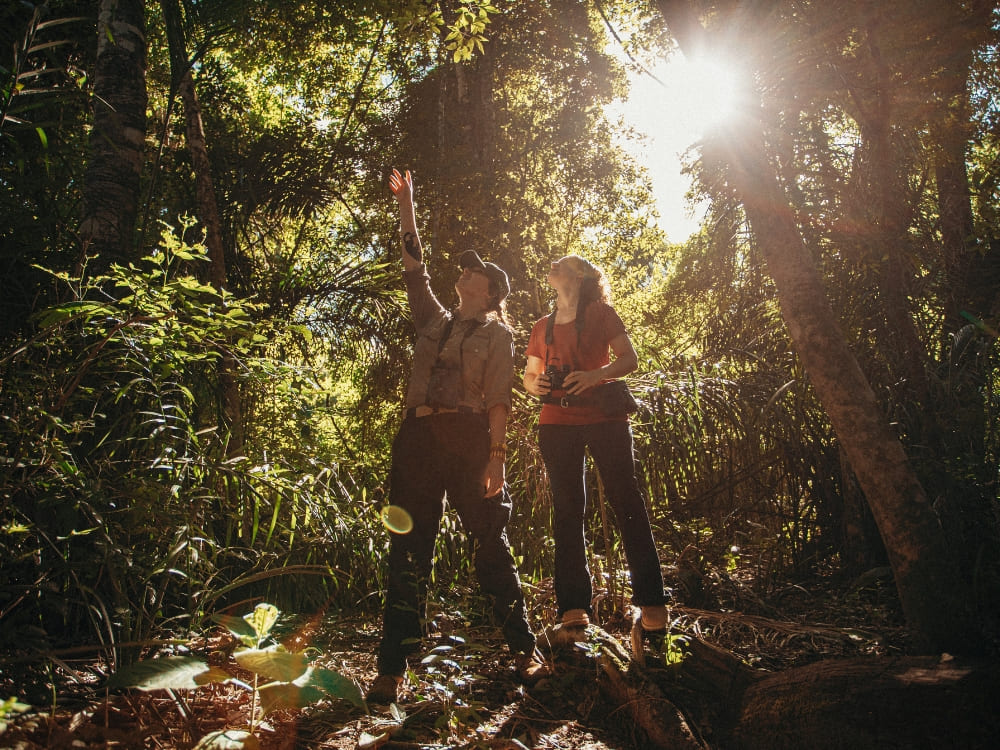
    Two hikers looking up and pointing at the forest canopy during a guided ecological walk in the Pantanal.
    Photo: Felipe Castellari, Caiman

    👉 Check our Pantanal tours and enjoy these incredible experiences!

    Where to stay in the Pantanal, Brazil?

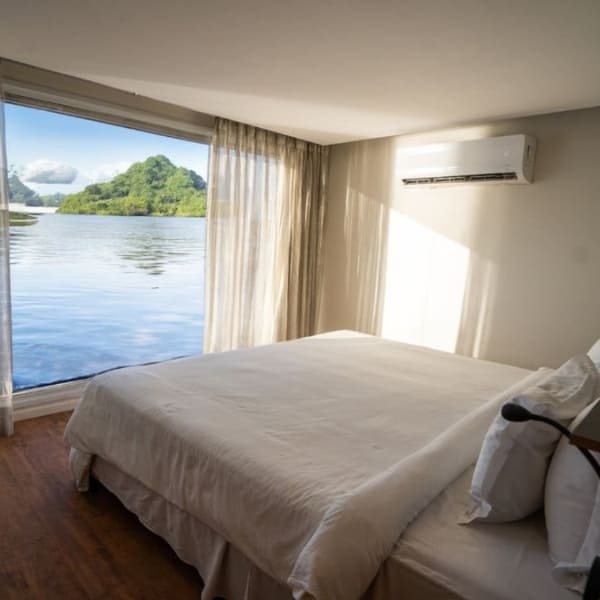
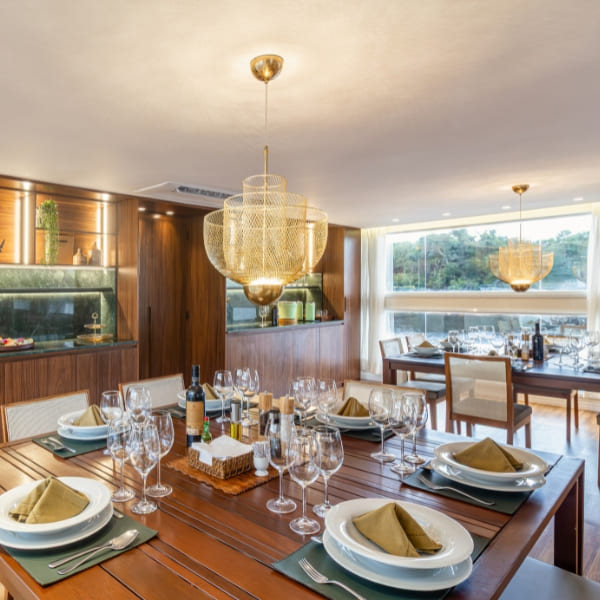
    In general, the accommodations in the Pantanal are typically found on traditional farms that have been transformed into conservation areas due to ecotourism efforts. This provides an authentic taste of the Pantaneiro lifestyle while you enjoy a wonderful stay experience with delicious meals, comfortable rooms and premium services.

    If you’re heading to Northern Pantanal, book your stay in Porto Jofre, Poconé, Barão de Melgaço or Cáceres. You’ll find simple, yet cozy accommodations with a charming rustic style that reflects directly into local day-to-day life.

    Miranda, Aquidauana and Corumbá, in Southern Pantanal, have a great variety of accommodations, from modest to luxury. Regardless of the category, they all combine hospitality, comfortable facilities and sustainability.
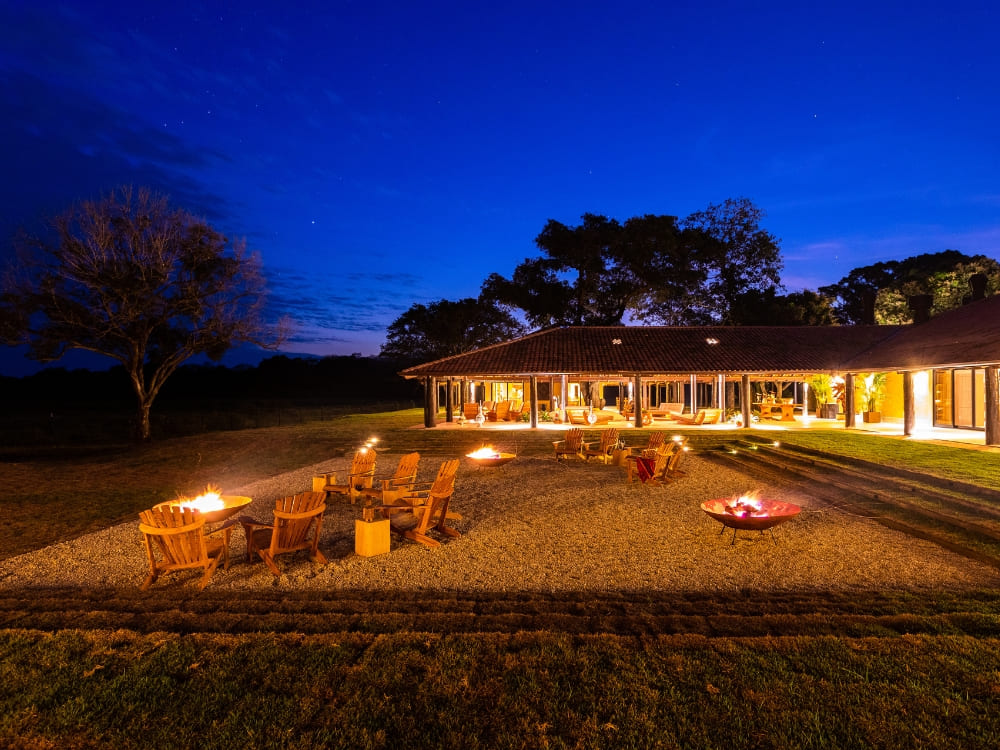
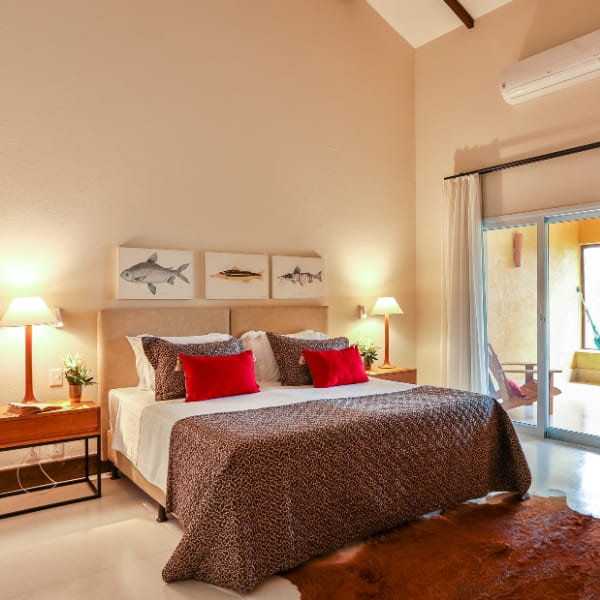
    The exterior lounge of Casa Caiman at night, featuring fire pits and wooden chairs under a deep blue starry sky.
    Photo: Felipe Castellari, Caiman

    👉 Read more: Where to stay in the Pantanal?

    How many days should I stay in the Pantanal?

    You need at least 4 days to truly enjoy the richness of the Pantanal with safaris at sunrise and sunset, explore different habitats, and increase your chances of seeing species like jaguars, giant otters, hyacinth macaws, capybaras, etc.

    By staying 5 days or more, you’ll have the opportunity to visit more remote regions, join specialized activities (jaguar tracking, birdwatching expeditions, photography-focused tours), and engage more closely with local conservation projects.

    Don’t forget: reaching one of the biome’s gateway towns requires a considerable amount of time on the road due to the distances involved, so be prepared to set aside at least 3 hours. The drive itself is a mini-adventure that offers great opportunities for wildlife spotting. Enjoy this journey as a part of your Pantanal trip!
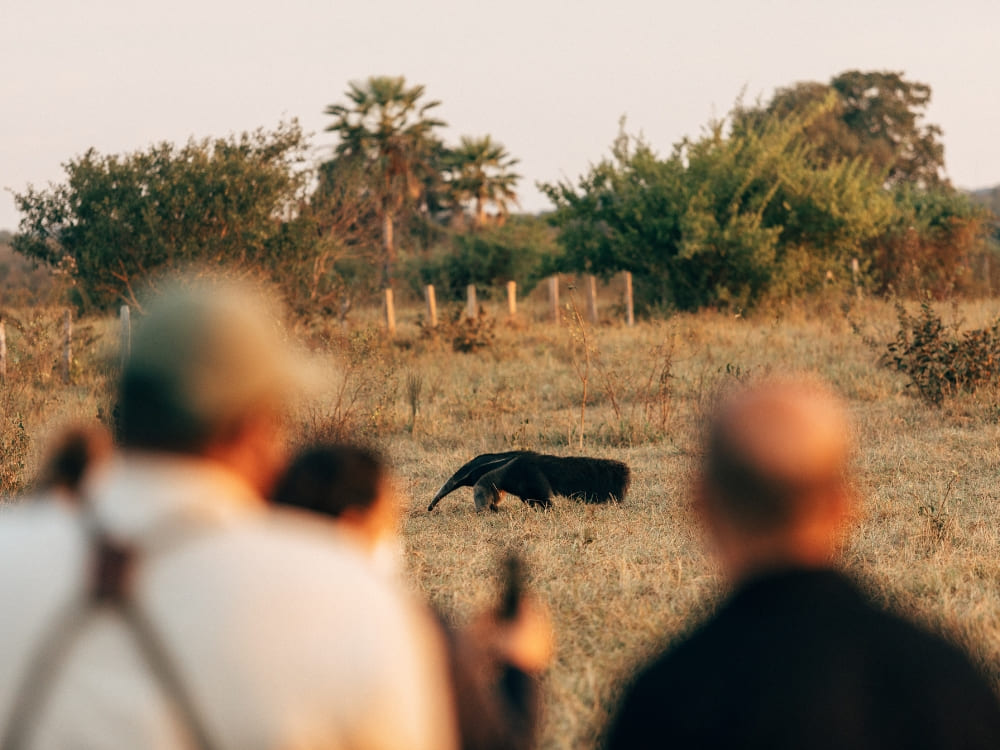
    Travelers observing a giant anteater foraging in an open field during a Pantanal trip at dusk.
    Photo: Felipe Castellari, Caiman

    👉 See more details: How many days should you spend in the Pantanal?

    What is the best Pantanal safari? 

    When choosing your Pantanal safari, several factors come into play: type of wildlife, comfort level, preferred activities and budget.

    The Northern Pantanal, especially around Porto Jofre, is perfect for wildlife watching. Boat safaris often sail across Cuiabá River in search for jaguars and other native species. Check it out: Pantanal Jaguar Safari in Porto Jofre, Cuiabá.

    Alternatively, the Southern Pantanal also offers remarkable safari experiences. If you have a larger budget, the best option is the ecological refuge for jaguars, notable for its conservation and education efforts that help sustain local wildlife and promote eco-friendly tourism.

    This is also the only place in the South that guarantees a 98% chance of jaguar sightings while also providing luxury accommodations. Check it out: Pantanal Luxury Safari.

    For those on a limited budget, there are other options for safaris in the Southern Pantanal, including Pantanal tours from Campo Grande. Adventures like this provide an incredible wildlife viewing experience with horseback riding, boat tours, jeep safaris, and ecological walks. Accommodations are simple, yet incredibly cozy.

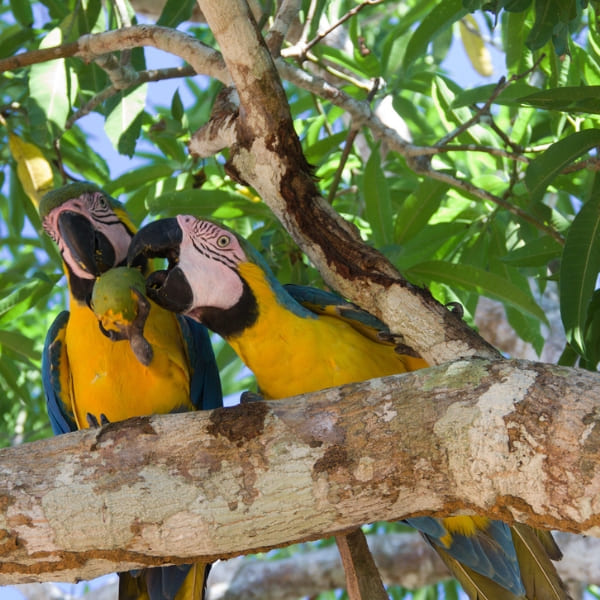
    Three vibrant hyacinth macaws with deep blue feathers flying across a clear sky during a Pantanal safari in Brazil.
    Photo: Felipe Castellari, Caiman

    👉 Read more: Which is the best Pantanal Safari Tour in Brazil?

    What should I pack for a Pantanal trip in Brazil?

    When preparing for a trip to the Pantanal, packing the right gear is essential to ensure comfort and safety. Here’s a list of must-bring items to make the most of your experience:

    • Light clothes, including at least one UV long-sleeved shirt and shorts/pants (earth or light colors)
    • Lightweight jacket
    • Windbreaker or rain jacket
    • Swimming suit
    • 2 pairs of shoes (sneakers/walking shoes and hiking boots)
    • Sandals (or water shoes)
    • Socks
    • Hats
    • Sunglasses
    • Waterproof sunscreen (SPF30+)
    • Insect repellent
    • Bath towel and washcloth
    • Camera, batteries/battery charger for cameras (underwater camera is also highly recommended)
    • Headlamp or flashlight + extra batteries
    • Dry-bag for cameras and personal gear
    • Daypack for hiking and short outings
    • Binoculars
    • Non-perishable snacks
    • Non-breakable reusable water bottle
    Three travelers guided through a dense forest path with sunlight filtering through the trees in the Pantanal
    .

    What makes the Pantanal so special?

    Traveling to one of the world’s most fascinating ecosystems not only allows for an escape from the urban pace, but it also provides an authentic immersion in untouched nature.

    The Pantanal is a one of a kind destination, offering the opportunity to witness rich biodiversity while encouraging local tourism, supporting communities, and helping conservation efforts.

    Local customs also add an enriching cultural layer to the journey. Through ecotourism activities, visitors dive deep into the unique blend of tradition and nature to live experiences found nowhere else on Earth.
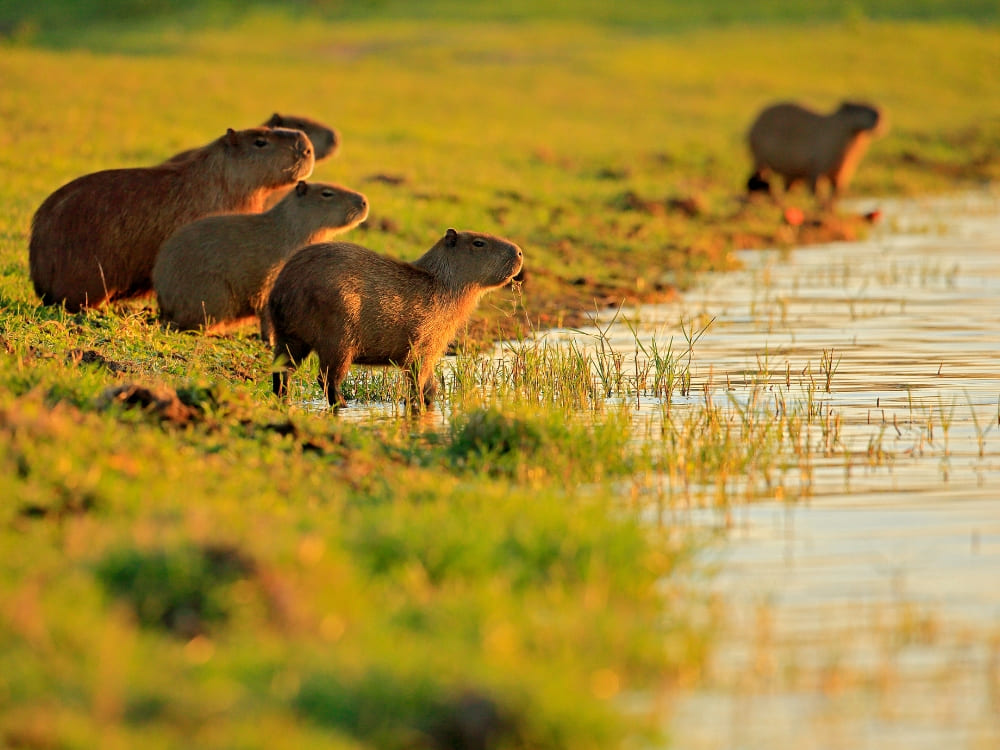
    A group of capybaras standing in the grass by a riverbank in the early morning light of Pantanal, Brazil.
    .

    Book your trip for the Pantanal in Brazil with PlanetaEXO

    We hope you’ve enjoyed our Pantanal travel guide! Now that you know everything about this incredible place, it’s time to start vacation planning.

    PlanetaEXO specializes in Pantanal tours and connects you with the best ecotourism operators while assisting with tailor-made itineraries, transfer options and much more. Book now!
    Read more!

  • How to Visit the Amazon Rainforest in Brazil – Travel Guide

    How to Visit the Amazon Rainforest in Brazil – Travel Guide

    Learn everything you need before enjoying your Amazon tour in Brazil, including when is the best time to visit, how to get there, what are the main activities and much more!

    Are you a nature lover and your ultimate dream to visit the Amazon Rainforest in Brazil so you can experience the fascinating wonders of the largest tropical rainforest in the world? If the answer is a loud and clear “yes!”, then you’ve come to the right place!

    There are many ways to discover it, from guided tours with wild camping, to staying in luxury jungle lodges, or even enjoying river cruises.

    To help with your vacation planning, PlanetaEXO, an ecotourism platform specialized in Amazon Rainforest tours in Brazil, has created this carefully curated travel guide. Check it out below and discover how to visit the Amazon and other important information about this spectacular destination!

    Table of contents:

    1. About the Amazon
    2. Where is the Amazon Rainforest?
    3. Can you visit the Amazon Rainforest?
    4. How to get to the Amazon Rainforest?
    5. When is the best time to visit the Amazon Rainforest in Brazil?
    6. What to do in the Amazon Rainforest?
    7. Animals in the Amazon Rainforest, Brazil
    8. Where to stay in the Amazon Rainforest?
    9. How long should you stay in the Amazon Rainforest?
    10. Traveling to the Amazon in Brazil: how much does it cost?
    11. Do you need a vaccine to go to the Amazon Rainforest in Brazil?
    12. Is it safe to visit the Amazon Rainforest in Brazil?
    13. What should I pack for an Amazon Rainforest trip?
    14. Is traveling to the Amazon worth it?
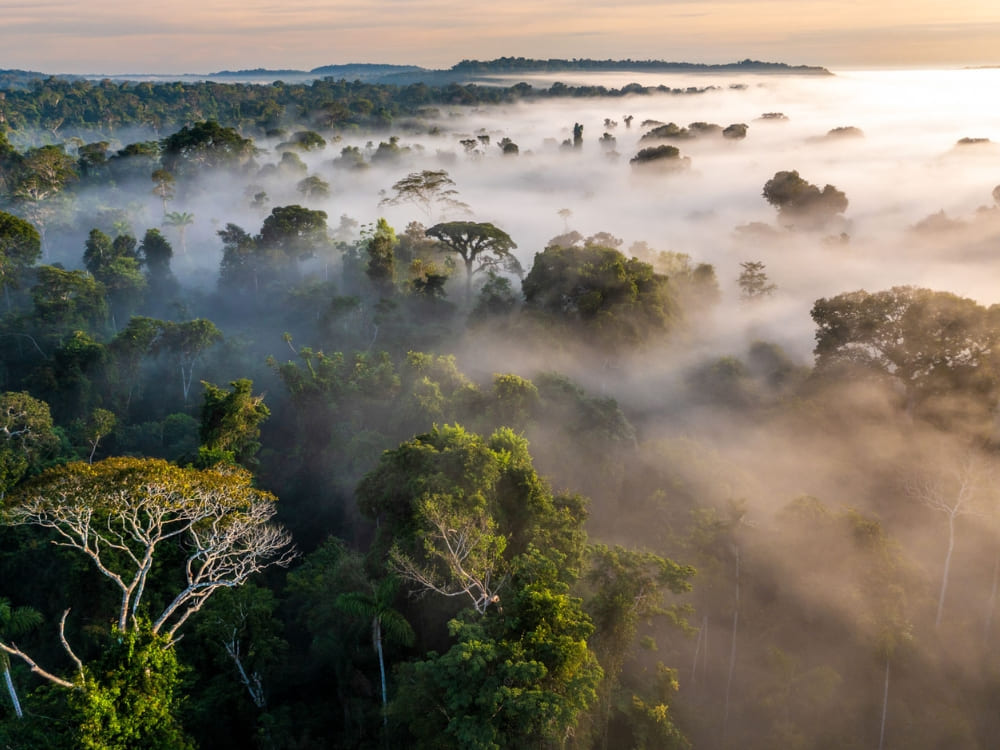
    How to visit the Amazon Rainforest - Cristalino National Reserve
    .

    About the Amazon

    If it were a country, the Amazon would be the seventh largest in the world. It spans 6.7 million km² — twice the size of India!

    The impressive numbers go on, this time regarding fauna and flora: there are 30 million species of animals — although not all of them have been officially cataloged yet —, 2.5 million types of insects, and 2,500 and 30,000 varieties of trees and plants, respectively.

    When it comes to the watershed, 20% of the planet’s freshwater belongs to the Amazon. The Amazon River alone has an extension of 6,400 km, going down the Andes Mountains and flowing into the Atlantic Ocean.

    Such richness holds more than half of the world’s entire biodiversity, making the value of the Amazon Rainforest immeasurable and irreplaceable.

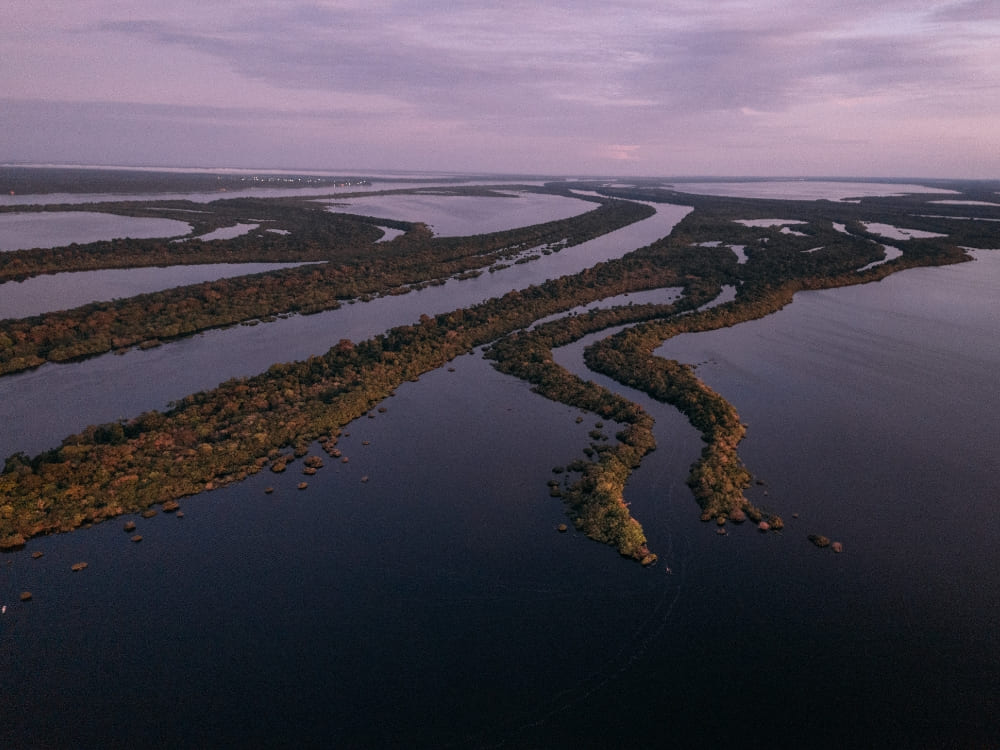
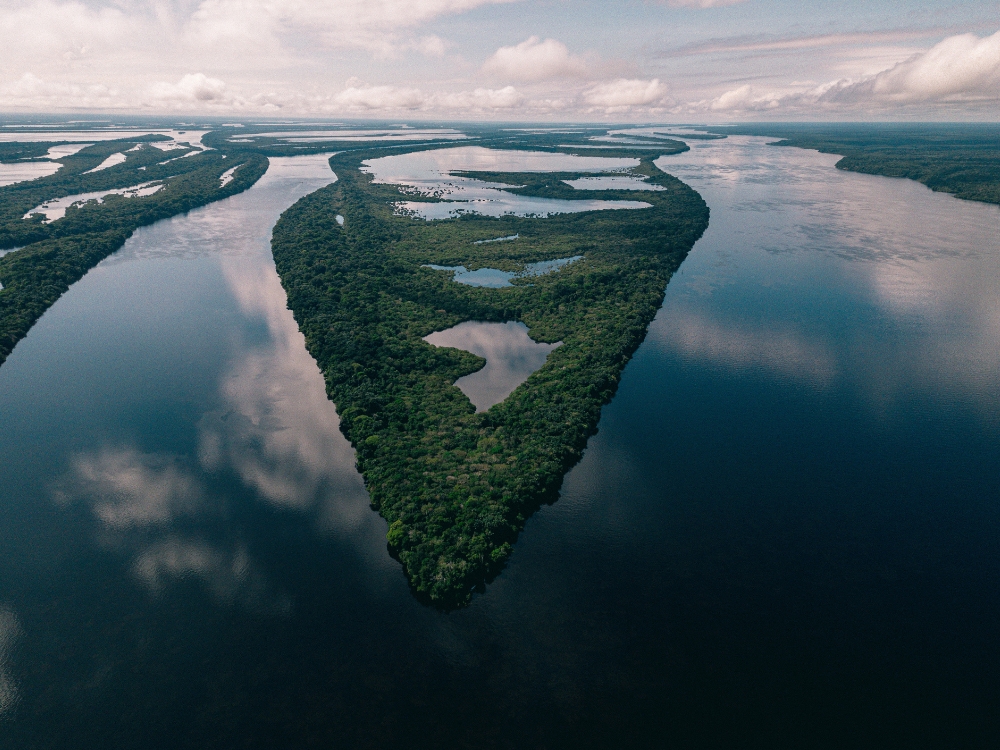
    Aerial panorama of the Amazon river channels and lush green islands, highlighting the massive watershed and freshwater ecosystem of the basin.
    Photo: Felipe Castellari


    👉 Read more: 15 Facts about the Amazon Rainforest in Brazil

    Where is the Amazon Rainforest?

    The Amazon Rainforest is in South America, reaching eight different countries: Brazil, Bolivia, Colombia, Ecuador, Guyana, Peru, Suriname and Venezuela.

    59% of its area is solely located in Brazil, touching the states of Amazonas, Mato Grosso, Pará, Acre, Amapá, Rondônia, Roraima and Tocantins. 

    Can you visit the Amazon Rainforest?

    Yes, absolutely! But it’s important to rely on professionals who truly know the area. The forest is incredibly beautiful, but the wilderness can be harsh. So if you’ve ever wondered if it’s safe to visit the Amazon Rainforest, the presence of qualified guides is crucial and non-negotiable.

    This is also the best way to appreciate nature in its fullness, since an expert will know how to move around the jungle. The activities are vast, but some factors should be considered for everyone’s enjoyment, like weather conditions and the right places to spot animals. 

    Brazil Amazon tours are actually encouraged because they can also be a great way to ensure its preservation. Ecotourism is a powerful tool to provide work for local communities. When sustainable travel companies employ these people, they inspire them to work in favor of the forest instead of its degradation.

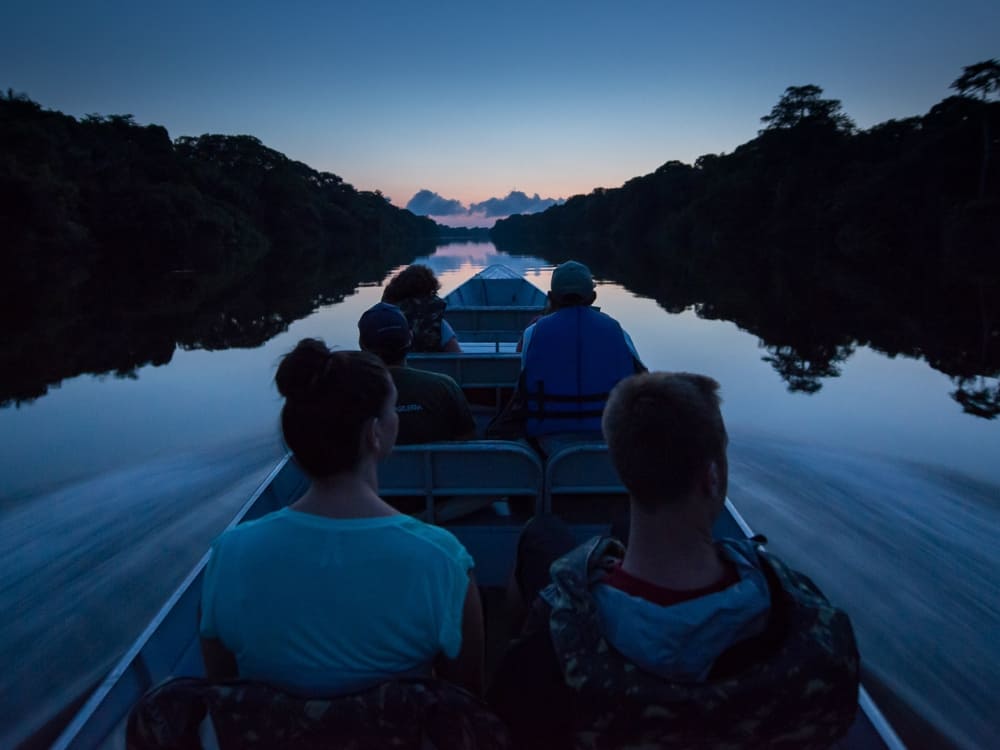
     Tourists enjoying a peaceful boat ride on an Amazon river at twilight, observing nature with a local guide to ensure a safe experience.
    .

    Ecotourism also raises awareness about environmental issues, like deforestation, pollution and climate change. Upon seeing the wonders of the Amazon, travelers fully understand why it is so important to protect it, which can make them engaged in conservation projects not only in the rainforest but also in their home countries.

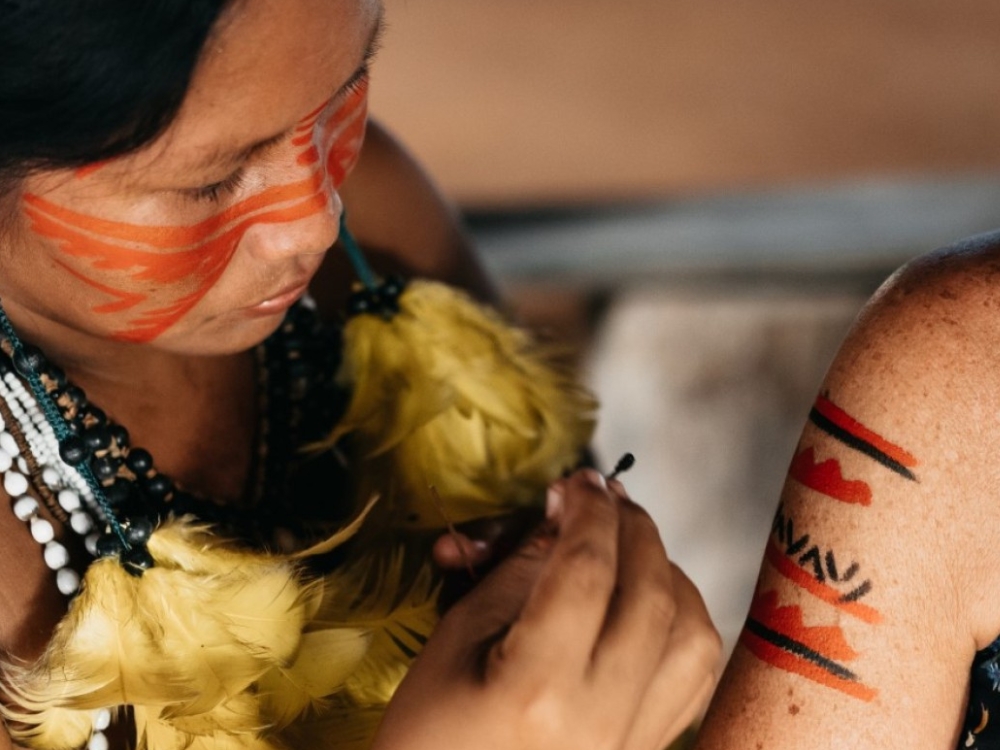
    Indigenous woman applying traditional red and black face paint, representing the rich culture of local communities in the Amazon supported by ecotourism.
    .

    👉 Read more:

    How to get to the Amazon Rainforest?

    There are a few ways to visit the Amazon Rainforest in Brazil, but the most convenient one is flying to Manaus, capital of Amazonas.

    From the US, travelers can depart from Miami (MIA) and fly straight to Manaus (MAO). From Fort Lauderdale (FLL), connecting flights have layovers in Bogotá (BOG), Panama City (PTY), Belém (BEL) and São Paulo (VCP or GRU).

    From Europe, layovers are also expected in Rio de Janeiro (GIG), Belo Horizonte (CNF), Recife (REC), Fortaleza (FOR) or Brasília (BSB), depending on the departure location.

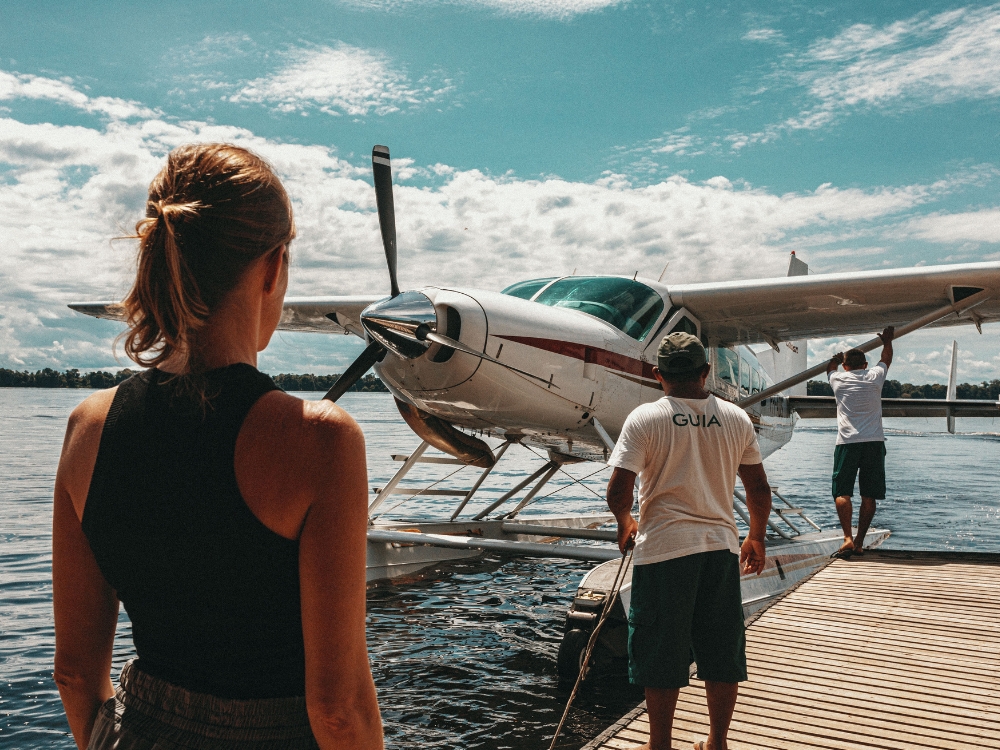
    Seaplane docked at a river pier in Manaus, a common transport method to reach remote Amazon jungle lodges and explore nature.
    .

    The Amazon in Mato Grosso and Pará are also amazing vacation spots to explore nature. In this case, flying to these states’ capitals is the best option.

    👉 See more details: How to get to the Amazon Rainforest in Brazil?

    When is the best time to visit the Amazon Rainforest in Brazil?

    Although the Amazon is considered a year-round destination, the period from January to September offers the best conditions because it avoids the peak of the dry season. At the same time, there are good hiking trail options and enough water for aquatic activities.

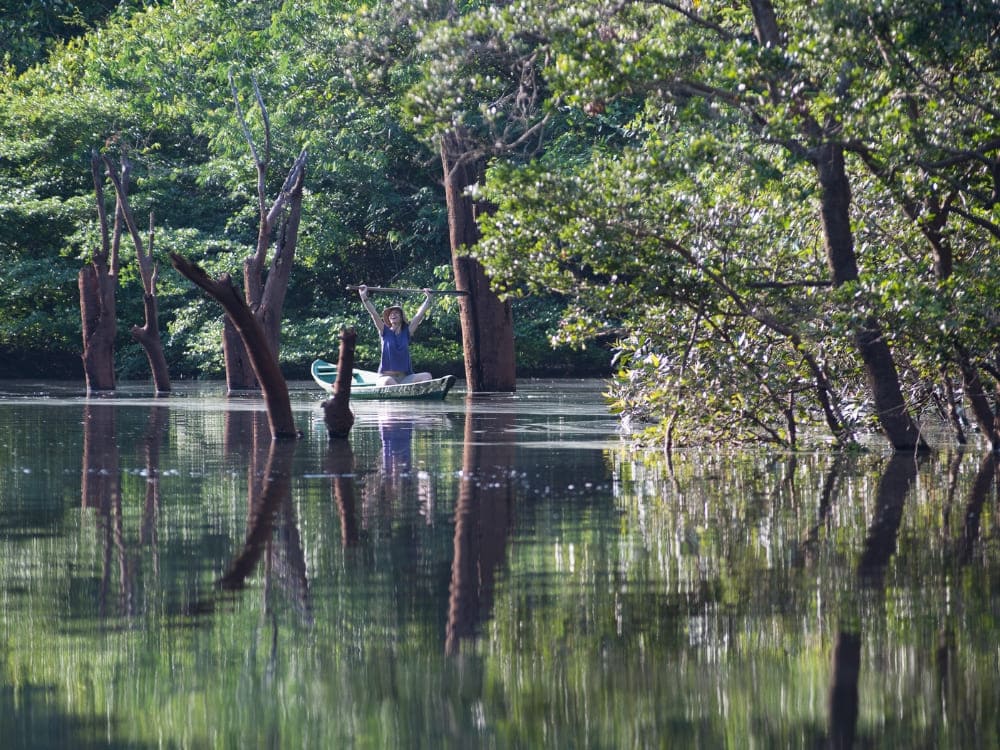
    Canoe navigating through the flooded forest (igapó) during the wet season in the Amazon, surrounded by water-reflected trees.
    .

    The wet season (December to May) is great for people who want to enjoy the Amazonian rivers by kayaking, canoeing, swimming and exploring the igapós (flooded forests). Rainstorms are common, but don’t last too long. 

    Meanwhile, the dry season (June to November) is popular because it usually allows both water and land-based activities. However, extended droughts are becoming more frequent, especially from October to December. This causes low water levels and limited access to a few areas and itineraries, though things tend to get better by January.

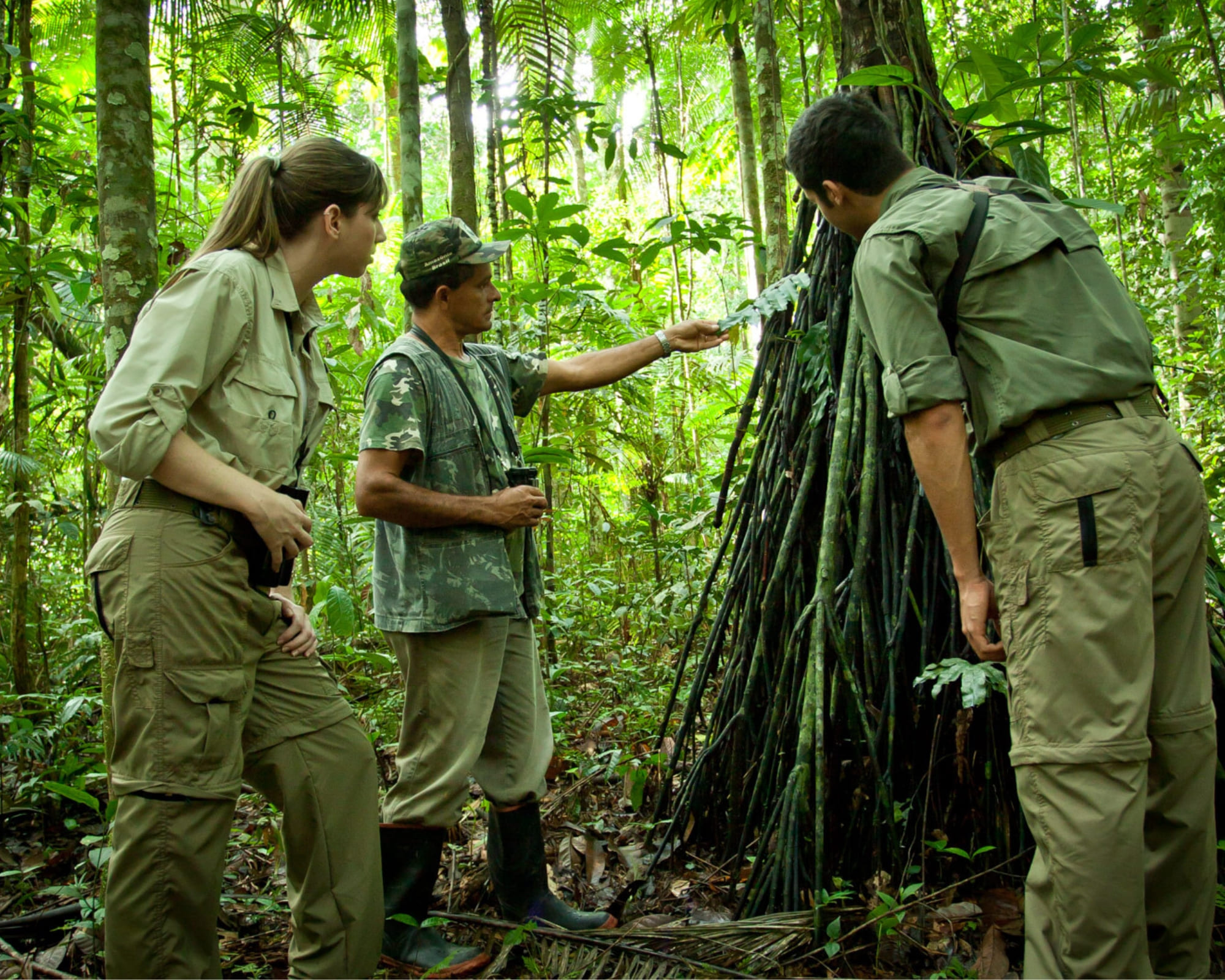
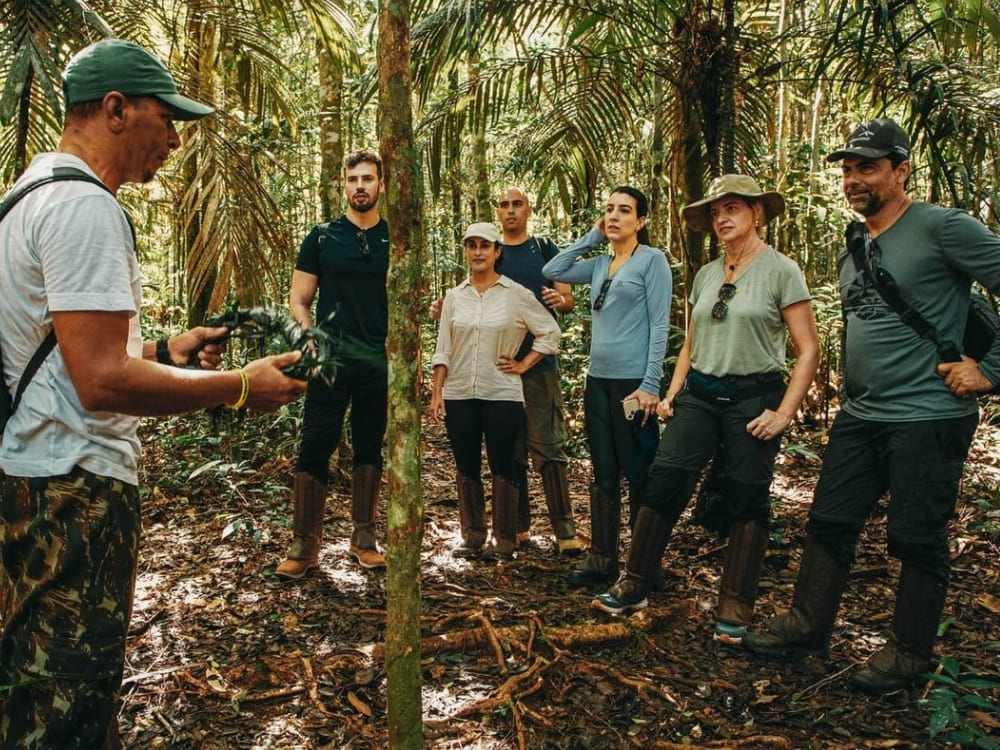
     Local guide explaining the flora to a group of tourists during a jungle hiking tour in the Amazon Rainforest.
    .

    👉 Read more: When is the best time to visit the Amazon Rainforest in Brazil

    What to do in the Amazon Rainforest?

    In addition to how to visit the Amazon Rainforest, what to do during the trip is a very frequently asked question by people who are interested in spending their vacation there. 

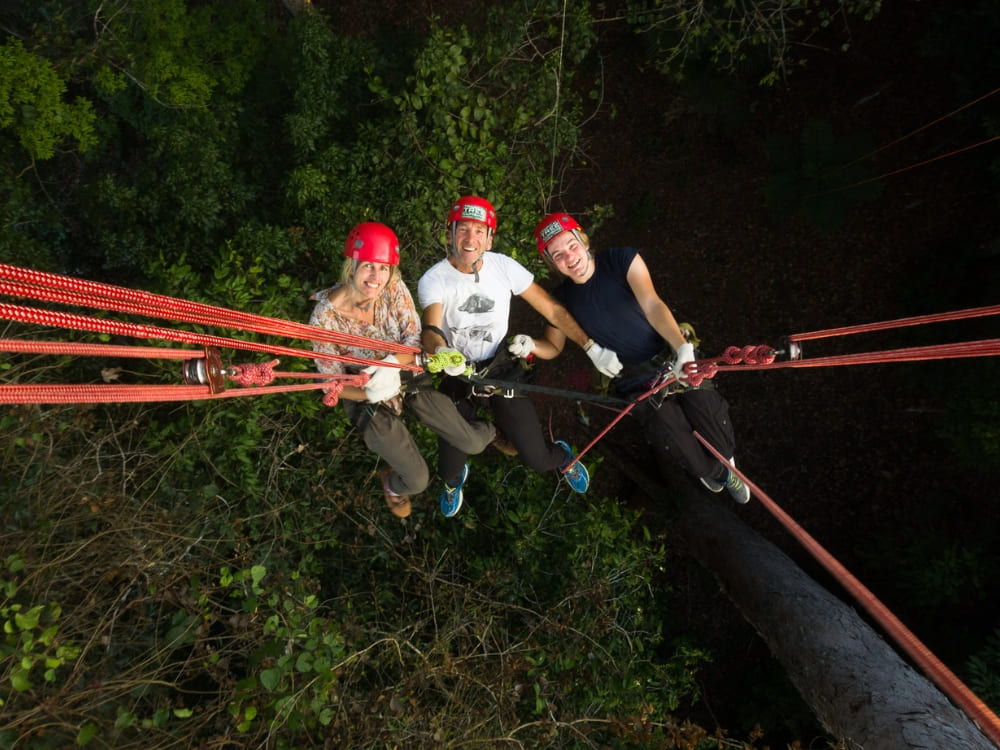
    Adventurous tourists equipped with helmets participating in tree climbing and rappelling activities high up in the Amazon canopy.
    .

    Each Amazon jungle tour in Brazil has its own itinerary, but tourists can expect a few activities, such as:

    • Jungle hiking
    • Boat trips
    • Kayaking
    • Canoeing
    • River cruises
    • Sailing through the Meeting of Waters
    • Wildlife watching
    • Tree climbing
    • Cave exploring
    • Forest immersion in jungle lodges
    • Visiting local communities, including indigenous groups

    👉 Read more: Top things to do in the Amazon Rainforest in Brazil

    Animals in the Amazon Rainforest, Brazil

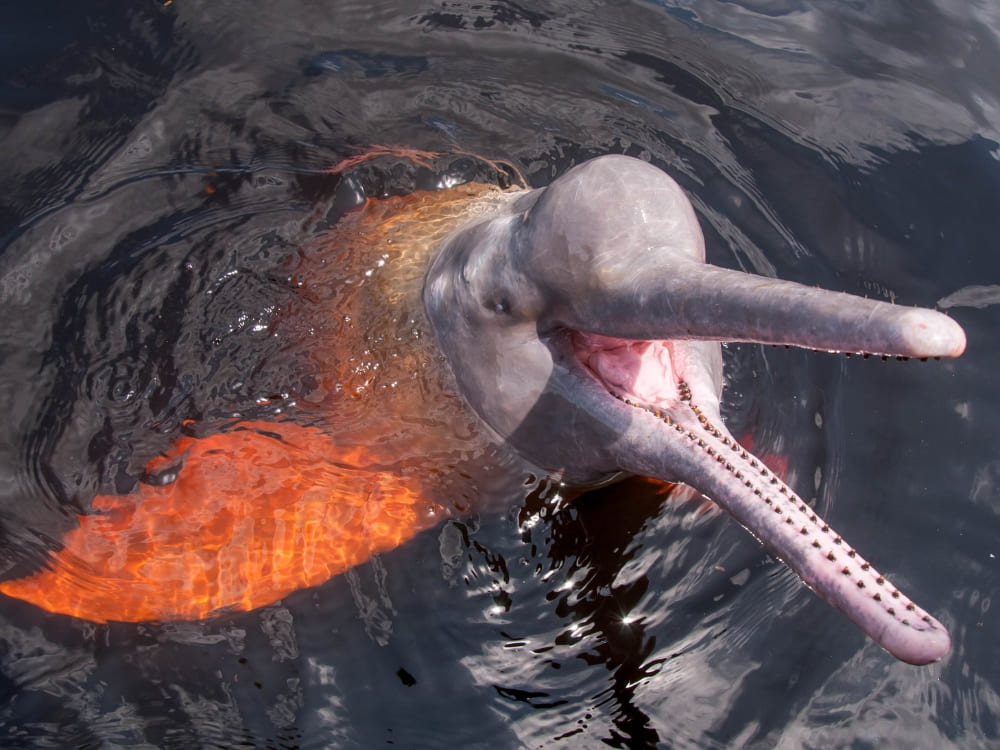
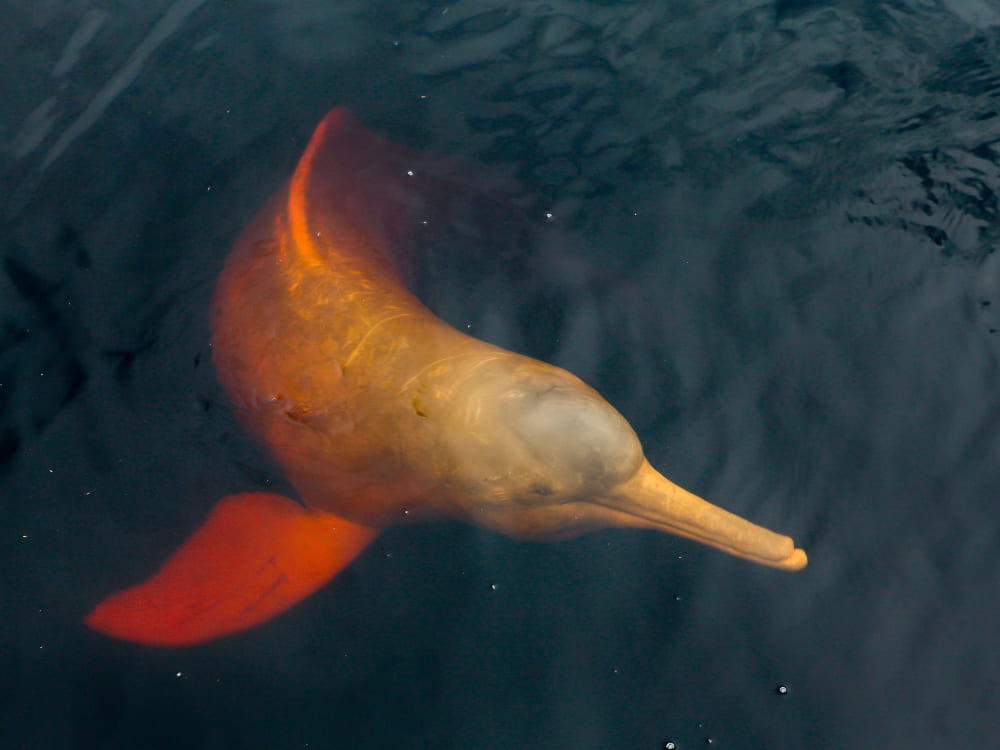
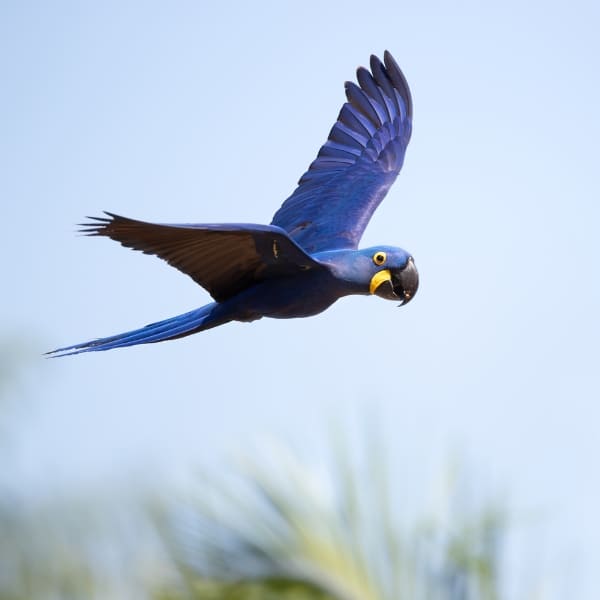
    There are millions of species of animals in this ecosystem, but some are considered symbols of the forest, like the mysterious harpy eagle, colorful macaws (red and blue), black spider monkeys, beautiful jaguars, cute-looking sloths, friendly Amazon pink dolphins and ravenous piranhas.

    The last two, in particular, are big Amazon stars. Interacting with dolphins is an absolute fan favorite, while fishing for piranhas brings everyone’s adrenaline to its maximum — an activity always monitored by experienced guides and respecting sustainable practices, of course.

    Amazon pink river dolphin swimming in the dark waters of the Rio Negro, a unique wildlife interaction and symbol of the Brazilian forest.
    .

    Keep in mind: despite the abundant fauna, there is no absolute guarantee that these animals will be spotted for a few reasons — the dense vegetation makes wildlife sightings more difficult, some species tend to hide from humans (especially during the day) and local operators follow strict protocols to not disturb animals.

    👉 Read more: Best Brazil Wildlife Tours and Destinations


    Where to stay in the Amazon Rainforest?

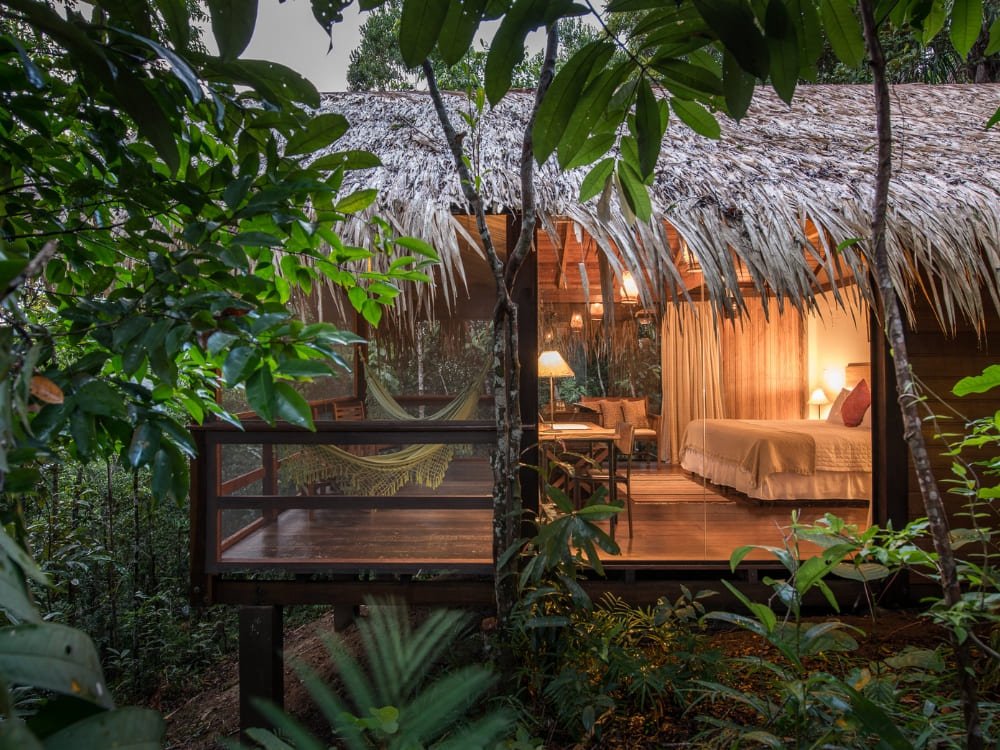
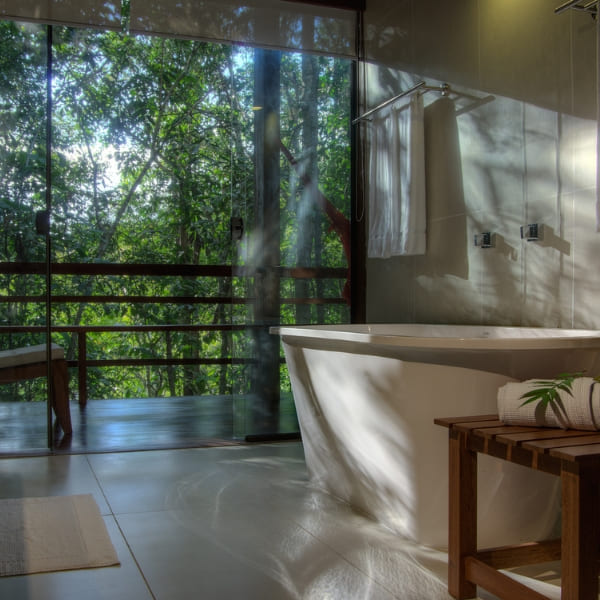
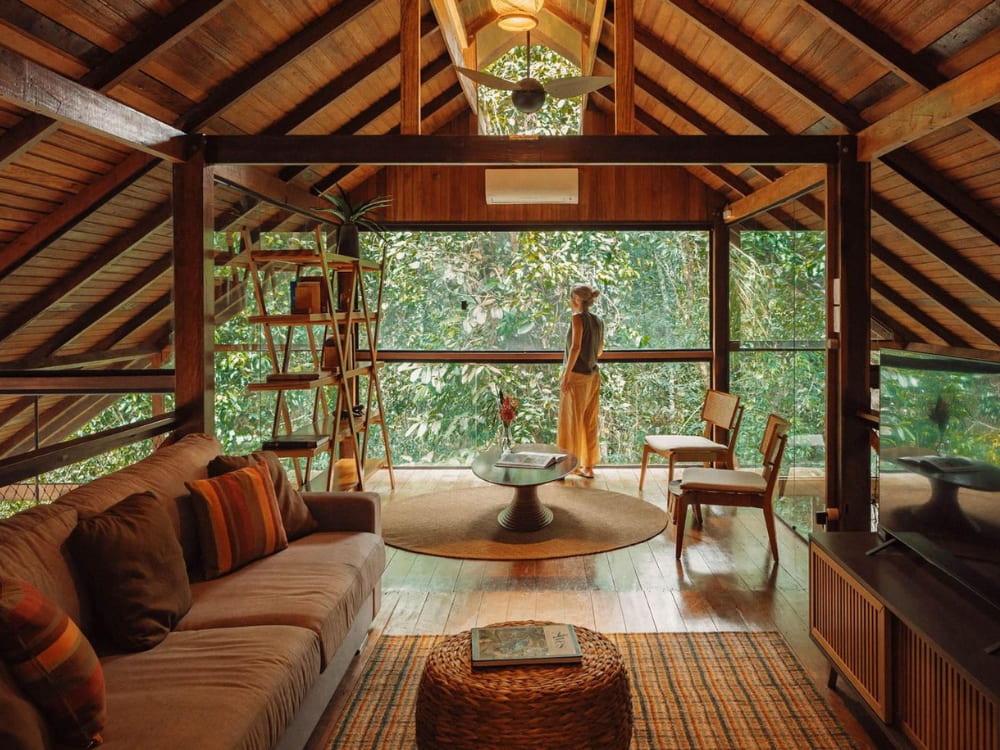
    Many people wonder if there are hotels in the Amazon. The answer is yes, but they’re known as jungle lodges since they are located in the middle of the forest. 

    Best Amazon Jungle Cozy lounge area inside an Amazon jungle lodge with large glass windows offering immersive views of the surrounding dense forest.
    Photo: Felipe Castellari

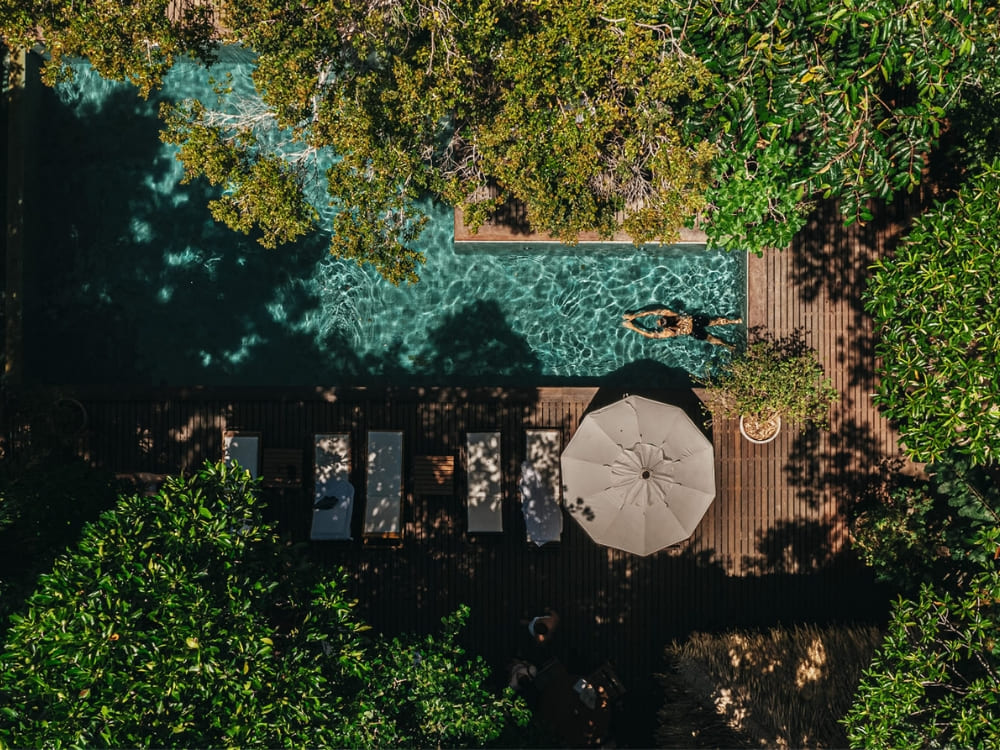
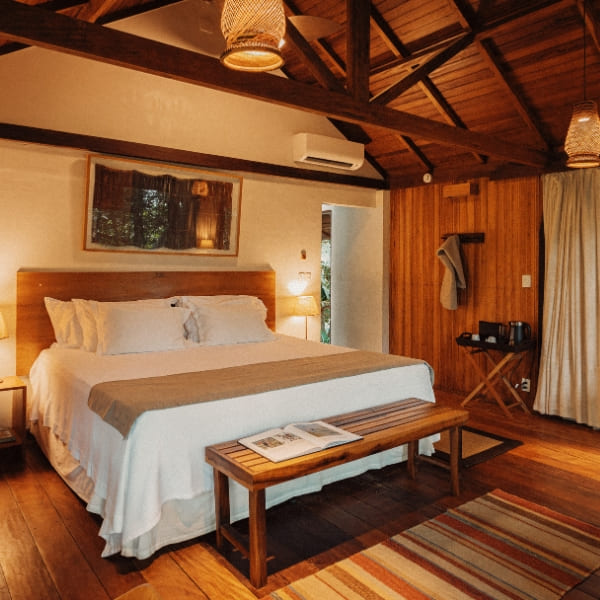
    Lodges offer comfortable accommodations, leisure areas (swimming pools, entertainment areas, gyms, lounges, bars, gift shops…), great restaurants and exclusive activities around the forest. From modest to luxury, there’s an option for everyone.

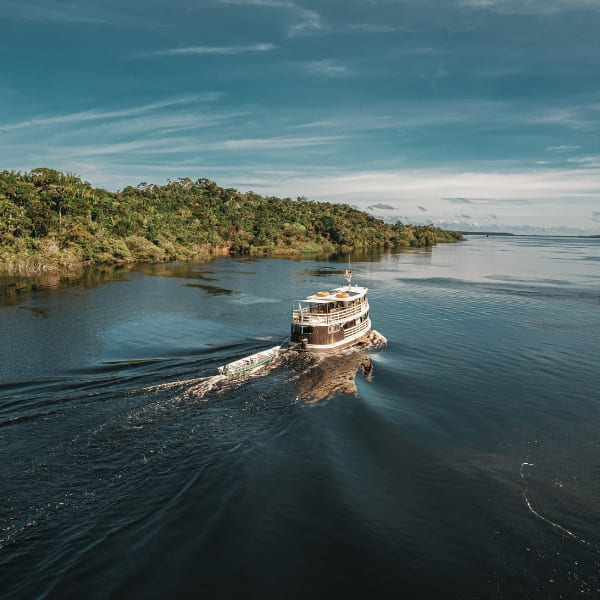
    Another alternative is the river cruises, which work similarly to classic cruise ships on the ocean, but with fewer passengers and sailing across the waters of Amazonian rivers, like the Rio Negro, Solimões, Tapajós and the Amazon River.

    Aerial view of a swimming pool at a luxury eco-lodge nestled deep within the Amazon Rainforest vegetation, offering leisure in nature.
    .


    The best Amazon cruises in Brazil include wonderful ensuite cabins, a restaurant onboard and many entertainment options, this is a fantastic way to experience nature.

    If you don’t mind giving up comfort so you can completely immerse yourself in nature, then our suggestion is the Amazon Jungle Survival Tour, a fantastic trip where you get to spend your nights camping in the middle of the forest! Accompanied by qualified guides, you’ll sleep in hammocks, cook your food on the campfire and even learn survival techniques.

    👉 Read more:

    How long should you stay in the Amazon Rainforest?

    The length of your trip depends on how immersive you want your experience to be.

    A 3-day tour is recommended for those on a tight schedule — it’s short, but still allows for river tours, guided jungle walks and a first introduction to the rainforest’s unique ecosystems. It’s a good option if you’re passing through Manaus or combining the Amazon with other destinations in Brazil.

    Breathtaking aerial view of a river fork and lush green islands in the Amazon basin, highlighting the region's vast hydrology and beauty.
    .

    Traveling to the Amazon in Brazil: how much does it cost?

    The cost of a trip to the Amazon in Brazil depends on various factors, like accommodation category, group size, trip length and itineraries.

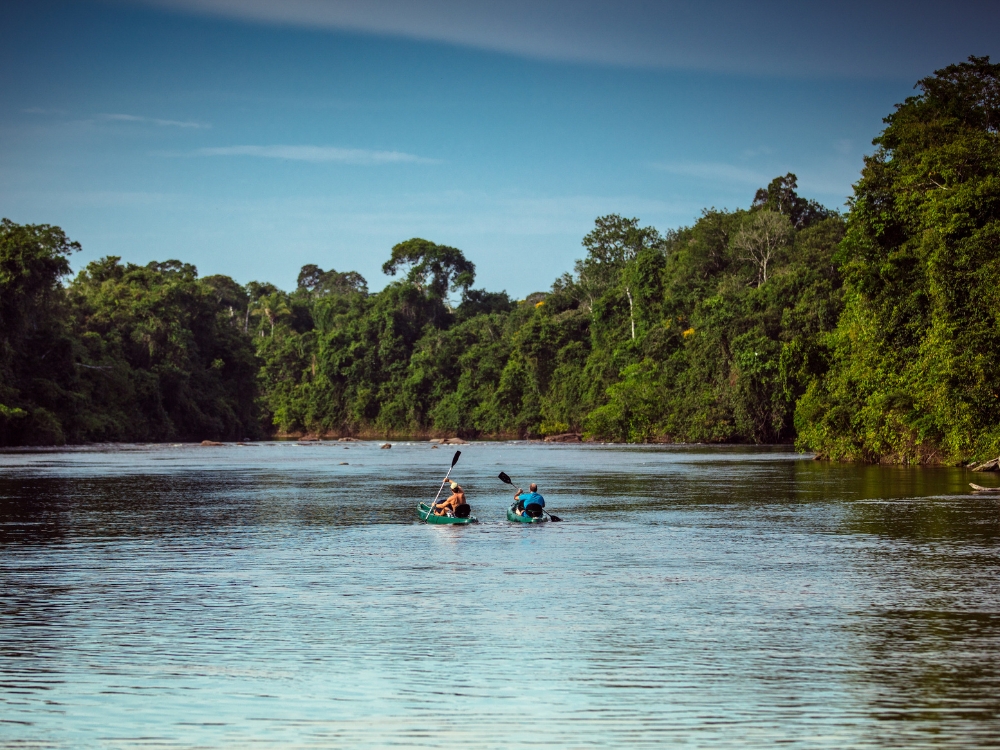
    Travelers kayaking down a tranquil Amazon river, enjoying an eco-friendly way to observe the rainforest ecosystem up close.
    Photo: Samuel Melim

    For example, wild camping tours are a more budget-friendly option, offering a raw and immersive experience, while luxury lodges provide high-end comfort at a higher price. Solo travelers may face higher costs due to single occupancy charges, whereas group travelers can benefit from shared costs.

    PlanetaEXO curates the best Amazon Rainforest Tours in Brazil, with prices (per person) ranging from R$2.170 (approximately $418) for basic camping expeditions to R$23,000 (approximately $4,392) for premium luxury packages — not including flight tickets.

    Do you need a vaccine to go to the Amazon Rainforest in Brazil?

    Unlike other countries (Bolivia, Colombia, Guyana, Panama, and Venezuela), there is no requirement of yellow fever vaccinations to visit the Amazon in Brazil because ANVISA (Brazil Health Regulatory Agency) doesn’t consider the disease a risk in national territory.

    However, it’s strongly recommended that foreign tourists get their shots at least ten days before the trip — especially if they intend to visit the rainforest in the countries previously mentioned. Better safe than sorry!

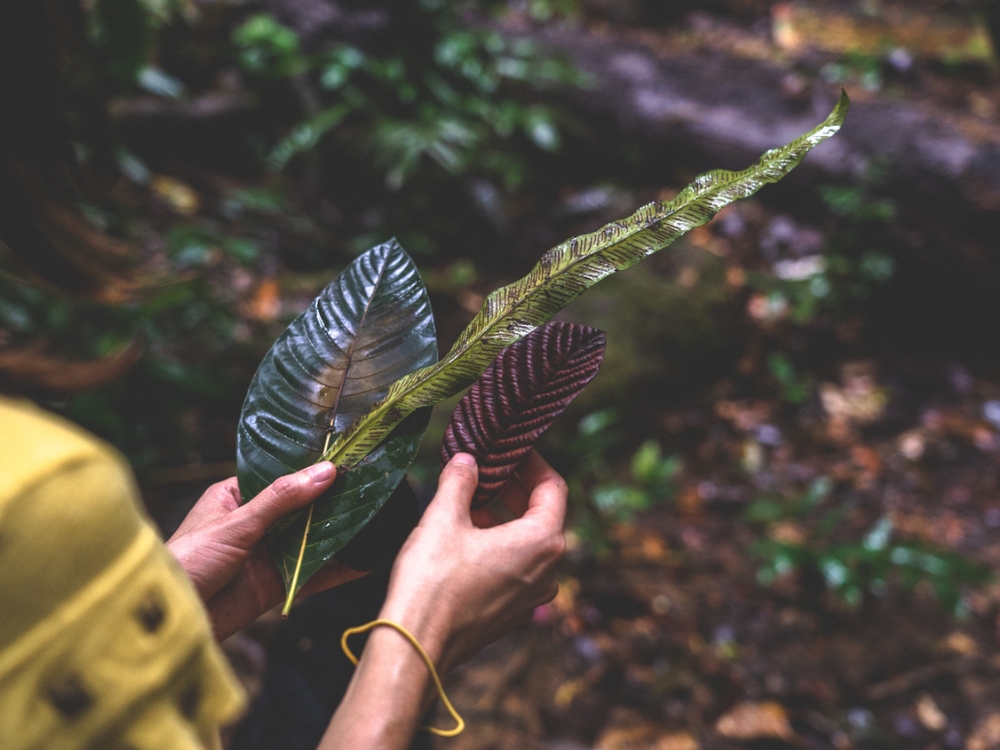
    Close-up of a traveler's hands examining unique leaf textures during a guided educational walk in the Amazon jungle.
    .

    Is it safe to visit the Amazon Rainforest in Brazil?

    Yes, it’s safe to visit the Amazon, as long as you explore with experienced local guides. Travelers might think there are wild animals and hidden dangers along the trails, but tours are carefully planned to avoid risky situations.

    Tour guides know the forest inside out and ensure that every activity, from jungle walks to boat trips, is carried out with complete safety and respect for nature.

    Since itineraries are designed only for observation, you won’t come across animals that pose any threat. Besides, most species prefer to stay hidden, so encounters are peaceful moments to admire their beauty.

    With professional guidance, comfortable logistics, and well-structured activities, visiting the Amazon is a safe and unforgettable adventure for all travelers.

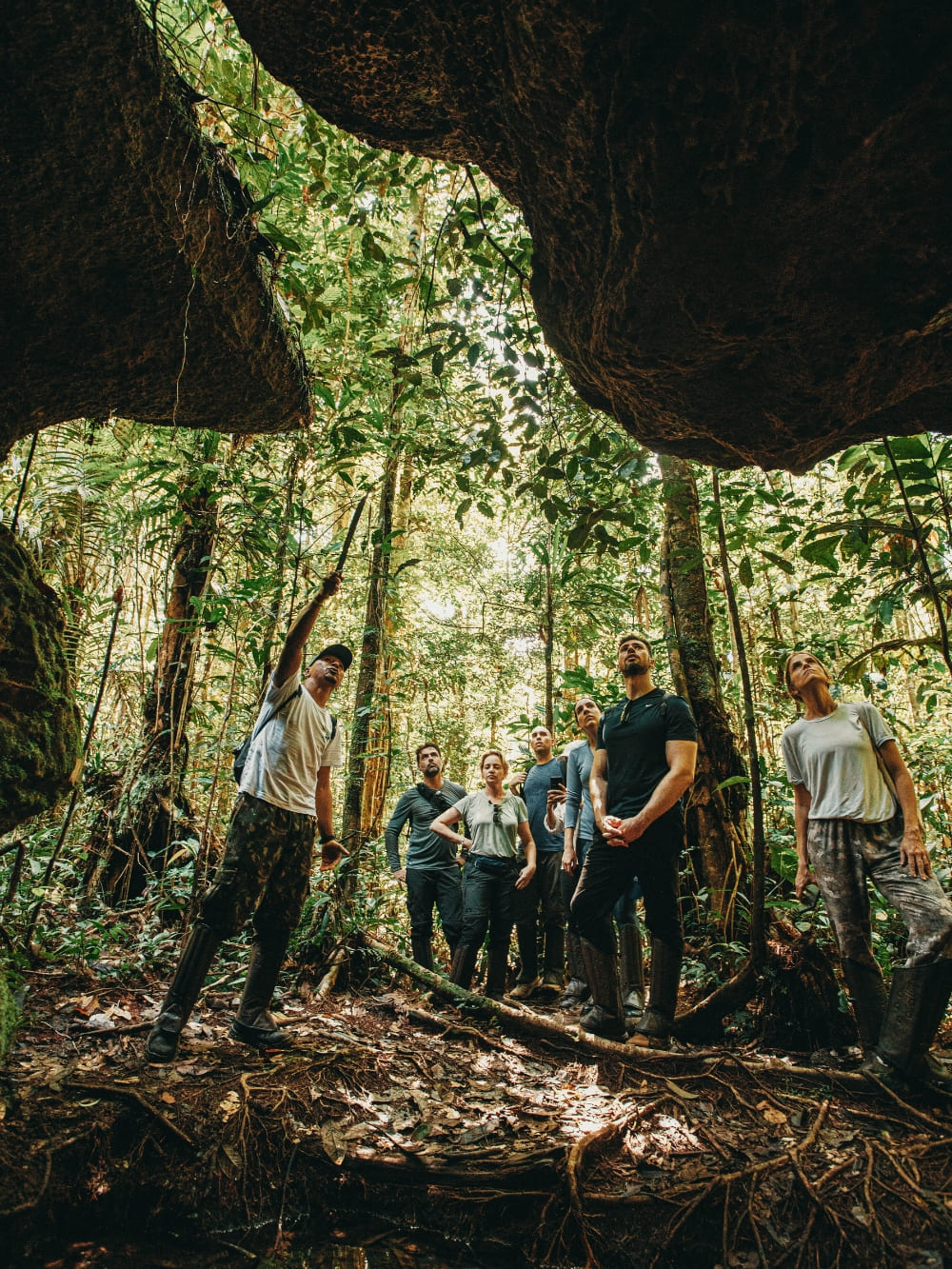
    Group of tourists exploring a cave formation within the Amazon rainforest, looking out at the jungle with an expert local guide.
    Photo: Felipe Castellari

    What should I pack for an Amazon Rainforest trip?

    Pack your bags with:

    • Light clothes (t-shirts, long-sleeved t-shirts, shorts, pants, hats/caps, swimwear)
    • Comfy shoes (sneakers for hiking, flip-flops, sandals)
    • Travel essentials (documents, cash, credit/debit cards, medication, sunscreens, after-sun gel, insect repellent)
    • Equipment for jungle hiking (raincoat, flashlight, reusable water bottle)
    • Electronic devices (cellphone, camera, chargers, portable chargers, etc.)

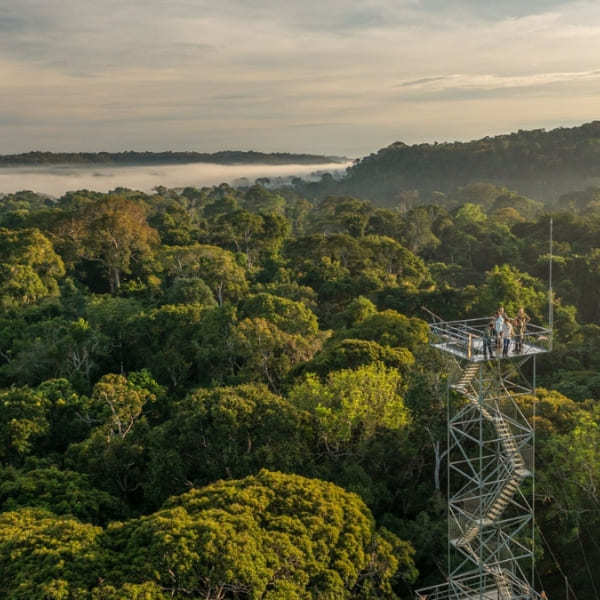
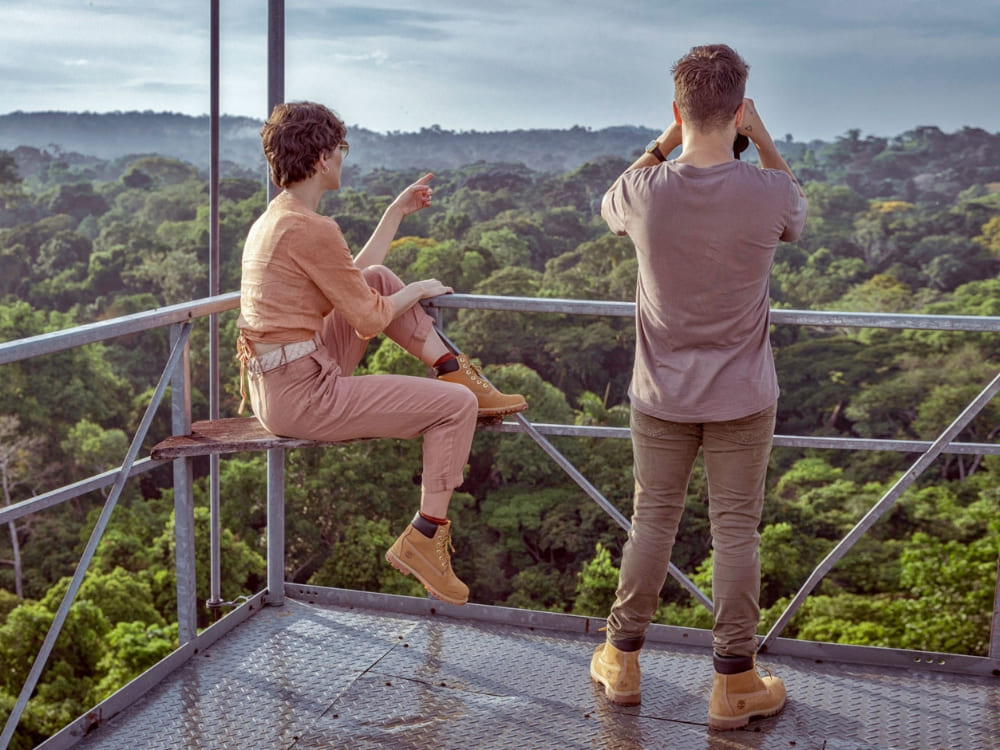
    Travelers using binoculars on an observation tower high above the canopy to safely spot birds and wildlife in the Amazon Rainforest.

    👉 Read more: 10 Amazon Rainforest Travel Tips to Make the Most of Your Adventure

    Is traveling to the Amazon worth it?

    It’s more than worth it! The Amazon Rainforest is the richest place on the planet when it comes to natural resources. The jungle, the rivers, the animals, the food, the people — everything holds an inexplicable beauty and magical atmosphere not found anywhere else.

    Adventure and ecotourism enthusiasts should spend at least a few days in this surreal destination so they can witness with their own eyes what Mother Nature is truly capable of. 

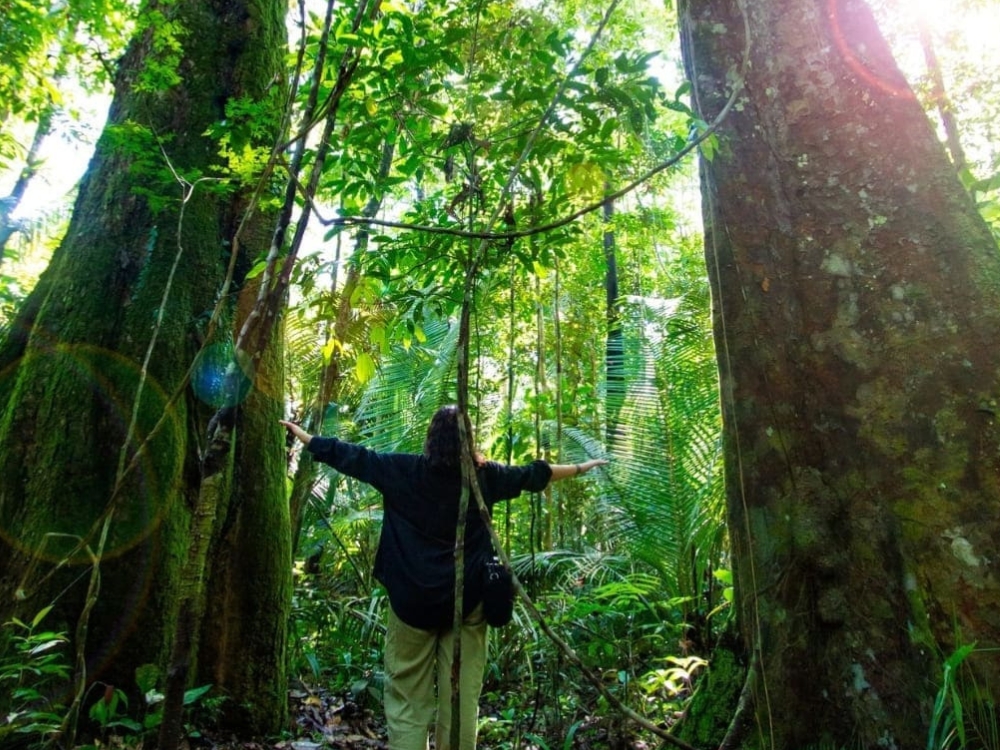
    Tourist embracing the massive trunk of a Samauma tree, showcasing the scale of the giant trees and the connection with nature in the Amazon.
    .

    Shall we book your Amazon adventure?

    We hope this guide on how to visit the Amazon has been helpful to kick off your travel plans!

    As an expert platform that works with the best local operators, PlanetaEXO offers incredible Amazon Rainforest tours in Brazil with tailor-made itineraries and all the support you might need. Contact us now!
  • How to visit Chapada Diamantina National Park, Brazil – Travel Guide

    How to visit Chapada Diamantina National Park, Brazil – Travel Guide

    Learn everything you need to know to travel to Brazil’s Chapada Diamantina, including how to get there, the best time to visit, main activities, and more!

    Chapada Diamantina National Park, in Brazil, is a conservation unit that protects a massive area of stunning natural landscapes formed by waterfalls, caves, canyons, mountains, and rich fauna and flora.

    Considered one of the best places in the world for ecotourism activities—especially trekking—Chapada Diamantina is the most well-known national park among Brazilians, according to research by the Semeia Institute. Among foreigners, it’s the sixth most sought-after Brazilian destination, reaching more than 11,500 online searches in 2024 alone, according to data from the Brazilian Tourist Board.

    PlanetaEXO, an ecotourism platform specializing in Chapada Diamantina tours, not only knows this fantastic destination intimately, but we’ve also taken countless adventurers from all over the world to explore it. To help even more travelers immerse themselves in this universe of natural beauty, we’ve put together a complete travel guide with all the essential information. See below!

    Table of contents:

    1. About Chapada Diamantina
    2. How to get to Chapada Diamantina National Park, Brazil?
    3. When is the best time to visit Chapada Diamantina?
    4. What to do in Chapada Diamantina?
    5. How many days should I stay in Chapada Diamantina National Park?
    6. Where to stay in Chapada Diamantina?
    7. Do I need a guide to visit Chapada Diamantina?
    8. What should I pack for a Chapada Diamantina hike?
    9. Best Chapada Diamantina tours
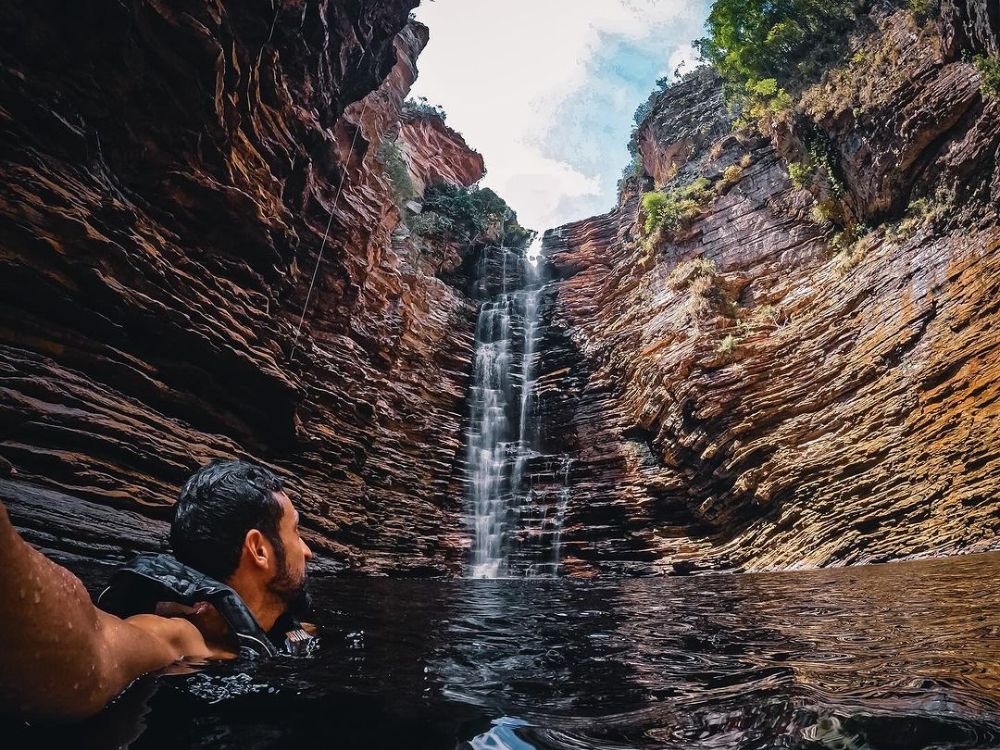
    A man swims in a dark natural pool, looking up at a tall waterfall cascading down a canyon with layered rock formations.
    @vilkercruz

    About Chapada Diamantina

    In northeastern Brazil, the Chapada Diamantina National Park is located approximately 420 km away from Salvador, the capital of the state of Bahia. Its area of over 1,521 km²  is distributed among the municipalities of Lençóis, Mucugê, Ibicoara, Andaraí, Itaetê, and Palmeiras.

    With the highest elevation above 500 meters, Chapada Diamantina is also an integral part of the Serra do Sincorá. Extending across 80 kilometers, this mountain range significantly contributes to the landscape and the biodiversity of the park.

    Like the other seventy national parks scattered throughout Brazil, Chapada Diamantina protects natural resources—including fauna, flora, bodies of water, rock formations, and archaeological sites—and opposes the negative effects of industrialization on ecosystems.

    Spanning the Caatinga, Cerrado, and Atlantic Forest biomes, its biodiversity blends rocky fields, riparian forests, and seasonal forests, proving just how important this natural richness actually is for the country’s ecological balance, as well as presenting great possibilities for sustainable tourism.

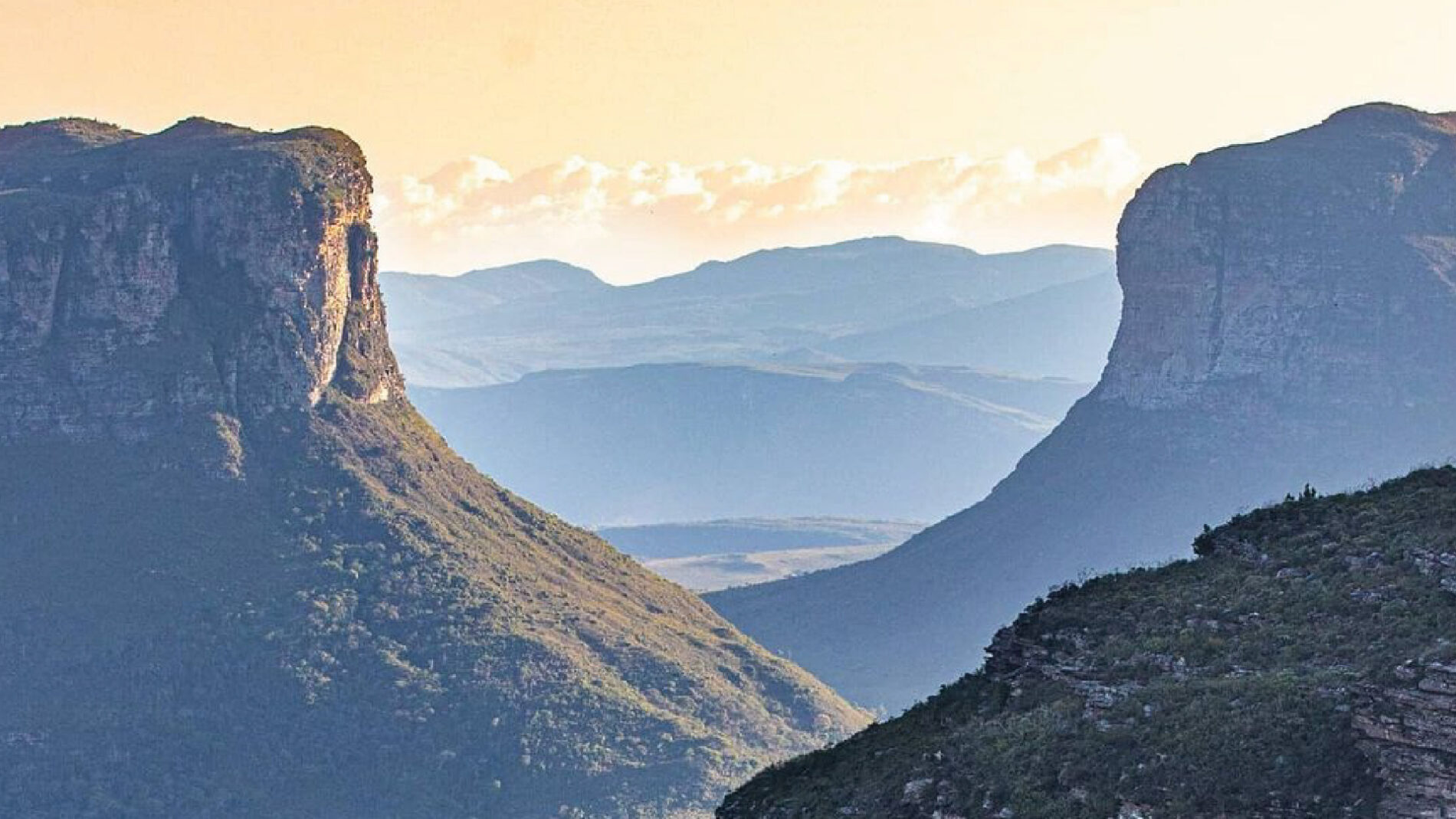
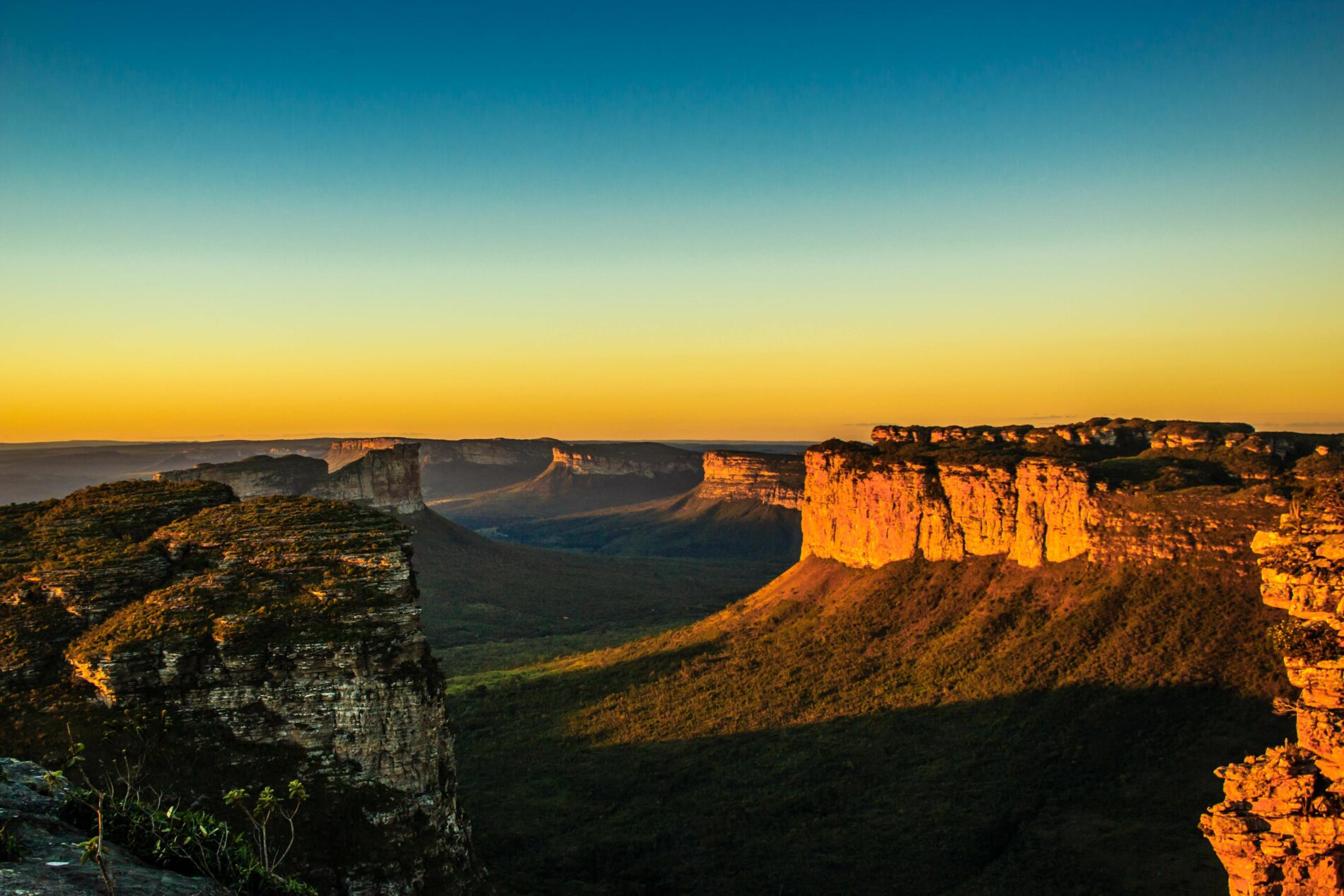
    Panoramic view of Chapada Diamantina's flat-topped mountains and deep green valleys illuminated by the golden light of a sunset.
    .

    Although not the best place in Brazil for wildlife observation—this title belongs to the Pantanalthe fauna of Chapada Diamantina is very rich, especially the birds. There are more than 370 different species, including the chaco eagle, white-browed guan, vinaceous-breasted amazon, and the endemic hooded visorbearer.

    The flora is also abundant. With over a hundred types of flowers, they can be seen in shrubs, rocky fields, and among the rocks. There are also cacti, begonias, low palm trees, and about 440 endemic plant species throughout the park.

    Chapada Diamantina’s history

    Nearly 2 billion years ago, the Chapada Diamantina National Park in Brazil was covered by the waters of the Espinhaço Sea. Over time, the ecosystem changed, going through glacial periods, deserts, and new floods.

    Slowly, the soil became fertile, and vegetation grew, turning into the ideal home for large reptiles, dinosaurs, and now-extinct mammals such as the giant sloth, whose remains have been found in the well-known Poço Azul in 2005.

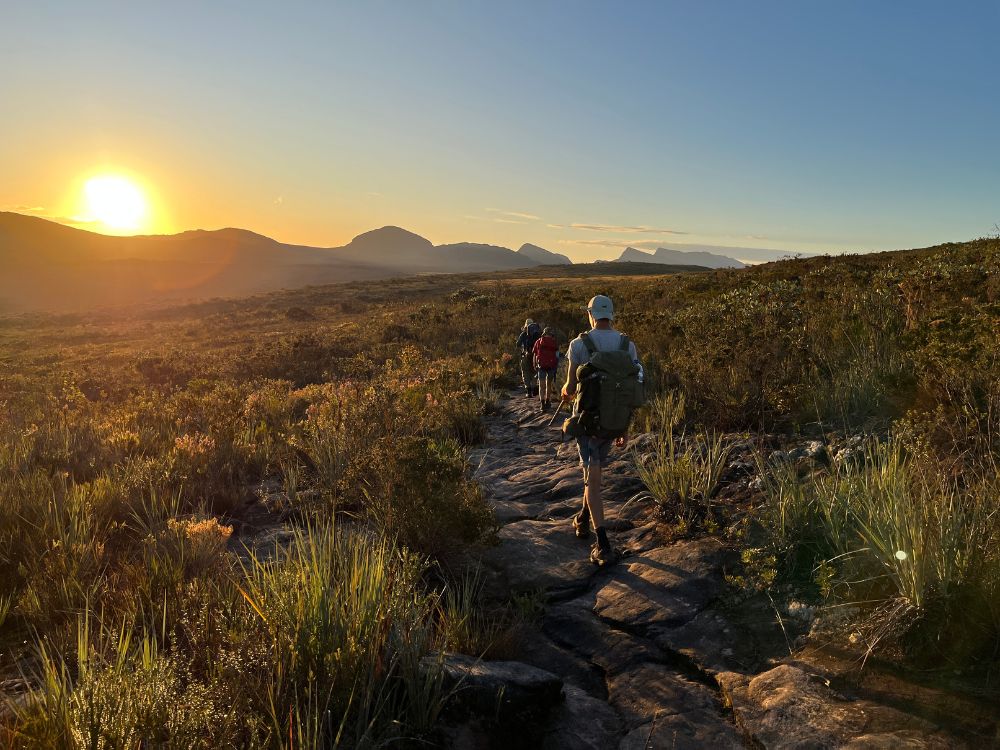
    A group of hikers with backpacks walks along a rocky trail towards the mountains during a bright sunset in Chapada Diamantina.
    .

    Rock paintings found in Lençóis indicate that the first humans inhabited the region about 13,000 years ago, while various indigenous groups (Papayá, Maracá, Aimoré, Topins, etc.) also called Chapada home.

    In the 16th century, explorers from other Brazilian states began to explore the natural resources of Bahia. At the end of the 17th century, the first diamonds were discovered in the Cumbucas River, in Mucugê. This triggered a great era of diamond extraction—hence the name “Diamantina”—making mining the main economic activity for a long time.

    Eventually, mining cooled down until it was completely banned in 1996. The national park was created in 1985 with the aim of preserving the region’s biodiversity, something that would not have been possible if the miners had continued their work.

    Today, Chapada Diamantina serves as a center for adventure and eco-tourism, drawing thousands of visitors to experience some of its famous unique attractions like the Morro do Pai Inácio, Poço Azul, Cachoeira da Fumaça, and Vale do Pati.

    How to get to Chapada Diamantina National Park, Brazil?

    The easiest route to get to Chapada Diamantina is from Salvador (SSA), which is served by flights from São Paulo, Recife, Belo Horizonte, and Brasília. International visitors can get to Bahia’s capital departing from Buenos Aires, Lisbon, Madrid, Paris, and Panama City.

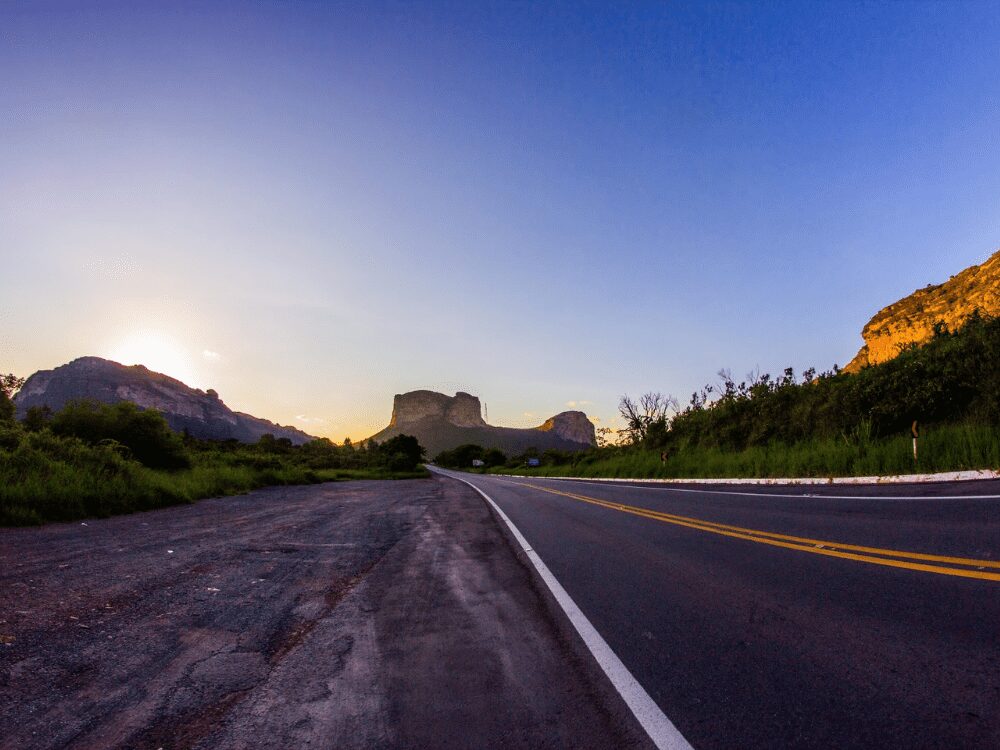
    An empty paved road leads directly toward the iconic Morro do Pai Inácio mountain under a clear blue sky at dusk.
    .

    From Salvador, it takes a little over an hour to fly to Lençóis (LEC), considered by many as the main gateway to the national park. By car or bus, it takes 6–7 hours to reach Lençóis, Mucugê, or Palmeiras.

    👉 Read more: How to Get to Chapada Diamantina National Park?

    When is the best time to visit Chapada Diamantina?

    Chapada Diamantina can be visited all year round, but your experience will vary depending on the season.

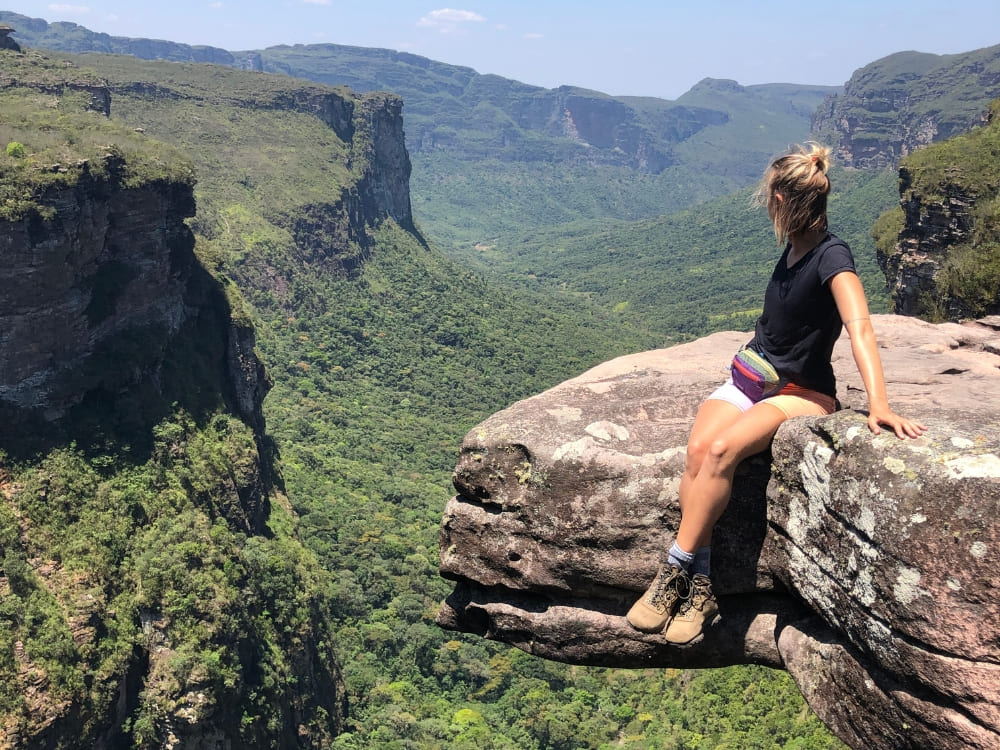
    Woman hiker resting on a rocky cliff edge, overlooking a vast, lush green canyon and distant plateaus during an ecotourism adventure.
    .

    The dry months (May to September) offer clear skies and ideal conditions for hiking, while the rainy season (October to April) brings lush green landscapes and powerful waterfalls. Each with its own charm, so it really is a matter of personal preference.

    👉 Read more: When is the best time to visit Chapada Diamantina?

    What to do in Chapada Diamantina?

    Brazil’s Chapada Diamantina offers a great variety of attractions that cater to adventure seekers and nature enthusiasts alike. Here’s a breakdown of the main activities within the park:

    Hiking and trekking

    Chapada Diamantina hikes attract thousands of visitors every year. Vale do Pati, in particular, has some of the greatest trekking routes not only in Brazil but on the planet due to its beauty and challenging trails.

    This area is noted for its vast plateaus and steep valleys, providing spectacular views and a truly immersive experience in nature. Hiking tours usually pass by Chapada’s most beloved attractions, like Morro do Pai Inácio and Fumaça Waterfall.

    👉 Read more: Best Hikes in Brazil: From Rainforests to Mountain Peaks

    Waterfalls

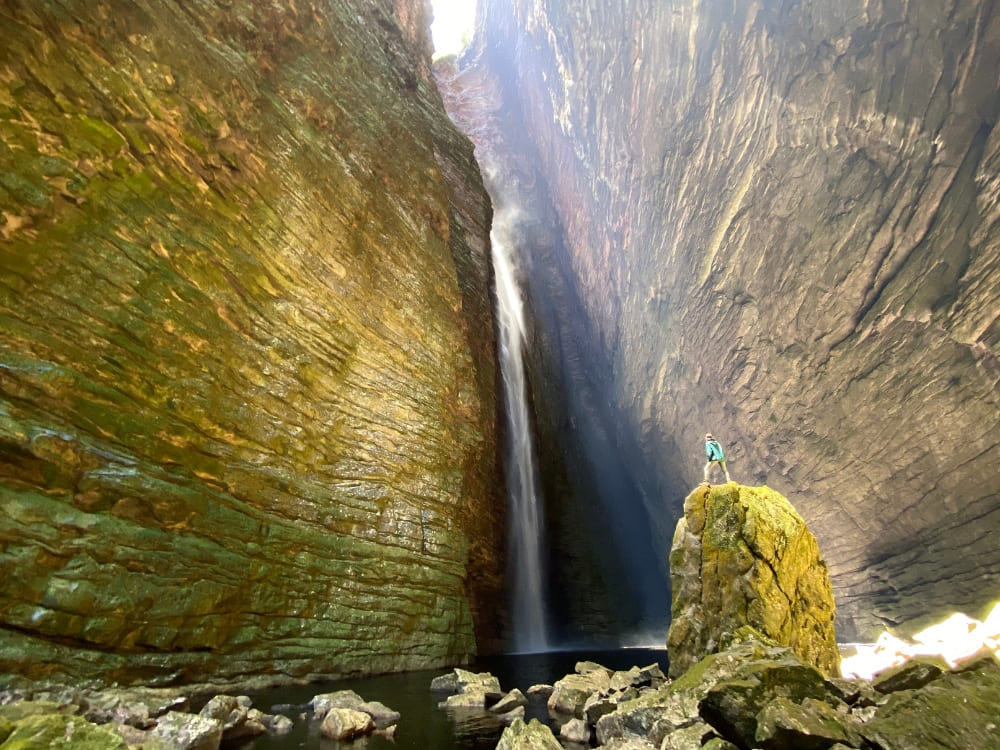
    Chapada Diamantina National Park has approximately 300 officially cataloged waterfalls. The most well-known is Fumaça, one of the tallest in Brazil, measuring nearly 340 meters in height.

    A person stands on a green mossy rock in a narrow canyon, looking at a powerful waterfall crashing into the dark water below.
    Photo: Lucas Ribeiro

    Other waterfalls worth visiting to cool off during treks are Fumacinha, Buracão, Mixila, and Sossego.

    👉 Read more: Chapada Diamantina Waterfalls – Best Trails and Hidden Gems

    Caves

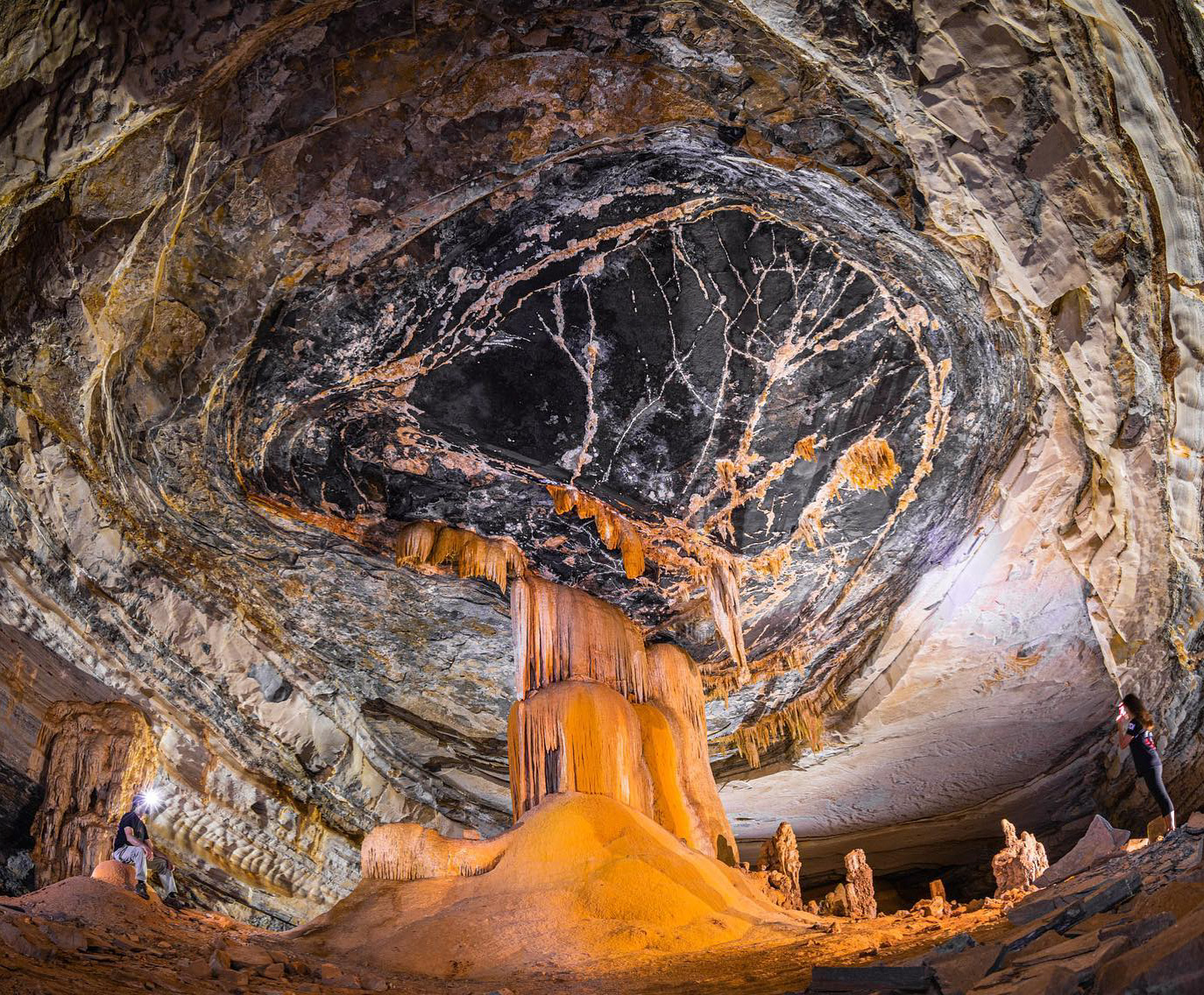
    The caves scattered around the park offer a unique underground experience. Gruta da Lapa Doce is one of the most noticeable, where visitors can explore an 850-meter path lined with impressive limestone formations and delve into the geological past of the region.

     The interior of a large, illuminated cave showing an impressive cluster of ancient limestone stalactites and stalagmites.
    .

    Close by is Gruta da Fumaça, famous for its stalactite-filled ceiling and fairly easy access. Other caves worth visiting are Gruta Azul, Gruta do Pratinha, and Gruta da Torrinha.

    Natural pools

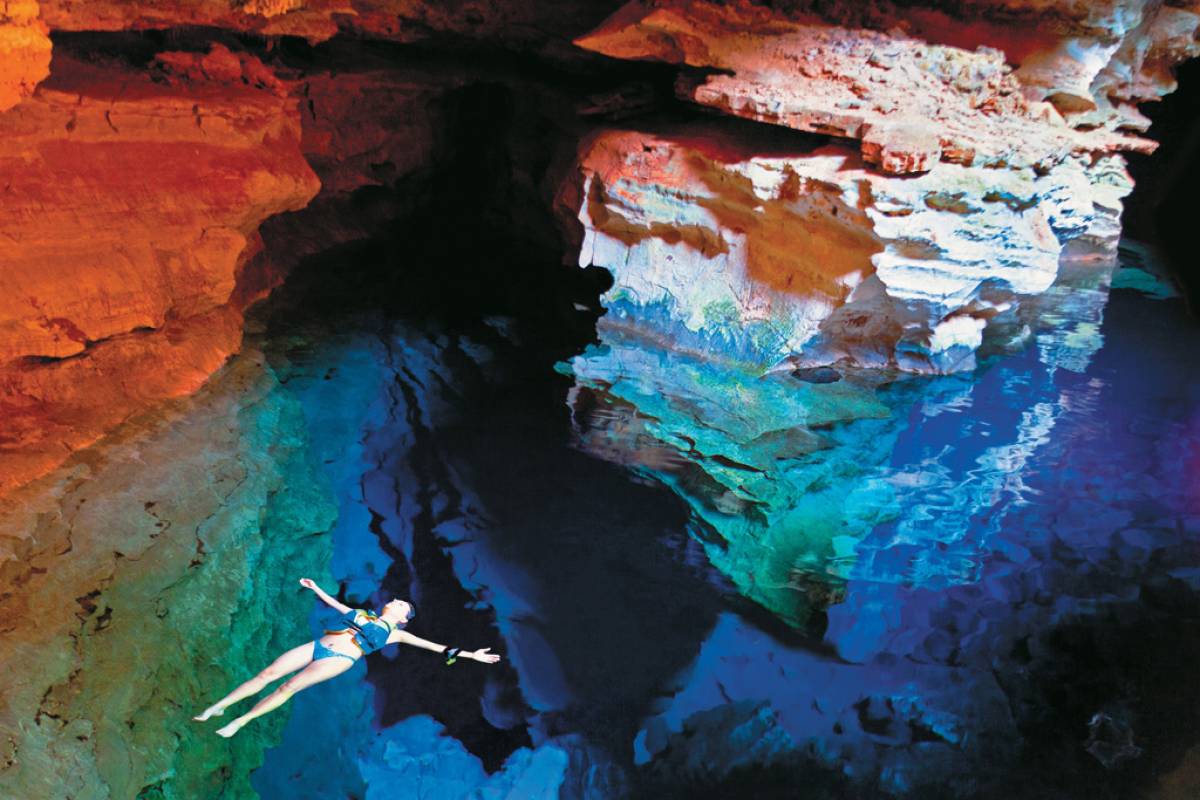
    Poço Encantado offers an escape with its crystal-clear waters sourced from a non-renewable aquifer, providing a place for quiet reflection rather than swimming. Nearby, Poço Azul invites visitors to swim and enjoy its breathtaking beauty up close.

     A woman floats on her back in the crystal-clear, bright blue water of an underground natural pool surrounded by rock walls.
    .

    During the day, the darkness of both caves is broken by sunlight escaping through openings in the rocks, illuminating the water with a beautiful, bright blue hue.

    Culture

    The cultural heritage of Chapada Diamantina is as extensive as its natural resources. In the base towns, there is a strong influence from traditional communities in the cultural vein of the region, including African, indigenous, riverside, mining, and quilombola (Afro-Brazilian) communities.

    Many of these groups lead activities open to the public, such as regional festivals, visits to villages, and immersive tours. Cultural diversity is also observed in various aspects of daily life, such as architecture, cuisine, and handicrafts.

    Visitors can also explore the geological and archaeological richness of the Chapada by visiting the Sincorá Museum and the Serra das Paridas archaeological site—both located in Lençóis.

    👉 Read more: What to do in Chapada Diamantina?

    How many days should I stay in Chapada Diamantina National Park?

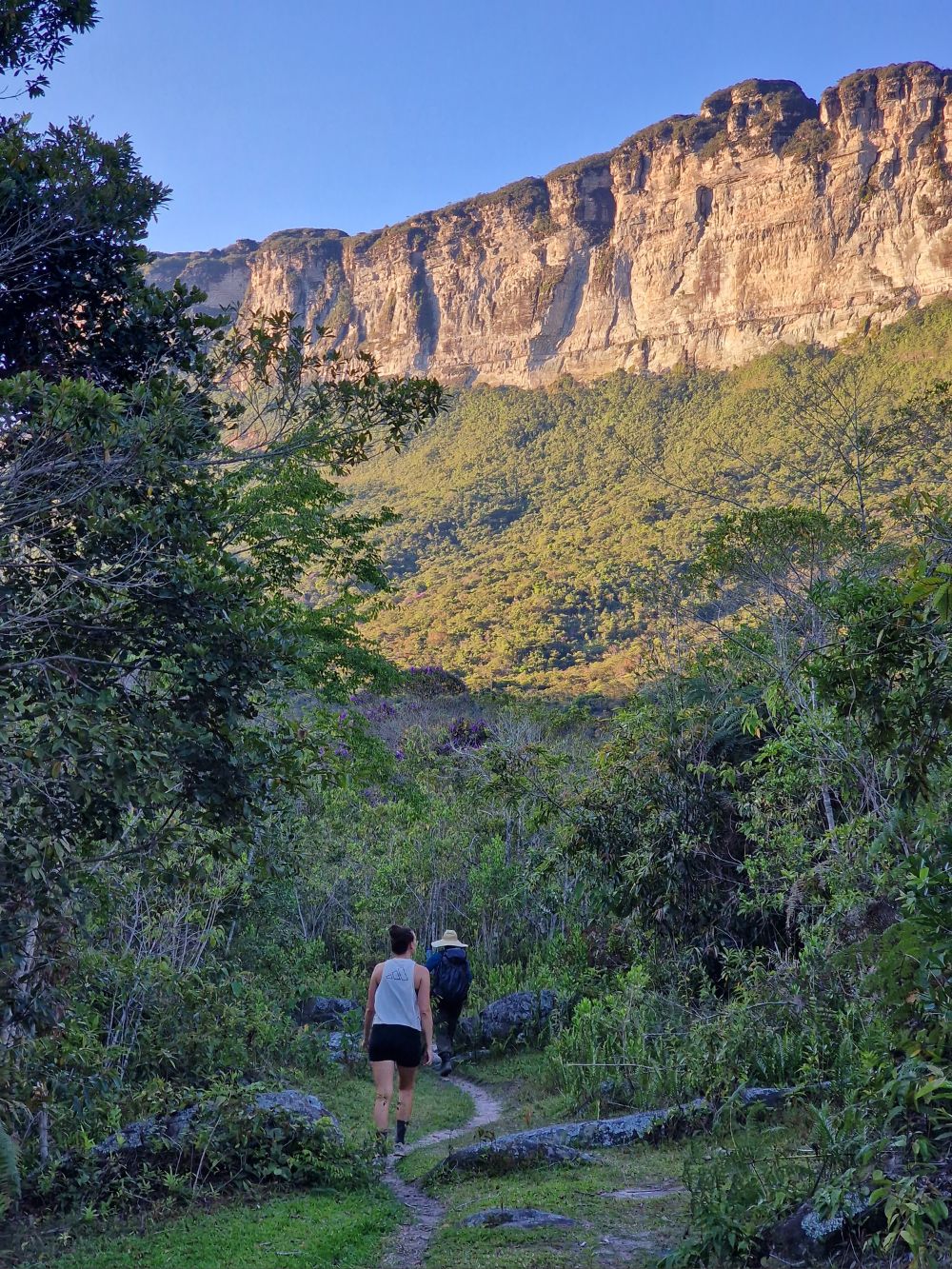
    It all depends on your travel style and priorities. If you’re on a tight schedule, a 3-day trip is enough for a first introduction to the park’s iconic spots like Morro do Pai Inácio, Cachoeira da Fumaça, or Poço Azul. It’s a compact but rewarding way to experience some of the region’s landscapes and natural highlights without rushing too much.

    Two hikers walk along a narrow dirt path through lush green vegetation towards a massive, towering rock wall in Vale do Pati.
    @Rasmus Soeby

    For travelers with more time and a bit more flexibility, staying 5 to 7 days (or even longer) will allow for a much deeper connection with the park. With extra days, you can venture into remote areas like Vale do Pati, explore hidden waterfalls, and balance physically demanding trails with moments of relaxation in the surrounding towns.

    Given the size of the park and the long distances between attractions, it’s worth planning your itinerary carefully to minimize time spent on the road and maximize your time on the trails.

    👉 Read more: How many days should you stay in Chapada Diamantina?

    Where to stay in Chapada Diamantina?

    Chapada Diamantina is a broad area dotted with diverse towns, each offering unique accommodation options to suit various tastes and preferences. From charming bed & breakfasts and authentic homestays to traditional hotels, there is an alternative for everyone.

    Lençóis

    Lençóis is a favored starting point for many travelers due to its easy access and great infrastructure. This historic town is alive with activities, offering numerous Chapada Diamantina tours that explore the natural and cultural highlights of the area.

    Mucugê

    Mucugê is a quieter, more reflective atmosphere with beautifully preserved colonial architecture and peaceful cemeteries, providing a serene retreat after a busy day of exploration.

    Palmeiras

    Palmeiras is the gateway to the stunning Vale do Capão, renowned for its lush landscapes and extensive hiking trails. It’s ideal for those looking for a closer connection to nature.

    Andaraí

    Andaraí is located along the banks of the Paraguaçu River. Steeped in natural beauty, it offers easy access to a variety of trails, waterfalls, and historical sites, making it a versatile choice for accommodation.

    Igatu

    For those who prefer smaller, more intimate settings, this historic village is the perfect choice. Known as “Stone Village” and “Bahia’s Machu Picchu,” Igatu enchants everyone with its 19th-century stone ruins and calm ambiance, offering a peaceful retreat for people who love nature and history.

    Ibicoara

    Ibicoara is a paradise for avid hikers and nature lovers. This less-crowded town is an excellent base for exploring some of the park’s most magnificent waterfalls, including the breathtaking Fumacinha.

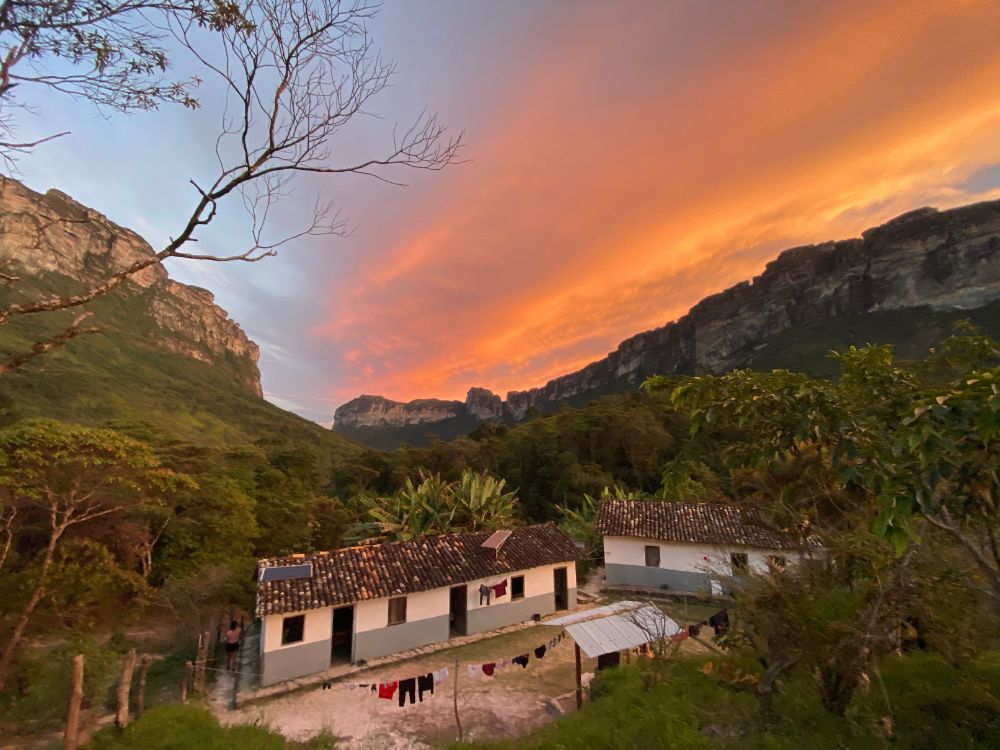
    Homestay

    For adventurers seeking a truly immersive trip, the Vale do Pati trek is unmatched. Since this is a multi-day experience, spending the night within the national park borders is the only option for accommodation.

     Modest white homestay houses with clay roofs nestled in a green valley beneath towering mountains, under a dramatic orange sunset sky.
    .

    Only a handful of families live in the area, which makes the stay even more authentic and intimate. The houses are modest but still cozy, providing everything trekkers need for a good rest, including beds, blankets, bathrooms, and hot meals.

    This type of accommodation enhances the experience and causes a positive impact on the local communities who rely on ecotourism to make a living.

    👉 Read more: Where to stay in Chapada Diamantina?

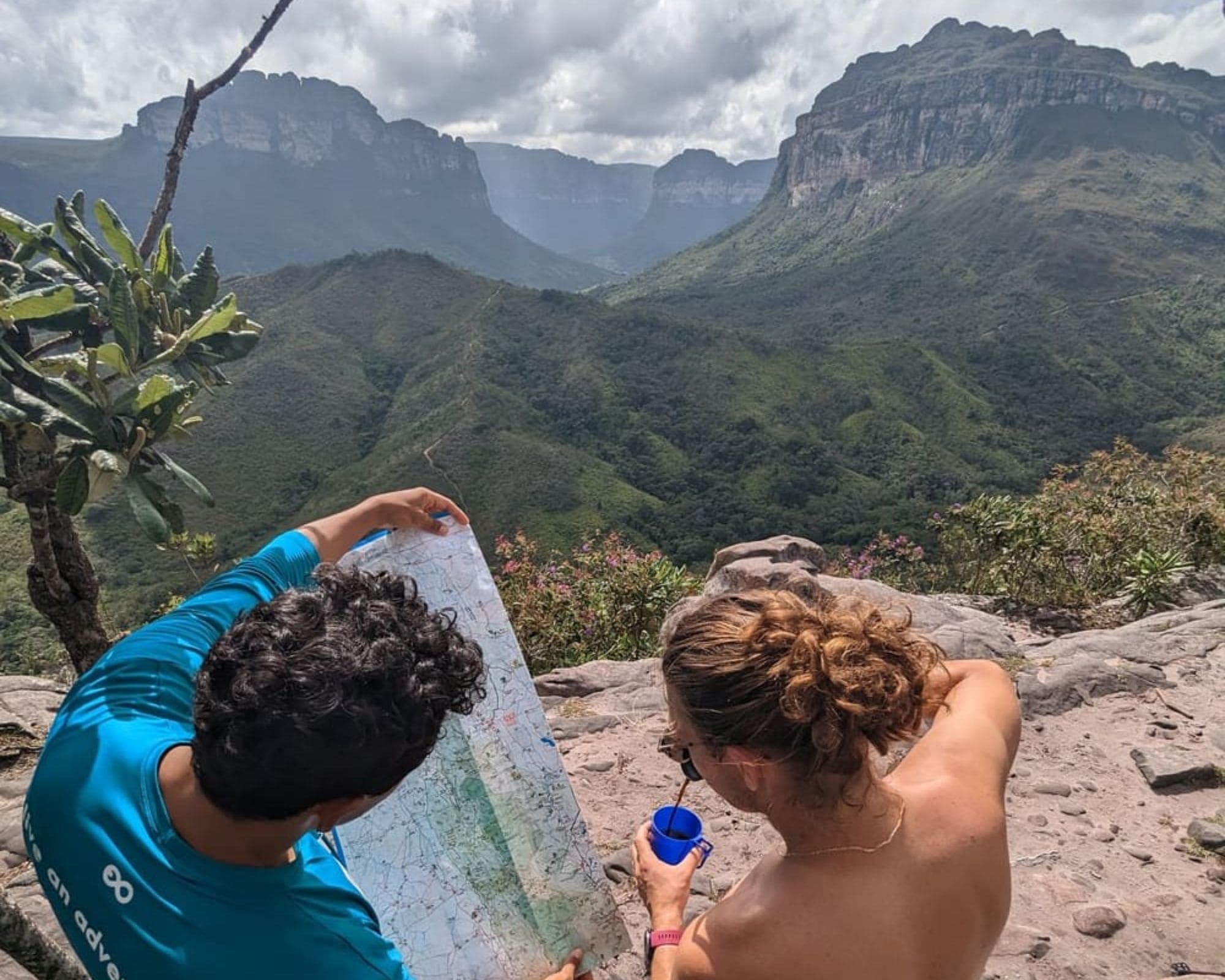
    Do I need a guide to visit Chapada Diamantina?

    Yes, you absolutely need a guide in Chapada Diamantina. In addition to being massive, the national park has numerous areas that are difficult to navigate and can be potentially dangerous for those unfamiliar with it. The lack of cell phone and internet service also complicates things, making calls for help very difficult in emergency situations.

    A PlanetaEXO local guide wearing a blue shirt shows a trail map to a female hiker, with a vast green valley and mountains in the background.
    .

    The guides are locals, which means they know every trail, waterfall, and cave intimately. These professionals help groups stay on track, keep them safe, and gain a deeper understanding of Chapada’s secrets by sharing their knowledge of its ecosystem and culture.

    What should I pack for a Chapada Diamantina hike?

    If you’re traveling to Chapada Diamantina National Park in Brazil, be sure to bring the following items:

    • Light clothes, including UV-resistant long-sleeved shirts
    • Windbreaker and sweater
    • Raincoat and/or waterproof jacket
    • Quick-drying towel
    • Hiking shoes
    • Socks
    • Flip-flops
    • Swimwear
    • Hats/caps
    • Sunglasses
    • Sunscreen
    • Insect repellent
    • Reusable water bottle
    • Waterproof bag
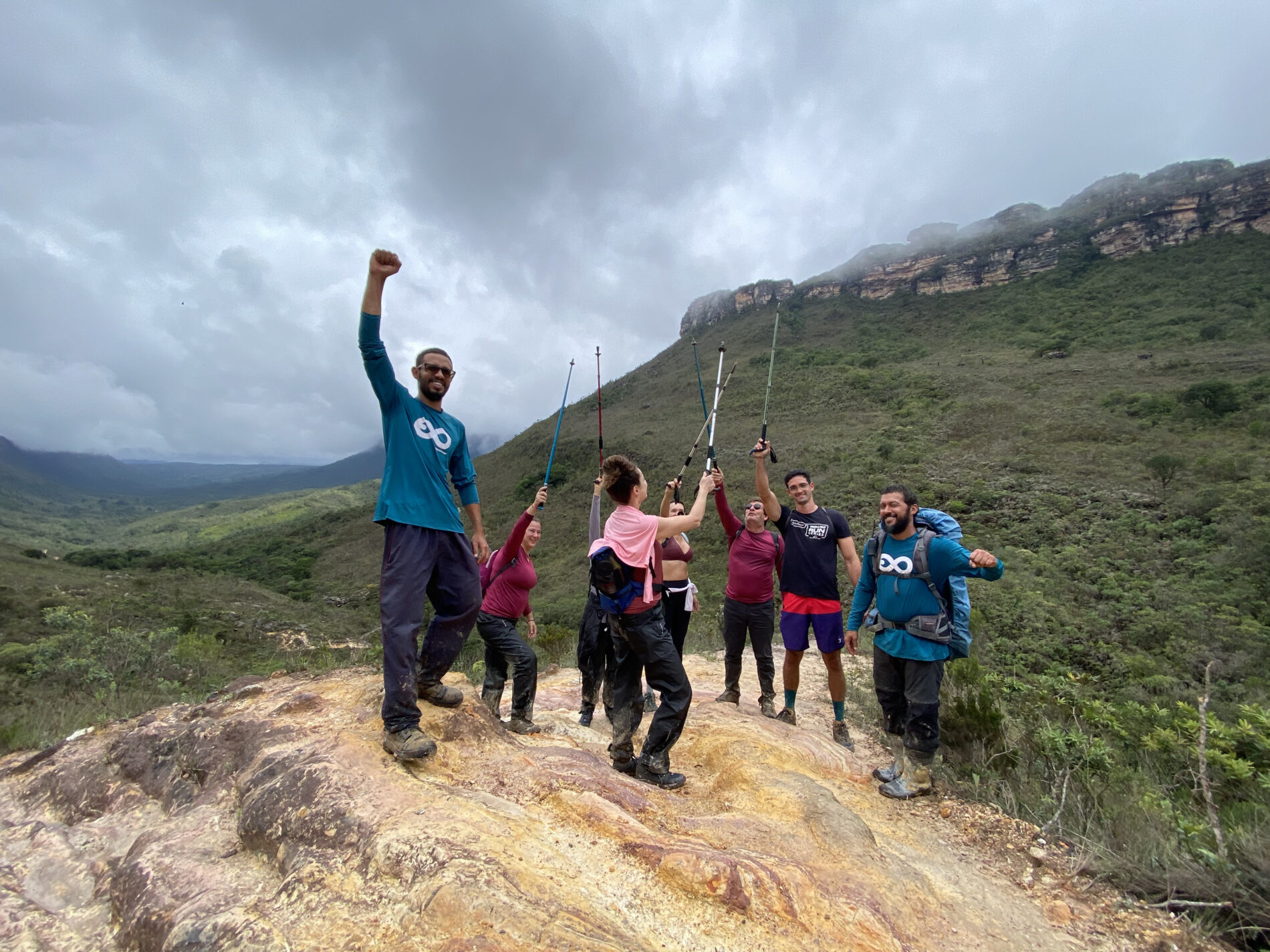
    A group of hikers and a PlanetaEXO guide celebrate with raised arms on a rocky peak, surrounded by green mountains under a cloudy sky.
    .

    Don’t forget the usual travel essentials: documents, credit/debit cards, cash (Brazilian Real), medicine (for headaches, muscle tension, stomach bugs…), chargers, and portable chargers for cellphones, laptops, tablets, and cameras.

    Best Chapada Diamantina tours

    Can’t wait to live the adventure of a lifetime in an unforgettable Chapada Diamantina hike? Check out PlanetaEXO’s tours!

    TOUR HIGHLIGHTS DURATION STARTING PRICE*
    Chapada Diamantina Tour  Waterfalls (Fumaça, Fumacinha, Riachinho, Mosquito), caves (Gruta Azul, Gruta Lapa Doce), Pai Inácio Hill, hiking, historic center of Lençóis. 3 days US$ 280
    Ultimate Chapada Diamantina Hike Hiking, Poço Encantado, Poço Azul, 3 days of trekking in Vale do Pati + Buracão and Fumacinha waterfalls. 6 days US$ 1,000
    Chapada Diamantina Trip Hiking, Vale do Capão, waterfalls (Fumaça, Buracão, Mosquito) Gruta Lapa Doce, Pai Inácio Hill, Poço Encantado, Poço Azul, historic center of Mucugê. 7 days US$ 630
    Vale do Pati Trek Chapada Diamantina Hiking, Morro do Castelo, Cachoeirão and Funis waterfalls, accommodation with locals. 3 days US$ 410
    Pati Valley Hike Chapada Diamantina Hiking, Morro do Castelo, waterfalls (Cachoeirão and Funis), accommodation at locals’ houses. 4 days US$ 545
    Chapada Diamantina Trek Vale do Pati Trekking, Morro do Castelo, Cachoeirão and Funis waterfalls, Poço da Árvore, Ladeira do Império, Andaraí, accommodation with locals. 5 days US$ 585

    *Per person, based on double occupancy in group departures. Prices may vary depending on season and availability. Exchange rate as of April 2nd, 2026; subject to change.

    Explore Chapada Diamantina National Park with PlanetaEXO

    PlanetaEXO is an ecotourism platform specializing in Chapada Diamantina tours. By working alongside the best local operators, our team turns your dream vacation into reality!

    From bookings to tailor-made itineraries, we work every day to ensure unforgettable travel experiences and sustainable practices that benefit both the environment and local communities. Contact us now!
  • How to Visit Manaus, Brazil – Travel Guide: What to Do and More!

    How to Visit Manaus, Brazil – Travel Guide: What to Do and More!

    Check out our travel tips to enjoy Manaus City to its fullest and immerse yourself in this wonderful place that blends urban atmosphere and the Amazon’s natural resources!

    Manaus, capital of the state of Amazonas, Brazil, has been listed by The New York Times as one of the 52 places in the world worth visiting. Visitors make quick stops there on their way to the Amazon Rainforest, but most don’t even imagine the beauty and the authenticity of this place.

    Besides the natural wonders, Manaus is full of history and culture. As the main gateway to the Amazon, the capital offers something to everyone — from river cruises, to jungle expeditions and local cuisine that reflects the region’s biodiversity.

    PlanetaEXO, an ecotourism platform specialized in Amazon tours in Brazil, has created a complete Manaus travel guide to help you navigate this incredible city. Read more below!
    About Manaus

    Manaus was founded in the 17th century as a Portuguese fort, but grew fast during the rubber boom of the late 1800s. It received this name as an homage to the indigenous group Manaós, which inhabited the territory back at the time. Manaus means “mother of the gods”.

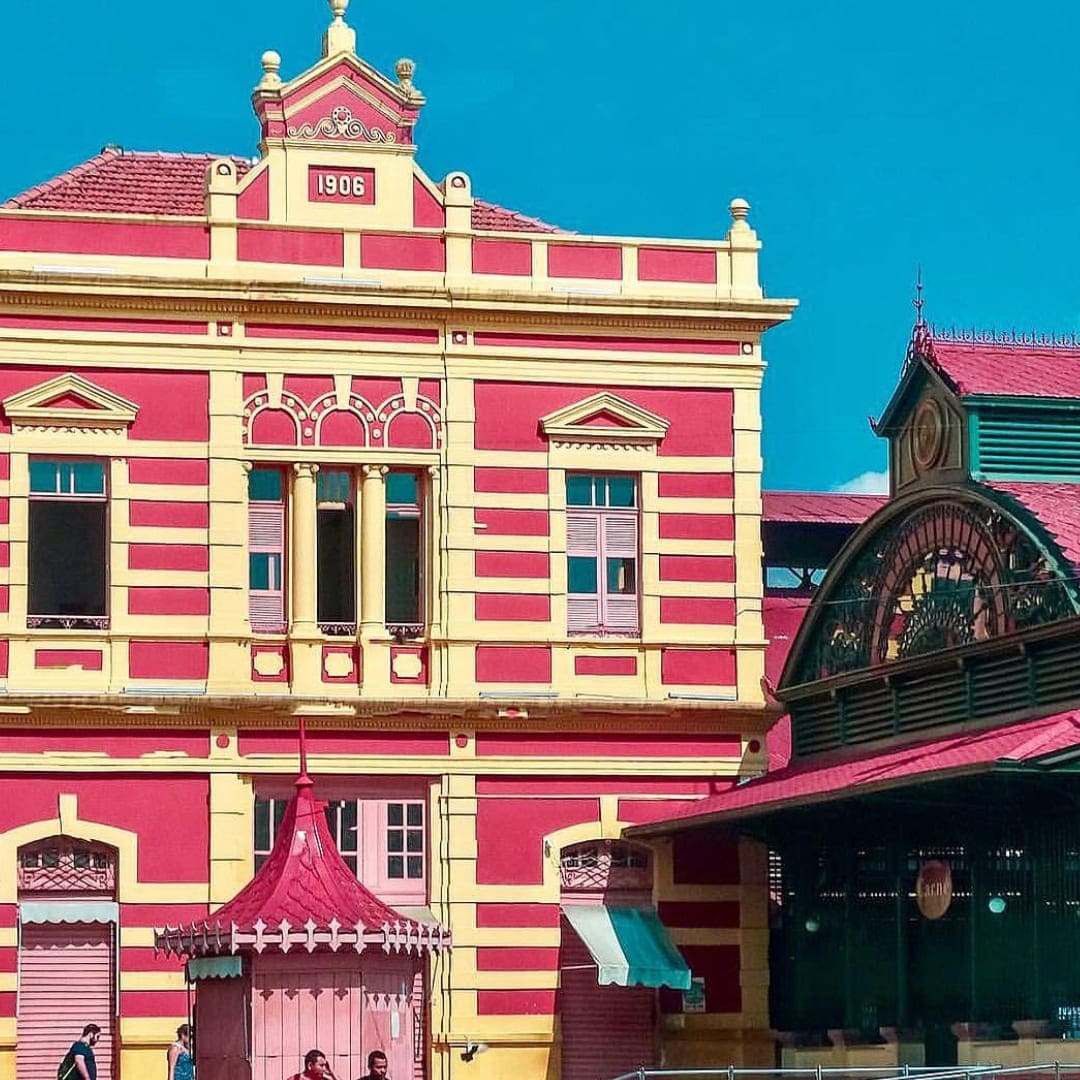
    Historic red and pink colonial building facade in Manaus featuring architecture from the rubber boom era.
    @manauschibata

    The rubber boom was so prosperous that Manaus was known as the “Paris of the Tropics”, but it didn’t last long due to heavy competition from abroad.  Even so, the city reinvented itself as a regional metropolis where 2.3 million people live nowadays, as well as a thriving ecotourism hub that blends colonial architecture, bustling markets and lush landscapes.

    Where is Manaus located?

    Manaus, in Amazonas, is located in the Northern Region of Brazil. At the east center of the state, it’s a metropolitan area heavily influenced by the Negro and Amazon rivers.

    What is Manaus famous for?

    Manaus is mostly known as the primary gateway to the Amazon Rainforest and a huge ecotourism destination not only in Brazil, but in the world. 

    The unique mix of urban aspects and natural resources is what makes this city so fascinating and worth visiting.

    Aerial view of a winding blue river flowing through the lush green Amazon Rainforest near Manaus.
    .

    Best time to visit Manaus

    Manaus City has a tropical rainforest climate, with two main seasons: the rainy season (December to May) and the dry season (June to November)

    December, January, February, March, April, May

    The forest is at its lushest and most vibrant during this time, making it the ideal period for riverboat tours. With higher water levels, you can explore the igapós (flooded forests) by canoe, which grants a unique perspective of the Amazon.

    Trees of the Amazon rainforest reflected in the dark calm waters of a flooded forest during the rainy season.
    Photo: @buyehelen

    June, July, August, September, October, November

    Great period for hiking and wildlife spotting, as animals gather near rivers and water sources. It’s also the perfect time to visit the famous Meeting of the Waters, where the Negro and Solimões rivers meet.

    👉 Read more: When is the best time to visit the Amazon Rainforest in Brazil

    How to get to Manaus?

    Most travelers reach Manaus by flying into Eduardo Gomes International Airport (MAO), served by direct flights from several major Brazilian cities (Belém, Belo Horizonte, Brasília, Fortaleza, Recife, Rio de Janeiro e São Paulo) and a few international destinations.

    There are no direct flights from the US or Europe, so foreign tourists should travel to Bogota (BOG), Panama City (PTY) or Curaçao (CUR) first.

    Flights departing from North American or European countries usually have layovers in São Paulo (GRU/VCP), Rio de Janeiro (GIG) or Brasília (BSB). From these destinations, it takes 3–4 hours to reach Manaus with Azul or GOL airlines.

    View from an airplane window looking out over the wing towards the Amazon clouds and landscape below.
    @villaamazonia

    👉 Read more: How to get to the Amazon Rainforest in Brazil?

    What to do in Manaus?

    A Manaus travel guide is incomplete without a list of activities around the city — which offers a wide range of experiences and tours that allow visitors to experience and enjoy the Amazon’s natural beauty and local culture.

    Check out PlanetaEXO’s selection of things to do in Manaus!

    Historic Center Tour

    Embark on a tour of Manaus’s historic center to dive into the city’s cultural and gastronomic core.

    Wander through traditional buildings and landmarks that showcase Manaus’s rich heritage, including the Adolpho Lisboa Market, Palácio Rio Negro, São Sebastião Church, and Casa Eduardo Ribeiro Museum. Perfect for people who love history and cultural experiences!

    Green iron fountain located in a public square within the historic center of Manaus surrounded by trees.
    @janelasdemanaus

    Amazon Theatre

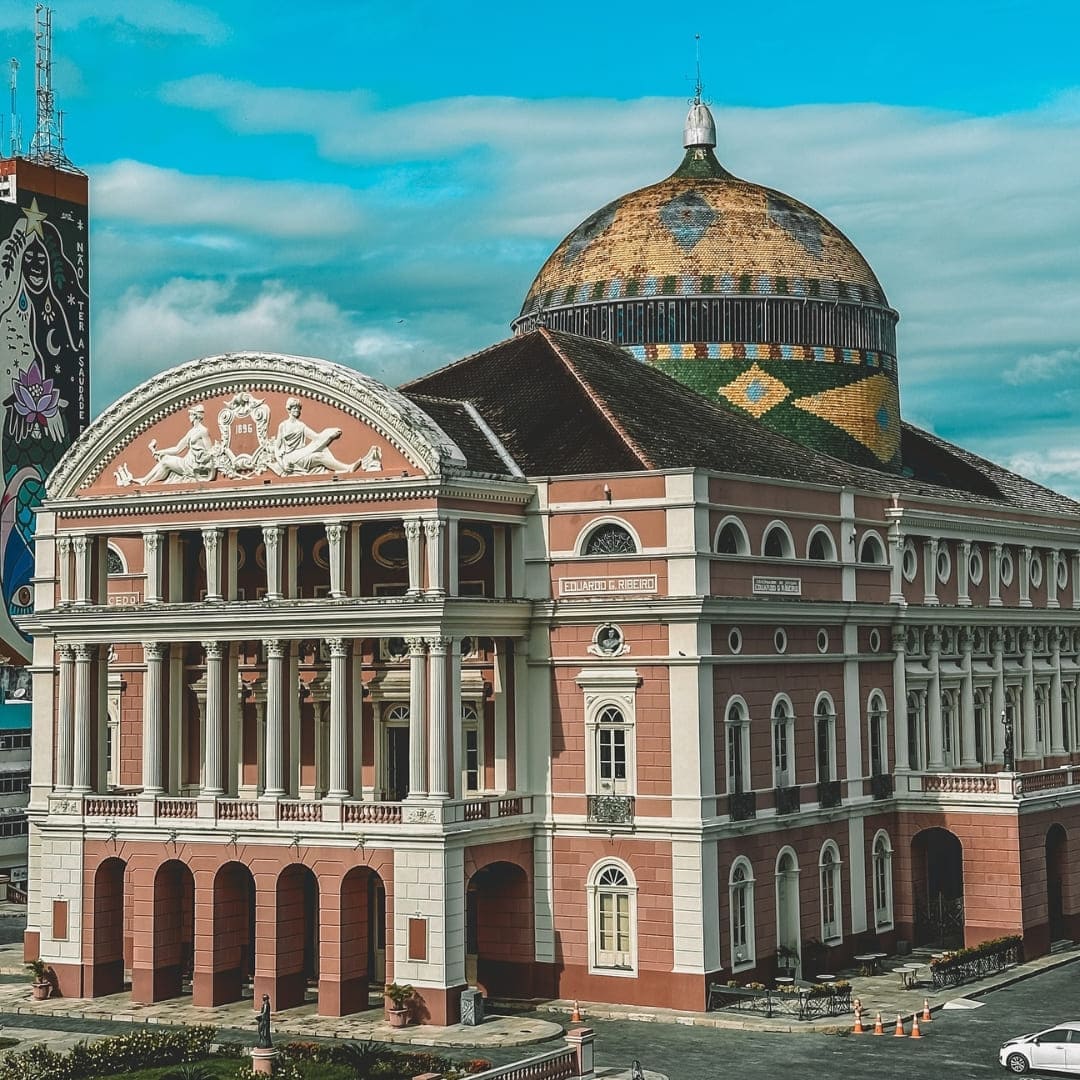
    The Amazon Theatre (Teatro Amazonas) is such an integral part of Manaus’ history. Built during the rubber boom period, it used to be a grand opera house. Nowadays, as one of the capital’s most beloved landmarks, it’s open for visitation.

    While visiting the theater, stroll through Largo de São Sebastião, where you can explore the charming central church and the lively surrounding square.

    Address: Av. Eduardo Ribeiro, 659 — Centro, Manaus

    The pink neoclassical facade and colorful tiled dome of the Amazon Theatre in Manaus under a blue sky.
    @manausnasfotos

    MUSA (Museum of the Amazon)

    MUSA showcases the Amazon’s sociocultural and biological diversity through themed exhibitions and forest hikes

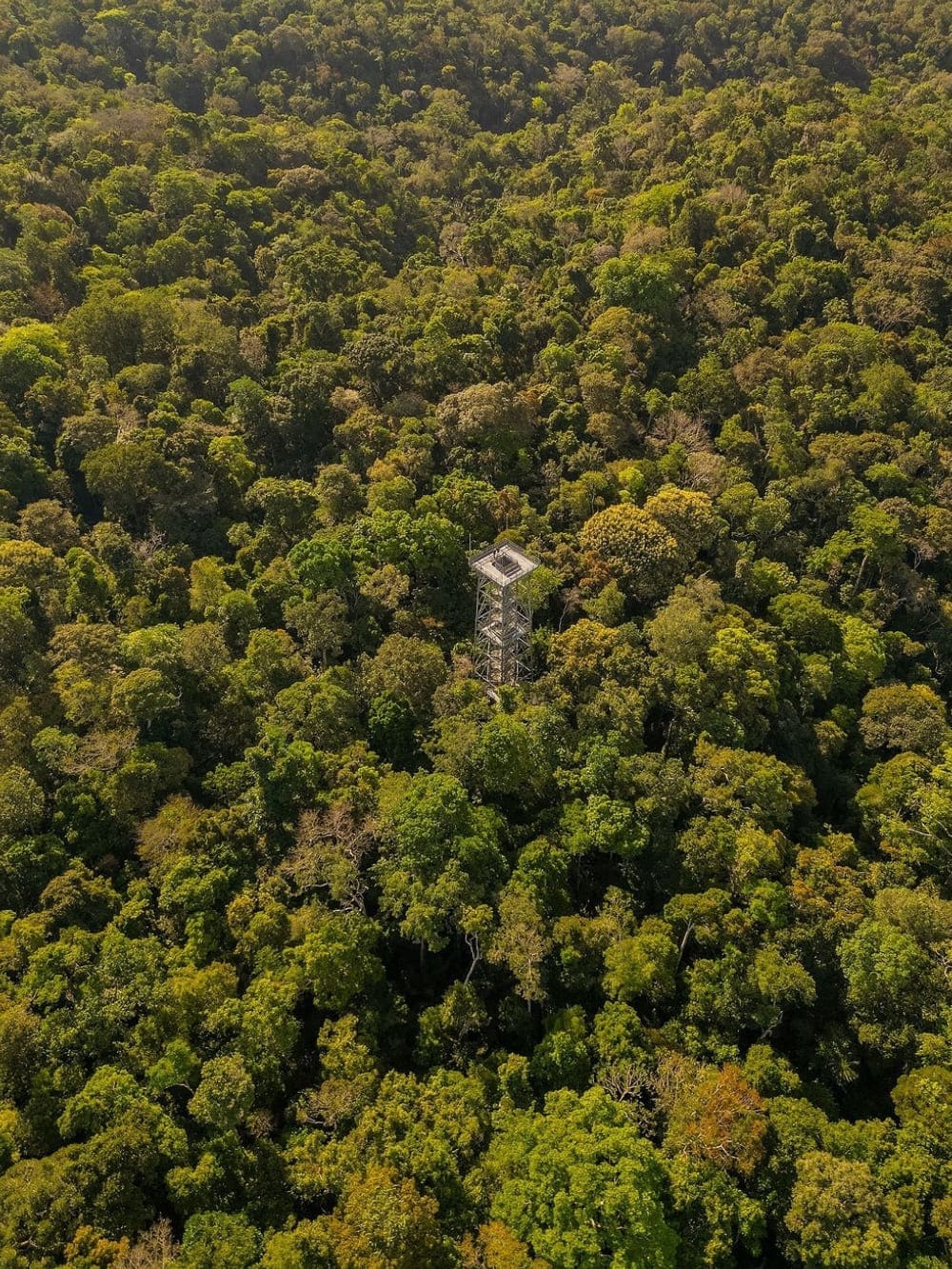
    Located in a 100-hectare area at the Adolpho Ducke Forest Reserve, it has a 42-meter observation tower and hundreds of plant species, like orchids, bromeliads, araceae, palm trees, etc. You can also see animals, including snakes, scorpions, spiders and butterflies.

    Address: Av. Margarita, 6305 (formerly Av. Uirapuru) — Jorge Teixeira, Manaus

    Tall metal observation tower rising above the dense green canopy of the Amazon rainforest at MUSA.
    @alaisooon

    Meeting of the Waters

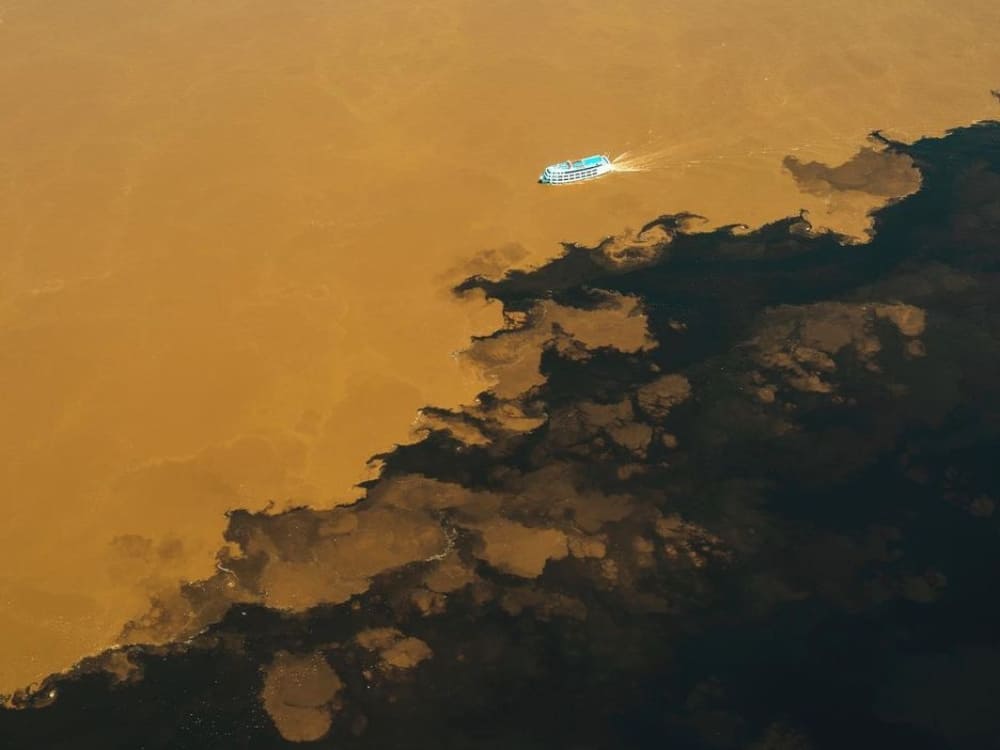
    The Meeting of Waters is one of the most incredible natural phenomena in Brazil. Due to differences in current speed, temperature and acidity, the Negro and Solimões rivers meet, but don’t quite mix.

    Black and brown waters create a perfect contrasting line in the water, effortlessly dividing the two rivers in a jaw-dropping view.

    Aerial view showing the distinct dividing line where the black Rio Negro meets the brown Solimões River.
    @fromflora

    👉 Read more: 15 Facts about the Amazon Rainforest in Brazil

    Bosque da Ciência (INPA)

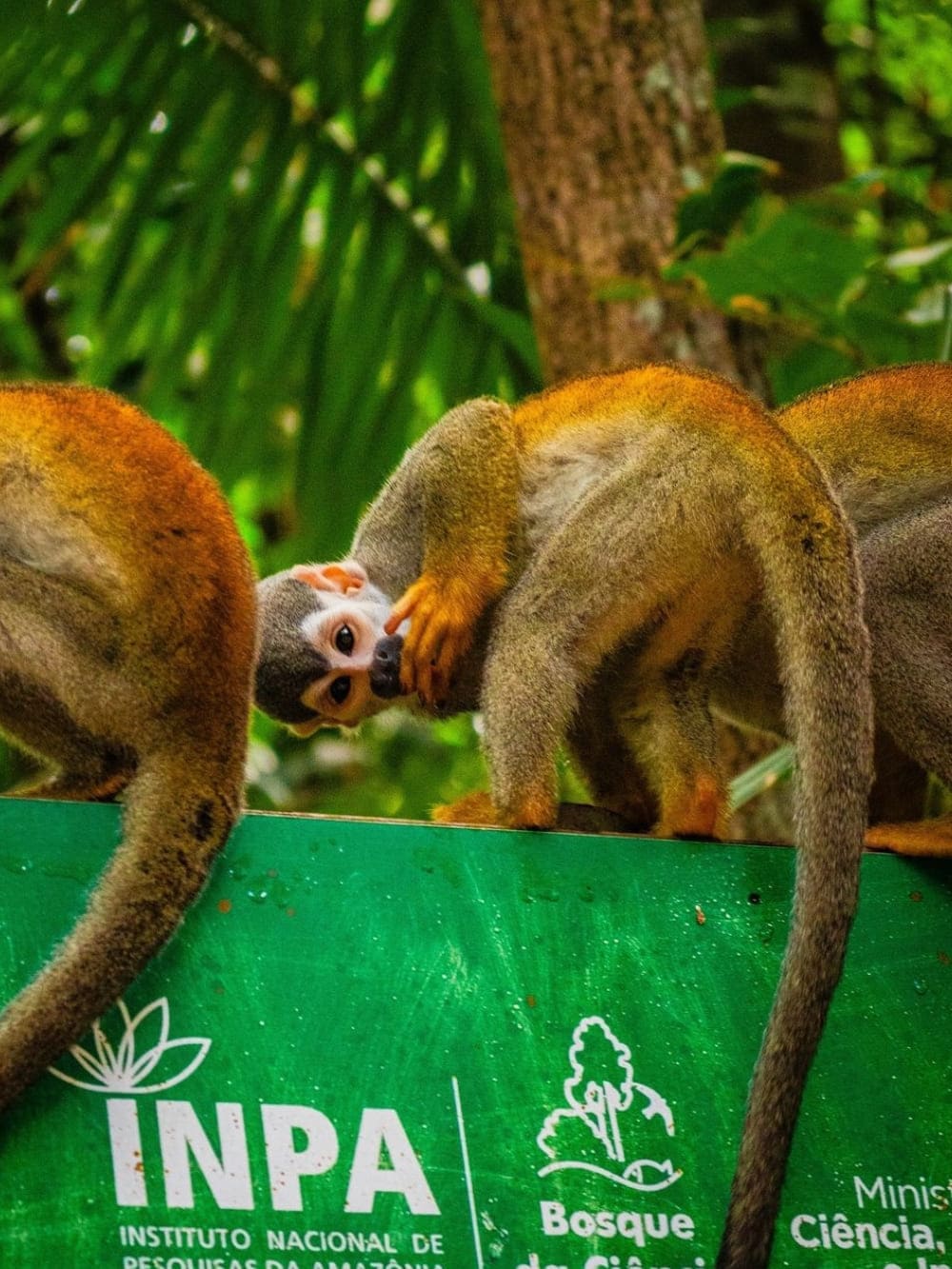
    For animal lovers, Bosque da Ciência, managed by INPA (National Institute for Amazonian Research), is almost an obligatory attraction for tourists visiting Manaus City.

    Join guided tours and learn everything about various free-roaming Amazon animals, from native bees to giant otters. If wildlife isn’t your main interest, the exhibitions also provide fascinating insights into the region’s flora and unique biodiversity. 

    Address: Av. Bem-Te-Vi, s/n — Petrópolis, Manaus

    Small squirrel monkeys resting together on top of a green sign at the Bosque da Ciência INPA.
    @yu.jhima

    Lúcia Almeida Viewpoint

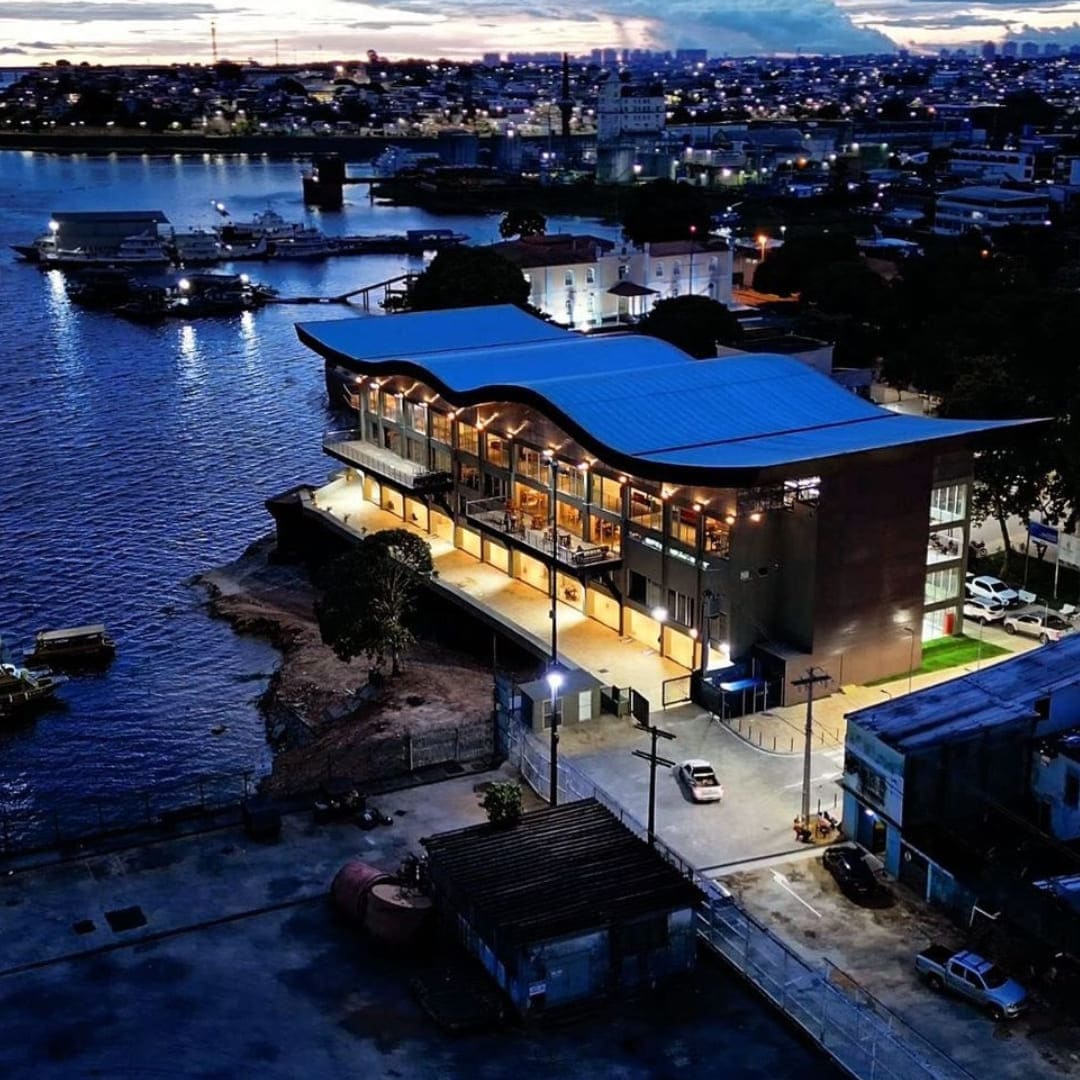
    For a  breathtaking view of Manaus in Brazil, the Lúcia Almeida Viewpoint is a must-visit spot. Located near the Amazon Theatre, it offers panoramic views of the city and the Rio Negro.

    It’s a perfect place to relax, take photos, and enjoy the unique charm of Manaus’ skyline.

    Address: Av. Sete de Setembro, 8 — Centro, Manaus

    Night view of the illuminated Lúcia Almeida Viewpoint building reflected in the river water in Manaus.

    Best Amazon tours departing from Manaus

    Most Amazon tours depart from Manaus, bound for incredible ecotourism spots in the forest, like Anavilhanas and Jaú National Park, Presidente Figueiredo and Careiro. See some options below!
    TOUR HIGHLIGHTS DURATION STARTING PRICE*
    Amazon Cruise Onboard accommodation, expeditions to Anavilhanas and Jaú, cave exploration, hiking, river beaches, wildlife watching, visiting indigenous groups. 4 days
    5 days
    7 days
    US$ 2,485
    Luxury Amazon Cruise Luxury onboard accommodation, Meeting of Waters, Lake Janauari, jungle hiking, fishing, boat rides, night tours, river beaches, luau. 5 days US$ 3,740 
    Anavilhanas Jungle Lodge Luxury stay at Anavilhanas, hiking, canoeing, wildlife watching, fishing, archery lessons, visiting local communities. 6 days US$ 3,180 
    Brazilian Amazon Jungle Tour Affordable stay, birdwatching, fishing, canoe trips, forest hikes, Meeting of Waters, visiting local markets. 3 days
    4 days
    5 days
    US$ 585 
    Mirante do Gavião Exclusive Amazon Lodge High-end stay, kayaking, stand-up paddling, cave exploration, wildlife watching, boat rides. 4 days
    5 days
    US$ 1,865 
    Amazon Kayak Tour Brazil Kayaking, camping in the forest, hiking, fishing, caiman spotting, visiting locals. 4 days US$ 600 
    Amazon Jungle Survival Tour Camping in the forest, survival skills lessons, trekking, canoeing, wildlife watching. 4 days
    6 days
    US$ 950 

    *Per person, based on double occupancy in group departures. Prices may vary depending on season and availability. Exchange rate as of February 6th, 2026; subject to change.

    PlanetaEXO has an entire selection of fantastic Amazon Rainforest tours in Brazil. Discover our adventures!
    👉 Read more:

    How to get around in Manaus?

    To get around in Manaus, there are a few options:

    • Public buses: Manaus City has an affordable bus system, but it can be crowded at rush hours and occasionally unreliable. Safety is a concern due to pickpocketing, so keep valuable items secure and stay alert. Check routes with apps like Moovit and Ônibus Manaus.
    • Ride-sharing apps: Uber and 99 App provide safe rides with set prices, making them ideal for solo travelers, nighttime trips and people who are unfamiliar with the area.
    • Ferries and boat services: For river transport, ferries and boats departing from the Port of Manaus can take you to surrounding areas and deeper into the Amazon. Use reputable operators and follow safety guidelines for a secure journey.

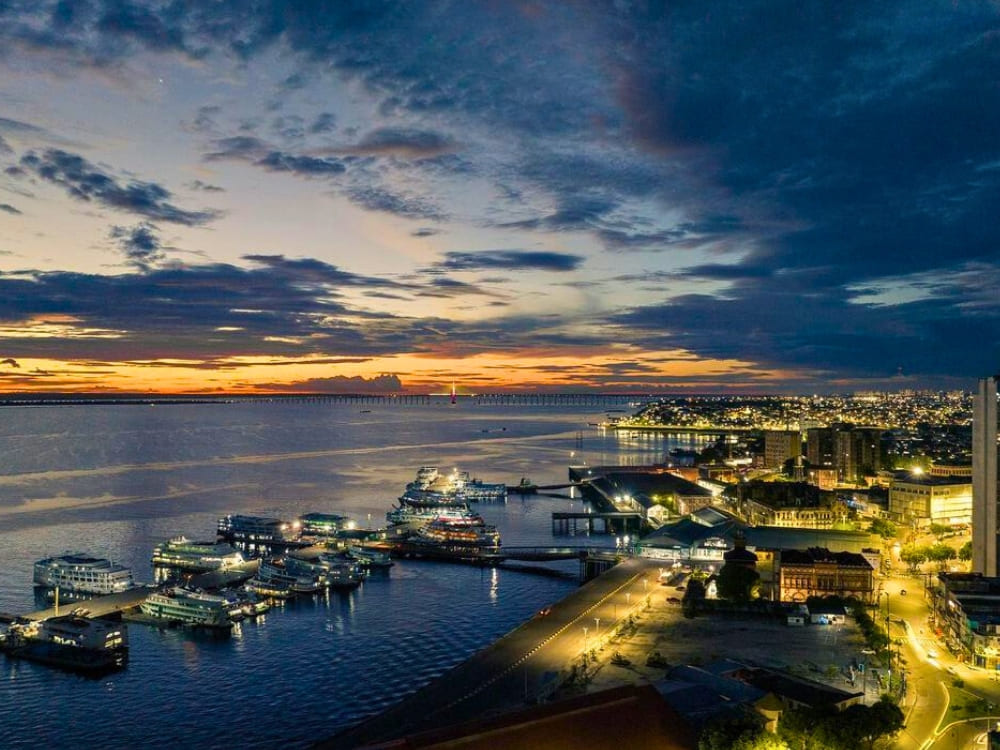
    manaus port

    Where to eat in Manaus

    The city is known for being a core for Amazonian cuisine, famous for dishes you won’t find anywhere else. Feeling hungry? PlanetaEXO’s Manaus travel guide has listed some local spots so you can try out the unique flavors of the forest!

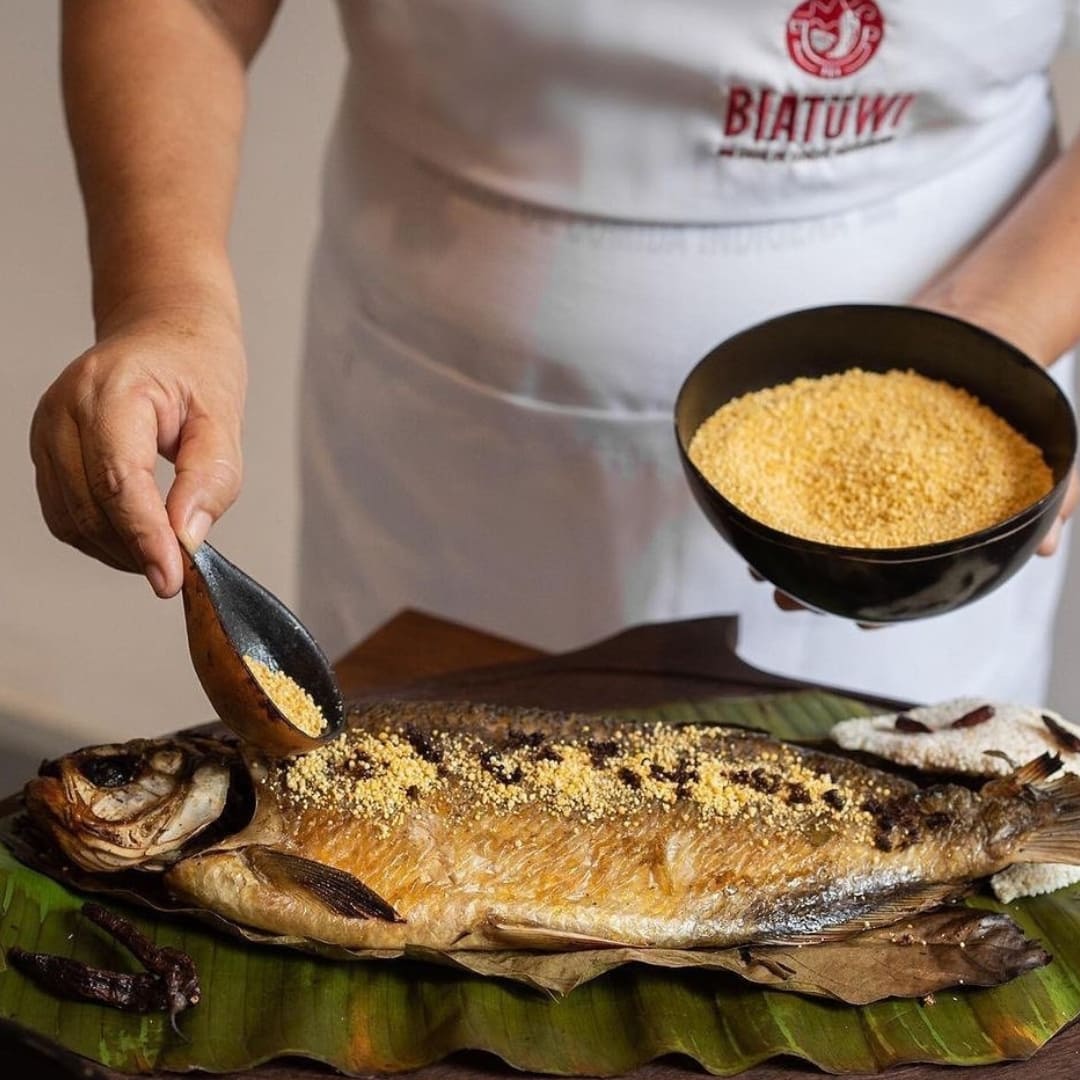
    Biatüwi $$$

    Biatüwi is an indigenous culinary house in the heart of Manaus, offering a unique experience rooted in Amazonian indigenous culture.  

    Address: R. Bernardo Ramos, 97 — Centro, Manaus

    Close-up of a person sprinkling manioc flour onto a roasted fish dish served on a banana leaf.
    .

    Caxiri Manaus $$$

    With a great view of the Amazon Theatre, Caxiri provides a sophisticated dining experience that celebrates local cuisine. The menu is described as a fusion of traditional Brazilian dishes with Amazonian culture.

    Address: R. 10 de Julho, 495 — Centro, Manaus

    Sophisticated dish featuring shrimp served in a white bowl at a Manaus restaurant.
    @caxiri_amazonia

    Tambaqui de Banda $$

    Tambaqui de Banda’s signature dish is traditional-style grilled tambaqui (a native fish). Known worldwide for its love and respect for Amazonian flavors, the restaurant has both indoor and outdoor seating — with a beautiful view of the Amazon Theatre.

    Address: R. José Clemente, 596 — Centro, Manaus

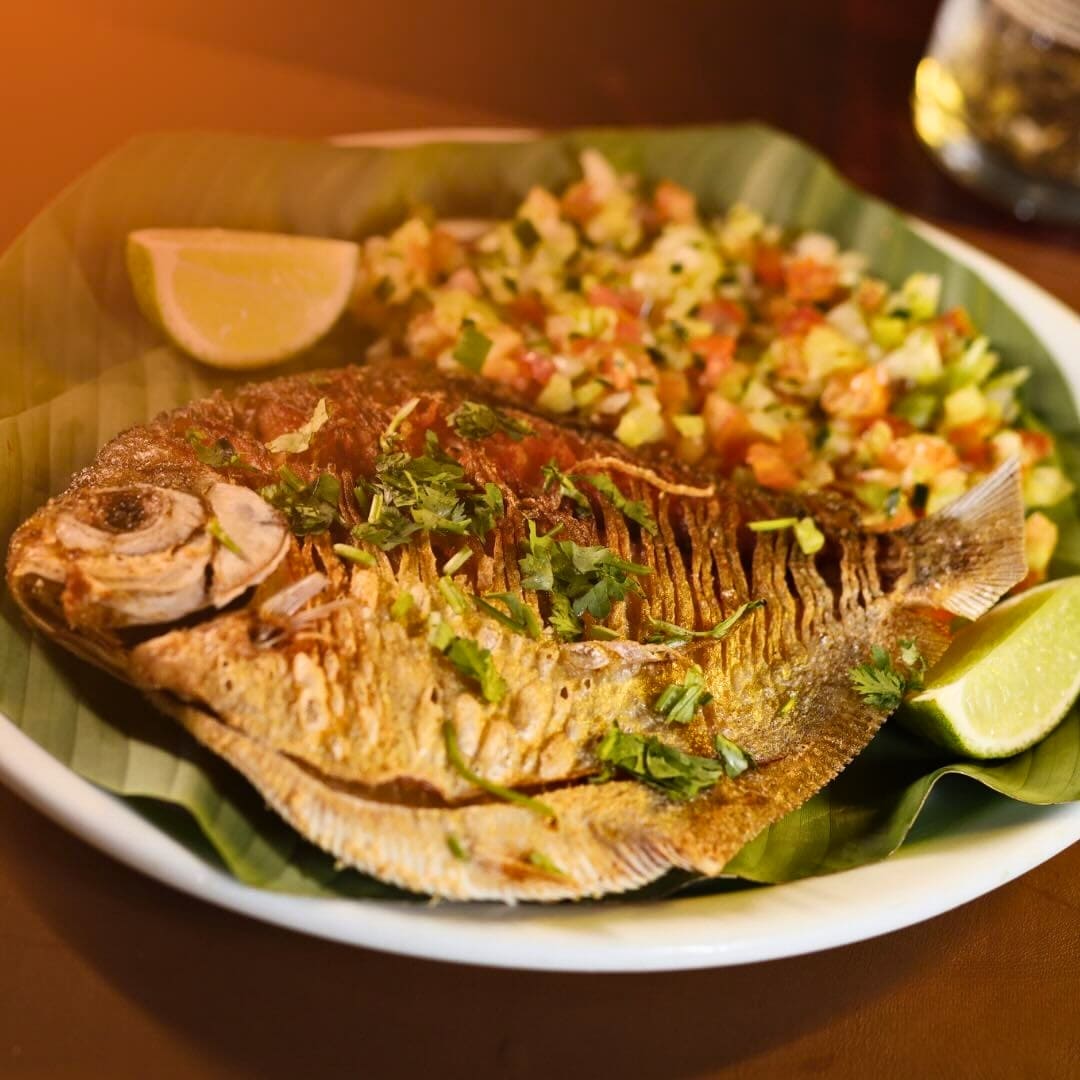
    O Lenhador $$$

    O Lenhador serves various traditional dishes, with a heavy focus on regional meats and hearty portions. Famous for its rustic atmosphere, it’s a favorite spot for those looking to experience local cuisine.

    Address: Av. do Turismo, 2371 — Ponta Negra, Manaus

     Grilled Tambaqui fish served whole on a banana leaf with vinaigrette and lime slices.
    @restauranteolenhador

    Peixaria Morada do Peixe $$

    Charming seafood restaurant, Peixaria Morada do Peixe is celebrated for its fresh fish and authentic Amazonian dishes. Specializing in regional dishes like tambaqui and pirarucu, it offers a relaxed atmosphere perfect for enjoying the culinary heritage of Manaus.

    Address: Beco Goiania, Conjunto Jardim Versalles — Planalto, Manaus

    Banzeiro Manaus $$$

    Blending traditional flavors with contemporary techniques, the menu of Banzeiro Manaus showcases various regional dishes, focusing on local recipes and ingredients like tacacá, tambaqui, cupuaçu and even leafcutter ants. 

    Address: R. Libertador, 102, — Nossa Senhora das Graças, Manaus

    Cachaçaria do Dedé $$$

    Famous for its selection of premium cachaças and Amazonian-inspired dishes, Cachaçaria do Dedé offers a unique dining experience that blends local flavors with Brazilian culinary traditions.

    Address: R. do Comercio, 1003-F (Box 4) — Parque 10 de Novembro, Manaus

    Where to stay: hotels in Manaus

    Manaus has great accommodation options to fit different budgets and preferences. Many hotels are located near major attractions, making it easier to explore the city. 

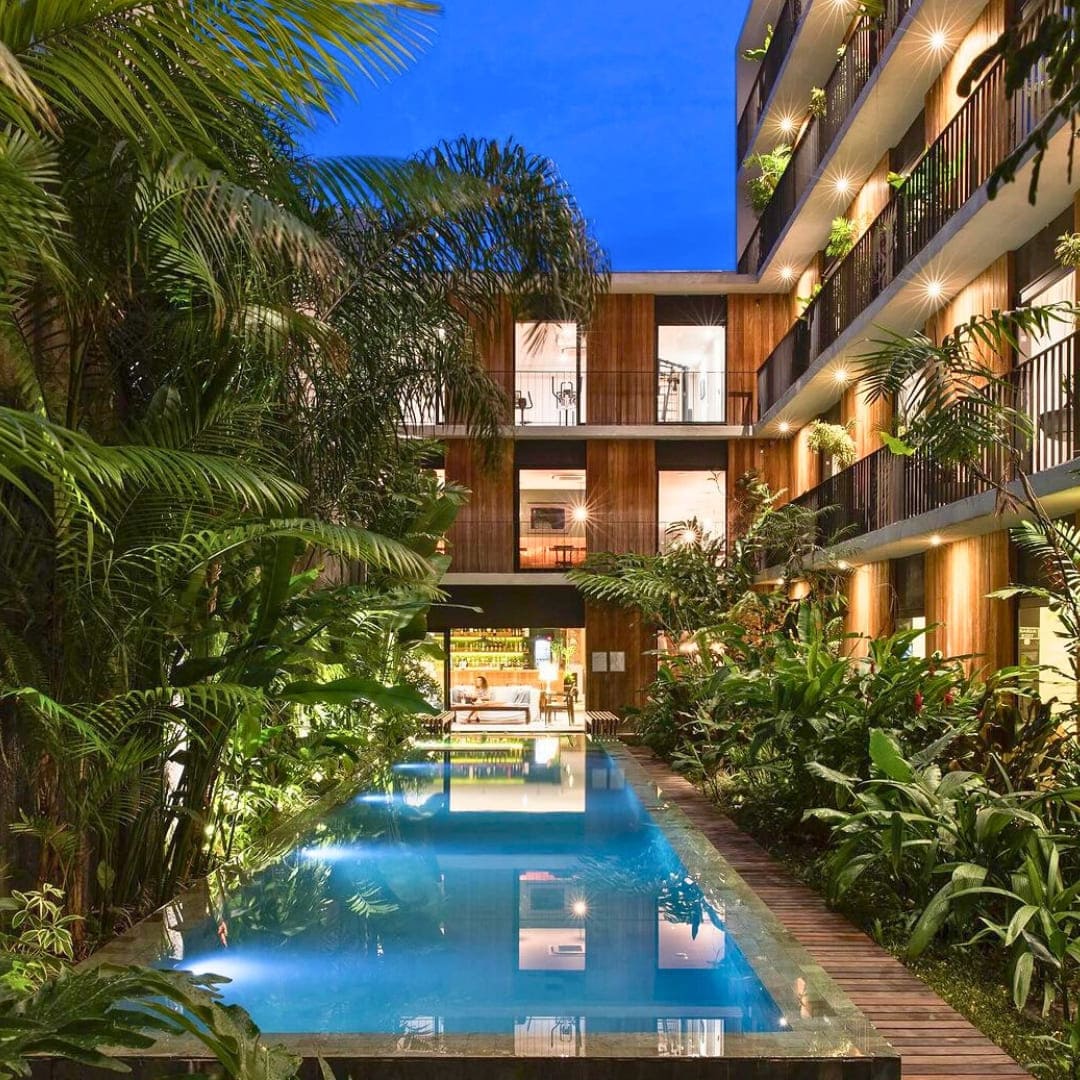
    Hotel Villa Amazonia ⭐️⭐️⭐️⭐️⭐️

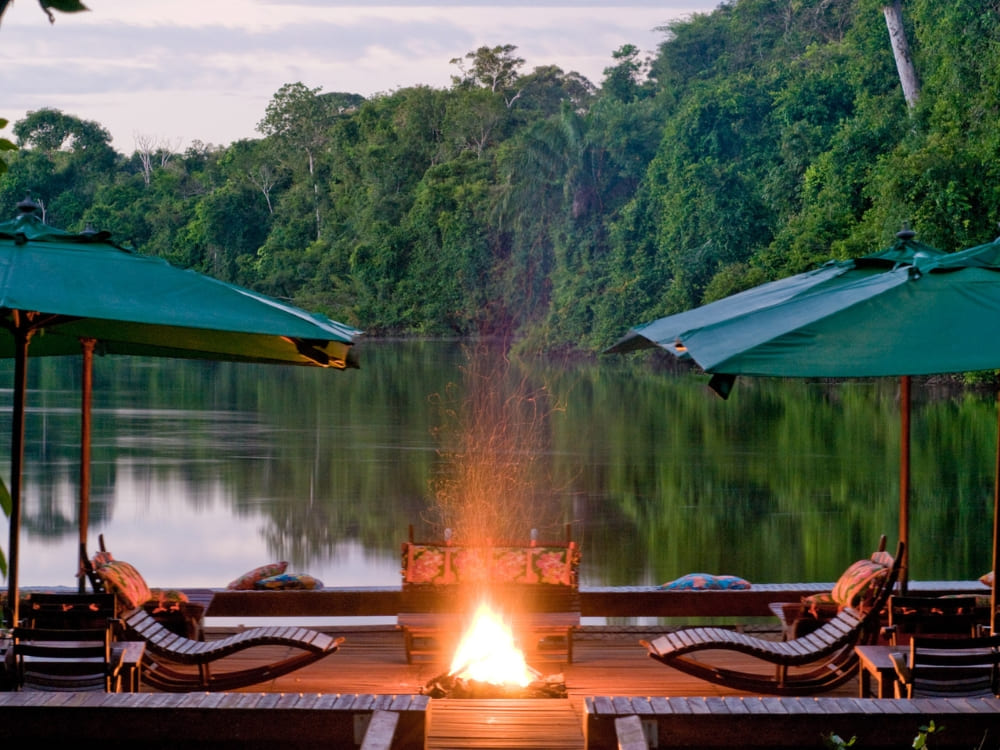
    Boutique hotel in the historic center with garden views, an Amazon-inspired restaurant, and a natural stone pool.

    Address: R. 10 de Julho, 315 — Centro, Manaus

    Outdoor swimming pool surrounded by tropical gardens and building balconies at Hotel Villa Amazonia.
    @villaamazonia

    Hotel Mural Living ⭐️⭐️⭐️⭐️

    A modern and minimalist hotel located in the heart of Manaus, offering clean and cozy rooms with contemporary decor. Perfect for travelers seeking comfort and practicality near the city’s main attractions. 

    Address: R. Doutor Moreira, 168 — Centro, Manaus

    Hostel Manaus ⭐️⭐️⭐️⭐️

    Located near Manaus’ historic center, Hostel Manaus has budget-friendly accommodations in a vibrant and welcoming atmosphere. Ideal for backpackers, it features shared dorms, private rooms, and a rooftop terrace with city views. 

    Address: R. Lauro Calvacante, 231 — Centro, Manaus

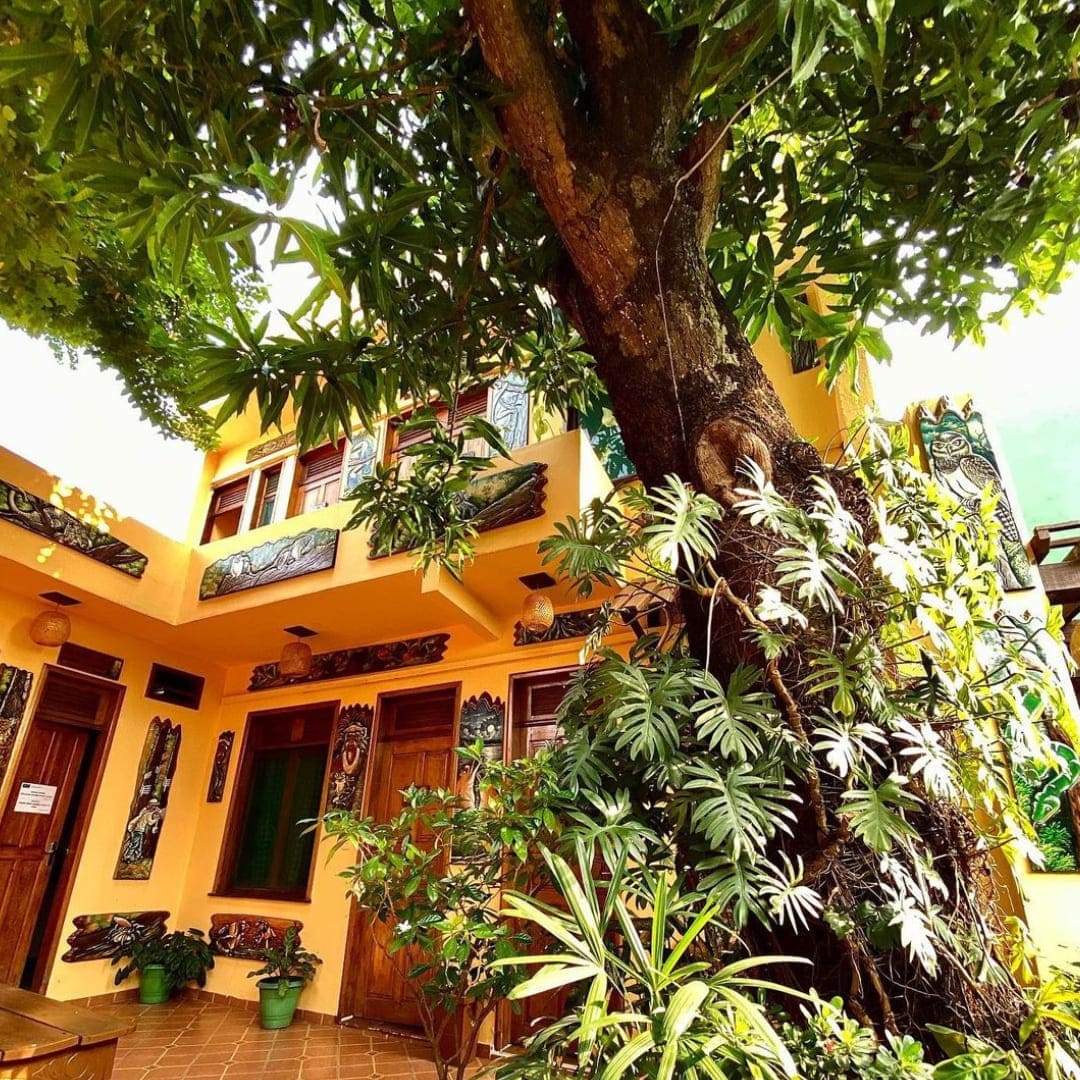
    Exterior view of the yellow Hostel Manaus building shaded by large green trees.
    @hostelmanaus

    Manaus Hóteis Millennium ⭐️⭐️⭐️⭐️

    Located within Millennium Shopping, the hotel offers rooms with balconies, a rooftop pool, and panoramic views. 

    Address: Av. Djalma Batista, 1661 — Chapada, Manaus

    Seringal Hotel ⭐️⭐️⭐️⭐️

    Just 50 meters away from the Amazon Theatre, it provides cozy rooms with air conditioning, Wi-Fi, and a breakfast buffet. 

    Address: R. Monsenhor Coutinho, 758 — Centro, Manaus

    Ramada by Wyndham Manaus Torres Center ⭐️⭐️⭐️

    A modern hotel near the Industrial District with contemporary rooms, a fitness center, an on-site restaurant, and an all-you-can-eat breakfast buffet. Ideal for both business and leisure travelers.

    Address: Av. José Lindoso, 280, Coroado — Manaus

    Juma Ópera Hotel ⭐️⭐️⭐️⭐️⭐️

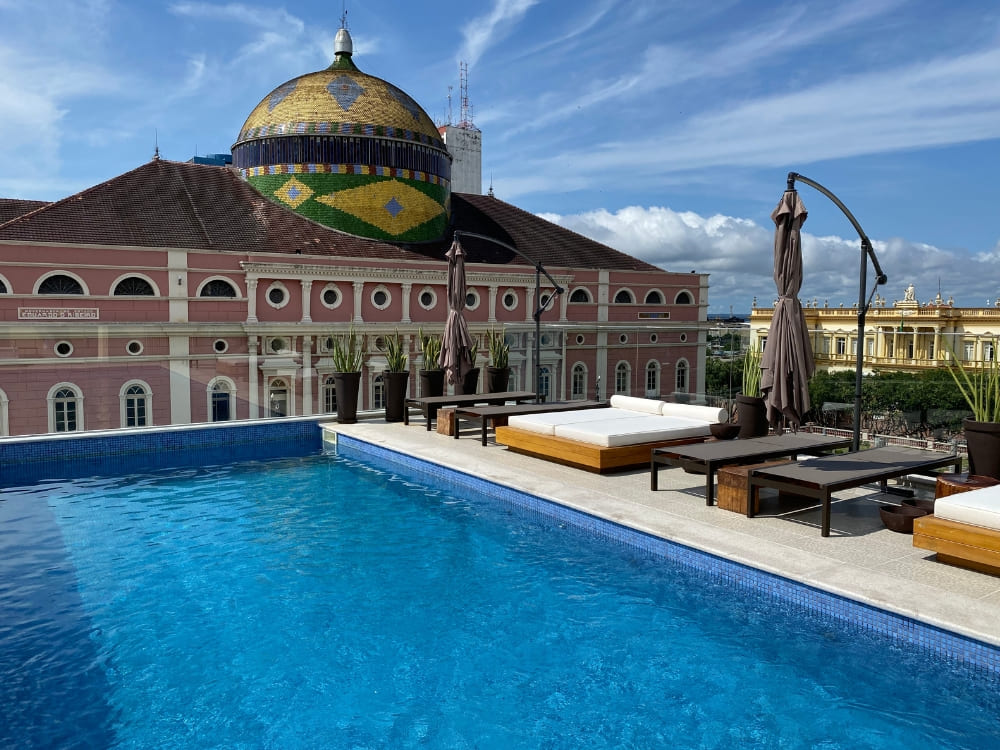
    Located in the heart of Manaus and directly across from the iconic Amazon Theatre, Juma Ópera Hotel offers a blend of historical charm and modern luxury. With elegant rooms, a rooftop pool, and a gourmet restaurant featuring Amazonian cuisine, it’s an excellent choice for those seeking an upscale stay close to the city’s cultural landmarks. 

    Address: R. 10 de Julho, 481 — Centro, Manaus

    Rooftop swimming pool at Juma Ópera Hotel offering a direct view of the Amazon Theatre dome.
    .

    Is Manaus safe?

    Overall, Manaus is safe, but like in any other destination, it’s important to be careful regarding physical integrity, health and your personal belongings. Here are some safety tips for your trip:

    • Banks and ATMs: Visit banks only during the day, when security is present. Only withdraw small amounts of cash and avoid ATMs where there’s no one else around — if possible, don’t do it alone.
    • Cash safety: Keep cash separate and consider carrying a fake wallet or fanny pack with minimal money to lower the impact of potential theft.
    • Public areas and tourist spots: Be mindful of pickpockets in busy areas. Avoid displaying valuable items openly and use a secure bag for your belongings.
    • Vaccinations: Although not required, yellow fever vaccines are recommended for people going to the Amazon — especially in neighboring countries, like Bolivia and Colombia. Malaria risk is low, though some choose preventive medication. Make sure your tetanus vaccination is also up to date for added safety.
    • Climate preparedness: Manaus is hot and humid, so stay hydrated, wear light clothing, and use insect repellent — especially in forested areas.

    Manaus, Brazil: more than just a gateway to the Amazon Rainforest

    Manaus is more than just a quick stop on the way to the Amazon — it’s a fascinating place with a complex history, rich culture, and stunning natural scenery. Upon booking your Amazon trip, consider saving a few days to explore the city. You’re going to love it!

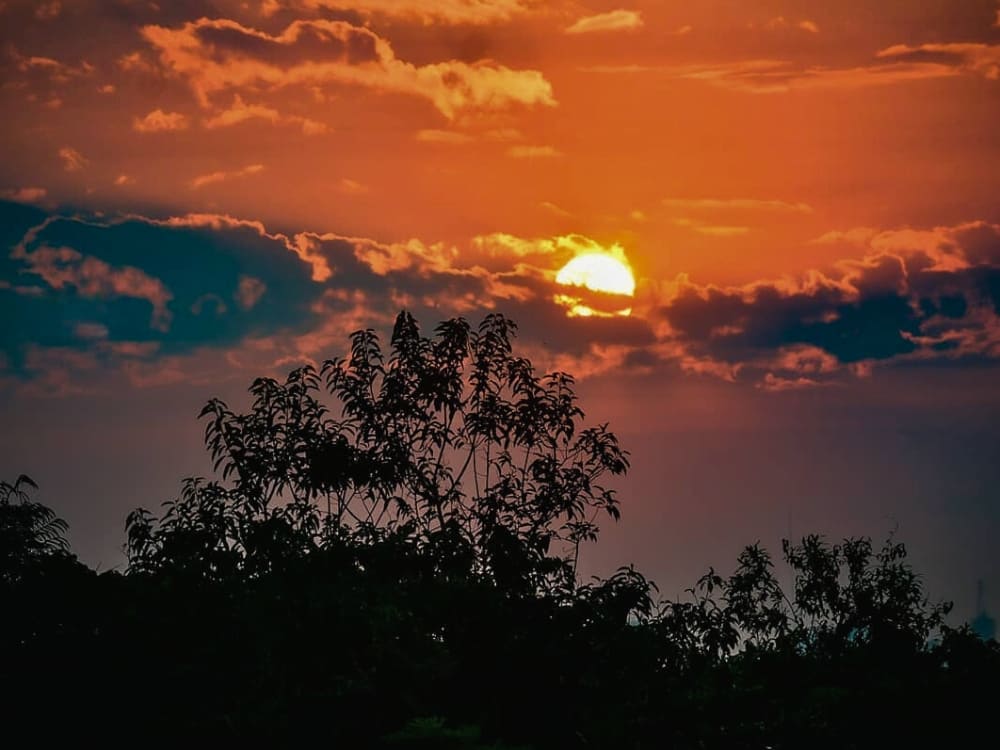
    Bright orange sun setting behind the dark silhouettes of Amazon rainforest trees.

    As a platform specialized in Amazon Rainforest tours in Brazil, PlanetaEXO works with the finest local operators to ensure the best experience, from your departure in Manaus to joining activities in the middle of the forest. Contact us now!
  • Mount Roraima Travel Guide

    Mount Roraima Travel Guide

    Learn valuable details to set off on the adventure of a lifetime and uncover the secrets of this ancient, breathtaking mountain.

    Ready to get lost in the heights? This Mount Roraima Travel Guide highlights a setting where the grandeur of nature unfolds, with peaks that touch the sky and an atmosphere of mystery that surrounds every step.

    Mount Roraima is an invitation to intrepid adventurers, providing a unique journey through the fascinating landscapes of the region. Be prepared to marvel at impressive rock formations, crystal-clear streams, and vegetation that defies gravity.

    In this guide, we have compiled essential information to guide your adventure, from the best time for climbing to the trails that will lead you to the heart of this natural monument.

    Let’s Go!

    1. Where is Mount Roraima?
    2. How to get to Mount Roraima?
    3. When is the best time to visit Mount Roraima?
    4. How many days to spend in Mount Roraima
    5. How hard is it to trek Mount Roraima?
    6. Is it safe to visit Mount Roraima?
    7. What’s on top of Mount Roraima?
    8. Is Mount Roraima the oldest place on Earth?
    9. What to bring to Mount Roraima?

    About Mount Roraima

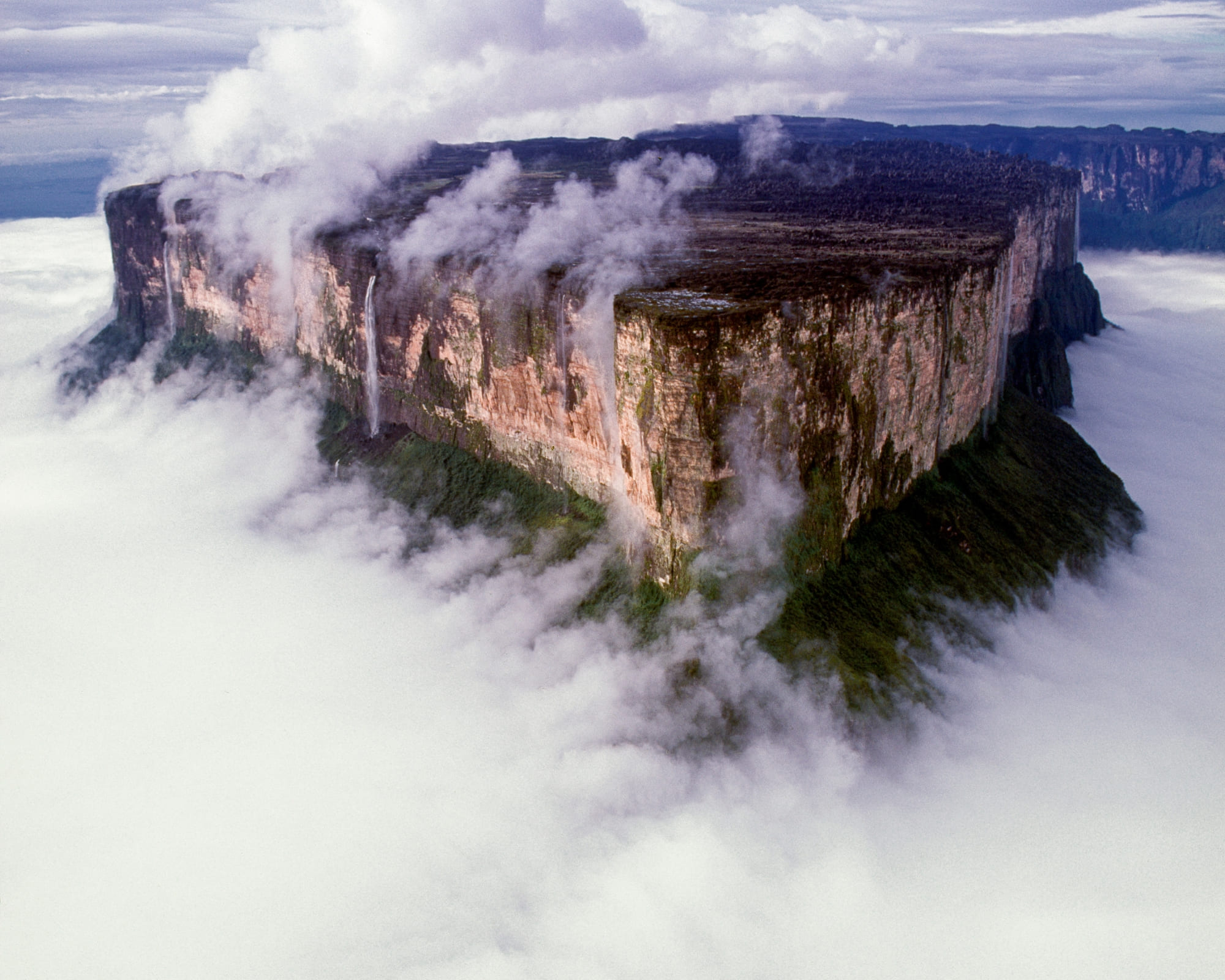
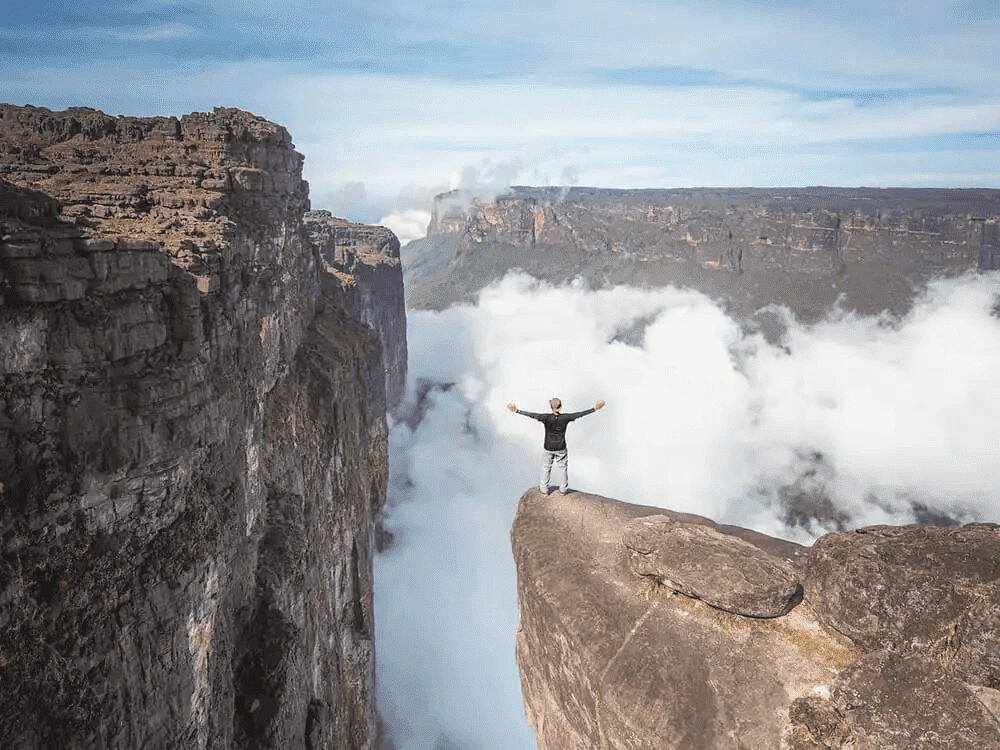
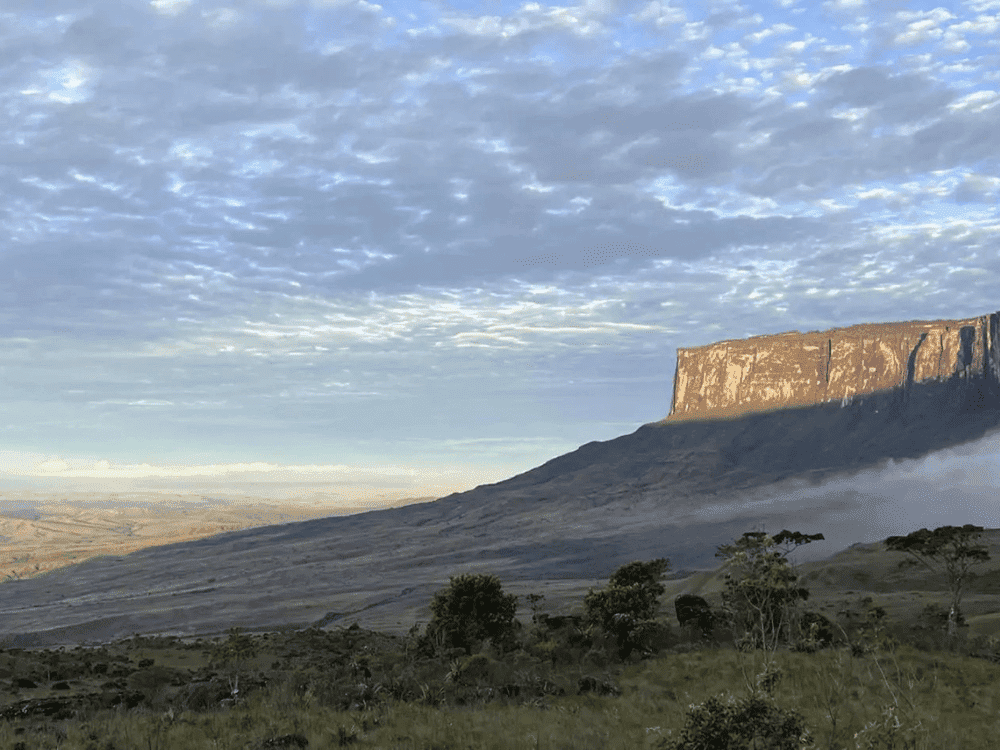
    Mount Roraima, standing tall at an impressive altitude of 2,810 meters (9,219 feet), is an ancient geological marvel that offers breathtaking views of plateaus, cliffs, and a unique natural landscape. It is renowned as one of the oldest formations on Earth. Based on historical records, the mount was first climbed in 1884 by Sir Everard Thurn, marking a significant moment in its story. Mount Roraima invites adventurers to explore its untouched beauty and timeless allure.

    Its most distinctive feature is the flat top, covering approximately 31 square kilometers (12 square miles), surrounded by cliffs that plunge almost vertically for hundreds of meters. The geological formation of Mount Roraima is believed to be the result of millions of years of erosion, giving it an impressive and truly unique appearance.

    Mount Roraima Travel Guide

    Where is Mount Roraima?

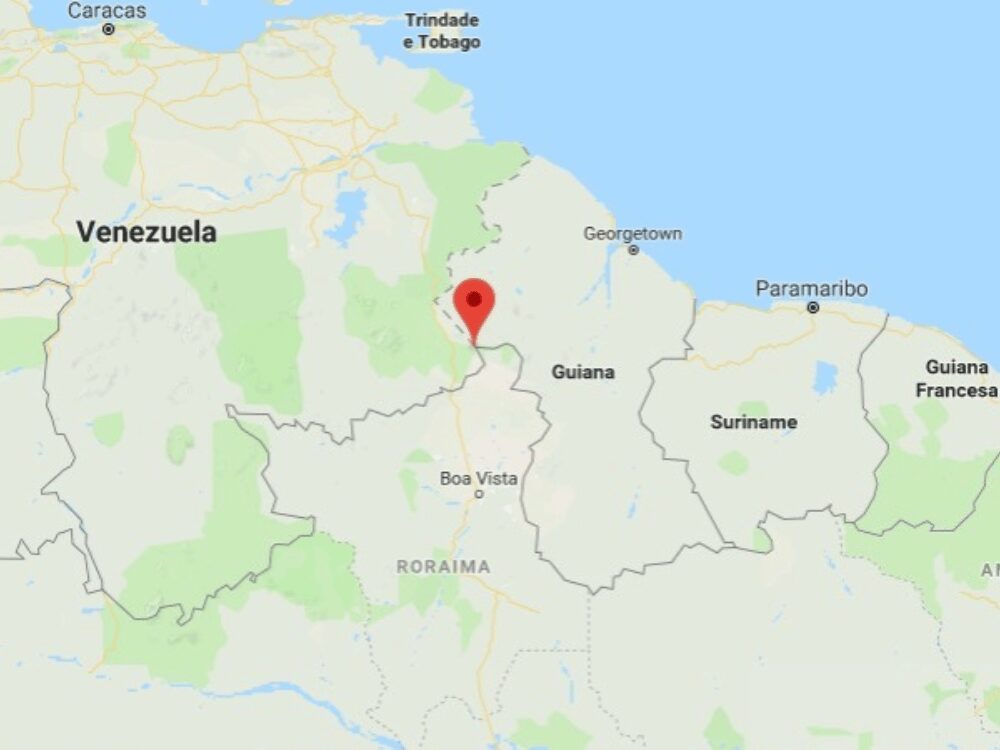
    Curious about where Mount Roraima is located? This stunning natural wonder sits at the intersection of three countries: Guyana, Venezuela, and Brazil. A significant portion of its territory is divided among these nations, with 5% in Brazil, 10% in Guyana, and the largest share, 85%, in Venezuela.

    The management of this area is overseen by the state of Roraima, more specifically, in the city of Uiramutã. Its unique position near the triple border offers an extraordinary opportunity to explore a remarkable corner of the world. For a clearer understanding of its exact location and how to navigate your way there, check out the Mount Roraima map.

    Where is Mount Roraima Travel Guide

    How to get to Mount Roraima?

    Mount Roraima, located at the crossroads of Brazil, Venezuela, and Guyana, can be reached from different entry points, with Boa Vista in Brazil being the most popular. The airport of Boa Vista is categorized as international, but in practice, it receives almost exclusively domestic flights from cities such as Brasília, Manaus, and São Paulo.

    From there, travelers head north on the BR-174 highway, crossing into Venezuela and arriving in Santa Elena de Uairén, the main hub for expeditions. This town provides accommodations and a pause before the trek begins.

    While Santa Elena has a small airport, flights are rare and less reliable, making the road journey from Boa Vista the preferred option. From Santa Elena, the route continues toward the Community of Paraitepuy, the official gateway to the trails. The drive across the Gran Sabana reveals breathtaking landscapes, where travelers often catch their first glimpse of the tepui.

    👉 Want the full guide with all routes, logistics, and tips? Read our complete article on how to get to Mount Roraima.

    How to get to Mount Roraima?

    When is the best time to visit Mount Roraima?

    The weather on Mount Roraima is highly unpredictable and follows the tropical climate of Venezuela. Rain, fog, and sudden temperature changes can happen at any time, so being prepared for all conditions is essential throughout the year.

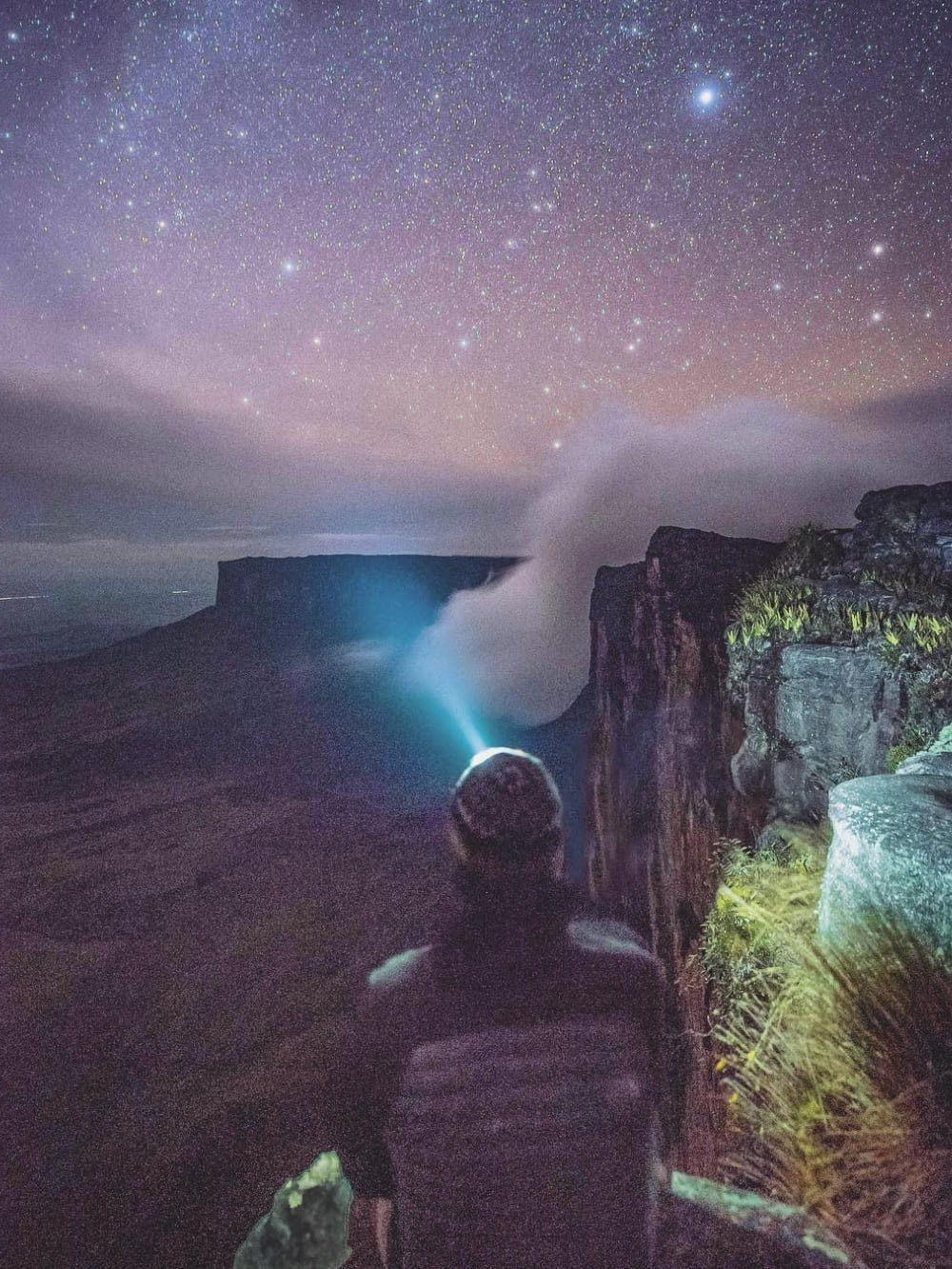
    From October to March (dry season), the trek is generally easier, with less rain and clearer trails. Views from the top of Mount Roraima are more frequent, and temperatures range from 20–25°C (68–77°F) at the base to 10–15°C (50–59°F) at the summit during the day, dropping to 5°C (41°F) or even 0°C (32°F) at night.

    From April to September (rainy season), the trails become muddier and more challenging, but waterfalls are fuller and some appear only during this period. 

    Year-round, trekkers should expect cold nights, frequent winds, afternoon showers, and mist at the summit: elements that make every expedition unique.

    When is the best time to go to Mount Roraima?

    How many days to spend at Mount Roraima?

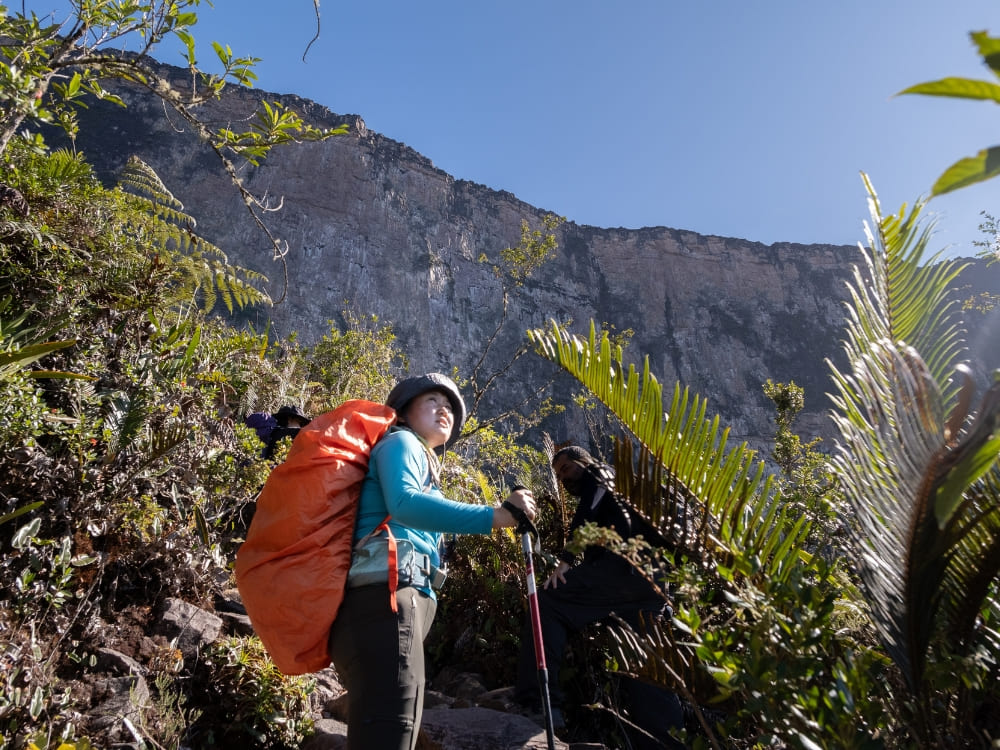
    The trek to Mount Roraima lasts at least 6 days. The first thing to bear in mind is that the climb to the summit involves 3 days of trekking through dense jungle and challenging trails, followed by 2 days of descending. At an altitude of 2,875 metres, Mount Roraima is the eighth highest point in Brazil, being a challenging and rewarding hike for the adventurer to this magical place.

    PlanetaEXO offers an 8-day package that includes 3 nights at the summit, while the 10-day option allows for an extended 5-night stay at the top of the plateau, whilst the 6-day trips are available for private groups. Our expeditions include transportation, guides, camping gear, and meals. This is a perfect adventure for those with good physical fitness and a deep desire for a more connection with nature.

    How long to spend in Mount Roraima?

    How hard is it to trek up Mount Roraima? 

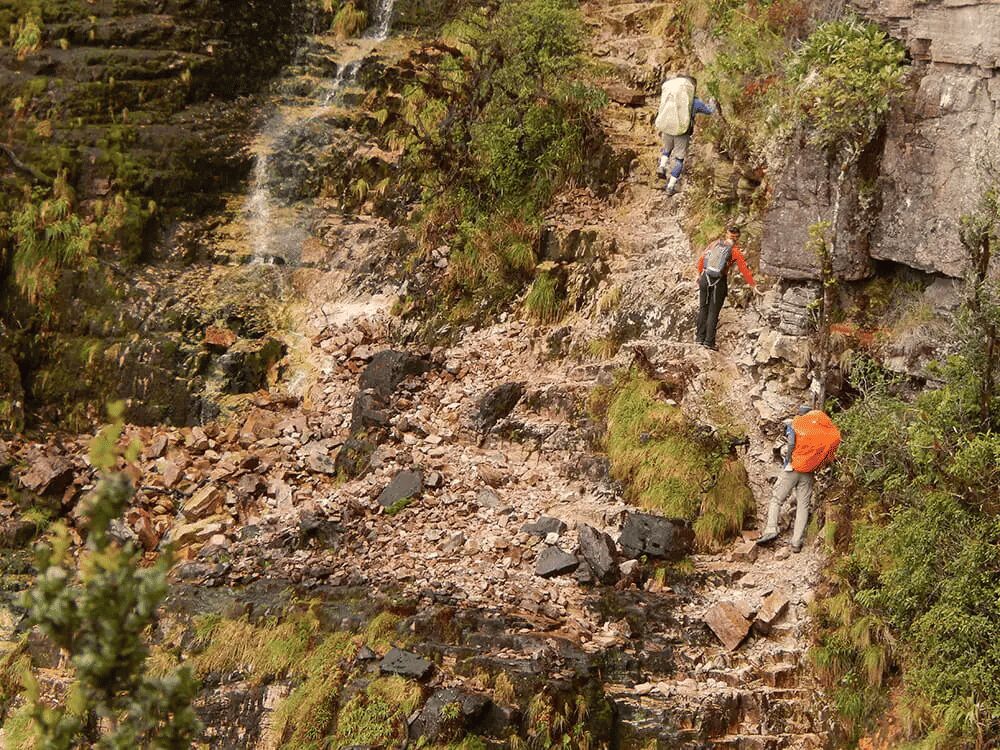
    Trekking Mount Roraima is a challenging hike that demands endurance and preparation. Some sections, like steep ascents and slippery rocky passages, require extra caution and physical strength. The trek covers up to 100 km in 8 to 10 days, with long walks, river crossings, and rugged trails. Nights at high altitude bring cold temperatures and less-than-ideal camping conditions.

    Still, with good fitness, proper gear, and the support of experienced local guides, the adventure is absolutely achievable and deeply rewarding.

    👉 Discover all the details in How hard it is to trek up Mount Roraima

    How hard is it to trek up Mount Roraima
    Photo: Lucas Gobatti

    Is it safe to visit Mount Roraima? 

    Yes, visiting Mount Roraima is considered safe, especially when starting the journey through Brazil. Boa Vista is a reliable gateway with daily flights from major cities, and the crossing into Venezuela via Santa Elena de Uairén is a well-established route frequently used by tourists. 

    With organized tours, border procedures are straightforward, and the town itself has adapted to receive trekkers, offering accommodations, restaurants, and support for expeditions. Traveling with local operators ensures logistics run smoothly and gives you peace of mind from the moment you land in Brazil.

    The trek itself is also safe when done with experienced local guides who know the terrain and conditions. Hiking to the top of Mount Roraima requires physical preparation, but the paths are well-marked, and campsites are organized. With proper guidance and realistic expectations, visitors can enjoy this adventure securely and focus on the incredible landscapes along the way.

    👉 Before planning your trek, remember to check the visa requirements

    Top of Mount Roraima
    @overlandtheamericas

    What’s on top of Mount Roraima?

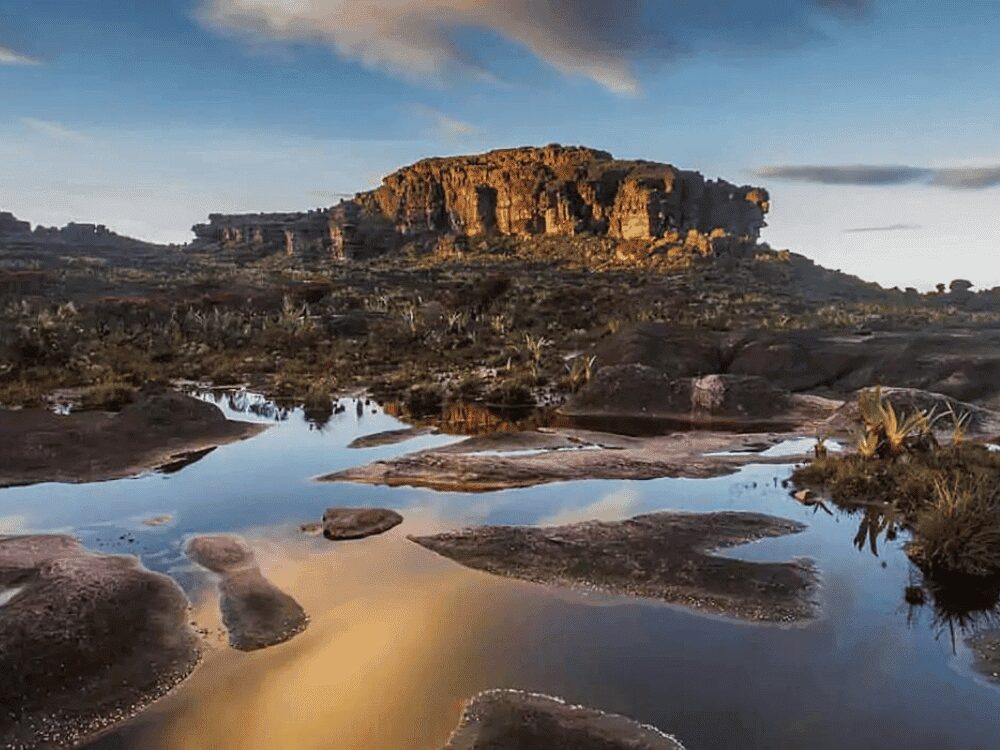
    On the top of Mount Roraima, adventurers find a collection of remarkable features including the Triple Border Point where Venezuela, Brazil, and Guyana converge, and the Valley of Crystals, known for its quartz crystals glittering in the sunlight. Notable points that you will have the opportunity to visit also include El Foso, a natural depression, and La Ventana lookout which offers expansive views of the savannah below. The summit is home to “Jacuzzis,” natural pools formed by rainwater, and the Maverick Rock, the mountain’s highest point.

    Reaching the summit of Mount Roraima isn’t just about the stunning vistas; it’s an expedition into a living museum of Earth’s ancient past. Contrary to expectations, the plateau isn’t flat but a rugged landscape that soars over 300 meters, adorned with rock formations, waterfalls, and crystal-clear pools. However, it’s the unique ecosystem that truly sets Roraima apart.

    The mountain hosts a remarkable variety of plant life, including diverse orchids, bromeliads, and carnivorous plants, many of which are exclusive to this location. But the vibrant tapestry of flora is matched by its fauna. at last, the plateau is also a sanctuary for a fascinating array of animals, including insects, birds, toads, small reptiles, and mammals like mice, each species playing a role in this biodiverse haven.

    What is on top of the mountain?
    .

    👉 Want to learn more? Read the full article: What’s on top of Mount Roraima?

    Is Mount Roraima the oldest place on Earth?

    Mount Roraima, discovered by Europeans in 1595 during the Spanish and British colonization of South America, is a true geological and historical treasure. It was only in 1884 that the adventurer Everard Ferdinand Im Thurm conquered the challenge of climbing this impressive “Crystal Mountain.” Its fame extends beyond climbing feats; Mount Roraima is known as the “Lost World,” a title that reflects its age.

    Its geological composition, predominantly formed by Precambrian rocks dating back approximately two billion years, provides a unique window into the planet’s distant past. Over millions of years, the mountain has resisted relentless erosion, shaping its unique landscape and revealing its flat plateau that extends for about 31 square kilometers.

    In addition to the ancient rocks, the tectonic activity that sculpted Mount Roraima. This is a crucial factor for its title as the oldest place on Earth. As part of the ancient Pakaraima mountain range, formed over billions of years by the movement of tectonic plates. The mountain bears witness to the geological forces that shaped the planet. This connection to geological processes from the distant past reinforces the antiquity of Mount Roraima.

    Is it the oldest place on Earth?

    What to bring to Mount Roraima?

    Packing smart is key to a successful Mount Roraima expedition. Equip yourself with durable hiking boots, breathable yet protective clothing, and weather-resistant gear to tackle the mountain’s diverse climates.

    Essential include a robust backpack, a comfortable sleeping bag rated for 0°C (32°F), reliable trekking poles, and an efficient headlamp. Prioritize hydration with eco-friendly water bottles, and ensure safety with a portable water purifier. Round off your gear with energy-boosting snacks, protective sunscreen, sunglasses, and a hat to shield you from the elements.

    What to bring?

    As we reach the end of this guide, remember that each step on Mount Roraima is a story waiting to be captured. Don’t leave behind anything but footprints and take everything but memories, captured on your camera or phone. Essential items like cash (Brazilian real BRL), passport, international certificate of vaccination with proof of yellow fever vaccination administered at least 10 days prior and important documents should not be forgotten.

    Eager for an adventure like no other at Mount Roraima? Check out our travel deals, designed for memorable trips. Click to see what’s waiting for you.

    At PlanetaEXO, we believe every journey can make tourism kinder to our planet, keeping its beauty intact. Book now for a tour experience beyond limits.

    Read more!

  • The Abrolhos Archipelago in Brazil – Travel Guide

    The Abrolhos Archipelago in Brazil – Travel Guide

    Experience one of South America’s most diverse marine habitats in this archipelago in Bahia.

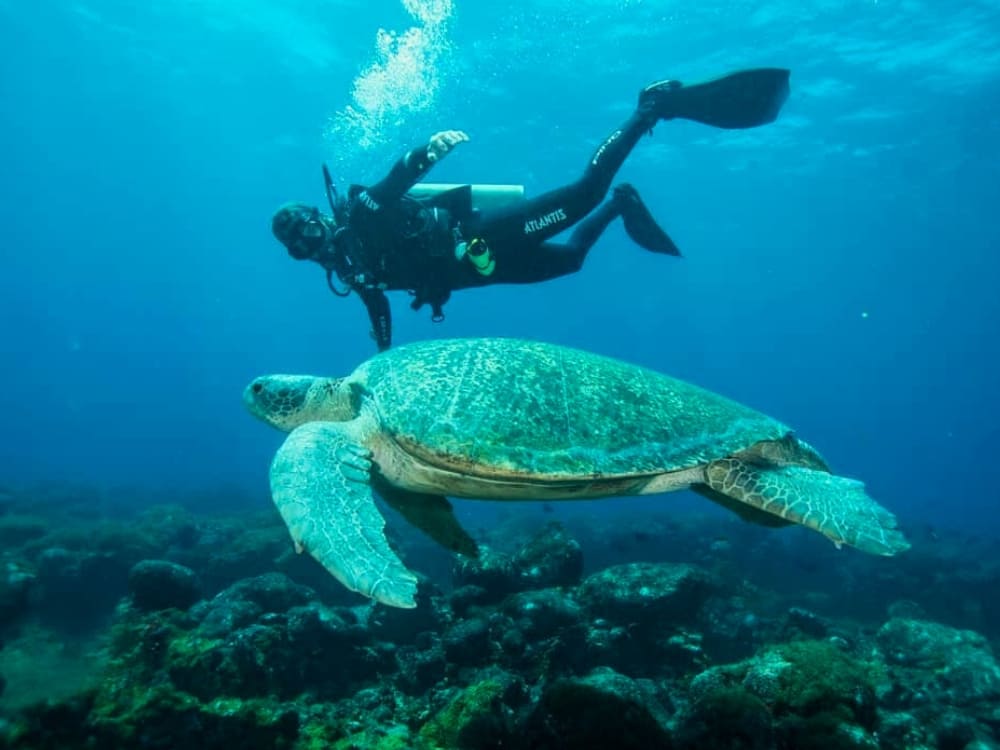
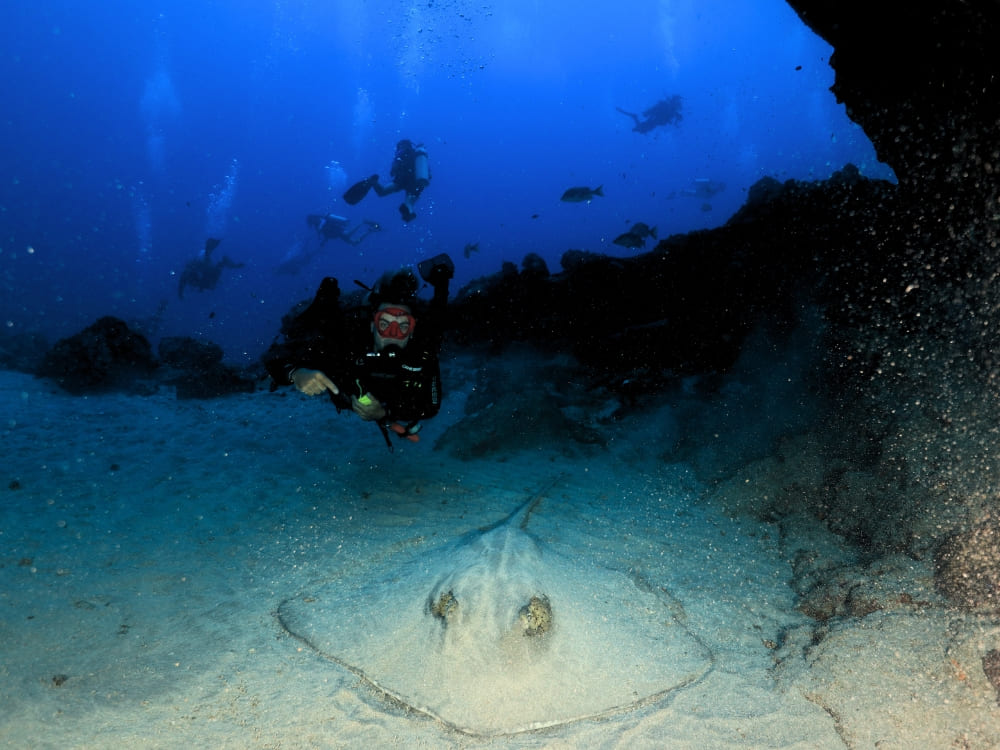
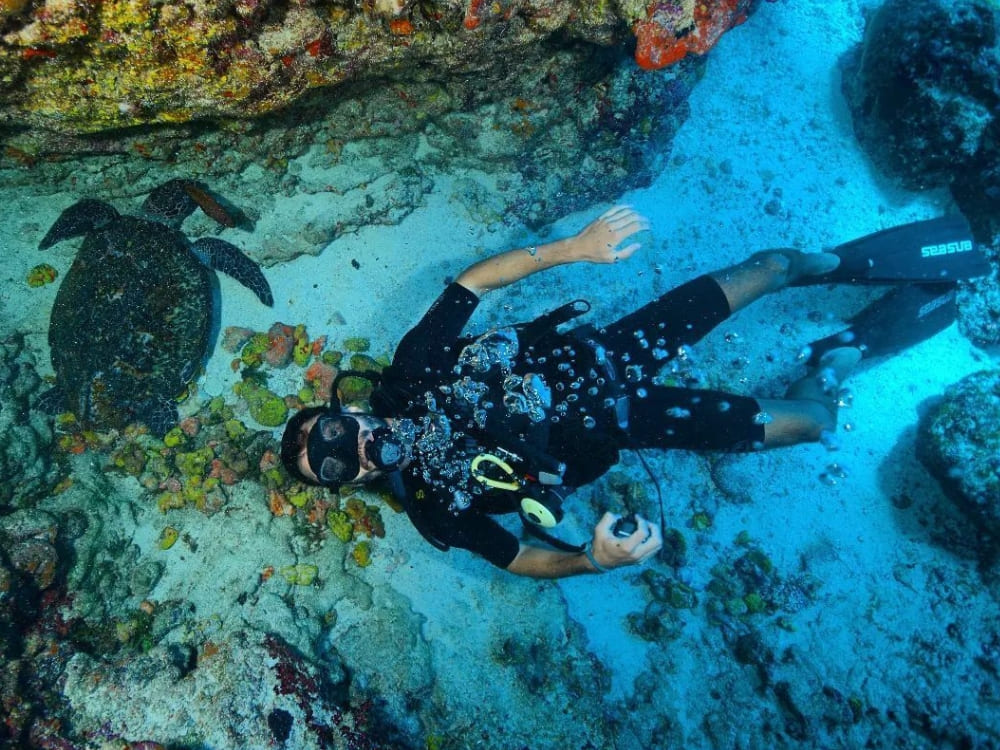
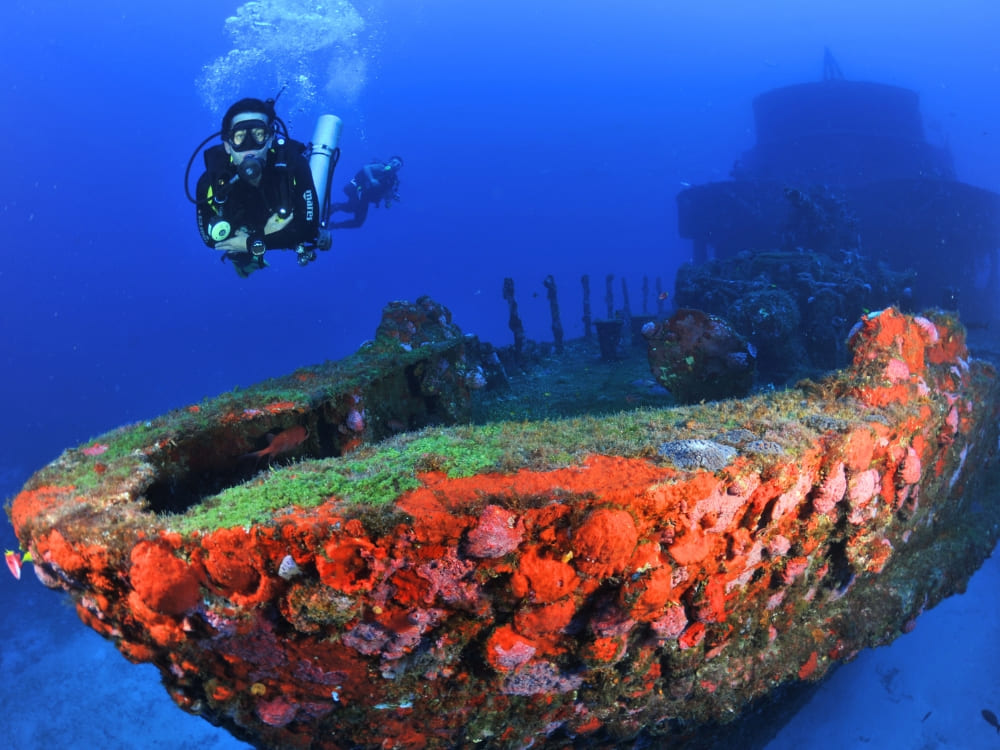
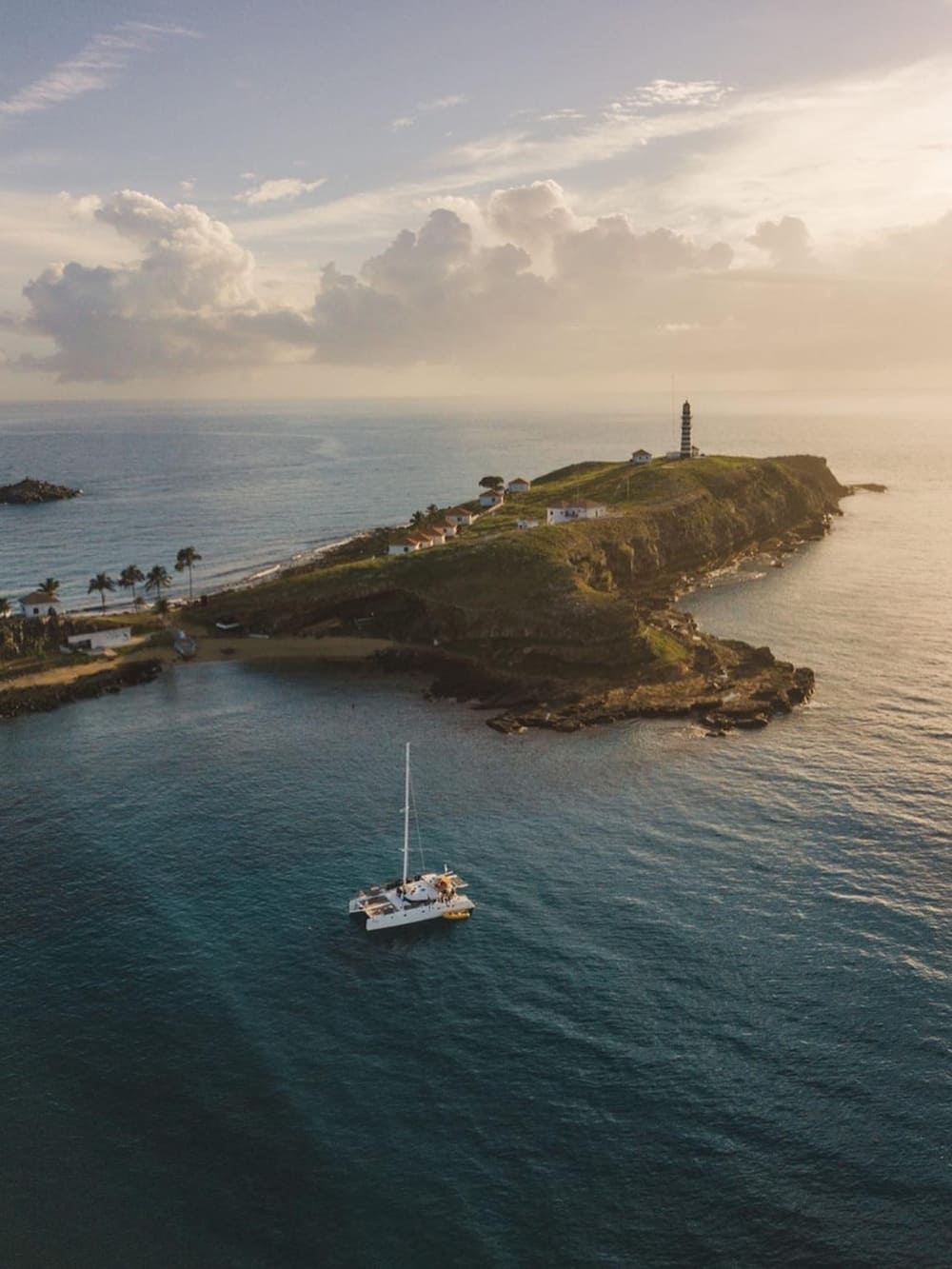
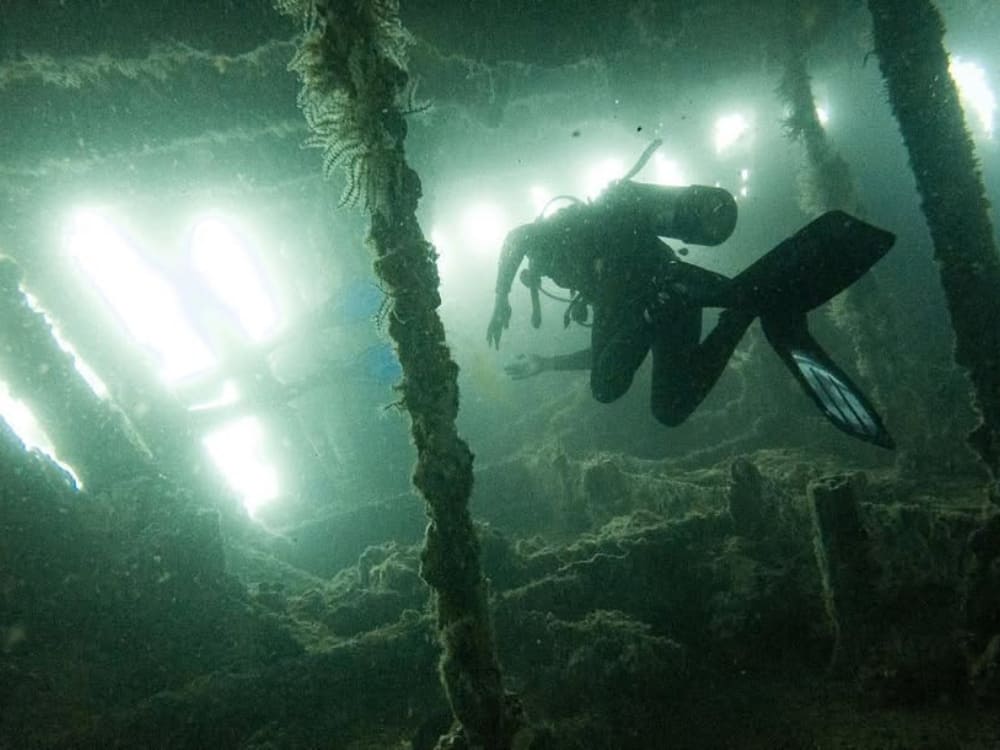
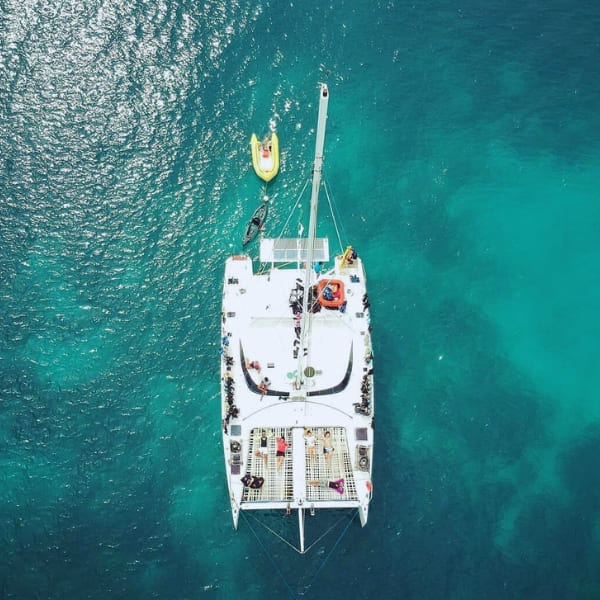
    Deep in South America, far from the packed beaches and already beaten tourist tracks, lies a secret underwater realm: The Abrolhos Archipelago in Brazil, a protected spot on the southern coast of Bahia. Known for its rare coral formations and historic shipwrecks, it offers an intimate and authentic encounter with nature. 

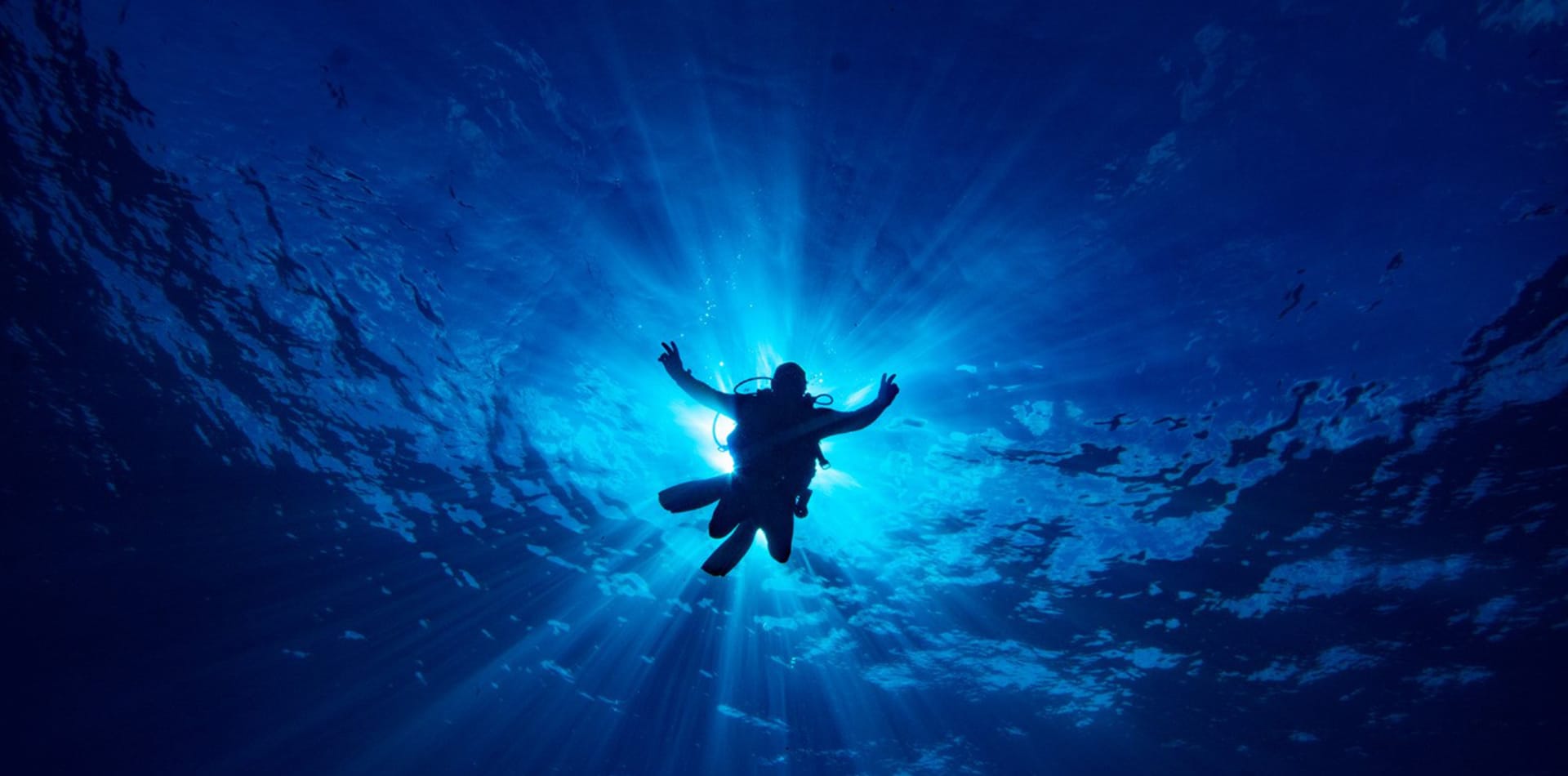
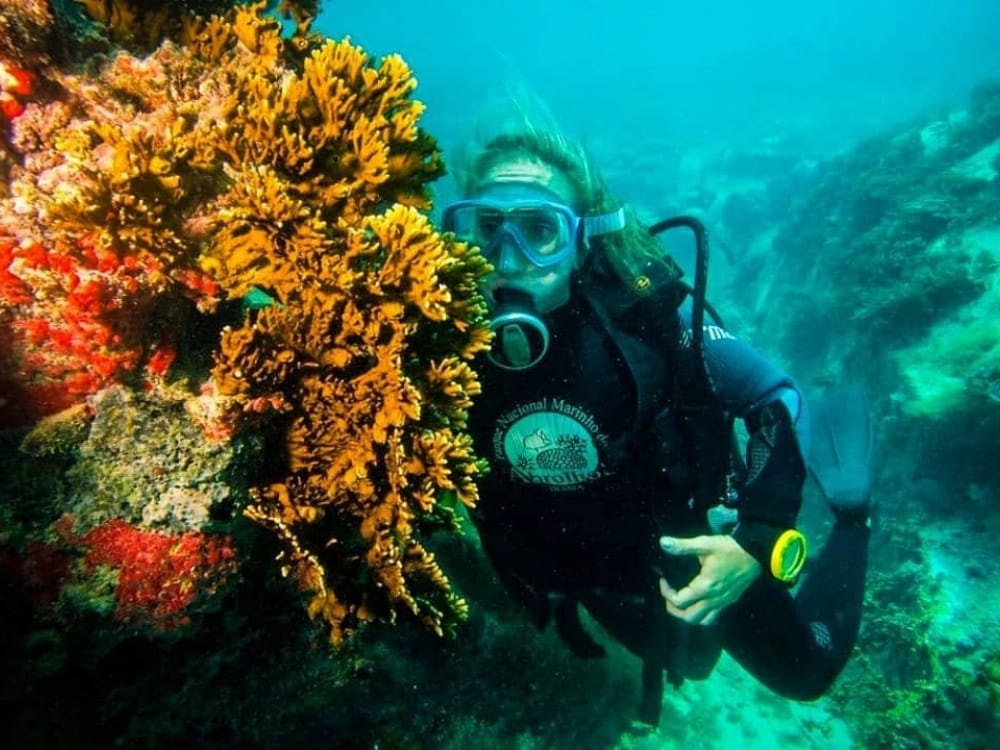
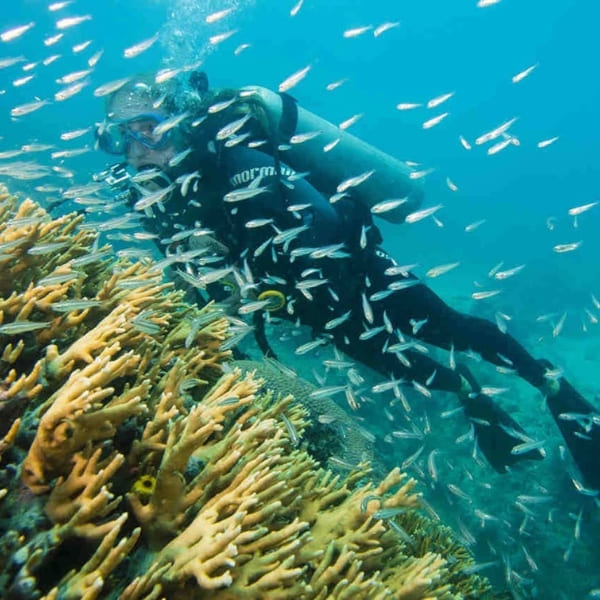
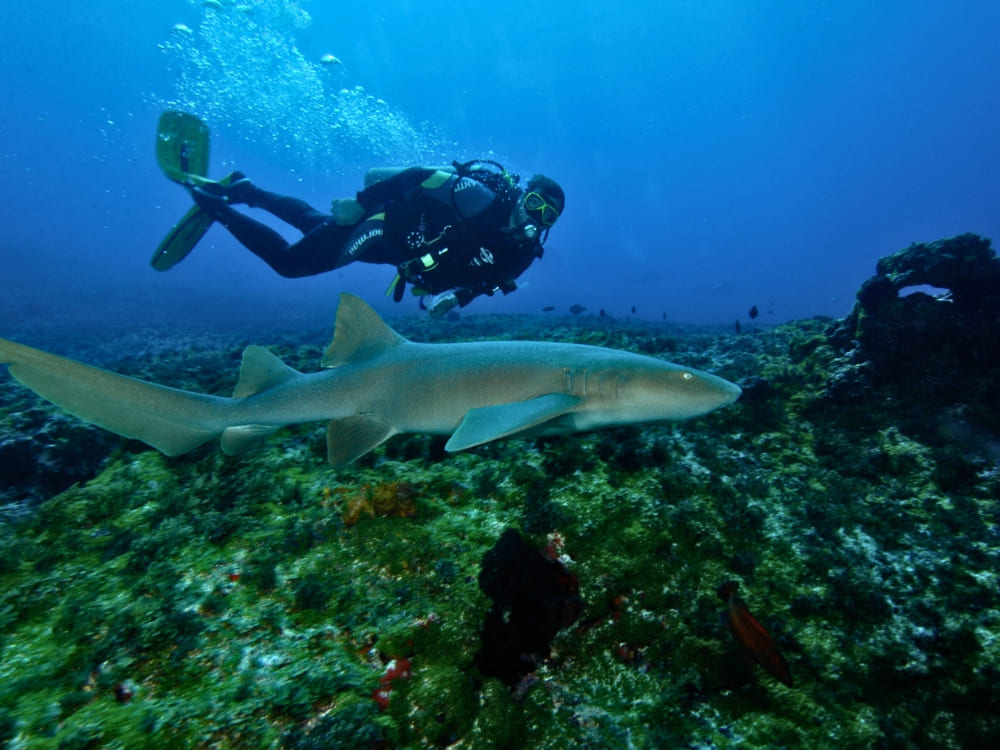
    top diving spot in Brazil
    Photo: @cicero.bezerra

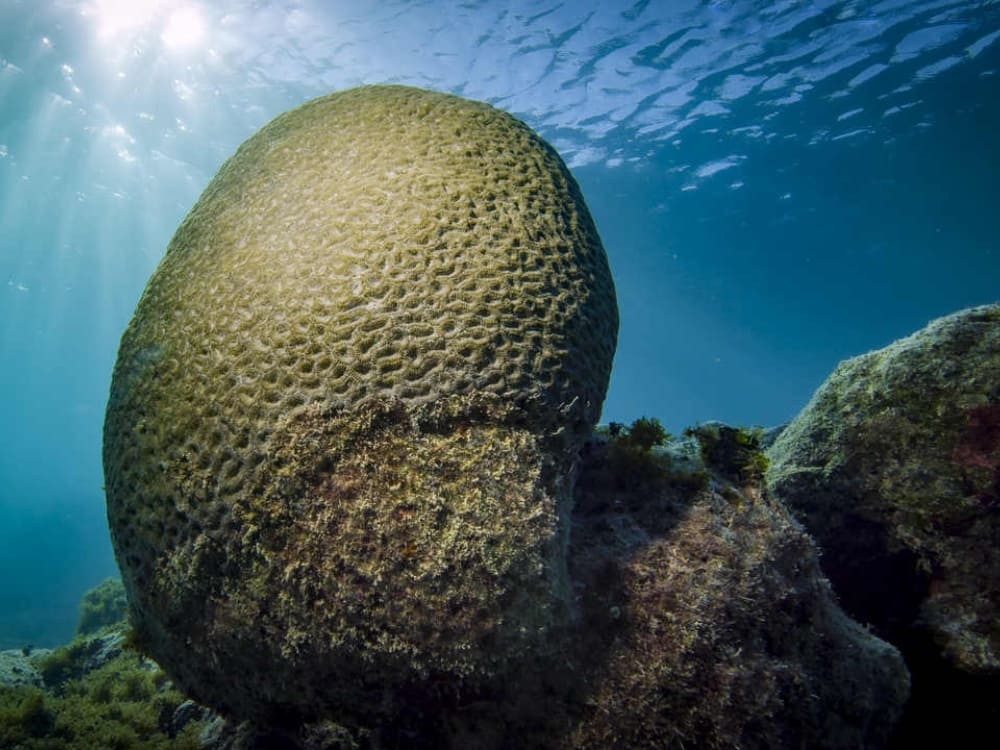
    This is one of the remotest and best-preserved destinations in the second half of the north-east, home to the greatest coral reefs in the South Atlantic. That’s why it’s the unassailable diving destination of the country, and for the best coral island experience, where you can observe an active marine life among the great chapeirões, individual mushroom-shaped coral formations. 

    Abrolhos Archipelago in Brazil
    Photo: ICMbio

    Abrolhos is a place to meditate silently on life and to hold nature in deep and holy regard. If you’re in search of peace, untamed beauty, and pure adventure, this could very well be your next memorable trip

    Are you ready to dive into this underwater paradise? 

    Table of contents:

    1. About Abrolhos 
    2. What to do in Abrolhos
    3. When is the best time to visit Abrolhos?
    4. How to get to Abrolhos
    5. Marine life in Abrolhos
    6. How Many Days to Spend in Abrolhos?
    7. Taxes and fees in Abrolhos
    8. Where to stay in Abrolhos?

    About Abrolhos 

    Consisting of five volcanic islands (Santa Bárbara, Redonda, Guarita, Sueste, and Siriba) and a large coral reef, the area has a total area of 87,943 hectares and is part of the Abrolhos National Marine Park, the country’s first marine national park, established in 1983. 

    The Abrolhos Archipelago Coral
    Photo: ICMbio

    The name Abrolhos is derived from a Portuguese term, “Abre Olhos,” which translates to “Open eyes.” As history has it, it was a caution call for 16th-century sailors and the dangerous region of reefs through which they traversed. 

    Today, it is also a call to notice the incredible beauty and biodiversity hidden under the surface. The archipelago, which contains the largest coral complex in the South Atlantic, is home to hundreds of species of animals that dwell in and outside of the sea. It’s also a humpback whale nursery (they come to this area to breed). 

    The reality is that despite its enormous ecological significance, Abrolhos is still predominantly off the traveller’s trail. There are no hotels on the islands, and tourism here is tightly restricted to help preserve its sensitive ecosystems. What you won’t find are beach bars or any resorts, but authentic wildlife experiences, world-class diving, or a quiet escape to maximum nature If that’s what you’re after, Abrolhos is worth the journey. 

    Of the five islands, the only one currently inhabited is Santa Bárbara Island, populated by military personnel and their families, as well as researchers and employees of the Chico Mendes Conservation Institute (ICMBio), responsible for managing and preserving the park. Siriba Island is the only one open to visitors.

    👉 Read our 10 Facts About Abrolhos and discover more about this marine paradise

    What to do in Abrolhos 

    Even though the archipelago may appear remote, there’s plenty of adventure to discover, with nature lovers, divers, and anyone interested in low-impact travel in mind. Here are some ideas for what to see and do in the region: 

    Diving in Abrolhos Bahia
    Photo: @maysasantoro

    Diving and snorkeling 

    This is what people are going here for. The reefs are alive, and visibility is typically great from December through May. 

    Highlights include: 

    • Chapeirões: These fantastic coral towers are inhabited by moray eels, turtles, nudibranchs, and all manner of colorful reef fish. 
    • Parcel dos Abrolhos: Massive reef bank suitable for beginner and experienced divers.
    • Shipwrecks: Several historic dive sites, including a British cargo ship (SS Rosalina, sunk in 1939) that now double as artificial reefs.
    • Night Dives: Occasionally, certified divers have the option of doing a night dive on liveaboard boats. Even nondivers will find fantastic biodiversity snorkeling on the shallow reefs.
    Shipwrecks in Abrolhos Brazil
    Photo: @viviankoblinsky

    Whale watching 

    No surprise that the Abrolhos Archipelago in Brazil is called a humpback whale nursery. These interesting animals of the sea, which are known to be migratory, travel from Antarctica to the Bahian coast from June to November to breed. Its appearance peaks in July to October. 

    During this period, sightings are frequent and often impressive! It is common to see these incredible mammals jumping, slapping their tails, and singing on the surface.

    nursery for humpback whales in Abrolhos
    Photo: @franksantos.photographer

    Hiking on the Siriba Island trails 

    It is the sole island in the archipelago open to the public. Hike along the trail with a park guide and look for seabirds, rock formations, and stunning landscapes. Bear in mind: this is a nature reserve, so respect for nature is crucial. 

    Siriba Island in Abrolhos Brazil
    Photo: @carolbrenck

    When is the best time to visit Abrolhos? 

    The best time to visit Abrolhos Marine National Park depends on what you are looking for. For diving and snorkeling, the best time is between December and February. The warm waters and fantastic visibility in the calm seas make it an understated paradise for activities in the water, so this is said to be the peak underwater season. 

    If you prefer fewer tourists and good diving conditions, plan a trip between March and May. Waters are cooler and remain great for water excursions. From June through November, it’s whale season in Abrolhos. Many people visit to combine diving and whale watching.

    Sunset in Abrolhos Bahia
    Photo: @joaoricardojanuzzi

    Keep in mind that all maritime tours depend on weather conditions, especially wind speed and wave height. Operators typically cancel trips when winds exceed 20 knots, so it’s important to check the forecast before planning your visit.

    How to get to Abrolhos 

    To reach Abrolhos, you first need to travel to Caravelas, a small town on the coast of the state of southern Bahia. It is the primary point of departure for boat tours to the archipelago. Caravelas doesn’t have any major airports, so it takes some time to get there, though the extra effort is worth it. You can fly, drive, or take the bus, whatever suits your style of travel best. 

    How to get to Caravelas? 

    By plane: Best for speed and convenience. The closest large airport is Porto Seguro (BPS), about 145 km away from Caravelas. It is served by direct flights from cities including Salvador and Belo Horizonte. Caravelas is approximately 5 to 6 hours from Porto Seguro by car. Or, you can take a flight to Teixeira de Freitas Airport (TXF), which is approximately 90 km from here. The drive there is 1.5 to 2 hours by car or bus. 

    By car: Best for flexibility and wandering at your own pace. Caravelas is accessible by road from cities in Bahia, Minas Gerais, and Espírito Santo. In Vitória (ES), for example, the trip lasts approximately 8 hours, while traveling from São Paulo takes around 17 hours. 

    Tip: Before you hit the road, check road conditions and plan your stops accordingly. 

    By bus: Best for budget travelers. Caravelas is served by several bus companies such as Água Branca, Rota Transportes, Brasileiro, and Gontijo. Journeys usually take the Teixeira de Freitas route, and vary according to your point of departure. 

    Tip: Purchase tickets in advance, especially in high season, and when visiting to watch the whales. 

    Caravelas in Bahia Brazil
    Photo: @visitecaravelas

    How to get to the islands? 

    Access is by boat only, and various tour operators, with licenses from the city of Caravelas, offer the trip. There are 2 primary options for doing this tour, both are amazing: 

    Day trips: Perfect for those short on time, these tours head out early in the morning and return late in the evening. The itinerary also takes in Siriba Island and stops for snorkeling at reefs nearby, where corals, marine life, and turtles can be spotted. 

    Liveaboards (overnight trips): For travelers who desire a comprehensive experience, liveaboards are the way to go. You spend the nights on board the boat and can go on multiple dives or snorkeling sessions each day, sometimes in further-out and more preserved areas. It’s the best way to get up close and personal with all the beauty of the Abrolhos Marine National Park

    Traveller in Abrolhos Bahia
    Photo: @joaoricardojanuzzi

    Either way, just make sure you choose an operator that is licensed by ICMBio and follows environmental regulations, that’s good for your safety and to preserve this very special ecosystem. 

    Marine life in Abrolhos 

    The marine life of Abrolhos is one of the most diverse in the Atlantic. The area is host to over 1,300 species of coral, many are endemic, that is, found nowhere else! 

    • Coral: accustomed to the world’s largest colonies of Mussismilia braziliensis, endemic in Brazil. 
    • Fish: parrotfish, butterflyfish, angelfish, groupers, reef sharks. 
    • Turtles: Green and Hawksbill turtles are commonly sighted. 
    • Sea mammals: Humpback whales (seasonal), dolphins. 
    • Invertebrates: Starfish, octopus, sponges, lobsters, etc. 

    The reefs also act as breeding and nursery grounds for a number of animals and as a breeding ground for rare wildlife. 

    How Many Days to Spend in Abrolhos? 

    You can visit Abrolhos on a day trip from Caravelas, but to truly experience the archipelago, it’s best to stay 3 days. This gives you time for extra dives, more snorkeling, exploring remote reef areas, and a better chance of spotting humpback whales between July and November.

    Staying longer also means you can enjoy the peaceful atmosphere of the region without rushing. Whether you’re sleeping on a liveaboard or staying in Caravelas and joining daily excursions, having a few days allows you to connect more deeply with the unique marine life and natural beauty of the Abrolhos Marine National Park.

    Boat at Abrolhos Bahia
    Photo: @anaabifadel

    Sleeping on a liveaboard also lets you see Abrolhos in a much more serene, whole, and immersive way. 

    👉 A great option is the 3-day package from PlanetaEXO, which includes sleeping on the boat, full board, and diving at the most outstanding points within the marine park. 

    Taxes and fees in Abrolhos 

    Before proceeding towards the Abrolhos Archipelago in Brazil, here are some of the compulsory and additional costs of the marine park visit, you should be aware of. 

    Price of Admission to the Abrolhos Marine National Park 

    The Abrolhos conservation fee for the protected area should be paid by all visitors: 

    • Brazilian visitors: R$ 46 (value approximate) 
    • Foreign visitors: R$ 92 (estimated) 
    • Discounts: valid for children, students, and seniors upon presentation of documentation
    Lighthouse in Abrolhos
    Photo: @marcosamend

    Additional costs 

    In addition to the park fee, there are other costs: 

    • Boat rides (round trips or liveaboard) 
    • Scuba diving or snorkeling Gear rental (if you don’t have your own) 
    • Whale watching (when in season, July-November) tours 

    👉 Important tip: bring cash. Even though some operators take cards, it is better to pay with cash for small expenses in Caravelas, such as local food, local transport, and extras, especially if you are going to places with poor or no internet signal or card machines. 

    Where to stay in Abrolhos? 

    There is no accommodation on the islands, which are a protected environmental area. For that reason, it’s not possible to stay overnight unless on a registered boat (or liveaboard) or on the mainland in towns like Caravelas, the gateway to the Abrolhos Archipelago in Brazil

    The best way to enjoy this experience is during a liveaboard tour, where you dive and snorkel every day, with the help of professional guides. All boats must be registered with ICMBio and abide by environmental conservation regulations.

    Where to stay in Abrolhos Brazil
    Photo: @saltyroutine

    Where to stay in Caravelas 

    Caravelas is a tranquil town and offers just a few places to stay, but they are all adequate. They’re mostly small inns and simple hotels. 

    If you prefer more comfort or options, staying in Nova Viçosa, which is an hour away, is a good alternative. However, keep in mind the trip to the port for early morning departures.

    Ready to embark on an adventure in the Abrolhos Archipelago? 

    Abrolhos is not a common destination. Don’t expect beach clubs, luxury hotels, or easy access. What you will find here is something much more valuable: an untouched paradise, teeming with marine life, silence, and nature in its raw state.

    The Abrolhos Archipelago in Brazil is somewhere for people who care about conservation, like a real adventure, and are taken by the wild beauty of the ocean. Descend to immense coral reefs, catch sight of humpback whales, or simply switch off in a marine sanctuary. 

    If this adventure is for you, PlanetaEXO can take you there. Discover with us how to live this experience safely, consciously, and unforgettably.

    Adventure in the Abrolhos Archipelago Brazil
    Photo: @piccinibr
  • How to visit the Lençóis Maranhenses National Park: Travel Guide

    How to visit the Lençóis Maranhenses National Park: Travel Guide

    Learn everything you need to know to travel to Lençóis Maranhenses in Brazil, including how to get there, the best time to visit, main activities, and more!

    Are you seeking adventure, relaxation, and breathtaking views? Then you should head to Lençóis Maranhenses National Park, a vast expanse of undulating sand dunes and crystal-clear pools that offers a serene escape from the chaos of city life.

    This destination shows a whole other side of Brazil’s nature—very different from the dense vegetation of rainforests or the open fields of wetlands, but still absolutely extraordinary.

    If you need some help with your vacation planning, PlanetaEXO, an ecotourism platform specializing in Lençóis Maranhenses tours, has created a complete guide detailing all the crucial information for a fantastic trip. Check it out below!

    Table of contents:

    About Lençóis Maranhenses

    Along the undulating white sand dunes formed by the wind, countless rainwater lagoons are formed during the rainy seasons in Lençois Maranhenses National Park. Due to the high volume of rainfall, the bodies of water become large and deep enough for swimming and diving.

    A backpacker walks barefoot along the white sand dunes near a blue rainwater lagoon while trekking in Lençóis Maranhenses National Park.

    The beauty of Lençóis is so otherworldly it got to Hollywood, serving as the setting for the fictional planet Vormir in Avengers: Infinity War. Amidst CGI effects, the dunes host the villain Thanos and his daughter Gamora in a few scenes from the film.

    The park has been protected by federal Brazilian law since 1981 and was declared a UNESCO World Heritage Site in 2024.

    👉 Read more: How are the dunes and lagoons in Lençóis Maranhenses formed?

    Is Lençóis Maranhenses a desert?

    Lençóis Maranhenses is what we call “a desert with a thousand lakes”. As a wet desert, it’s a broad area of sand dunes and high biodiversity, covered with over 36,000 rainwater lagoons.

    Travelers walk across the vast expanse of sand dunes in Lençóis Maranhenses during a bright sunset.
    .

    Therefore, Brazil does not have vast arid deserts like the Sahara, though there are places undergoing desertification processes, such as the Caatinga biome.

    Where is Lençóis Maranhenses located?

    Lençóis Maranhenses is located in a 155,000 ha area on the coast of the state of Maranhão, in the northeast of Brazil. 

    Barreirinhas, Atins, and Santo Amaro are the gateways for the national park, providing enough infrastructure to comfortably welcome tourists from all over the world.

    How to get to Lençóis Maranhenses National Park?

    To reach the breathtaking expanse of the Lençóis Maranhenses National Park, adventurers can set off from three entry points—all easily accessible from São Luís, capital of Maranhão, where Marechal Cunha Machado International Airport (SLZ) is located:

    A 4x4 vehicle carries tourists along a sandy path, offering a ride into the Lençóis Maranhenses National Park.
    .
    • Barreirinhas: the main gateway, 260 km east of São Luís. Options include buses, rental cars, shared vans, and private transfers.
    • Atins: accessible via Barreirinhas. From there, you can take a scenic boat ride along the Preguiças River or a 4×4 vehicle ride. Both options offer unique experiences and beautiful views.
    • Santo Amaro: 237 km southeast of São Luís, it’s a quieter alternative to Barreirinhas. Rent a car in São Luís to drive straight to Santo Amaro, or take a shared van service.
    • Pro tip: when you book your Lençóis Maranhenses tour with PlanetaEXO, our local partners provide shuttle services from the airport/hotels in São Luís to your accommodation in one of the base cities. Talk about convenience!

    👉 Read more: How to get to Lençóis Maranhenses?

    When is the best time to visit Lençóis Maranhenses?

    The ideal time to visit Lençóis Maranhenses in Brazil is from May to September. During this period, the lagoons are at their fullest, providing visitors with the best possible experience. Perfect for swimming, diving or simply relaxing in the crystal-clear waters!

    The sun sets brightly over the undulating white sand dunes and rainwater lagoons in the national park.
    .

    From September to October and February to April, the lagoons start to decrease but still offer plenty of action in the water. While the scenery might not be as lush as during the high-water season, these months are known for fewer crowds and enjoyable activities in the lagoons.

    From November to January, the lagoons dry up, limiting water activities and revealing pastures and meadows on the lagoon floors. This period shows a different side of Lençóis, highlighting the changing landscape and the unique formations of the park.

    👉 Read more: When is the best time to visit Lençóis Maranhenses?

    What to do in Lençóis Maranhenses National Park?

    Besides its jaw-dropping beauty, this is a destination ideal for travelers who love the outdoors and can’t say no to adventure. Watching the sunset from the sand dunes is an experience unlike any other, but there’s a lot more to do in Lençóis Maranhenses

    Lagoons

    Across the national park, there are thousand of lagoons of all sizes, which appear and disappear depending on the time of year.

     A wide landscape shows thousands of rainwater lagoons interspersed among the white sand dunes.
    Photo: Marcelo Bonifacio

    They all have their virtues, but some stand out for their beauty, size, and permanence even during times of drought:

    • Barreirinhas: Lagoa Azul and Lagoa Bonita
    • Atins: Lagoa Tropical and Lagoa da Capivara
    • Santo Amaro: Lagoa da Betânia, Lagoa da Andorinha and Lagoa da Gaivota

    Can I swim in Lençóis Maranhenses?

    Yes, you can swim in Lençóis Maranhenses! The lagoons are clear and have just the right temperature for swimming, diving or simply relaxing.

    A person swims and relaxes in the crystal-clear waters of a lagoon in Lençóis Maranhenses.
    Photo: Marcelo Bonifacio

    However, it’s important to follow the guides’ instructions and respect the park’s rules to ensure a safe and responsible experience. This includes avoiding the use of cosmetics that could contaminate the water and picking up your own trash.

    Trekking

    Those seeking total immersion can cross the national park on foot. The trek lasts 3–5 days and allows you to explore the sand dunes and lagoons located in the so-called “primitive zone” of Lençóis Maranhenses.

    A group of travelers wades through a shallow lagoon while crossing the national park on foot.
    Photo: Isadora Sá

    After long hours of trekking, travelers spend the night in the homes of locals who generously open their doors to welcome them. The accommodations are modest but cozy.

    The experience requires time and physical effort, meaning not everyone is ready to face it. However, visitors who are willing to embark on this adventure do not regret it and return home transformed!

    👉 Explore the adventure: 5-day Lençóis Maranhenses Hike

    Beaches

    The Lençóis Maranhenses National Park is bordered by the Atlantic Ocean, especially at the mouth of the Preguiças River.

    While somewhat famous, Atins Beach is not very crowded due to its fairly remote location in Atins and relatively difficult access—only by boat or 4×4 vehicles.

     Palm trees line the light-colored sand near the mouth of the Preguiças River, with small boats sailing on the water.
    .

    The beach is gorgeous, with calm waves, warm waters and light-colored sand. In addition to being great for relaxing and sunbathing, it’s also one of the main kitesurfing spots in Brazil. Therefore, the sky is always adorned with colorful kites that only make the view even more beautiful.

    Caburé Beach (Barreirinhas) and Travosa Beach (Santo Amaro) are also worth the visit!

    Boat rides and boiacross

    The landscape of Lençóis is not limited to sand dunes and lagoons but also includes green areas bathed by the Preguiças River. Passing through Barreirinhas, Atins, Vassouras, Mandacaru and Caburé, navigating its dark waters is a great way to truly get to know the region.

     A red and green boat named Esperanca rests on the sandy shore of the dark waters of the Preguiças River.
    .

    Tourists are also attracted by the Formigas River, which cuts through the village of Cardosa. The current is perfect for boiacross, a popular ecotourism activity in Brazil where people float down the rivers in large inflatable tubes.

    How many days should I stay in Lençóis Maranhenses?

    Knowing how long the trip will last is key to your planning. Lençóis Maranhenses National Park offers experiences ranging from quick introductions to deeper, multi-day adventures.

     A group of people casts long shadows while exploring the sand dunes in the primitive zone of Lençóis Maranhenses.
    .

    If your time is limited, a 2-day tour is enough for a taste of the sand dunes and lagoons. For a more immersive experience, 3 to 4 days allow you to explore different regions of the park, join longer hikes, or take boat trips along the Preguiças River.

    If you’re able to stay 5 days or more, you can enjoy more ambitious adventures, such as multi-day treks crossing the park or embarking on the wonderful Route of Emotions, a fantastic tour that includes destinations (Lençóis, Delta do Parnaíba, and Jericoacoara) in three different states (Maranhão, Piauí, and Ceará)!

    👉 Read more: How many days should you spend in Lençóis Maranhenses?

    Where to stay in Lençóis Maranhenses?

    As the main gateway, Barreirinhas has the widest range of accommodations, from budget guesthouses to comfortable hotels. With easy access to the national park, good transportation options, and restaurants all over town, it’s a very convenient place to stay.

    Atins is a peaceful fishing village by the sea, known for its rustic charm and relaxed pace. It’s ideal for travelers looking for a quieter atmosphere in cozy, more intimate hotels.

    Santo Amaro offers an even more remote and exclusive experience. With fewer visitors and inns surrounded by sand dunes and lagoons, it’s the perfect picture of tranquility and total disconnection.

    👉 Read more: Where to stay in Lençóis Maranhenses?

    Best Lençóis Maranhenses National Parks tours

    Can’t wait to witness the otherwordly beauty of Lençóis Maranhenses up close? Check out PlanetaEXO’s tours and start planning your vacation!

    TOUR HIGHLIGHTS DURATION STARTING PRICE*
    Lençóis Maranhenses trek from Atins Trekking across the sand dunes, rainwater lagoons, accommodation in locals’ houses inside the national park. 2 days US$ 416
    Lençóis Maranhenses Desert Brazil Trip Trekking across the sand dunes, rainwater lagoons, Baixa Grande Oasis, accommodation in locals’ houses inside the national park. 2 days US$ 380
    Lençóis Maranhenses Trek Trekking across the sand dunes, rainwater lagoons, Baixa Grande and Queima dos Britos Oasis, accommodation in locals’ houses inside the national park. 3 days US$ 485
    Lençóis Maranhenses Tour from Santo Amaro Sand dunes and lagoons in Santo Amaro, hiking, 4×4 car tours, Ponta Verde. 3 days US$ 615
    Horseback Riding Lençóis Maranhenses Tour Horseback riding the sand dunes, rainwater lagoons, Baixa Grande, Queimada dos Britos, Atins, accommodation in locals’ houses inside the national park. 3 days US$ 1,165
    Lençois Maranhenses Trekking Trekking across the sand dunes, rainwater lagoons, Lagoa Bicudo Gordo, Lagoa do Junco, Baixa Grande and Queima dos Britos Oasis, accommodation in locals’ houses inside the national park. 4 days US$ 600
    Lençóis Maranhenses Tour from Atins Sand dunes and lagoons in Canto do Atins and Ponta do Mangue, hiking, 4×4 car tours, Preguiças Lighthouse. 4 days US$ 960
    Lençóis Maranhenses Hike Hiking across the sand dunes, rainwater lagoons, Baixa Grande and Queima dos Britos Oasis, boat trips, Atins Beach, Vassouras and Mandacaru, accommodation in locals’ houses inside the national park. 5 days US$ 702
    Lençóis Maranhenses Full Itinerary: Barreirinhas, Santo Amaro & Atins Sand dunes and lagoons in Barreirinhas, Atins, and Santo Amaro. Boat rides, hiking, Mandacaru Lighthouse, waterfalls, visiting local communities. 6 days US$ 1,381
    Route of Emotions: from Lençóis to Jericoacoara trip Tours in Lençóis Maranhenses (MA), Delta do Parnaíba (PI), and Jericoacora (CE). Sand dunes, lagoons, beaches, natural pools, boat trips, ferry and 4×4 rides. 6 days US$ 1,430

    *Per person, based on double occupancy in group departures. Prices may vary depending on season and availability. Exchange rate as of March 13th, 2026; subject to change.

    Is Lençóis Maranhenses worth it?

    Lençóis Maranhenses is more than worth it! Thanks to its unique natural landscapes that combine white dunes with rainwater lagoons, this is surely the type of travel everyone should experience at least once in a lifetime.

    A golden sunset illuminates the unique natural landscapes of white dunes and a rainwater lagoon.
    .

    As you explore the wonders of this surreal-like setting, you’ll also have the chance to connect with Lençóis’ culture by interacting with local communities, take stunning photos, and dive deep into a different side of nature in Brazil.

    With a strong commitment to sustainable tourism, Lençóis Maranhenses National Park offers a journey that is both memorable and respectful of the environment, ensuring  rich and valuable moments for all visitors.

    Traveling to Lençóis Maranhenses with PlanetaEXO

    PlanetaEXO is an ecotourism platform specializing in Lençóis Maranhenses tours. By working alongside the best local operators, we’re able to make your dream vacation a reality!

    From bookings to tailor-made itineraries, our team works every day to ensure unforgettable travel experiences and sustainable practices that benefit both the environment and local communities. Contact us now!
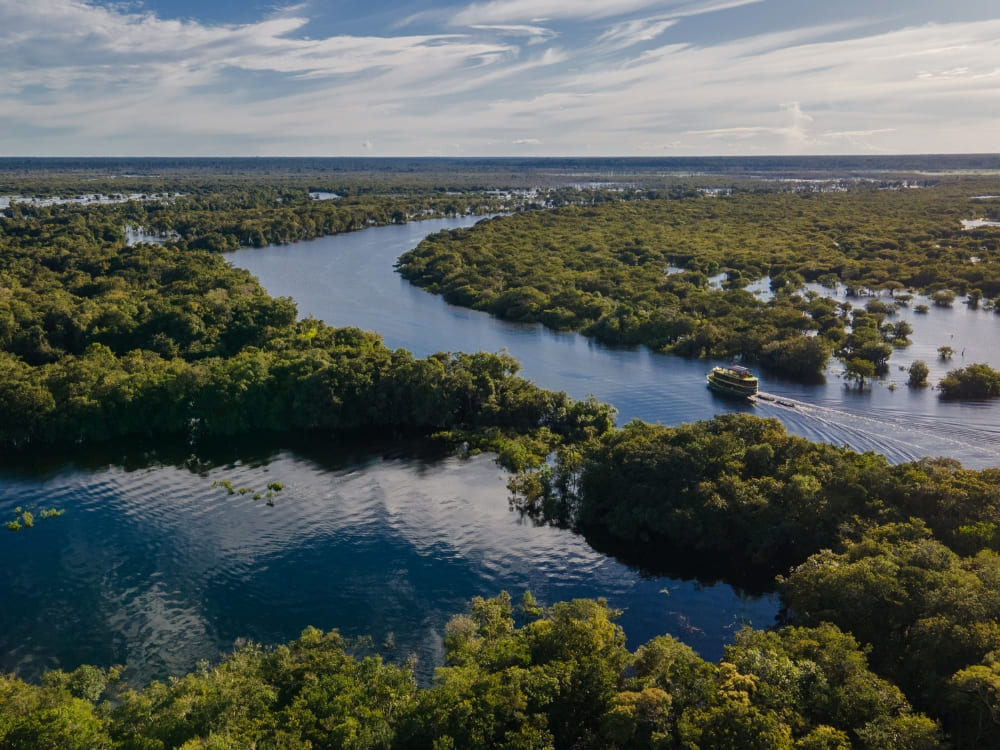
  • Diving in Fernando de Noronha: 2026 Ultimate Guide

    Diving in Fernando de Noronha: 2026 Ultimate Guide

    Discover everything you need to know to have an unforgettable experience  scuba diving and snorkeling in Fernando de Noronha

    Fernando de Noronha is known for the beauty of its crystal-clear waters, gorgeous white-sand beaches, and an elegant, peaceful atmosphere. This makes it one of the best destinations in Brazil for people looking for leisure and adventure alike.

    Diving in Fernando de Noronha is the best way to enjoy what nature has to offer. The sea presents wonderful conditions for divers to explore the breathtaking underwater landscapes and the local marine life. No wonder visitors from all over the world travel to this magical island!

    A scuba diver swims closely behind a nurse shark over a coral reef in the crystal-clear waters of Fernando de Noronha.
    Photo: All Angles

    To help you plan your Brazil diving trip, PlanetaEXO, an ecotourism platform that offers Fernando de Noronha scuba diving packages, has put together a complete guide with all the information you need. Check it out below!
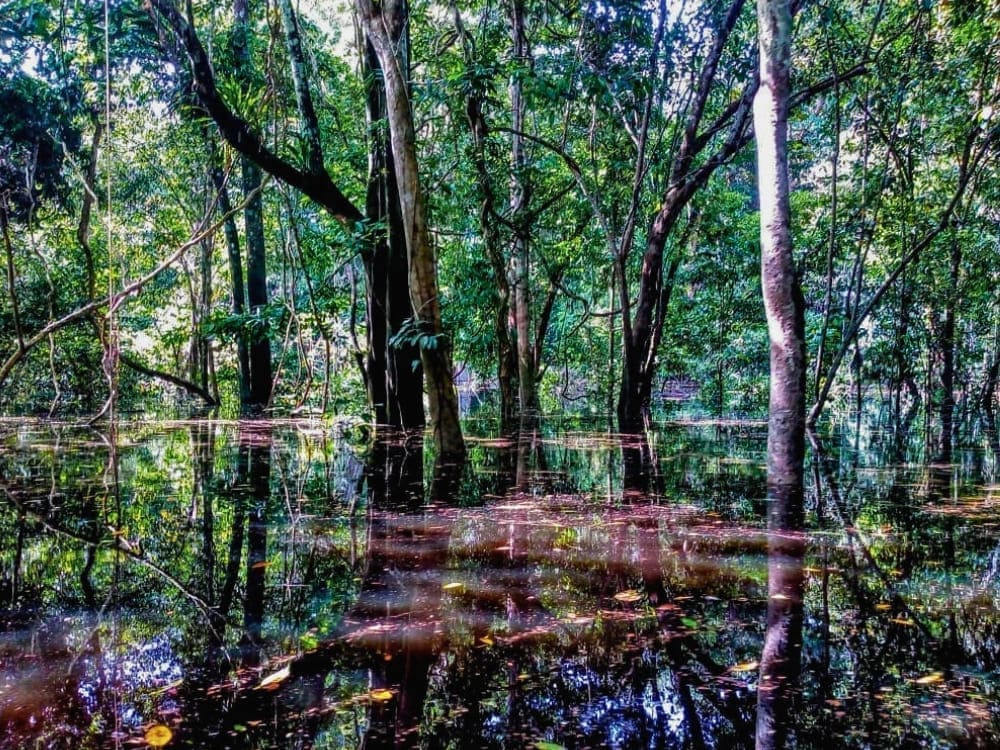
    About Fernando de Noronha

    Fernando de Noronha is the main island—and the only inhabited one—of an archipelago of 21 islands. Its origin traces back millions of years to an inactive volcanic field submerged into the Atlantic Ocean. 

    In 1503, during a Portuguese expedition led by sailor Gonçalo Coelho and explorer Fernão de Noronha—see something familiar about this name?—the islands were discovered. Over the centuries, many nations have occupied them. The Netherlands and France have heavily influenced local culture and architecture, but the Brazilian essence remains striking and undeniable.  

     The iconic Morro dos Dois Irmãos rock formations rise from the turquoise ocean along a lush, cliff-lined beach in Fernando de Noronha.
    .

    Nowadays, Noronha is always on the top of the list of Brazil’s most desired destinations and was even recognized as a UNESCO World Heritage Site in 2001 for its “outstanding universal value.”

    Formed by two federal conservation units, the Fernando de Noronha Marine National Park (PARNAMAR) and the Fernando de Noronha Environmental Protection Area (APA), the archipelago is an important player in the conservation of Brazil’s rich biodiversity.

    Where is Fernando de Noronha, Brazil?

    Fernando de Noronha is located in northeastern Brazil, in Pernambuco, 545 km from the state capital, Recife. Sitting in the Atlantic Ocean, its total area is 26 km², whereas 17 km² are occupied by the main island alone.

    How to Get to Fernando de Noronha?

    Fernando de Noronha Airport (FEN) welcomes tourists arriving on the island. Azul, GOL, and LATAM airlines offer daily direct flights from Recife (REC), while flights from São Paulo (GRU) operate 4 times a week.

    View from an airplane window showing the wing and the famous Morro do Pico peak as a flight arrives at Fernando de Noronha.
    @flor_decerejeirafotografia

    International travelers must disembark in Recife before departing for Noronha Airport, with direct flights from Buenos Aires (EZE/AEP), Lisbon (LIS), Porto (OPO), Madrid (MAD), Orlando (MCO), and Santiago, Chile (SCL). It’s also possible to make connections in São Paulo, Rio de Janeiro, Belo Horizonte, or Brasília before departing for Recife.

    Upon arrival, tourists have to head to their accommodations, which generally offer private or shared shuttle services.

    👉 Read more: How to get to Fernando de Noronha, Brazil?

    When is the Best Time to Go to Fernando de Noronha for Diving?

    The best time for diving in Fernando de Noronha depends on the type of experience you’re looking for, as well as the area you wish to explore. Over 75% of the island’s visitors practice some kind of diving, with the main modalities being free and scuba diving.

    This variety is greatly appreciated by tourists, but it’s important to notice that there are different seasons in Noronha that can affect these activities.

    A scuba diver explores the vibrant marine life of Brazil, completely surrounded by a massive school of bright yellow fish.
    Photo: All Angles

    Best Season For Diving in Brazil’s Fernando de Noronha

    Fernando de Noronha is divided between the Inner Sea (Mar de Dentro), which faces the Brazilian coast, and the Outer Sea (Mar de Fora), directed at Africa and Europe.

    Inner Sea

    The Inner Sea’s calm waters are great for snorkeling and free diving, especially from June to December. The most recommended sites are Praia do Porto, Praia da Conceição, and Praia do Boldró.

    When it comes to water visibility, the best conditions are usually from August to December, when the sea is at its most peaceful state.

    Outer Sea

    From December to May, the Outer Sea’s agitated waters are perfect for divers with more experience and people looking for complex underwater landscapes and a bigger range of marine species.

    A scuba diver observes a large green sea turtle swimming over a rocky underwater landscape during a dive in Fernando de Noronha.
    Photo: Thiege Rodrigues

    👉 Read more: When is the best time to dive in Fernando de Noronha?

    Diving Spots in Fernando de Noronha

    The best Fernando de Noronha diving spots may vary according to your preferences. If you have little to no experience or if you’re looking for a more relaxing activity to just enjoy the ocean and spot colorful fish, rock formations, and coral reefs, Atalaia, Pedras Secas, and Laje dos Dois Irmãos are great sites.

    An experienced scuba diver hovers above the sandy ocean floor near a resting stingray at a dive spot in Fernando de Noronha.
    Photo: Pamella Rech

    Baía dos Sanchos and Baía dos Golfinhos are perfect for animal enthusiasts. Dolphins, sea turtles, stingrays, and nurse sharks are often seen calmly swimming near the divers—already used to the presence of humans.

    Are you an expert diver who’s thirsty for adventure? Then you should go to Ponta da Sapata, one of Noronha’s most famous diving spots in the Inner Sea, mostly known for an underwater cave about 18 meters deep that shelters huge stingrays and the black grouper, a docile ray-finned fish that can reach up to 400 kilos.

    Ressureta is another amazing spot for experienced divers. At 16 meters deep, it’s not difficult to encounter barracudas, reef sharks, sea turtles, moray eels, etc.

    Whether you’re seeking a gentle immersion or an adrenaline-packed dive, Fernando de Noronha has it all!

    👉 Read more: Best Diving Spots in Fernando de Noronha

    Can Beginners Dive in Fernando de Noronha?

    Yes, Fernando de Noronha is a great place for baptism diving—an introductory dive for people with no prior experience.

    Fernando de Noronha Diving Guide
    .

    With the help of local instructors and top-quality equipment, amateur divers can safely explore the underwater beauty of the archipelago. The feeling of such an experience is indescribable! 

    Are There Any Restrictions or Permits Required for Diving in Fernando de Noronha?

    Permits are only required for diving instructors and companies, which must be properly accredited to operate. Trust only qualified and licensed professionals!

    Restrictions for divers are related to possible health conditions, such as heart problems, hypertension, respiratory diseases, and pregnancy. Before diving, you’ll be asked to fill out a form with a health assessment questionnaire to determine whether you are able to dive or not.

    To prevent any problems, always follow your guides/instructors’ directions.

    Marine Life in Fernando de Noronha

    The abundant marine life in Fernando de Noronha includes an extensive reef coverage and hundreds of different species of animals, such as 169 reef fish (10 endemics), 219 mollusks (3 endemics), 11 corals, 33 cnidarians, and 77 sponges.

    A scuba diver explores a sunken shipwreck heavily encrusted with bright red and orange sponges in the deep waters of Fernando de Noronha.
    Photo: All Angles

    Sea turtles are also a big part of the local fauna. From July to December, Noronha’s beaches are the breeding ground for the beautiful green turtle. Other residents are the hawksbill turtles, who often make themselves comfortable on the sand to feed and grow their babies. 

    These remarkable animals are protected by the Tamar Project and a decree-law that prohibits the capture and harassment of all species of turtles in Brazilian waters.

    A large pod of spinner dolphins swims gracefully together through the clear blue ocean waters of Fernando de Noronha.
    Photo: Sandro Rodrigues

    In general, September is the month with the best conditions to watch the marine life in Fernando de Noronha, though they can be spotted all year round. Stingrays, green turtles, barracudas, lemon sharks, moray eels, nurse sharks, octopuses, hawksbill turtles, and spinner dolphins are some of the most frequently spotted animals.

    Besides Diving, What to do in Fernando de Noronha?

    Diving is the main reason a lot of tourists choose to travel to Fernando de Noronha, but there are other incredible activities that are definitely worth your while.

    Aerial view of people paddling a traditional Hawaiian canoe through the vibrant, transparent turquoise waters of Fernando de Noronha.
    @noronhacanoeclube

    Explore the beaches

    Fernando de Noronha beaches are some of the most beautiful you’ll ever see. You can swim and snorkel in the gorgeous blue waters of Baía do Sancho, the 35th best beach on the planet, according to The World’s 50 Best Beaches.

    The stunning views of Morro dos Dois Irmãos at Baía dos Porcos or the surfing vibes at Cacimba do Padre are also mandatory attractions.

    Other beaches you can’t miss: Praia do Cachorro, Praia do Meio, Praia do Bode and Praia do Americano.

    Island tours

    Explore all the best spots of the island in 4×4 vehicles, the perfect way for first-time visitors to explore Noronha’s attractions.

    These tours offer stops at iconic locations and often end with a memorable sunset experience at Forte do Boldró.

    Adventure activities

    Noronha is a paradise for adventure lovers. Explore scenic trails like Trilha do Atalaia or the challenging Capim-Açu trail, which offers beautiful views of untouched landscapes.

    For a unique and unforgettable adventure, try Hawaiian canoeing from Praia do Porto during sunrise and marvel at the sight of dolphins in the open sea.

    Visit marine life projects

    Fernando de Noronha takes the preservation of the ocean and its creatures very seriously. Some organizations are open for visitation all year round, allowing travelers to learn more about their efforts to protect the environment and even engage in some activities.

    The Tamar Project focuses on sea turtles, whereas the Spinner Dolphin Project is committed to spinner dolphins’ well-being and the island’s overall marine life. 

    Local culture and cuisine

    Immerse yourself in Noronha’s culture by exploring Vila dos Remédios, the island’s historical heart. Indulge in fresh seafood at renowned restaurants like Mergulhão or Xica da Silva, and don’t miss trying out local delicacies like tapioca pancakes!

    Sunset contemplation

    The sunsets in Fernando de Noronha are legendary. Head to Forte do Boldró or Praia da Conceição for jaw-dropping views as the sun dips into the Atlantic.

    For a quieter option, Mirante dos Golfinhos is the perfect place for people in need of a few moments of peace.

    A golden sunset illuminates the ocean waves and the Morro dos Dois Irmãos rock formations as surfers paddle in the water.
    .

    👉 Read more: 10 facts about Fernando de Noronha

    How many days should you stay in Fernando de Noronha?

    The average Fernando de Noronha diving trip lasts 4 to 6 days, enough time to explore the island’s dive sites, marine life, and other natural attractions.

    If possible, you should consider extending your stay so you can experience the full spectrum of Noronha’s underwater life—and maybe dive again in your favorite spots or look for a specific animal—and enjoy non-diving activities!

    Where to stay in Fernando de Noronha?

    The island holds many options for every need and budget, from refined five-star establishments to shareable rooms in small hostels. Check it out!

    Luxury hotel deck featuring a swimming pool and comfortable lounge chairs facing the iconic Morro do Pico in Brazil.
    Photo: Hamares Boutique Hotel

    Luxury hotels

    Fernando de Noronha is a decadent destination with some of Brazil’s highest hotel prices due to the beauty and exclusivity of the archipelago. Luxury accommodations are very sophisticated and ideal for people who can’t say no to comfort, fine dining, and overall high-end services.

    They are usually a lot closer to some very famous spots, with panoramic views and short walks away from sites like Baía do SuestePraia do Boldró, and Morro do Pico

    Middle-range hotels and inns

    Middle-range hotels and inns are good alternatives for cheaper rates without sacrificing a high-quality stay.

    The accommodations are simpler than the luxury ones, but they still do a wonderful job at providing comfort, delicious food, and leisure to their guests.

    Basic accommodations

    Travelers on a limited budget can choose guesthouses and hostels with private or shared rooms and bathrooms.

    These accommodations might be considerably far from Noronha’s diving sites (usually 1–2 km away), but they’re usually located in great neighborhoods like Vila dos Remédios, Floresta Velha, and Floresta Nova, which offer restaurants, grocery stores, bars, and street markets.

    👉 Read more: Where to stay in Fernando de Noronha?

    How Much Does it Cost to Scuba Dive in Fernando de Noronha?

    Considering the type/number of dives, equipment, and services, a Fernando de Noronha scuba diving tour costs from R$ 2.000 (approximately US$ 400 and € 340) per person—an average of R$ 5.325 (US$ 1,070; € 905). Prices vary according to season, trip duration, etc.

    TOUR INCLUDES DURATION STARTING PRICE*
    Fernando de Noronha Diving Trip 2 diving sessions (double), island tour (four-wheel drive), full board accommodation, round-trip transfer. 5 days US$ 920 
    Scuba Diving in Fernando de Noronha Guided dives, ballast + 2 tanks (per day), round-trip transfer. 2 days US$ 400
    Open Water Diving Course 2 diving lessons at the beach + 4 guided boat dives (full equipment included), international certification (PADI, SSI or NAUI), round-trip transfer, 5 days US$ 1,525
    Advanced Diving Course Diving lessons, 5 dives (4 daytime + 1 evening), full equipment, international certification (SSI), round-trip transfer. 4 days US$ 1,425

    *Per person, based on double occupancy in group departures. Prices may vary depending on season and availability. Exchange rate as of March 17, 2026; subject to change.

    If not included, you should also consider additional costs of equipment (rental per day):

    • Regulator: R$ 115
    • BCD (buoyancy compensator): R$ 115
    • Diving suit (neoprene): R$ 100
    • Mask: R$ 30
    • Fins: R$ 30
    • Flashlight: R$ 155

    Send us a message to get a customized quote. We’ll be happy to help!

    Taxes, Fees and Other Important Information

    Every traveler visiting Fernando de Noronha for tourist purposes must pay the Environmental Preservation Tax (TPA), which ensures the conservation of the archipelago’s natural resources. The TPA is charged individually and according to the number of days each person will stay on the island.

    For your convenience, paying this fee ahead of boarding is recommended. All you have to do is follow the directions of Noronha’s official website. However, if your credit card isn’t issued in Brazil, the TPA can only be paid at the counter at Fernando de Noronha Airport

    Most sites in the archipelago are protected by Fernando de Noronha Marine National Park. To visit them, you should buy a ticket online or at the park’s Visitor Center (Vila do Boldró). The ticket is valid for 10 days. More information here.

    To travel to Fernando de Noronha, these are the fees that every tourist must pay:

    • Park entry fee: R$ 384 per stay for foreigners; R$ 192 for Brazilians
    • Environmental Preservation Tax (TPA): R$ 105,79 per day

    Another way to preserve the archipelago is by limiting the number of visitors. In 2023, state and federal laws have determined that only 11,000 people per month are allowed on the main island. This is great for the environment and for tourism, as fewer people make it for a more exclusive and quiet experience, with no crowded areas and long lines.

    Scuba Diving Fernando de Noronha
    .

    Diving in Fernando de Noronha with PlanetaEXO

    If your dream vacation is diving in Brazil, then you should definitely plan your trip to Fernando de Noronha, one of the most beautiful nature destinations in the country!

    At PlanetaEXO, an ecotourism platform that offers Fernando de Noronha scuba diving packages, you experience the most authentic side of the island by exploring jaw-dropping underwater views with the guidance of highly qualified professionals and everything else you need for a wonderful, hassle-free trip. Contact us now!
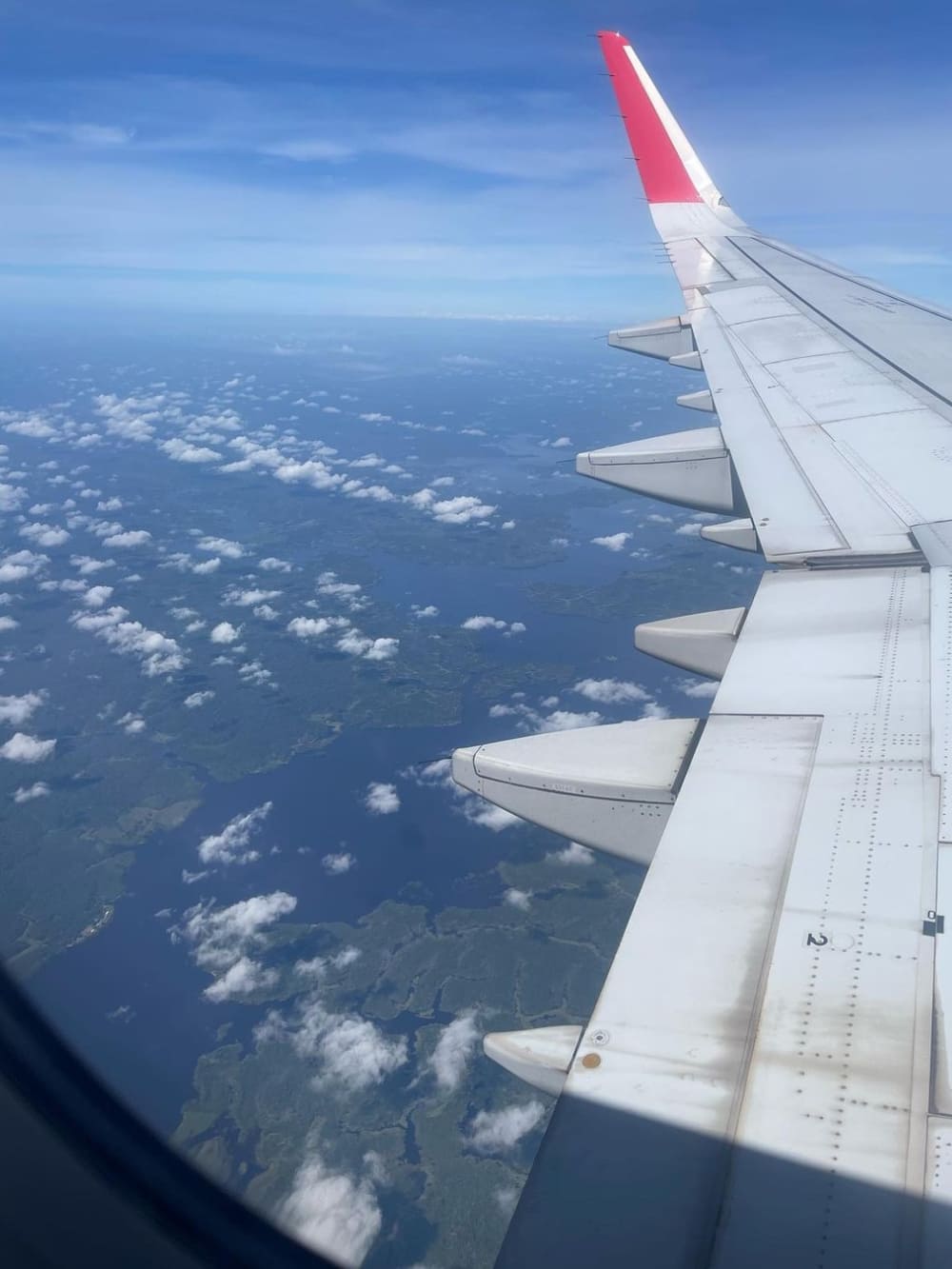
  • How to visit the Cerrado in Brazil?

    How to visit the Cerrado in Brazil?

    Here’s everything you should know to visit Brazil’s second-largest biome and one of the Earth’s most fascinating nature destinations

    Vast fields of green-yellow vegetation, short trees, and bushes thrive in the tropical climate of this Brazilian savanna, home to rich fauna and flora, breathtaking views, and undeniable environmental relevance. The Cerrado in Brazil is a great destination for travelers who love adventure and wildlife. In the article The 25 best places in the world to travel to in 2025, National Geographic describes the biome as “an underappreciated yet incredible place”, highlighting birdwatching and wolf tracking as reasons to visit it.

    How to visit the Cerrado in Brazil

    Traveling to the Cerrado is, without a doubt, an unforgettable experience of unparalleled beauty, connection with nature, contribution to sustainable practices, and the discovery of one of Brazil’s most important – and lesser known – ecosystems.

    Jalapão Waterfalls - How to visit the Cerrado in Brazil
    Photo: @viagemnarelacao

    What is the Cerrado in Brazil?

    Covering 25% of Brazil’s territory, in the states of Goiás, Brasília, Bahia, Mato Grosso, Mato Grosso do Sul, Minas Gerais, Tocantins, Maranhão, Piauí and São Paulo, the Cerrado is over 2 million km². The area is so big it can fit England, France, Germany and Spain!
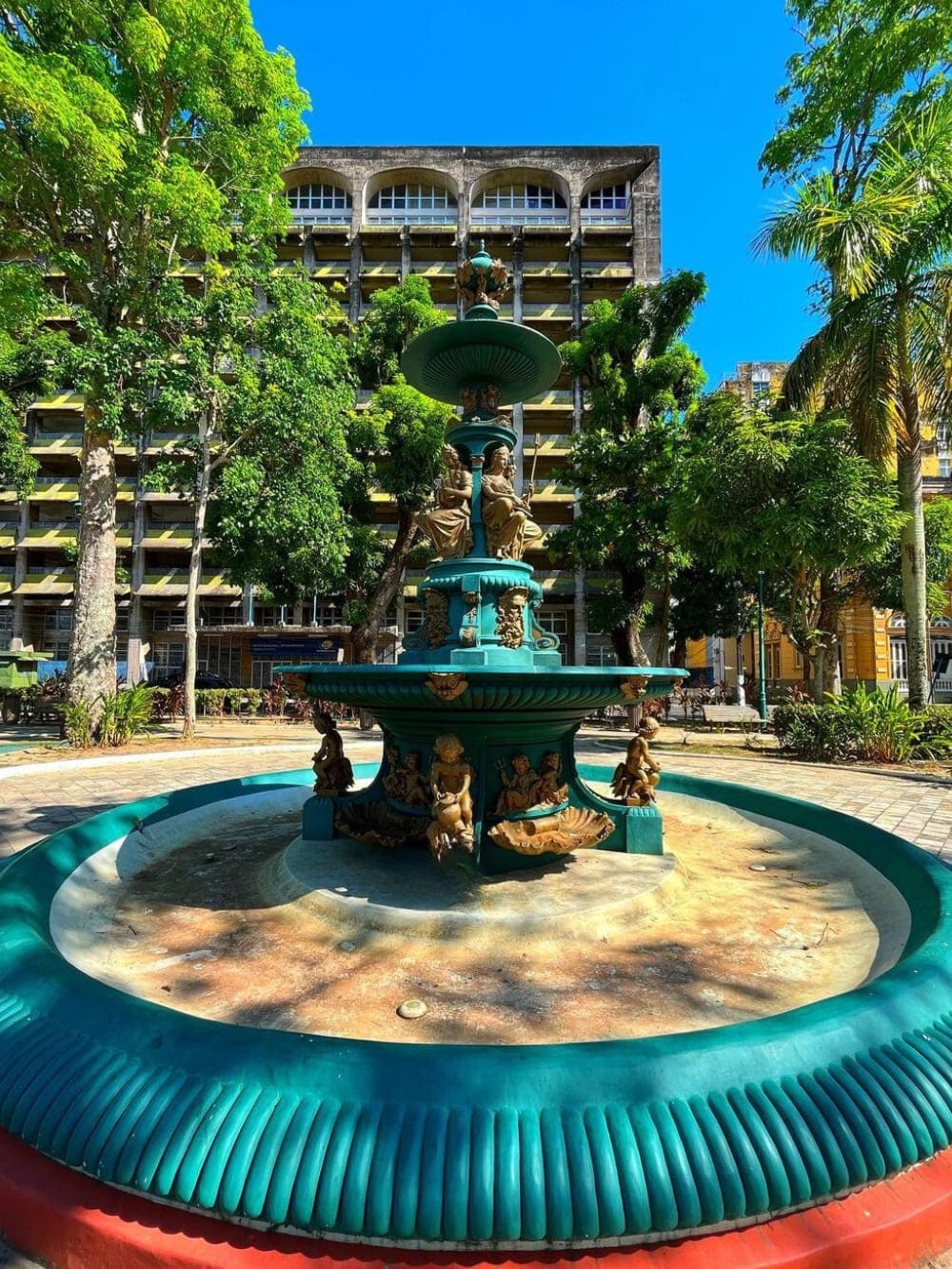
    How to visit the Cerrado in Brazil?

    The second-largest Brazilian biome – only after the Amazon Rainforest – the Cerrado is considered the most biodiverse savanna in the world for housing 5% of the planet’s animals and plants. The sources of eight of the country’s twelve main river basins are located there, including rivers like São Francisco, Tocantins, Paraná, and Paraguay. Due to its importance in supplying clean water, the biome is also known as “the water tank of Brazil”.

    Jalapão - How to visit the Cerrado in Brazil?

    The GHG emissions profile is also a relevant part of the region, which plays a huge role in regulating the weather and minimizing the amount of carbon dioxide in the atmosphere. According to MapBiomas Brasil, an initiative to map Brazil’s land cover and its changes over the years, there are 8.1 gigatons of organic carbon stock in the first 30 cm of Cerrado’s soil. In the areas with natural vegetation, there are 41 tons of carbon per hectare.

    Environmental challenges

    60% of Brazil’s agriculture production takes place in the Cerrado’s fertile soil, including soy, corn, cotton, and beef. This is very important for the country’s economy, yet harmful to the environment. Between the years 2000 and 2015, the areas dedicated to crops have increased by 87% – and continue to grow at a rapid pace.

    Converting native vegetation into agricultural lands consumes carbon stocks, deregulates the climate, worsens erosion, reduces the soil’s ability to retain water, and endangers the animals. Although scientists claim the best way to protect the Cerrado in Brazil is simply by leaving it untouched, this is not a realistic possibility given its importance for the country’s economic functioning.

    Luckily, some national and state parks safeguard the Cerrado in different areas, like Jalapão State Park (Tocantins), Sempre-Vivas National Park (Minas Gerais), Emas National Park (Goiás), Chapada dos Veadeiros National Park (Goiás) and Grande Sertão Veredas National Park (Minas Gerais).

    How to visit the Cerrado in Brazil?

    Even so, it’s still important to keep the balance between agriculture and the environment. A few solutions can be very useful, such as applying sustainable agriculture activities, restoring native vegetation, using renewable energy sources, and creating more laws that aim for Cerrado’s conservation – as well as toughening the punishments for those who disrespect them.

    Ecotourism is also a powerful resolution. Sustainable travel practices are capable of raising funds for preservation efforts, creating awareness of the importance of the biome, and empowering local communities to not only make a living but also remove these people from jobs that could be potentially harmful to the Cerrado. 

    How to visit the Cerrado in Brazil? - Pousada Trijunção

    Cerrado Wildlife

    Some of the best wildlife tours in Brazil take place in the Cerrado. 860 species of birds, 200 mammals, 180 reptiles, 150 amphibians, 1,200 fish, and millions of insects live in this ecosystem.

    The star of the Cerrado’s fauna is the mane wolf, the largest canid in South America. Its reddish-orange fur, long legs, solitary nature, and eating habits – which include small animals and even a native fruit called lobeira – are the main traits of this gorgeous creature. In the region’s folklore, the mane wolf has magical powers, capable of vanishing in the blink of an eye and hypnotizing its prey to make hunting easier.

    Cerrado Mane Wolfes - How to visit the Cerrado in Brazil?

    Other animals are considered to also be symbols of the Cerrado, like ocelots, armadillos, giant anteaters, porcupines, macaws, brocket deer, etc.

    How to visit the Cerrado in Brazil? - Blue Araras

    When is the best time for a Cerrado trip?

    During the dry season, the best time to visit the Cerrado is between May and September. That’s when the weather is milder, with warm days and cool nights. Temperatures can range from 15º C to 30º C.

    Hiking and spotting animals are great activities when the rainfall volume is lower, while the wet season (October to April) allows for greener vegetation and fuller rivers/waterfalls.

    How to visit the Cerrado in Brazil?

    Places and tours in the Cerrado

    As previously said, the Cerrado is so massive it touches different states, which means many great options for places and tours. Some of them, however, stand out for their beauty, total immersion in nature, and unique experiences.

    How to visit the Cerrado in Brazil?

    See the best Cerrado tours below!

    Jalapão

    Jalapão State Park is a conservation unit whose purpose is protecting the natural resources located in the east of the state of Tocantins, which is covered by the Cerrado. 

    Falling head over heels for this place is a given for any traveler. Sand dunes, ancient rock formations, hiking trails, waterfalls, rivers, and lagoons are safely nestled within the park, but the fervedouros are probably Japalão’s main attractions.

    Jalapão - How to visit the Cerrado in Brazil?

    Fervedouros are very similar to natural pools, only they are surrounded by trees – mostly buriti palm trees –, and it’s impossible to sink into them, no matter how deep they are. The pressure coming from underground aquifers makes anyone and anything float, and it also gives a boiling-like effect to the water.

     Jalapão State Park - How to visit the Cerrado in Brazil?

    How to get there: Brigadeiro Lysias Rodriguez Airport (PMW), in Palmas, the capital of Tocantins, is the nearest airport to Jalapão. There are direct flights from Brasília, São Paulo, Belo Horizonte and Goiânia. After landing, a 4-hour car ride will take you to Jalapão.

    👉 Don’t miss the chance to visit this magical place: Check out our Jalapão tours! 

    Pousada Trijunção

    Just as the Cerrado in Brazil is a must-visit place for 2025 according to National Geographic, the publication also mentions Pousada Trijuncão, a high-end lodge situated in the triple border of Bahia, Minas Gerais, and Goiás, as the perfect accommodation when traveling to the biome.

    Besides the sophistication, premium services, elegant facilities, delicious food, and exclusivity – there are only seven suites available for booking –, Trijunção’s love and respect for the Cerrado make for activities unlike any others.

    Cerrado Mane Wolfes - How to visit the Cerrado in Brazil?

    This is the ideal option for those who want to see mane wolves. In partnership with Onçafari – a non-profit that aims to make wild animals used to the presence of humans to develop ecotourism and protect the fauna and flora –, Pousada Trijunção’s guests can join safaris to spot mane wolves in their natural habitat, always accompanied by expert guides who follow strict protocols to ensure the group’s safety and the animal’s comfort.

    The itinerary also offers birdwatching, hiking, night safari, visiting Grande Sertão Veredas National Park, kayaking, sunset contemplation, and bike riding through the Cerrado fields.

    Night Safaris - Pousada Trijunção- How to visit the Cerrado in Brazil?

    How to get there: From Brasília, Trijunção is 333 km away (5-hour car ride). Guests can either drive their own cars, rent vehicles, hire a transfer service on the side, or even fly in a private plane or chartered flight departing from Brasília Airport (BSB).

    👉 Curious to see more? Check our Brazil Wild Cerrado Tour at Pousada Trijunção!

    Chapada dos Veadeiros

    In the northeast of Goiás, Chapada dos Veadeiros National Park is home to typical Cerrado vegetation, gorgeous waterfalls, dozens of water springs, and billion-year-old rock formations! Recognizing its importance, UNESCO nominated this mesmerizing place as a World Heritage site in 2001.

    Cerrado in Brazil - Chapada dos Veadeiros
    Photo: @camilarbs

    Hikers from all over the planet visit Chapada dos Veadeiros to explore all of its secrets, including quartz crystals formed over the course of time that many people believe to have healing powers.

    The waterfalls, however, are surely the most sought-after attractions in the park. Just to name a few, Saltos do Rio Preto, Cariocas, Segredo, Almécegas I and II, Vale da Lua, and Catarata dos Couros are definitely worth the visit.

    Cerrado in Brazil - Chapada dos Veadeiros
    Photo: @dougcerrado

    How to get there: Chapada dos Veadeiros is served by Brasília Airport (BSB), but a 3-hour journey on the road is required after landing. Accommodations take place in Alto Paraíso de Goiás, a small town with only 10,306 inhabitants – and great access to the park.

    👉 See for yourself: Book our Trekking Tour in Chapada dos Veadeiros now!

    Chapada das Mesas

    Chapada das Mesas National Park touches 11 towns in the south-central of the state of Maranhão. Its plateaus resemble the shape of stone tables, hence the name – the word mesas means “tables” in Portuguese.

    Chapada das Mesas - How to visit the Cerrado in Brazil
    Photo: @omeupaismaranhao

    The Cerrado covers a good portion of the park’s 160,000 ha, but the Caatinga and the Amazon biomes also share the same space. This creates a beautiful natural diversity among crystal-clear waterfalls, natural pools, and huge rocky walls that give the place all of its charm. Due to this richness, Chapada das Mesas is often compared to Jalapão.

    When it comes to what to do in the Cerrado in this particular spot, some activities are almost mandatory. Cachoeira do Santuário is a 46-meter waterfall hidden inside a canyon, while Encanto Azul and Poço Azul are jaw-dropping natural pools nestled in between rock formations.

    Chapada das Mesas - Cerrado in Brazil
    Photo: @eusouwill_rj

    How to get there: Carolina and Richão are the main entry points to Chapada das Mesas, but there are no airports in either town. Landing at Palmas Airport (PMW), in Tocantins, is the method chosen by many travelers because there are more flight options. On the road, the journey to the national park takes about 7 hours.

    • Araguaína Airport (AUX) – Tocantins: 110 km away from Carolina, is served by flights from Palmas, Brasília and Goiânia. 2-hour car ride to Chapada das Mesas. Closer to the final destination, but there are few weekly flights and the prices are usually higher.
    • Imperatriz Airport (IMP) – Maranhão: 220 km away from Carolina, is served by flights from São Luís, Brasília, Belém and Belo Horizonte. 3-hour car ride to Chapada das Mesas. Average prices and more transfer options.
    • Palmas Airport (PMW) – Tocantins: 475 km away from Carolina, is served by flights from Recife, Brasília, Belo Horizonte, and São Paulo. 7-hour car ride to Chapada das Mesas. The lowest price rates, but the distance to the national park is considerably longer.

    The Cerrado in Brazil is waiting for you!

    Now that you know all the major details about the Cerrado, it’s time to see this magnificence with your own eyes!

    PlanetaEXO not only helps you with your travel plans, but we also connect you to the best professionals in the field so you can finally have the vacation of your dreams. Send us a message and let’s begin!

    Jalapão - How to visit the Cerrado in Brazil

  • Jalapão State Park Brazil Travel Guide

    Jalapão State Park Brazil Travel Guide

    Welcome to our Jalapão State Park travel guide, your perfect companion for exploring the Cerrado biome, South America’s largest savannah and one of Brazil’s most stunning natural wonders.

    In this wild region, Jalapão State Park is a paradise for adventurers and nature lovers alike, offering stunning landscapes with its famous fervedouro springs, golden dunes, and diverse wildlife. This travel guide provides essential information, including the best time to visit, the main activities to enjoy, and tips for making the most of your adventure.

    Whether you’re planning an exhilarating Jalapão tour or a peaceful retreat into nature, this travel guide will help you plan your trip, ensuring an experience as memorable as the park’s breathtaking beauty.

    Let’s get to it!

    1. Where is Jalapão?
    2. How to get to Jalapão State Park?
    3. When is the best time to visit Jalapão?
    4. What to do in Jalapão State Park?
    6. How many days do I need in Jalapão?
    7. Do we need a guide?
    8. How much does it cost?
    9. What to bring?
    10. Is it worth visiting Jalapão?

    👉 Curious already? Discover 10 facts about Jalapão that you need to know

    About Jalapão State Park Brazil
    Discover Jalapão State Park, a natural gem in Tocantins state. Photo: Lucas Guerra

    About Jalapão State Park Brazil

    The Jalapão State Park, located in Brazil’s newest state, Tocantins, is a vast natural area covering 34,000 square kilometres. To give you an idea, its total area is almost the size of the whole of Switzerland! Established in 2001, the Jalapão State Park is a protected area that is home to stunning waterfalls, dunes, canyons, and rocks, not to mention the famous fervedouro springs, which form unique natural pools.

    The region where Jalapão is located has an extremely ancient geological origin and dates back millions of years, which means that, a long time ago, it was a sea.  Due to drastic climatic and atmospheric changes over the millennia, the sea receded, giving way to a diverse ecosystem. Today, Jalapão represents the largest continuous area of Cerrado in Brazil with a high degree of conservation and also boasts a variety of wildlife, some of which are threatened with extinction, such as the Pato Mergulhão (Brazilian Merganser).

    Beyond its natural beauty, Jalapão is also a centre for sustainable handicraft production, particularly using capim dourado (golden grass) and buriti silk. These crafts are not only a primary source of income for local communities but also the focus of efforts to ensure their production remains both ecologically and economically sustainable. Whether you’re seeking adventure or tranquillity, Jalapão State Park in Brazil offers a range of activities from hiking and trekking to rafting and kayaking, making it an unforgettable destination for any traveller. 

    Where is Jalapão?

    Jalapão State Park is located in the eastern part of Tocantins, approximately 300 kilometres from Palmas, the state’s capital city. The park extends over several municipalities, including Ponte Alta do Tocantins, Mateiros, São Félix do Tocantins and others. Jalapão’s diverse landscapes feature everything from rivers and waterfalls to sand dunes and rocky plateaus, rising up to 800 meters high (2624,67 ft).

    Known for its remote and pristine environment, Jalapão is far away from major urban centres, making it an ideal destination for those seeking an immersive experience in the wilderness. This isolation not only provides a tranquil escape but also preserves the park’s rugged beauty, offering a unique blend of adventure and relaxation in the Cerrado Biome.


    How to get to Jalapão State Park?

    The most convenient and common way to access Jalapão State Park is from Palmas, which hosts the closest airport, the Brigadeiro Lysias Rodrigues Airport (PMW). There are direct flights to this airport from Brasília, São Paulo, Belo Horizonte, and Goiânia. From Palmas, due to the expansive area of the Park, expect at least a four-hour car journey to Mateiros, or São Félix, which are the preferred bases for most tourists to enjoy the Jalapão attractions located there. The best way to reach these towns is by a 4×4 vehicle, as most roads are unpaved or covered in soft sand. Travelling with a guide is also highly recommended due to the minimal road signage and the challenging access to the attractions.

    It’s also important to note that Jalapão is full of fascinating attractions scattered throughout the area and that touring the park is not a linear journey, but a circuit; typically starting on one side and finishing on the other. It is common for the tours to start and end in Palmas, so all the Jalapão packages from PlanetaEXO include this transportation and offer various options for routes, available days, and activities so you fully appreciate this paradise. Carefully planning your itinerary is therefore essential to ensure a full and rewarding experience!

    How to get to Jalapão State Park?
    From Palmas to Jalapão: a thrilling drive through Brazil’s Cerrado biome.

    When is the best time to visit Jalapão?

    When planning a tour to Jalapão State Park in Brazil, choosing the right time of year is important to enhance your experience. You can visit Jalapão at any time of the year, but the best time to visit is during the dry season, from May to September. During this period, the weather is more predictable, with lower chances of rainfall and clearer skies, creating optimal conditions for outdoor activities and sightseeing. The closer you get to September, the drier the air will be, which is why many visitors prefer to come in May, when the humidity is still high, there isn’t much rain and the vegetation is greener and more lush. However, the drier it is, the more beautiful the sunsets! 

    When is the best time to visit Jalapão?
    Go to Jalapão and be enchanted with stunning sunsets and vibrant landscapes.

    During the rainy season from October to April, heavy rains and storms can occur, rendering some of the roads almost impassable and obstructing wildlife observation. The peak rainfall is in January when it reaches 225 mm on some days. But that doesn’t mean it gets cold here; the heat is constant, and the sun never fails to make an appearance. During the rainy season the entire landscape is green, while during the dry season, the wide stretch of the Cerrado terrain becomes very dry. 

    When is the best time to visit Jalapão?
    Experience Jalapão’s beauty under clear skies and warm sun.

    As far as the climate, the temperature in Jalapão remains tropically warm throughout the year with an average daytime temperature of 25 °C (77 °F). Regardless of the time of year, the temperature variation is small, with a maximum between 30°C (86 °F) and 34°C (93.2 °F) and a minimum between 15°C (59 °F) and 20°C (68 °F).

    What is the current weather in Jalapão, Tocantins?

    Take a look at how the weather is right now in the Jalapão State Park!


    What to do in Jalapão State Park?

    Jalapão offers a variety of tour itineraries and activities for nature enthusiasts and adventure seekers alike. From hiking scenic trails and floating in natural pools to exploring the cultural richness of local communities, there’s something for everyone. Here are some of the must-do activities in Jalapão:

    Floating in the Fervedouros:
    Experience the unique phenomenon of floating in the crystal-clear waters of the fervedouros. The most popular in Jalapão include Fervedouro do Soninho, do Ceiça, Buritizinho, and Bela Vista. These natural pools are fed by underground springs, creating a buoyant effect that makes it impossible to sink. It is estimated that some springs are up to 30 metres deep! Don’t be fooled: at the points where the water flows from the springs, it’s impossible to touch the ground. Despite the initial strangeness of swimming in a “bottomless” place, the experience is absolutely incredible!

    Rafting Adventures:
    For adrenaline seekers, rafting on the Rio Novo is a must. This adventure takes you through Class III and IV rapids, offering both excitement and stunning views of the surrounding wilderness. The clear waters of Rio Novo and the natural environment make it one of the best rafting experiences in Brazil. Rafting trips often include stops at sandy beaches along the river, where you can relax and take in the scenery​​.

    What to do in Jalapão?
    Thrill-seekers will love rafting on Jalapão!

    Refresh in Pure Waters:
    Cool off in the refreshing waters of Jalapão’s waterfalls. Visit Cachoeira da Formiga with its emerald-green waters, and the impressive Cachoeira da Velha, which boasts a powerful cascade and is perfect for a rejuvenating swim​​​​.

    What to do in Jalapão'
    Swimming in the crystal-clear waters of Jalapão! – Photo: @viagemnarelacao

    Trails and Hikes:
    Explore the stunning landscapes of Jalapão through various trails and hikes. Start your day early to witness breathtaking sunrises at the Serra do Espírito Santo, and end your day with mesmerising sunsets from the top of the dunes, offering panoramic views of the region​​​​. The scenery is spectacular, with golden sands forming elevations of up to 40 metres!

    What to do in Jalapão State Park Brazil?
    Jalapão’s beauty and thrilling activities make it a must-visit.

    Cultural Richness of the Local Communities:
    Discover the cultural richness of Jalapão by visiting local communities. Engage with the Mumbuca Quilombola Community, known for its golden grass handicrafts, and enjoy home-cooked meals while learning about the traditions and history of the area​​.

    From fervedouros and waterfalls to mountain trails and rafting, Jalapão is a playground for adventure lovers who wish to immerse themselves in the landscape. Learn more about what to do in Jalapão State Park.

    How many days do I need in Jalapão?

    To fully experience the beauty and diversity of Jalapão State Park in Brazil, a stay of at least 4 days is recommended. However, due to the park’s extensive area and numerous attractions, a longer visit enables a more thorough exploration. Each area within Jalapão, from Ponte Alta to Mateiros and São Félix, has its own set of attractions and requires time to fully appreciate them. 

    Remember, travelling to reach one of these gateway towns of Jalapão requires considerable time on the road due to the distances involved and the isolation of the park, so be prepared to set aside at least 4 hours for the journey. If you’re short on time, this can impact your experience. 

    If you have the luxury of more time, extending your stay to 5 or 6 days can be incredibly rewarding. With these extra days, you can delve deeper into the park’s natural wonders, enjoy more extended hikes, explore locations off the beaten track, and have more opportunities to connect with the local communities. A longer stay also allows you more time to cross through Jalapão and get to know its main attractions with no rush. Browse various itinerary options for our Jalapão tours.

    How many days do I need in Jalapão?
    A multi-day stay in Jalapão lets you immerse in its natural marvels.

    Do we need a guide to visit Jalapão?

    Although it is not compulsory, it is recommended that you visit Jalapão with a professional guide. Due to the dirt roads with sandy soil, Jalapão is only suitable for 4×4 vehicles and the roads are poorly signposted, making most of the attractions difficult to access. In addition, the population density is extremely low (not even 1 inhabitant/km²), meaning that you can drive for hours without seeing anyone along the way to give you directions. 

    Don’t worry! The PlanetaEXO team is ready to pick you up and take you back to Palmas in comfort and safety throughout your trip! A guided tour not only enhances your experience but also makes it more thorough and memorable, ensuring that your visit has a minimal impact on the environment and helps the local community.

    Do we need a guide to visit Jalapão?
    Guided tours makes exploring Jalapão safer and more rewarding.


    How much does it cost to go to Jalapão?

    The cost of the tours of Jalapão State Park will depend on how many days you will spend there, the number of people, and the activities you want to do. The average is R$2.835,00 to R$3.415,00 per person for a 5-day itinerary, including a professional guide, accommodation, a varied buffet for breakfast and lunch, transport throughout the trip and tickets to all the attractions you visit. It is also possible to do the tours in Jalapão in 4 days or 6 days.

    A super important point: some attractions are often listed as optional. For example, the sunrise at Serra do Espírito Santo, and rafting at Soninho River, among other options, can be booked separately.

    How much does it cost to go to Jalapão?
    Go to Jalapão and unwind in nature!

    What to bring to Jalapão?

    When packing for Jalapão, it’s important to consider your itinerary as different activities, such as treks, waterfalls, or rafting adventures, require specific items. Here is a list of essential items that we highly recommend you include in your backpack:

    • Long-sleeved T-shirt with UV protection;
    • Trekking trousers (light trousers or leggings);
    • Trekking boots or comfortable trainers (with good grip) for the trail;
    • Water shoes or extra trainers (that can get wet for rafting);
    • Sunscreen/repellent;
    • Hat or cap. 
    • Sunglasses;
    • Water bottle or canteen;
    • Backpack (small backpack of up to 20 litres to carry on the trail);
    • Light jacket for the colder nights from May to September (minimum 16°C);
    • Raincoat between October and April (heavier rains between December and March);
    • Light clothing and swimwear.
    What to bring to Jalapão?
    Jalapão tours offers a unique opportunity to disconnect from the hustle and bustle of the world

    Is it worth visiting Jalapão?

    Of course, it is worth it to visit Jalapão State Park! It offers a unique blend of stunning landscapes, diverse wildlife, and a range of activities for adventurers and nature enthusiasts. With its famous fervedouro springs, golden dunes, and refreshing waterfalls, Jalapão provides breathtaking experiences that are hard to find elsewhere. The park’s remote and well-preserved environment, combined with its cultural richness, such as the local communities’ sustainable handicraft production, makes it an unforgettable destination. Whether you’re seeking thrilling adventures like rafting and hiking or a peaceful retreat in nature, Jalapão has a lot to offer for you!

    Is it worth visiting Jalapão?
    From fervedouro springs to golden dunes, Jalapão offers unforgettable experiences for all.

    Ready to discover Jalapão State Park?
    Now that you know everything about Jalapão, let PlanetaEXO guide you through this amazing adventure, exploring an extraordinary natural paradise. Experience our exclusive guided tours, and get ready to immerse yourself in the natural beauty of Jalapão to create memories that will last a lifetime.

    Discover more and book your adventure today!

    Read more!